Results by title
216 books match the query 'Social' and 8 start with b

BEING PROFILED
COGITAS ERGO SUM: 10 Years of Profiling the European CitizenEmre Bayamlioglu
Amsterdam University Press, 2019
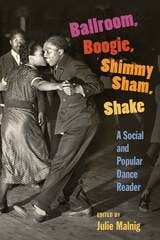
Ballroom, Boogie, Shimmy Sham, Shake
A Social and Popular Dance ReaderEdited by Julie Malnig
University of Illinois Press, 2008
This dynamic collection documents the rich and varied history of social dance and the multiple styles it has generated, while drawing on some of the most current forms of critical and theoretical inquiry. The essays cover different historical periods and styles; encompass regional influences from North and South America, Britain, Europe, and Africa; and emphasize a variety of methodological approaches, including ethnography, anthropology, gender studies, and critical race theory. While social dance is defined primarily as dance performed by the public in ballrooms, clubs, dance halls, and other meeting spots, contributors also examine social dance’s symbiotic relationship with popular, theatrical stage dance forms.
Contributors are Elizabeth Aldrich, Barbara Cohen-Stratyner, Yvonne Daniel, Sherril Dodds, Lisa Doolittle, David F. García, Nadine George-Graves, Jurretta Jordan Heckscher, Constance Valis Hill, Karen W. Hubbard, Tim Lawrence, Julie Malnig, Carol Martin, Juliet McMains, Terry Monaghan, Halifu Osumare, Sally R. Sommer, May Gwin Waggoner, Tim Wall, and Christina Zanfagna.
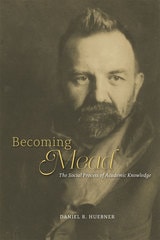
Becoming Mead
The Social Process of Academic KnowledgeDaniel R. Huebner
University of Chicago Press, 2014
In Becoming Mead, Daniel R. Huebner traces the ways in which knowledge has been produced by and about the famed American philosopher. Instead of treating Mead’s problematic reputation as a separate topic of study from his intellectual biography, Huebner considers both biography and reputation as social processes of knowledge production. He uses Mead as a case study and provides fresh new answers to critical questions in the social sciences, such as how authors come to be considered canonical in particular disciplines, how academics understand and use others’ works in their research, and how claims to authority and knowledge are made in scholarship. Becoming Mead provides a novel take on the history of sociology, placing it in critical dialogue with cultural sociology and the sociology of knowledge and intellectuals.
Beyond Nature and Culture
Philippe Descola
University of Chicago Press, 2013
Culture—as a collective human making, of art, language, and so forth—is often seen as essentially different from nature, which is portrayed as a collective of the nonhuman world, of plants, animals, geology, and natural forces. Descola shows this essential difference to be, however, not only a specifically Western notion, but also a very recent one. Drawing on ethnographic examples from around the world and theoretical understandings from cognitive science, structural analysis, and phenomenology, he formulates a sophisticated new framework, the “four ontologies”— animism, totemism, naturalism, and analogism—to account for all the ways we relate ourselves to nature. By thinking beyond nature and culture as a simple dichotomy, Descola offers nothing short of a fundamental reformulation by which anthropologists and philosophers can see the world afresh.

Beyond Personhood
An Essay in Trans PhilosophyTalia Mae Bettcher
University of Minnesota Press, 2025
A bold intervention in the philosophical concepts of gender, sex, and self
Beyond Personhood provides an entirely new philosophical approach to trans experience, trans oppression, gender dysphoria, and the relationship between gender and identity. Until now, trans experience has overwhelmingly been understood in terms of two reductive frameworks: trans people are either “trapped in the wrong body” or they are oppressed by the gender binary. Both accounts misgender large trans constituencies while distorting their experience, and neither can explain the presentation of trans people as make-believers and deceivers or the serious consequences thereof. In Beyond Personhood, Talia Mae Bettcher demonstrates how taking this phenomenon seriously affords a new perspective on trans oppression and trans dysphoria—one involving liminal states of “make-believe” that bear positive possibilities for self-recognition and resistance.
Undergirding this account is Bettcher’s groundbreaking theory of interpersonal spatiality—a theory of intimacy and distance that requires rejection of the philosophical concepts of person, self, and subject. She argues that only interpersonal spatiality theory can successfully explain trans oppression and gender dysphoria, thus creating new possibilities for thinking about connection and relatedness.
An essential contribution to the burgeoning field of trans philosophy, Beyond Personhood offers an intersectional trans feminism that illuminates transphobic, sexist, heterosexist, and racist oppressions, situating trans oppression and resistance within a much larger decolonial struggle. By refusing to separate theory from its application, Bettcher shows how a philosophy of depth can emerge from the everyday experiences of trans people, pointing the way to a reinvigoration of philosophy.
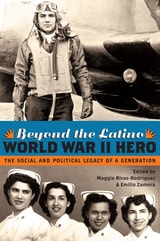
Beyond the Latino World War II Hero
The Social and Political Legacy of a GenerationEdited by Maggie Rivas-Rodríguez and Emilio Zamora
University of Texas Press, 2009
Maggie Rivas-Rodríguez 's edited volume Mexican Americans & World War II brought pivotal stories from the shadows, contributing to the growing acknowledgment of Mexican American patriotism as a meaningful force within the Greatest Generation. In this latest anthology, Rivas-Rodríguez and historian Emilio Zamora team up with scholars from various disciplines to add new insights. Beyond the Latino World War II Hero focuses on home-front issues and government relations, delving into new arenas of research and incorporating stirring oral histories.
These recollections highlight realities such as post-traumatic stress disorder and its effects on veterans' families, as well as Mexican American women of this era, whose fighting spirit inspired their daughters to participate in Chicana/o activism of the 1960s and 1970s. Other topics include the importance of radio as a powerful medium during the war and postwar periods, the participation of Mexican nationals in World War II, and intergovernmental negotiations involving Mexico and Puerto Rico. Addressing the complexity of the Latino war experience, such as the tandem between the frontline and the disruption of the agricultural migrant stream on the home front, the authors and contributors unite diverse perspectives to harness the rich resources of an invaluable oral history.

Black Swan Lake
Life of a WetlandRod Giblett
Intellect Books, 2013

Bordering on War
A Social and Political History of KhuzestanShaherzad Ahmadi
University of Texas Press, 2024
A study of transnational identity, migration, and state loyalties told through the social and political history of Iran’s Khuzestan province.
In 1980, Saddam Hussein’s Ba‘athist forces invaded Khuzestan, one of the oldest and richest provinces in Iran, triggering the Iran-Iraq War. Shaherzad Ahmadi’s Bordering on War examines the social history of Khuzestan and sheds light on how border dwellers, provincial leaders, and migrants in the region shaped Iran and Iraq's history before, during, and after the war.
Drawing from a rich collection of Persian- and Arabic-language archival sources—rarely used by western scholars due to restrictions in Iran—Ahmadi’s research focuses on Arab Iranians and argues that Iranian border dwellers and migrants formed local, non-national loyalties, thereby eschewing bureaucratic pressures to confine loyalties to a single nation-state. The transnational character and ethnically diverse composition of Khuzestan, especially in the oil-rich towns on the southwestern border, led many, including Iraq’s Ba‘ath Party, to question the national belonging of Arab Iranians. Bordering on War contributes to a wider discussion about the ability of individuals and communities to exert agency through migration, trade, education, and other activities.