Results by title
70 books match the query 'Social conflict' and 6 start with b

Ballymurphy and the Irish War
Ciaran de Baroid
Pluto Press, 2000
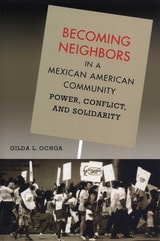
Becoming Neighbors in a Mexican American Community
Power, Conflict, and SolidarityBy Gilda L. Ochoa
University of Texas Press, 2004
On the surface, Mexican Americans and Mexican immigrants to the United States seem to share a common cultural identity but often make uneasy neighbors. Discrimination and assimilationist policies have influenced generations of Mexican Americans so that some now fear that the status they have gained by assimilating into American society will be jeopardized by Spanish-speaking newcomers. Other Mexican Americans, however, adopt a position of group solidarity and work to better the social conditions and educational opportunities of Mexican immigrants.
Focusing on the Mexican-origin, working-class city of La Puente in Los Angeles County, California, this book examines Mexican Americans' everyday attitudes toward and interactions with Mexican immigrants—a topic that has so far received little serious study. Using in-depth interviews, participant observations, school board meeting minutes, and other historical documents, Gilda Ochoa investigates how Mexican Americans are negotiating their relationships with immigrants at an interpersonal level in the places where they shop, worship, learn, and raise their families. This research into daily lives highlights the centrality of women in the process of negotiating and building communities and sheds new light on identity formation and group mobilization in the U.S. and on educational issues, especially bilingual education. It also complements previous studies on the impact of immigration on the wages and employment opportunities of Mexican Americans.
Belfast
Segregation, Violence and the CityPeter Shirlow and Brendan Murtagh
Pluto Press, 2006
The book offers a vivid portrait of the human drama and brutality of the conflict in Belfast. The authors argue that the control of place remains the most important weapon in the politicization of communities and the reproduction of political violence. Segregation provides the laboratory within which sectarianism continues to grow. Examining the implications of these social divisions, the authors draw upon a wide international literature and provide insights that will be useful to students of geography, planning, politics, sociology and peace studies.
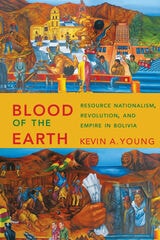
Blood of the Earth
Resource Nationalism, Revolution, and Empire in BoliviaBy Kevin A. Young
University of Texas Press, 2017
Conflicts over subterranean resources, particularly tin, oil, and natural gas, have driven Bolivian politics for nearly a century. “Resource nationalism”—the conviction that resource wealth should be used for the benefit of the “nation”—has often united otherwise disparate groups, including mineworkers, urban workers, students, war veterans, and middle-class professionals, and propelled an indigenous union leader, Evo Morales, into the presidency in 2006. Blood of the Earth reexamines the Bolivian mobilization around resource nationalism that began in the 1920s, crystallized with the 1952 revolution, and continues into the twenty-first century.
Drawing on a wide array of Bolivian and US sources, Kevin A. Young reveals that Bolivia became a key site in a global battle among economic models, with grassroots coalitions demanding nationalist and egalitarian alternatives to market capitalism. While US-supported moderates within the revolutionary regime were able to defeat more radical forces, Young shows how the political culture of resource nationalism, though often comprising contradictory elements, constrained government actions and galvanized mobilizations against neoliberalism in later decades. His transnational and multilevel approach to the 1952 revolution illuminates the struggles among Bolivian popular sectors, government officials, and foreign powers, as well as the competing currents and visions within Bolivia’s popular political cultures. Offering a fresh appraisal of the Bolivian Revolution, resource nationalism, and the Cold War in Latin America, Blood of the Earth is an ideal case study for understanding the challenges shared by countries across the Global South.
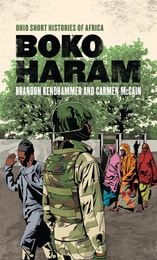
Boko Haram
Brandon Kendhammer
Ohio University Press, 2018
From its small-time origins in the early 2000s to its transformation into one of the world’s most-recognized terrorist groups, this remarkable short book tells the story of Boko Haram’s bloody, decade-long war in northeastern Nigeria. Going beyond the headlines, including the group’s 2014 abduction of 276 girls in Chibok and the international outrage it inspired, Boko Haram provides readers new to the conflict with a clearly written and comprehensive history of how the group came to be, the Nigerian government’s failed efforts to end it, and its enormous impact on ordinary citizens.
Drawing on years of research, Boko Haram is a timely addition to the acclaimed Ohio Short Histories of Africa. Brandon Kendhammer and Carmen McCain—two leading specialists on northern Nigeria—separate fact from fiction within one of the world’s least-understood conflicts. Most distinctively, it is a social history, one that tells the story of Boko Haram’s violence through the journalism, literature, film, and music made by people close to it.
Bread and Roses
Gender and Class Under CapitalismAndrea D'Atri
Pluto Press, 2021