71 books match the query 'Social networks' and 5 start with b
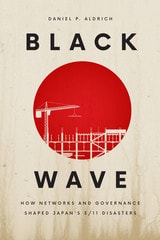
cover of Black Wave: How Networks and Governance Shaped Japan’s 3/11 Disasters

Black Wave

How Networks and Governance Shaped Japan’s 3/11 Disasters

Daniel P. Aldrich

University of Chicago Press, 2019

Despite the devastation caused by the magnitude 9.0 earthquake and 60-foot tsunami that struck Japan in 2011, some 96% of those living and working in the most disaster-stricken region of Tōhoku made it through. Smaller earthquakes and tsunamis have killed far more people in nearby China and India. What accounts for the exceptionally high survival rate? And why is it that some towns and cities in the Tōhoku region have built back more quickly than others?
           
Black Wave illuminates two critical factors that had a direct influence on why survival rates varied so much across the Tōhoku region following the 3/11 disasters and why the rebuilding process has also not moved in lockstep across the region. Individuals and communities with stronger networks and better governance, Daniel P. Aldrich shows, had higher survival rates and accelerated recoveries. Less-connected communities with fewer such ties faced harder recovery processes and lower survival rates. Beyond the individual and neighborhood levels of survival and recovery, the rebuilding process has varied greatly, as some towns and cities have sought to work independently on rebuilding plans, ignoring recommendations from the national government and moving quickly to institute their own visions, while others have followed the guidelines offered by Tokyo-based bureaucrats for economic development and rebuilding.

 
[more]
cover of Black Women's Art Ecosystems: Sites of Wellness and Self-Care

Black Women's Art Ecosystems

Sites of Wellness and Self-Care

Tanisha M. Jackson

University of Illinois Press, 2025
It is not an uncommon burden but rather a choice that Black women artists embrace creating art as a socio-political strategy to save themselves and their communities. Tanisha M. Jackson analyzes visual and personal narratives, historical archives, and artmaking practices to reveal how Black women artists facilitate wellness through creative expression and cultural knowledge. Delving into historical and contemporary practices, Jackson looks at Black women who use their artwork as acts of resistance, self-expression, and holistic wellness. Jackson’s multidisciplinary approach blends art history, Black studies, and personal narratives to examine the ways that the art ecosystems created by these women foster resilience and empowerment. Their dramatic stories underscore the transformative power of art in cultivating activism and mental, emotional, and spiritual well-being but also provide a framework for understanding how art can be a vital component of self-care and communal wellness. A meticulous portrait and inspiring roadmap, Black Women’s Art Ecosystems celebrates Black women’s artistic achievements while revealing how their work creates communities of restoration and mental health.
[more]
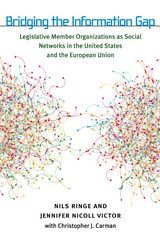
cover of Bridging the Information Gap: Legislative Member Organizations as Social Networks in the United States and the European Union

Bridging the Information Gap

Legislative Member Organizations as Social Networks in the United States and the European Union

Nils Ringe and Jennifer Nicoll Victor with Christopher J. Carman

University of Michigan Press, 2013

Legislative member organizations (LMOs)—such as caucuses in the U.S. Congress and intergroups in the European Parliament—exist in lawmaking bodies around the world. Unlike parties and committees, LMOs play no obvious, predefined role in the legislative process. They provide legislators with opportunities to establish social networks with colleagues who share common interests. In turn, such networks offer valuable opportunities for the efficient exchange of policy-relevant—and sometimes otherwise unattainable—information between legislative offices. Building on classic insights from the study of social networks, the authors provide a comparative overview of LMOs across advanced, liberal democracies. In two nuanced case studies of LMOs in the European Parliament and the U.S. Congress, the authors rely on a mix of social network analysis, sophisticated statistical methods, and careful qualitative analysis of a large number of in-depth interviews.
[more]
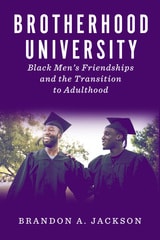
cover of Brotherhood University: Black Men's Friendships and the Transition to Adulthood

Brotherhood University

Black Men's Friendships and the Transition to Adulthood

Brandon A. Jackson

Rutgers University Press, 2024
How do young Black men navigate the transition to adulthood in an era of labor market precarity, an increasing emphasis on personal independence, and gendered racism? In Brotherhood University, Brandon A. Jackson utilizes longitudinal qualitative data to examine the role of emotions and social support among a group of young Black men as they navigate a “structural double bind” as college students and into early adulthood. While prevailing stereotypes portray young Black men as emotionally aloof, Jackson finds that the men invested in an emotion culture characterized by vulnerability, loyalty, and trust, which created a system of mutual social support, or brotherhood, among the group as they navigated college, prepared for the labor market, and experienced romantic relationships. Ten years later, as they managed the early stages of their careers and considered marriage and child-rearing, the men continued to depend on the emotional vulnerability and close relationships they forged in their college years.
 
[more]
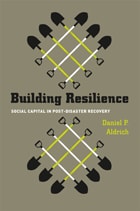
cover of Building Resilience: Social Capital in Post-Disaster Recovery

Building Resilience

Social Capital in Post-Disaster Recovery

Daniel P. Aldrich

University of Chicago Press, 2012

Each year, natural disasters threaten the strength and stability of communities worldwide. Yet responses to the challenges of recovery vary greatly and in ways that aren’t explained by the magnitude of the catastrophe or the amount of aid provided by national governments or the international community. The difference between resilience and disrepair, as Daniel P. Aldrich shows, lies in the depth of communities’ social capital.
 
Building Resilience highlights the critical role of social capital in the ability of a community to withstand disaster and rebuild both the infrastructure and the ties that are at the foundation of any community. Aldrich examines the post-disaster responses of four distinct communities—Tokyo following the 1923 earthquake, Kobe after the 1995 earthquake, Tamil Nadu after the 2004 Indian Ocean Tsunami, and New Orleans post-Katrina—and finds that those with robust social networks were better able to coordinate recovery. In addition to quickly disseminating information and financial and physical assistance, communities with an abundance of social capital were able to minimize the migration of people and valuable resources out of the area.
 
With governments increasingly overstretched and natural disasters likely to increase in frequency and intensity, a thorough understanding of what contributes to efficient reconstruction is more important than ever. Building Resilience underscores a critical component of an effective response.
[more]