Results by title
52 books match the query 'Social values' and 2 start with b
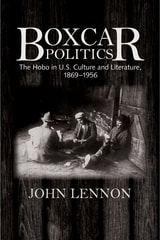
Boxcar Politics
The Hobo in U.S. Culture and Literature, 1869-1956John Lennon
University of Massachusetts Press, 2014
The hobo is a figure ensconced in the cultural fabric of the United States. Once categorized as a member of a homeless army who ought to be jailed or killed, the hobo has evolved into a safe, grandfatherly exemplar of Americana. Boxcar Politics reestablishes the hobo's political thorns.
John Lennon maps the rise and demise of the political hobo from the nineteenth-century introduction of the transcontinental railroad to the Federal Aid Highway Act of 1956. Intertwining literary, historical, and theoretical representations of the hobo, he explores how riders and writers imagined alternative ways that working-class people could use mobility to create powerful dissenting voices outside of fixed hierarchal political organizations. Placing portrayals of hobos in the works of Jack London, Jim Tully, John Dos Passos, and Jack Kerouac alongside the lived reality of people hopping trains (including hobos of the IWW, the Scottsboro Boys, and those found in numerous long-forgotten memoirs), Lennon investigates how these marginalized individuals exerted collective political voices through subcultural practices.
John Lennon maps the rise and demise of the political hobo from the nineteenth-century introduction of the transcontinental railroad to the Federal Aid Highway Act of 1956. Intertwining literary, historical, and theoretical representations of the hobo, he explores how riders and writers imagined alternative ways that working-class people could use mobility to create powerful dissenting voices outside of fixed hierarchal political organizations. Placing portrayals of hobos in the works of Jack London, Jim Tully, John Dos Passos, and Jack Kerouac alongside the lived reality of people hopping trains (including hobos of the IWW, the Scottsboro Boys, and those found in numerous long-forgotten memoirs), Lennon investigates how these marginalized individuals exerted collective political voices through subcultural practices.
[more]
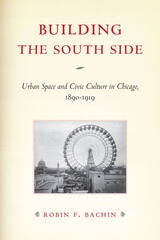
Building the South Side
Urban Space and Civic Culture in Chicago, 1890-1919Robin F. Bachin
University of Chicago Press, 2004
Building the South Side explores the struggle for influence that dominated the planning and development of Chicago's South Side during the Progressive Era. Robin F. Bachin examines the early days of the University of Chicago, Chicago’s public parks, Comiskey Park, and the Black Belt to consider how community leaders looked to the physical design of the city to shape its culture and promote civic interaction.
Bachin highlights how the creation of a local terrain of civic culture was a contested process, with the battle for cultural authority transforming urban politics and blurring the line between private and public space. In the process, universities, parks and playgrounds, and commercial entertainment districts emerged as alternative arenas of civic engagement.
“Bachin incisively charts the development of key urban institutions and landscapes that helped constitute the messy vitality of Chicago’s late nineteenth- and early twentieth-century public realm.”—Daniel Bluestone, Journal of American History
"This is an ambitious book filled with important insights about issues of public space and its use by urban residents. . . . It is thoughtful, very well written, and should be read and appreciated by anyone interested in Chicago or cities generally. It is also a gentle reminder that people are as important as structures and spaces in trying to understand urban development."
—Maureen A. Flanagan, American Historical Review
[more]