Results by title
74 books match the query 'Sociology, Urban' and 3 start with b
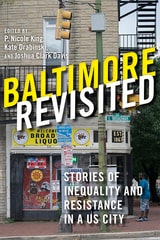
Baltimore Revisited
Stories of Inequality and Resistance in a U.S. CityEdited by P. Nicole King, Kate Drabinski, and Joshua Clark Davis
Rutgers University Press, 2019
Nicknamed both “Mobtown” and “Charm City” and located on the border of the North and South, Baltimore is a city of contradictions. From media depictions in The Wire to the real-life trial of police officers for the murder of Freddie Gray, Baltimore has become a quintessential example of a struggling American city. Yet the truth about Baltimore is far more complicated—and more fascinating.
To help untangle these apparent paradoxes, the editors of Baltimore Revisited have assembled a collection of over thirty experts from inside and outside academia. Together, they reveal that Baltimore has been ground zero for a slew of neoliberal policies, a place where inequality has increased as corporate interests have eagerly privatized public goods and services to maximize profits. But they also uncover how community members resist and reveal a long tradition of Baltimoreans who have fought for social justice.
The essays in this collection take readers on a tour through the city’s diverse neighborhoods, from the Lumbee Indian community in East Baltimore to the crusade for environmental justice in South Baltimore. Baltimore Revisited examines the city’s past, reflects upon the city’s present, and envisions the city’s future.
[more]
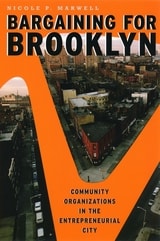
Bargaining for Brooklyn
Community Organizations in the Entrepreneurial CityNicole P. Marwell
University of Chicago Press, 2007
When middle-class residents fled American cities in the 1960s and 1970s, government services and investment capital left too. Countless urban neighborhoods thus entered phases of precipitous decline, prompting the creation of community-based organizations that sought to bring direly needed resources back to the inner city. Today there are tens of thousands of these CBOs—private nonprofit groups that work diligently within tight budgets to give assistance and opportunity to our most vulnerable citizens by providing services such as housing, child care, and legal aid.
Through ethnographic fieldwork at eight CBOs in the Brooklyn neighborhoods of Williamsburg and Bushwick, Nicole P. Marwell discovered that the complex and contentious relationships these groups form with larger economic and political institutions outside the neighborhood have a huge and unexamined impact on the lives of the poor. Most studies of urban poverty focus on individuals or families, but Bargaining for Brooklyn widens the lens, examining the organizations whose actions and decisions collectively drive urban life.
Through ethnographic fieldwork at eight CBOs in the Brooklyn neighborhoods of Williamsburg and Bushwick, Nicole P. Marwell discovered that the complex and contentious relationships these groups form with larger economic and political institutions outside the neighborhood have a huge and unexamined impact on the lives of the poor. Most studies of urban poverty focus on individuals or families, but Bargaining for Brooklyn widens the lens, examining the organizations whose actions and decisions collectively drive urban life.
[more]
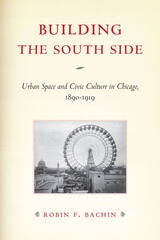
Building the South Side
Urban Space and Civic Culture in Chicago, 1890-1919Robin F. Bachin
University of Chicago Press, 2004
Building the South Side explores the struggle for influence that dominated the planning and development of Chicago's South Side during the Progressive Era. Robin F. Bachin examines the early days of the University of Chicago, Chicago’s public parks, Comiskey Park, and the Black Belt to consider how community leaders looked to the physical design of the city to shape its culture and promote civic interaction.
Bachin highlights how the creation of a local terrain of civic culture was a contested process, with the battle for cultural authority transforming urban politics and blurring the line between private and public space. In the process, universities, parks and playgrounds, and commercial entertainment districts emerged as alternative arenas of civic engagement.
“Bachin incisively charts the development of key urban institutions and landscapes that helped constitute the messy vitality of Chicago’s late nineteenth- and early twentieth-century public realm.”—Daniel Bluestone, Journal of American History
"This is an ambitious book filled with important insights about issues of public space and its use by urban residents. . . . It is thoughtful, very well written, and should be read and appreciated by anyone interested in Chicago or cities generally. It is also a gentle reminder that people are as important as structures and spaces in trying to understand urban development."
—Maureen A. Flanagan, American Historical Review
[more]