Results by title
51 books match the query 'Songs and music' and 3 start with b
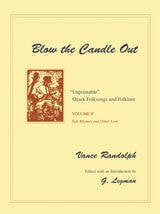
Blow the Candle Out
"Unprintable" Ozark Folksongs and Folklore, Volume II, Folk Rhymes and Other LoreVance Randolph
University of Arkansas Press, 1992
Collected in the field from 1915 through 1955, these tales and songs were considered by the publisher at the time to be too salacious for inclusion in Vance Randolph’s Ozark Folksongs. Randolph came to doubt that they would ever appear in print, and they did not in his lifetime.
<em>Roll Me in Your Arms</em>, Volume I of “Unprintable” Ozark Folksongs and Folklore, includes 180 unexpurgated songs collected by Randolph with tunes transcribed from the original singers. Volume II, <em><a href="https://wordpressua.uark.edu/uapress/product/blow-the-candle-out/">Blow the Candle Out</a></em>, contains rhymes and songs without music as well as other unexpurgated Ozark folk materials, including children’s lore, elements in speech, graffiti, riddles, dance calls, and beliefs.
G. Legman’s painstaking and patient editing, annotating, and crossreferencing richly complement the Randolph collection. The result is a look into a previously neglected area in the study of folksong and folklore in the Ozarks and further evidence of Randolph’s preeminence in the field.
The late Vance Randolph lived in the Ozark Mountains from 1920 until his death in 1980. Although he taught folklore at the University of Arkansas in Fayetteville, he is best remembered for his many years of field research resulting in the national bestseller <em>Pissing in the Snow & Other Ozark Folktales</em> and more than a dozen other books on American folklore.
[more]
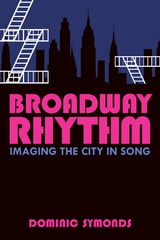
Broadway Rhythm
Imaging the City in SongDominic Symonds
University of Michigan Press, 2017
Broadway Rhythm is a guide to Manhattan like nothing you've ever read. Author Dominic Symonds calls it a performance cartography, and argues that the city of New York maps its iconicity in the music of the Broadway songbook. A series of walking tours takes the reader through the landscape of Manhattan, clambering over rooftops, riding the subway, and flying over skyscrapers. Symonds argues that Broadway's songs can themselves be used as maps to better understand the city though identifiable patterns in the visual graphics of the score, the auditory experience of the music, and the embodied articulation of performance, recognizing in all of these patterns, corollaries inscribed in the terrain, geography, and architecture of the city.
Through musicological analyses of works by Gershwin, Bernstein, Copland, Sondheim and others, the author proposes that performance cartography is a versatile methodology for urban theory, and establishes a methodological approach that uses the idea of the map in three ways: as an impetus, a metaphor, and a tool for exploring the city.
Through musicological analyses of works by Gershwin, Bernstein, Copland, Sondheim and others, the author proposes that performance cartography is a versatile methodology for urban theory, and establishes a methodological approach that uses the idea of the map in three ways: as an impetus, a metaphor, and a tool for exploring the city.
[more]
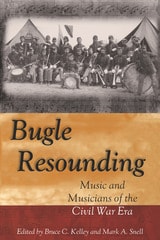
Bugle Resounding
Music and Musicians of the Civil War EraEdited by Bruce C. Kelley & Mark A. Snell
University of Missouri Press, 2004
In the mid-nineteenth century the United States was musically vibrant. Rising industrialization, a growing middle class, and increasing concern for the founding of American centers of art created a culture that was rich in musical capital. Beyond its importance to the people who created and played it is the fact that this music still influences our culture today.
Although numerous academic resources examine the music and musicians of the Civil War era, the research is spread across a variety of disciplines and is found in a wide array of scholarly journals, books, and papers. It is difficult to assimilate this diverse body of research, and few sources are dedicated solely to a rigorous and comprehensive investigation of the music and the musicians of this era. This anthology, which grew out of the first two National Conferences on Music of the Civil War Era, is an initial attempt to address that need.
Those conferences established the first academic setting solely devoted to exploring the effects of the Civil War on music and musicians. Bridging musicology and history, these essays represent the forefront of scholarship in music of the Civil War era. Each one makes a significant contribution to research in the music of this era and will ultimately encourage more interdisciplinary research on a subject that has relevance both for its own time and for ours. The result is a readable, understandable volume on one of the few understudied—yet fascinating—aspects of the Civil War era.
[more]