Results by title
661 books match the query 'South America' and 36 start with b
Banana Wars
Power, Production, and History in the AmericasSteve Striffler and Mark Moberg, eds.
Duke University Press, 2003
Bringing together the work of anthropologists, sociologists, economists, historians, and geographers, this collection reveals how the banana industry marshaled workers of differing nationalities, ethnicities, and languages and, in so doing, created unprecedented potential for conflict throughout Latin American and the Caribbean. The frequently abusive conditions that banana workers experienced, the contributors point out, gave rise to one of Latin America’s earliest and most militant labor movements. Responding to both the demands of workers’ organizations and the power of U.S. capital, Latin American governments were inevitably affected by banana production. Banana Wars explores how these governments sometimes asserted their sovereignty over foreign fruit companies, but more often became their willing accomplices. With several essays focusing on the operations of the extraordinarily powerful United Fruit Company, the collection also examines the strategies and reactions of the American and European corporations seeking to profit from the sale of bananas grown by people of different cultures working in varied agricultural and economic environments.
Contributors. Philippe Bourgois, Marcelo Bucheli, Dario Euraque, Cindy Forster, Lawrence Grossman, Mark Moberg, Laura T. Raynolds, Karla Slocum, John Soluri, Steve Striffler, Allen Wells
Basques and Vicuñas at the Mouth of Hell
A Documentary History of Potosí in the Early 1620sKris Lane
University of Nevada Press, 2024
As mines flooded and Indigenous workers died or fled, the city descended into a maelstrom of swordfights, gun battles, ambushes, sniper attacks, and summary executions. Though its roots were economic, the Basque-Vicuña conflict strained the sinews of Habsburg global governance even as it exposed festering local tensions, only some of which were unique to Potosí.
This rich collection of original sources, all of them archival documents housed in Bolivia, Spain, the United Kingdom, and the United States, consists of contemporary eyewitness accounts from several perspectives, allowing readers to play historian. All sources have been expertly translated and carefully annotated in a manner that will engage students and scholars alike. Basques and Vicuñas at the Mouth of Hell includes an extensive introduction, seven vital documents in translation, and appendices on everyday life in 1620s Potosí and on the historiography of this watershed episode of colonial violence.
Battling for Hearts and Minds
Memory Struggles in Pinochet's Chile, 1973–1988Steve J. Stern
Duke University Press, 2006
In the 1970s, Chilean dissidents were lonely “voices in the wilderness” insisting that state terror and its victims be recognized and remembered. By the 1980s, the dissent had spread, catalyzing a mass movement of individuals who revived public dialogue by taking to the streets, creating alternative media, and demanding democracy and human rights. Despite long odds and discouraging defeats, people of conscience—victims of the dictatorship, priests, youth, women, workers, and others—overcame fear and succeeded in creating truthful public memories of state atrocities. Recounting both their efforts and those of the regime’s supporters to win the battle for Chileans’ hearts and minds, Stern shows how profoundly the struggle to create memories, to tell history, matters.
Battling for Hearts and Minds is the second volume in the trilogy The Memory Box of Pinochet’s Chile. The third book will examine Chileans’ efforts to achieve democracy while reckoning with Pinochet’s legacy.
Becoming Mapuche
Person and Ritual in Indigenous ChileMagnus Course
University of Illinois Press, 2011
Becoming the Tupamaros
Solidarity and Transnational Revolutionaries in Uruguay and the United StatesLindsey Churchill
Vanderbilt University Press, 2013
Churchill examines the relationship between state repression and revolutionary resistance, the transnational connections between the Uruguayan Tupamaro revolutionaries and leftist groups in the US, and issues of gender and sexuality within these movements. Angela Davis and Eldridge Cleaver, for example, became symbols of resistance in both the United States and Uruguay. and while much of the Uruguayan left and many other revolutionary groups in Latin America focused on motherhood as inspiring women's politics, the Tupamaros disdained traditional constructions of femininity for female combatants. Ultimately, Becoming the Tupamaros revises our understanding of what makes a Movement truly revolutionary.

Before Bemberg
Women Filmmakers in ArgentinaMatt Losada
Rutgers University Press, 2020
Watch some of the films discussed in the book with English subtitles (https://www.youtube.com/channel/UCF_6F4am5024rklIWwExUVA?view_as=subscriber).
Before the Flood
The Itaipu Dam and the Visibility of Rural BrazilJacob Blanc
Duke University Press, 2019
Behold the Black Caiman
A Chronicle of Ayoreo LifeLucas Bessire
University of Chicago Press, 2014
Drawing on ten years of fieldwork, Bessire highlights the stark disconnect between the desperate conditions of Ayoreo life for those out of the forest and the well-funded global efforts to preserve those Ayoreo still living in it. By showing how this disconnect reverberates within Ayoreo bodies and minds, his reflexive account takes aim at the devastating consequences of our society’s continued obsession with the primitive and raises important questions about anthropology’s potent capacity to further or impede indigenous struggles for sovereignty. The result is a timely update to the classic literary ethnographies of South America, a sustained critique of the so-called ontological turn—one of anthropology’s hottest trends—and, above all, an urgent call for scholars and activists alike to rethink their notions of difference.
Between Legitimacy and Violence
A History of Colombia, 1875–2002Marco Palacios
Duke University Press, 2006
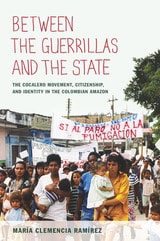
Between the Guerrillas and the State
The Cocalero Movement, Citizenship, and Identity in the Colombian AmazonMaría Clemencia Ramírez
Duke University Press, 2011
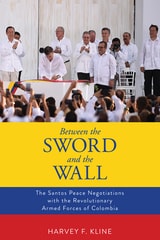
Between the Sword and the Wall
The Santos Peace Negotiations with the Revolutionary Armed Forces of ColombiaHarvey F. Kline
University of Alabama Press, 2020
Chronicles the peace process negotiations between Colombian president Juan Manuel Santos and the Marxist Revolutionary Armed Forces of Colombia
In Between the Sword and the Wall: The Santos Peace Negotiations with the Revolutionary Armed Forces of Colombia, Harvey Kline, a noted expert on contemporary Colombian politics, brings to a close his multivolume chronicle of the incessant violence that has devastated Colombia’s population, politics, and military for decades. This, his newest work on the subject, recounts and analyzes the negotiations between Colombian president Juan Manuel Santos and the Marxist Revolutionary Armed Forces of Colombia (FARC), which ended with a peace agreement in 2016.
The FARC insurgency began in 1964, and every Colombian president after 1980 unsuccessfully tried to negotiate a peace agreement with the group. Kline analyzes how the Santos administration was ultimately able to negotiate peace with the FARC. The agreement failed to receive the approval of the Colombian people in an October 2016 plebiscite, but a renegotiated version was later approved by the congress in the same year. Afterward, more than 7,000 rebels turned over their weapons to the UN mission in Colombia. The former combatants were then to be judged by a special court empowered to punish but not imprison those who had violated human rights. Throughout the book, Kline emphasizes the dual nature of the Santos negotiations, first with the FARC and second with the democratic opposition to the agreement led by former president Álvaro Uribe Vélez.
Kline provides readers with a well-researched analysis based on a variety of resources, including media articles and primary documents from the government, international organizations, and the FARC. He also conducted extensive interviews with twenty-eight government officials and Colombian experts from all ideological persuasions.
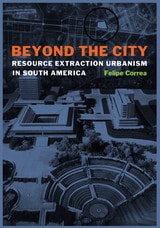
Beyond the City
Resource Extraction Urbanism in South AmericaBy Felipe Correa
University of Texas Press, 2016
During the last decade, the South American continent has seen a strong push for transnational integration, initiated by the former Brazilian president Fernando Henrique Cardoso, who (with the endorsement of eleven other nations) spearheaded the Initiative for the Integration of Regional Infrastructure in South America (IIRSA), a comprehensive energy, transport, and communications network. The most aggressive transcontinental integration project ever planned for South America, the initiative systematically deploys ten east-west infrastructural corridors, enhancing economic development but raising important questions about the polarizing effect of pitting regional needs against the colossal processes of resource extraction. Providing much-needed historical contextualization to IIRSA’s agenda, Beyond the City ties together a series of spatial models and offers a survey of regional strategies in five case studies of often overlooked sites built outside the traditional South American urban constructs.
Implementing the term “resource extraction urbanism,” the architect and urbanist Felipe Correa takes us from Brazil’s nineteenth-century regional capital city of Belo Horizonte to the experimental, circular, “temporary” city of Vila Piloto in Três Lagoas. In Chile, he surveys the mining town of María Elena. In Venezuela, he explores petrochemical encampments at Judibana and El Tablazo, as well as new industrial frontiers at Ciudad Guayana. The result is both a cautionary tale, bringing to light a history of societies that were “inscribed” and administered, and a perceptive examination of the agency of architecture and urban planning in shaping South American lives.
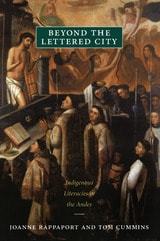
Beyond the Lettered City
Indigenous Literacies in the AndesJoanne Rappaport and Tom Cummins
Duke University Press, 2012

Big Water
The Making of the Borderlands Between Brazil, Argentina, and ParaguayEdited by Jacob Blanc and Frederico Freitas; Foreword by Zephyr Frank
University of Arizona Press, 2018
From the Jesuit reductions in the seventeenth century to the flows of capital and goods accelerated by contemporary trade agreements, the Triple Frontier region has proven fundamental to the development of Brazil, Argentina, and Paraguay, as well as to the Southern Cone and South America itself. Although historians from each of these three countries have tended to construct narratives that stop at their respective borders, the contributors call for a reinterpretation that goes beyond the material and conceptual boundaries of the Triple Frontier. In offering a transnational approach, Big Water helps transcend nation-centered blind spots and approach new understandings of how space and society have developed throughout Latin America.
These essays complicate traditional frontier histories and balance the excessive weight previously given to empires, nations, and territorial expansion. Overcoming stagnant comparisons between national cases, the research explores regional identity beyond border and geopolitical divides. Thus, Big Water focuses on the uniquely overlapping character of the Triple Frontier and emphasizes a perspective usually left at the periphery of national histories.
Contributors
Shawn Michael Austin
Jacob Blanc
Bridget María Chesterton
Christine Folch
Zephyr Frank
Frederico Freitas
Michael Kenneth Huner
Evaldo Mendes da Silva
Eunice Sueli Nodari
Graciela Silvestri
Guillermo Wilde
Daryle Williams
Black and Green
Afro-Colombians, Development, and Nature in the Pacific LowlandsKiran Asher
Duke University Press, 2009
The Pacific region had yet to be overrun by drug traffickers, guerrillas, and paramilitary forces in the early 1990s. It was better known as the largest area of black culture in the country (90 percent of the region’s population is Afro-Colombian) and as a supplier of natural resources, including timber, gold, platinum, and silver. Colombia’s Law 70, passed in 1993, promised ethnic and cultural rights, collective land ownership, and socioeconomic development to Afro-Colombian communities. At the same time that various constituencies sought to interpret and implement Law 70, the state was moving ahead with large-scale development initiatives intended to modernize the economically backward coastal lowlands. Meanwhile national and international conservation organizations were attempting to protect the region’s rich biodiversity. Asher explores this juxtaposition of black rights, economic development, and conservation—and the tensions it catalyzed. She analyzes the meanings attached to “culture,” “nature,” and “development” by the Colombian state and Afro-Colombian social movements, including women’s groups. In so doing, she shows that the appropriation of development and conservation discourses by the social movements had a paradoxical effect. It legitimized the presence of state, development, and conservation agencies in the Pacific region even as it influenced those agencies’ visions and plans.
Blacks and Whites in Sao Paulo, Brazil, 1888-1988
George Reid Andrews
University of Wisconsin Press, 1991
For much of the twentieth century Brazil enjoyed an international reputation as a “racial democracy,” but that image has been largely undermined in recent decades by research suggesting the existence of widespread racial inequality. George Reid Andrews provides the first thoroughly documented history of Brazilian racial inequality from the abolition of slavery in 1888 up to the late 1980s, showing how economic, social, and political changes in Brazil during the last one hundred years have shaped race relations.
No laws of segregation or apartheid exist in Brazil, but by looking carefully at government policies, data on employment, mainstream and Afro-Brazilian newspapers, and a variety of other sources, Andrews traces pervasive discrimination against Afro-Brazilians over time. He draws his evidence from the country’s largest and most economically important state, São Paulo, showing how race relations were affected by its transformation from a plantation-based economy to South America’s most urban, industrialized society.
The book focuses first on Afro-Brazilians' entry into the agricultural and urban working class after the abolition of slavery. This transition, Andrews argues, was seriously hampered by state policies giving the many European immigrants of the period preference over black workers. As immigration declined and these policies were overturned in the late 1920s, black laborers began to be employed in agriculture and industry on nearly equal terms with whites. Andrews then surveys efforts of blacks to move into the middle class during the 1900s. He finds that informal racial solidarity among middle-class whites has tended to exclude Afro-Brazilians from the professions and other white-collar jobs.
Andrews traces how discrimination throughout the century led Afro-Brazilians to mobilize, first through the antislavery movement of the 1880s, then through such social and political organizations of the 1920s and 1930s as the Brazilian Black Front, and finally through the anti-racism movements of the 1970s and 1980s. These recent movements have provoked much debate among Brazilians over their national image as a racial democracy. It remains to be seen, Andrews concludes, whether that debate will result in increased opportunities for black Brazilians.
Winner of the 1993 Arthur P. Whitaker Prize
Blood and Fire
La Violencia in Antioquia, Colombia, 1946-1953Mary Roldan
Duke University Press, 2003
Through an analysis of the evolution of violence in Antioquia, which at the time was the wealthiest and most economically diverse region of Colombia, Roldán demonstrates how tensions between regional politicians and the weak central state, diverse forms of social prejudice, and processes of economic development combined to make violence a preferred mode of political action. Privatization of state violence into paramilitary units and the emergence of armed resistance movements exacted a horrible cost on Colombian civic life, and these processes continue to plague the country.
Roldan’s reading of the historical events suggests that Antioquia’s experience of la Violencia was the culmination of a brand of internal colonialism in which regional identity formation based on assumptions of cultural superiority was used to justify violence against racial or ethnic "others" and as a pretext to seize land and natural resources. Blood and Fire demonstrates that, far from being a peculiarity of the Colombians, la Violencia was a logical product of capitalist development and state formation in the modern world.
This is the first study to analyze intersections of ethnicity, geography, and class to explore the genesis of Colombian violence, and it has implications for the study of repression in many other nations.
Blood of the Earth
Resource Nationalism, Revolution, and Empire in BoliviaBy Kevin A. Young
University of Texas Press, 2017
Conflicts over subterranean resources, particularly tin, oil, and natural gas, have driven Bolivian politics for nearly a century. “Resource nationalism”—the conviction that resource wealth should be used for the benefit of the “nation”—has often united otherwise disparate groups, including mineworkers, urban workers, students, war veterans, and middle-class professionals, and propelled an indigenous union leader, Evo Morales, into the presidency in 2006. Blood of the Earth reexamines the Bolivian mobilization around resource nationalism that began in the 1920s, crystallized with the 1952 revolution, and continues into the twenty-first century.
Drawing on a wide array of Bolivian and US sources, Kevin A. Young reveals that Bolivia became a key site in a global battle among economic models, with grassroots coalitions demanding nationalist and egalitarian alternatives to market capitalism. While US-supported moderates within the revolutionary regime were able to defeat more radical forces, Young shows how the political culture of resource nationalism, though often comprising contradictory elements, constrained government actions and galvanized mobilizations against neoliberalism in later decades. His transnational and multilevel approach to the 1952 revolution illuminates the struggles among Bolivian popular sectors, government officials, and foreign powers, as well as the competing currents and visions within Bolivia’s popular political cultures. Offering a fresh appraisal of the Bolivian Revolution, resource nationalism, and the Cold War in Latin America, Blood of the Earth is an ideal case study for understanding the challenges shared by countries across the Global South.
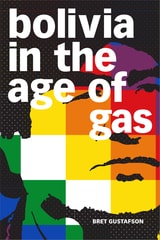
Bolivia in the Age of Gas
Bret Gustafson
Duke University Press, 2020
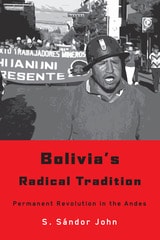
Bolivia's Radical Tradition
Permanent Revolution in the AndesS. Sándor John
University of Arizona Press, 2012

Bolivia
Revolution and the Power of History in the PresentJames Dunkerley
University of London Press, 2007
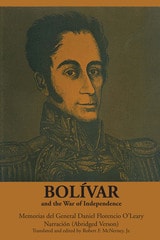
Bolívar and the War of Independence
Memorias del General Daniel Florencio O’Leary, NarraciónBy Daniel Florencio O'Leary
University of Texas Press, 1970
The overthrow of Spanish rule and the birth of new republican governments in northern South America at the beginning of the nineteenth century were in large part the work of one man—Simón Bolívar. Bolívar was not only the soldier who built a patriot army from a small band of exiles and led them victoriously across Venezuela and down the spine of the Andes as far as Potosí; he was also the statesman who framed the new republics that sprang to life after the defeat of the Spanish and who called the Congress of Panama in hopes of making real his dream of uniting all the South American republics in a single confederation. He was truly the Liberator.
The Narración, or narrative, of the Memorias of Daniel Florencio O’Leary has long been recognized by Spanish American scholars as one of the most important historical sources for a major part of Bolívar’s life. O’Leary took an active part in the wars for independence, first as a young officer, recruited in the British Isles to aid the patriot cause, and later as Bolívar’s chief aide, often entrusted with diplomatic missions. His firsthand knowledge of the stirring events of the period, his access to relevant documents, and his close association with the major figures in the struggle, as well as his friendship with Bolívar, made O’Leary a particularly valuable chronicler and biographer. Bolívar himself, shortly before his death, requested that O’Leary write the story of his life.
O’Leary’s meticulous attention to military and diplomatic maneuvers and his keen, sometimes acrid, comments on both men and events give the reader not only a vivid portrait of Bolívar—the man and his achievements—but also a remarkable insight into O’Leary’s own position as an autocratic-minded participant in the wars for independence. Although O’Leary’s devotion to, and admiration for, his Chief make for an occasionally partisan view, his stark account of the hardships and disappointments that Bolívar and his armies overcame against almost impossible odds does much to balance the narrative.
In his abridged translation, Robert McNerney has omitted the Apéndice, documents that O’Leary, had he lived, undoubtedly would have used as the source for completing his account of Bolívar’s life. Numerous letters and documents scattered through the original text also have been omitted, leaving a highly readable narrative.
Born of War in Colombia
Reproductive Violence and Memories of AbsenceTatiana Sanchez Parra
Rutgers University Press, 2024
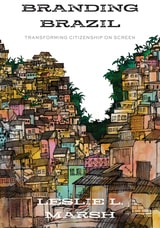
Branding Brazil
Transforming Citizenship on ScreenLeslie L. Marsh
Rutgers University Press, 2021
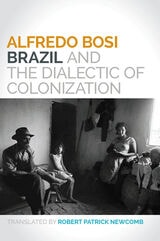
Brazil and the Dialectic of Colonization
Alfredo Bosi
University of Illinois Press, 2015
Portugal extracted wealth from its Brazilian colony. Slaves--first indigenous peoples, later Africans--mined its ore and cut its sugarcane. From the customs of the colonists and the aspirations of the enslaved rose Brazil. Bosi scrutinizes signal points in the creation of Brazilian culture--the plays and poetry, the sermons of missionaries and Jesuit priests, the Indian novels of José de Alencar and the Voices of Africa of poet Castro Alves. His portrait of the country's response to the pressures of colonial conformity offers a groundbreaking appraisal of Brazilian culture as it emerged from the tensions between imposed colonial control and the African and Amerindian cults--including the Catholic-influenced ones--that resisted it.
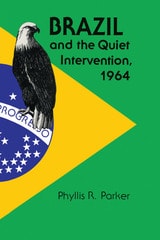
Brazil and the Quiet Intervention, 1964
By Phyllis R. Parker
University of Texas Press, 1979
When the Brazilian military overthrew President João Goulart in 1964, American diplomats characterized the coup as a "100 percent Brazilian movement." It has since become apparent, largely through government documents declassified during the course of research for this book, that the United States had an invisible but pervasive part in the coup.
Relying principally on documents from the Johnson and Kennedy presidential libraries, Phyllis Parker unravels the events of the coup in fascinating detail. The evidence she presents is corroborated by interviews with key participants.
U.S. interference in the Goulart regime began when normal diplomatic pressure failed to produce the desired enthusiasm from him for the Alliance of Progress. Political and economic manipulations also proving ineffective, the United States stood ready to back a military takeover of Brazil's constitutional democracy.
U.S. operation "Brother Sam" involved shipments of petroleum, a naval task force, and tons of arms and ammunition in preparation for intervention during the 1964 coup. When the Brazilian military gained control without calling on the ready assistance, U.S. policy makers immediately accorded recognition to the new government and set in motion plans for economic support.
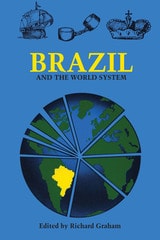
Brazil and the World System
Edited and with an introduction by Richard Graham; with chapters by Fernando A. Novais, John R. Hall, and Luís Carlos Soares
University of Texas Press, 1991
Has the world economy shaped and defined Brazil’s economic and political history and, if so, to what extent? Is Brazil’s past to be explained principally by its insertion in a single world capitalist system? The authors of the three essays in this volume reflect critically on these questions along with the following: Should the determining factors be understood as sociological-cultural (as in a heritage of patrimonial rule) or were they based on material reality? What was the connection between the presence of slavery in the Americas and the emergence of capitalism in Europe? What accounts for Brazil’s centuries-long reliance on exports and the slow development of its industry?
The chapters in this book draw contrasting judgments on virtually every major issue in Brazilian history because they begin from divergent premises. In arguing their cause, noted scholars John R. Hall, Fernando A. Novais, and Luís Carlos Soares provide a formidable intellectual point and counterpoint whose theoretical assumptions bear heavily on all social scientists engaged in exploring colonialism, imperialism, capitalism, dependency, and relative international poverty.
Brazil and the World System provides provocative insights not only about Brazil but also about the nature of colonialism in general and its relationship to the rise of capitalism in Europe. It should appeal to Latin Americanists of all disciplinary persuasions as well as to general readers curious about great patterns of change in history. Stuart Schwartz, director of the Center for Early Modern History at the University of Minnesota, says, “ . . . an excellent collection . . . North American scholarship will find these essays an eye-opener.
Brazilian Art under Dictatorship
Antonio Manuel, Artur Barrio, and Cildo MeirelesClaudia Calirman
Duke University Press, 2012
Brazilian Communism, 1935-1945
Repression during World UpheavalBy John W. F. Dulles
University of Texas Press, 1983
The Brazilian Communist Party was one of the largest Communist parties in Latin America until its split and dissolution in the 1990s. Although not granted legal status as a political party of Brazil until 1985, the Partido Comunista Brasileiro (PCB) has been tolerated by that country's regime.
Such governmental tolerance of the PCB was not always the case. In the past, the regime of Getúlio Vargas practiced savage forms of repression against Brazilian leftists, whose "Red extremism" was cited by both government leaders and the press as sufficient cause for Vargas' adoption of the most extreme measures.
Brazilian Communism, 1935–1945 is an objective and remarkably comprehensive account of the Brazilian Communist Party's struggle to survive those days of repression.
From his prison cell, PCB leader Luís Carlos Prestes guided the Party's quarreling factions. All who were associated with the Left shared a common enemy: the police, who used the most brutal forms of torture to extract information about leftist activities. Young Elza Fernandes, companion of the PCB's secretary general, was one whom the police interrogated. Suspecting that she had betrayed them, the Party itself arranged her murder.
Dulles' vivid account of this violent chapter in Latin American history is based on exclusive interviews with leading activists of the period and exhaustive research in the archives of both the PCB and the Brazilian police. The results make fascinating reading for Latin Americanists, historians of World War II, and students of international Communism alike.
Brazilian Popular Music and Citizenship
Idelber Avelar and Christopher Dunn, eds.
Duke University Press, 2011
Contributors. Idelber Avelar, Christopher Dunn, João Freire Filho, Goli Guerreiro, Micael Herschmann, Ari Lima, Aaron Lorenz, Shanna Lorenz, Angélica Madeira, Malcolm K. McNee, Frederick Moehn, Flávio Oliveira, Adalberto Paranhos, Derek Pardue, Marco Aurélio Paz Tella, Osmundo Pinho, Carlos Sandroni, Daniel Sharp, Hermano Vianna, Wivian Weller
Brazilian Women's Filmmaking
From Dictatorship to DemocracyLeslie Marsh
University of Illinois Press, 2012
At most recent count, there are no fewer than forty-five women in Brazil directing or codirecting feature-length fiction or documentary films. In the early 1990s, women filmmakers in Brazil were credited for being at the forefront of the rebirth of filmmaking, or retomada, after the abolition of the state film agency and subsequent standstill of film production. Despite their numbers and success, films by Brazilian women directors are generally absent from discussions of Latin American film and published scholarly works.
Brazilian-African Diaspora in Ghana
The Tabom, Slavery, Dissonance of Memory, Identity, and Locating HomeKwame Essien
Michigan State University Press, 2016
British-Owned Railways in Argentina
Their Effect on the Growth of Economic Nationalism, 1854-1948By Winthrop R. Wright
University of Texas Press, 1974
During the nineteenth century, British-owned railways grew under the protection of an Argentine ruling elite that considered railways both instruments and symbols of progress. Under this program of support for foreign enterprise, Argentina had by 1914 built the largest railway network in Latin America.
During the first decades of the twentieth century, the railways were successful in following a policy of calculated disregard for Argentine interests in general. However, following the end of World War I, the British economic empire began to decline and Argentine economic nationalism grew. A number of popularistic political movements incorporated economic nationalism into their platforms, and even among the ruling elite there were signs of increasing nationalistic sentiment.
Although most studies of economic nationalism have emphasized the importance of the middle-class Radical party in the rise of xenophobia, Winthrop R. Wright's study shows that antiforeign economic nationalism was not entirely a reaction to the conservative elite. Between 1932 and 1938 the nationalistic programs of General Agustin Justo's government—basically a conservative regime—led the British interests to decide to sell their holdings. The British govemment had arrived at a position of supporting the economic withdrawal of the large British-owned firms long before Juan D. Perón appeared on the political scene.
Perón combined traditional Argentine economic nationalism with his own scheme to gain power over all elements in Argentina. His solution to the railway problem, although more dramatically executed, did not differ greatly from that of the conservative Justo. Perón purchased the railways outright in 1947–1948, but his use of nationalism was in reality covering his own inability to outbargain Britain and the United States following the conclusion of World War II.

Bruno
Conversations with a Brazilian Drug DealerRobert Gay
Duke University Press, 2015
Buenos Aires
400 YearsEdited by Stanley R. Ross and Thomas F. McGann
University of Texas Press, 1982
Buying into the Regime
Grapes and Consumption in Cold War Chile and the United StatesHeidi Tinsman
Duke University Press, 2014