Results by title
146 books match the query 'Terrorism' and 8 start with b

Beyond September 11
An Anthology of DissentEdited by Phil Scraton
Pluto Press, 2002
This anthology includes some of the world's leading commentators - Noam Chomsky, Robert Fisk, Naomi Klein, John Pilger, Paul Foot and A.Sivanandan. It presents accessible, detailed and often deeply personal accounts of the aftermath, the bombing of Afghanistan and the dubious claims for its legality. From investigative journalists to critical academics, human rights lawyers and anti-racist campaigners, the contributors are united in their opposition to military intervention in Afghanistan and beyond and to the attack on civil liberties in the US, the UK and Europe.
From the US and Canada, Herman and Julia Schwendinger, Jonathan Farley, Tony Platt, Cecilia O'Leary, Christian Parenti and Michael Mandel are among critical academics who assess the validity, lawfulness and political consequences of the Bush/Blair agenda. European based commentators include Martti Gronfors and Thomas Mathiesen.
Examining the the context and rhetoric of US vengeance -- ennobled by the symbolic title 'Enduring Freedom' -- they challenge political and popular definitions, constructions,pathologisation and reporting of terrorism. In questioning the representation of war as 'just', the anthology focuses on civilian deaths in Afghanistan, evidence of US/allied atrocities, violations of prisoners' rights and US determination to escalate military offensives, regardless of global destabilisation.
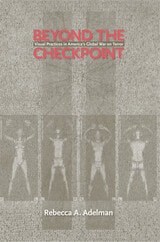
Beyond the Checkpoint
Visual Practices in America's Global War on TerrorRebecca A. Adelman
University of Massachusetts Press, 2014
Tracing the connections between citizenship and spectatorship, and moving beyond the close reading of visual representations, this book focuses on the institutions and actors that create, monitor, and regulate the visual landscape of the GWOT. Adelman looks around and through common images to follow the complex patterns of practice by which institutions and audiences engage them in various contexts. In the process, she proposes a new methodology for studying visual cultures of conflict, and related phenomena like violence, terror, and suffering that are notoriously difficult to represent.
Attending to previously unanalyzed dimensions of this conflict, this book illustrates the complexity of GWOT visual culture and the variegated experiences of citizenship that result as Americans navigate this terrain.
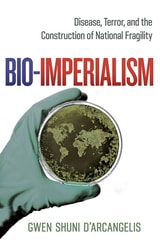
Bio-Imperialism
Disease, Terror, and the Construction of National FragilityGwen Shuni D'Arcangelis
Rutgers University Press, 2021
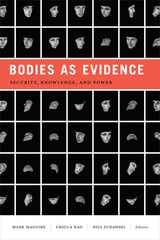
Bodies as Evidence
Security, Knowledge, and PowerMark Maguire, Ursula Rao, and Nils Zurawski, editors
Duke University Press, 2018
Contributors. Carolina Alonso-Bejarano, Gregory Feldman, Francisco J. Ferrándiz, Daniel M. Goldstein, Ieva Jusionyte, Amade M’charek, Mark Maguire, Joseph P. Masco, Ursula Rao, Antonius C. G. M. Robben, Joseba Zulaika, Nils Zurawski
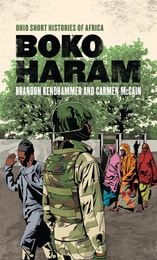
Boko Haram
Brandon Kendhammer
Ohio University Press, 2018
From its small-time origins in the early 2000s to its transformation into one of the world’s most-recognized terrorist groups, this remarkable short book tells the story of Boko Haram’s bloody, decade-long war in northeastern Nigeria. Going beyond the headlines, including the group’s 2014 abduction of 276 girls in Chibok and the international outrage it inspired, Boko Haram provides readers new to the conflict with a clearly written and comprehensive history of how the group came to be, the Nigerian government’s failed efforts to end it, and its enormous impact on ordinary citizens.
Drawing on years of research, Boko Haram is a timely addition to the acclaimed Ohio Short Histories of Africa. Brandon Kendhammer and Carmen McCain—two leading specialists on northern Nigeria—separate fact from fiction within one of the world’s least-understood conflicts. Most distinctively, it is a social history, one that tells the story of Boko Haram’s violence through the journalism, literature, film, and music made by people close to it.
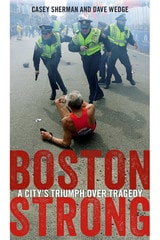
Boston Strong
A City's Triumph over TragedyCasey Sherman and Dave Wedge
University Press of New England, 2015
Brown Threat
Identification in the Security StateKumarini Silva
University of Minnesota Press, 2016
What is “brown” in—and beyond—the context of American identity politics? How has the concept changed since 9/11? In the most sustained examination of these questions to date, Kumarini Silva argues that “brown” is no longer conceived of solely as a cultural, ethnic, or political identity. Instead, after 9/11, the Patriot Act, and the wars in Iran, Iraq, and Afghanistan, it has also become a concept and, indeed, a strategy of identification—one rooted in xenophobic, imperialistic, and racist ideologies to target those who do not neatly fit or subscribe to ideas of nationhood.
Interweaving personal narratives, ethnographic research, analyses of popular events like the Miss America pageant, and films and TV shows such as the Harold and Kumar franchise and Black-ish, Silva maps junctures where the ideological, political, and mediated terrain intersect, resulting in an appetite for all things “brown” (especially South Asian brown) by U.S. consumers, while political and nationalist discourses and legal structures (immigration, emigration, migration, outsourcing, incarceration) conspire to control brown bodies both within and outside the United States.
Silva explores this contradictory relationship between representation and reality, arguing that the representation mediates and manages the anxieties that come from contemporary global realities, in which brown spaces, like India, Pakistan, and the Middle East pose key economic, security, and political challenges to the United States. While racism is hardly new, what makes this iteration of brown new is that anyone or any group, at any time, can be branded as deviant, as a threat.
Business Confronts Terrorism
Risks and ResponsesDean C. Alexander
University of Wisconsin Press, 2004
These scenarios could be part of a future Hollywood movie. Sadly, they are representative of previous terror attacks against industry and government interests worldwide. Moreover, they are harbingers of global terror threats.
Industry constitutes a prime target of contemporary terrorism. This timely book analyzes the threats companies face due to terrorism, industry responses to these dangers, and terrorism’s effects on conducting business in the post-9/11 environment. Dean C. Alexander details the conventional and unconventional terror capabilities facing industry. He describes the activities of terrorists in the economic system and the ways they finance their operations.
Alexander discusses how companies can reduce terrorist threats and that corporate security can minimize political violence. He outlines the dynamics of the public-private partnership against terrorism: government aiding industry, business supporting government, and tensions between the two. He also delineates terrorism’s effects—financial, physical, and emotional—on workers and employers. He highlights the negative financial and economic consequences of terrorism. He discusses the impact of terrorism on traditional business practices and concludes with an assessment of future trends.