Results by title
10 books match the query 'Salvador'
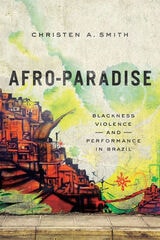
Afro-Paradise
Blackness, Violence, and Performance in BrazilChristen A. Smith
University of Illinois Press, 2016
Christen A. Smith argues that the dialectic of glorified representations of black bodies and subsequent state repression reinforces Brazil's racially hierarchal society. Interpreting the violence as both institutional and performative, Smith follows a grassroots movement and social protest theater troupe in their campaigns against racial violence. As Smith reveals, economies of black pain and suffering form the backdrop for the staged, scripted, and choreographed afro-paradise that dazzles visitors. The work of grassroots organizers exposes this relationship, exploding illusions and asking unwelcome questions about the impact of state violence performed against the still-marginalized mass of Afro-Brazilians.
Based on years of field work, Afro-Paradise is a passionate account of a long-overlooked struggle for life and dignity in contemporary Brazil.
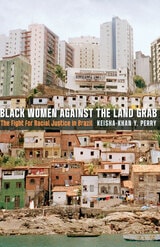
Black Women against the Land Grab
The Fight for Racial Justice in BrazilKeisha-Khan Y. Perry
University of Minnesota Press, 2013
In Brazil and throughout the African diaspora, black women, especially poor black women, are rarely considered leaders of social movements let alone political theorists. But in the northeastern city of Salvador, Brazil, it is these very women who determine how urban policies are established. Focusing on the Gamboa de Baixo neighborhood in Salvador’s city center, Black Women against the Land Grab explores how black women’s views on development have radicalized local communities to demand justice and social change.
In Black Women against the Land Grab, Keisha-Khan Y. Perry describes the key role of local women activists in the citywide movement for land and housing rights. She reveals the importance of geographic location for understanding the gendered aspects of urban renewal and the formation of black women–led social movements. How have black women shaped the politics of urban redevelopment, Perry asks, and what does this kind of political intervention tell us about black women’s agency? Her work uncovers the ways in which political labor at the neighborhood level is central to the mass mobilization of black people against institutional racism and for citizenship rights and resources in Brazil.
Highlighting the political life of black communities, specifically those in urban contexts often represented as socially pathological and politically bankrupt, Black Women against the Land Grab offers a valuable corrective to how we think about politics and about black women, particularly poor black women, as a political force.
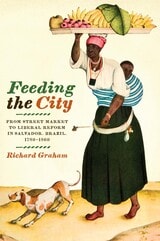
Feeding the City
From Street Market to Liberal Reform in Salvador, Brazil, 1780–1860By Richard Graham
University of Texas Press, 2010
Winner, Bolton-Johnson Prize, Conference on Latin American History, 2011
Murdo J. McLeod Book Prize, 2011
On the eastern coast of Brazil, facing westward across a wide magnificent bay, lies Salvador, a major city in the Americas at the end of the eighteenth century. Those who distributed and sold food, from the poorest street vendors to the most prosperous traders—black and white, male and female, slave and free, Brazilian, Portuguese, and African—were connected in tangled ways to each other and to practically everyone else in the city, and are the subjects of this book. Food traders formed the city's most dynamic social component during the late eighteenth and early nineteenth centuries, constantly negotiating their social place. The boatmen who brought food to the city from across the bay decisively influenced the outcome of the war for Brazilian independence from Portugal by supplying the insurgents and not the colonial army. Richard Graham here shows for the first time that, far from being a city sharply and principally divided into two groups—the rich and powerful or the hapless poor or enslaved—Salvador had a population that included a great many who lived in between and moved up and down.
The day-to-day behavior of those engaged in food marketing leads to questions about the government's role in regulating the economy and thus to notions of justice and equity, questions that directly affected both food traders and the wider consuming public. Their voices significantly shaped the debate still going on between those who support economic liberalization and those who resist it.
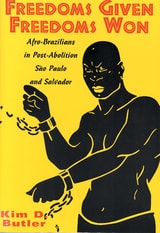
Freedoms Given, Freedoms Won
Afro-Brazilians in Post-Abolition São Paolo and SalvadorButler, Kim D
Rutgers University Press, 1998
Freedoms Given, Freedoms Won explores the ways Afro-Brazilians in two major cities adapted to the new conditions of life after the abolition of slavery and how they confronted limitations placed on their new freedom. The book sets forth new ways of understanding why the abolition of slavery did not yield equitable fruits of citizenship, not only in Brazil, but throughout the Americas and the Caribbean.
Afro-Brazilians in Sao Paulo and Salvador lived out their new freedom in ways that raise issues common to the entire Afro-Atlantic diaspora. In Sao Paulo, they initiated a vocal struggle for inclusion in the creation of the nation's first black civil rights organization and political party, and they appropriated a discriminatory identity that isolated blacks. In contrast, African identity prevaled over black identity in Salvador, where social protest was oriented toward protecting the right of cultural pluralism.
Of all the eras and issues studied in Afro-Brazilian history, post-abolition social and political action has been the most neglected. Butler provides many details of this period for the first time in English and supplements published sources with original oral histories, Afro-Brazilian newspapers, and new state archival documents currently being catalogued in Bahia. Freedoms Given, Freedoms Won sets the Afro-Brazilian experience in a national context as well as situating it within the Afro-Atlantic diaspora through a series of explicit parallels, particularly with Cuba and Jamaica.

Plastic Bodies
Sex Hormones and Menstrual Suppression in BrazilEmilia Sanabria
Duke University Press, 2016
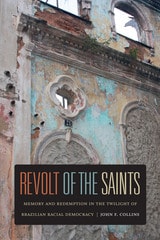
Revolt of the Saints
Memory and Redemption in the Twilight of Brazilian Racial DemocracyJohn F. Collins
Duke University Press, 2015
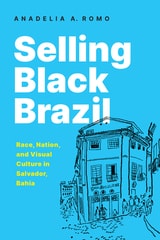
Selling Black Brazil
Race, Nation, and Visual Culture in Salvador, BahiaAnadelia Romo
University of Texas Press, 2022
2023 Honorable Mention, Brazil Section Humanities Book Prize, Latin American Studies Association (LASA)
This book explores visual portrayals of blackness in Brazil to reveal the integral role of visual culture in crafting race and nation across Latin America.
In the early twentieth century, Brazil shifted from a nation intent on whitening its population to one billing itself as a racial democracy. Anadelia Romo shows that this shift centered in Salvador, Bahia, where throughout the 1950s, modernist artists and intellectuals forged critical alliances with Afro-Brazilian religious communities of Candomblé to promote their culture and their city. These efforts combined with a growing promotion of tourism to transform what had been one of the busiest slaving depots in the Americas into a popular tourist enclave celebrated for its rich Afro-Brazilian culture. Vibrant illustrations and texts by the likes of Jorge Amado, Pierre Verger, and others contributed to a distinctive iconography of the city, with Afro-Bahians at its center. But these optimistic visions of inclusion, Romo reveals, concealed deep racial inequalities. Illustrating how these visual archetypes laid the foundation for Salvador’s modern racial landscape, this book unveils the ways ethnic and racial populations have been both included and excluded not only in Brazil but in Latin America as a whole.

Sex Tourism in Bahia
Ambiguous EntanglementsErica Lorraine Williams
University of Illinois Press, 2013

The Color of Love
Racial Features, Stigma, and Socialization in Black Brazilian FamiliesBy Elizabeth Hordge-Freeman
University of Texas Press, 2015
Winner, Section on the Sociology of Emotions Outstanding Recent Contribution (Book) Award, American Sociological Association, 2016
Charles Horton Cooley Award for Recent Book, Society for the Study of Symbolic Interaction, 2017
Best Publication Award, Section on Body and Embodiment, American Sociological Association (ASA), 2018
The Color Of Love reveals the power of racial hierarchies to infiltrate our most intimate relationships. Delving far deeper than previous sociologists have into the black Brazilian experience, Elizabeth Hordge-Freeman examines the relationship between racialization and the emotional life of a family. Based on interviews and a sixteen-month ethnography of ten working-class Brazilian families, this provocative work sheds light on how families simultaneously resist and reproduce racial hierarchies. Examining race and gender, Hordge-Freeman illustrates the privileges of whiteness by revealing how those with “blacker” features often experience material and emotional hardships. From parental ties, to sibling interactions, to extended family and romantic relationships, the chapters chart new territory by revealing the connection between proximity to whiteness and the distribution of affection within families.
Hordge-Freeman also explores how black Brazilian families, particularly mothers, rely on diverse strategies that reproduce, negotiate, and resist racism. She frames efforts to modify racial features as sometimes reflecting internalized racism, and at other times as responding to material and emotional considerations. Contextualizing their strategies within broader narratives of the African diaspora, she examines how Salvador’s inhabitants perceive the history of the slave trade itself in a city that is referred to as the “blackest” in Brazil. She argues that racial hierarchies may orchestrate family relationships in ways that reflect and reproduce racial inequality, but black Brazilian families actively negotiate these hierarchies to assert their citizenship and humanity.
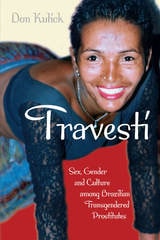
Travesti
Sex, Gender, and Culture among Brazilian Transgendered ProstitutesDon Kulick
University of Chicago Press, 1998
Kulick analyzes the various ways travestis modify their bodies, explores the motivations that lead them to choose this particular gendered identity, and examines the complex relationships that they maintain with one another, their boyfriends, and their families. Kulick also looks at how travestis earn their living through prostitution and discusses the reasons prostitution, for most travestis, is a positive and affirmative experience.
Arguing that transgenderism never occurs in a "natural" or arbitrary form, Kulick shows how it is created in specific social contexts and assumes specific social forms. Furthermore, Kulick suggests that travestis—far from deviating from normative gendered expectations—may in fact distill and perfect the messages that give meaning to gender throughout Brazilian society and possibly throughout much of Latin America.
Through Kulick's engaging voice and sharp analysis, this elegantly rendered account is not only a landmark study in its discipline but also a fascinating read for anyone interested in sexuality and gender.