Results by title
177 books match the query 'Themes, motives' and 5 start with b

Balthazar
A Black African King in Medieval and Renaissance ArtKristen Collins
J. Paul Getty Trust, The, 0
According to the Gospel of Matthew, magi from the East, following a star, traveled to Jerusalem bearing precious gifts for the infant Jesus. The magi were revered as wise men and later as kings. Over time, one of the three came to be known as Balthazar and to be depicted as a Black man.
Balthazar was familiar to medieval Europeans, appearing in paintings, manuscript illuminations, mosaics, carved ivories, and jewelry. But the origin story of this fascinating character uncovers intricate ties between Europe and Africa, including trade and diplomacy as well as colonization and enslavement.
In this book, experts in the fields of Ethiopian, West African, Nubian, and Western European art explore the representation of Balthazar as a Black African king. They examine exceptional art that portrays the European fantasy of the Black magus while offering clues about the very real Africans who may have inspired these images. Along the way, the authors chronicle the Black presence in premodern Europe, where free and enslaved Black people moved through public spaces and courtly circles. The volume’s lavish illustrations include selected works by contemporary artists who creatively challenge traditional depictions of Black history.

Barn Quilts and the American Quilt Trail Movement
Suzi Parron
Ohio University Press, 2012
The story of the American Quilt Trail, featuring the colorful patterns of quilt squares painted large on barns throughout North America, is the story of one of the fastest-growing grassroots public arts movements in the United States and Canada. In Barn Quilts and the American Quilt Trail Movement Suzi Parron takes us to twenty-five states as well as Canada to visit the people and places that have put this movement on America’s tourist and folk art map.
Through dozens of interviews with barn quilt artists, committee members, and barn owners, Parron documents a journey that began in 2001 with the founder of the movement, Donna Sue Groves. Groves’s desire to honor her mother with a quilt square painted on their barn became a group effort that eventually grew into a county-wide project. Today, quilt squares form a long imaginary clothesline, appearing on more than three thousand barns scattered along one hundred and twenty driving trails.
With more than eighty full-color photographs, Parron documents here a movement that combines rural economic development with an American folk art phenomenon.
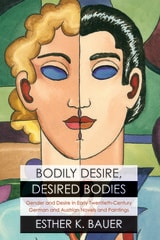
Bodily Desire, Desired Bodies
Gender and Desire in Early Twentieth-Century German and Austrian Novels and PaintingsEsther K. Bauer
Northwestern University Press, 2014
Bodily Desire, Desired Bodies examines the diverse ways that literary works and paintings can be read as screens onto which new images of masculinity and femininity are cast. Esther Bauer focuses on German and Austrian writers and artists from the 1910s and 1920s —specifically authors Franz Kafka, Vicki Baum, and Thomas Mann, and painters Otto Dix, Christian Schad, and Egon Schiele—who gave spectacular expression to shifting trends in male and female social roles and the organization of physical desire and the sexual body.
Bauer’s comparative approach reveals the ways in which artists and writers echoed one another in undermining the gender duality and highlighting sexuality and the body. As she points out, as sites of negotiation and innovation, these works reconfigured bodies of desire against prevailing notions of sexual difference and physical attraction and thus became instruments of social transformation.
Border Writing
The Multidimensional TextD. Emily HicksForeword by Neil Larsen
University of Minnesota Press, 1991
Border Writing was first published in 1991. Minnesota Archive Editions uses digital technology to make long-unavailable books once again accessible, and are published unaltered from the original University of Minnesota Press editions.
Until recently, literary theory has been grounded in the histories of English, French, German, and Spanish literature. The terms and models for the production of literature and its function in culture and society were decided in Western Europe, and any deviations were immediately marginalized. This Eurocentric view has been widely attached by postmodern, feminist, and postcolonial political practices.
Drawing on a variety of critical and theoretical sources, D. Emily Hicks employs the concept of border writing to consider the complexities of contemporary Latin American writing. With its emphasis on the multiplicity of languages and the problems of translation, border writing connotes a perspective that is no longer determined by neat distinctions. Hicks combines Deleuze and Guattari's notion of "deterritorialization" (the geographic, linguistic, or cultural displacement from one's own country, language, or native culture) with a holographic metaphor in provocative readings of Latin America writers, including Gabriel Garcia Marquez, Luisa Valenzuela, and Julio Cortazar. The result is a volume that forces the reader to consider the development of literature in terms of strategies and tactics that contribute to the production of meaning in culturally complex and politically repressive societies.
D. Emily Hicks is associate professor of English and comparative literature and a member of the Latin American studies faculty at San Diego State University. Neil Larsen is associate professor of Spanish and Latin American literature at Northeastern University and the author of Modernism and Hegemony: A Materialist Critique of Aesthetic Agencies (Minnesota, 1990).
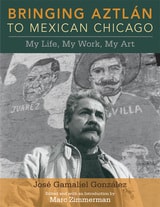
Bringing Aztlan to Mexican Chicago
My Life, My Work, My ArtJose Gamaliel Gonzalez, Edited and with an Introduction by Marc Zimmerman
University of Illinois Press, 2010