Results by title
493 books match the query 'Theory' and 16 start with b

Badass Feminist Politics
Exploring Radical Edges of Feminist Theory, Communication, and ActivismSarah Jane Blithe
Rutgers University Press, 2022
Badass Feminist Politics includes a diverse range of engaging feminist political projects to not only analyze the work being done on the ground but provide an overview for action that can be taken on by those seeking to engage in feminist activism in their own communities. Contributors included here are working for equality and equity and resisting violent, racist, homophobic, transphobic, xenophobic, and sexist language and action during this tension-filled political moment. Collectively, the book explores what it means to live and communicate feminist politics in everyday choices and actions, and how we can facilitate learning by analyzing these examples. Taking up current issues and new theoretical perspectives, the authors offer novel perspectives into what it means to live feminist politics. This book is a testament to resilience, resistance, communication, and forward thinking about what these themes all mean for new feminist agendas. Learning how to resist oppressive structures through words and actions is particularly important for students. Badass Feminist Politics features scholars from non-dominant groups taking up issues of marginalization and oppression, which can help people accomplish their social justice goals of inclusivity on the ground and in the classroom.

Basic Concepts in Music Education, II
Richard J. Cowell
University Press of Colorado, 1991
A continuation on the first edition, Basic Concepts in Music Education, II features revisions and updates by the living authors as well as contributions by new authors who delineate concepts of music education that are particularly important to the nineties and beyond. These topics include growth processes, learning theory, functional music, messages for teachers, the range of musical experience, technology, and evaluation.
Chapters from the most noted authorities in music education promise to provide definitive guidance in Basic Concepts, II that Basic Concepts, I has provided for the past quarter century. Among the contributors are Charles Fowler, Harry S. Broudy, Foster McMury, Wayne Bowman, Marilyn Zimmerman, Bennett Reimer, Clifton Burmeister, Richard Colwell, Robert Ehle, and Allen P. Britton. Like its predecessor, Basic Concepts, II offers rich and stimulating discussions on the most pertinent issues facing music education today - discussions that are vital to professionals and enlightening to the general reader.

Basic Income
The Material Conditions of FreedomDaniel Raventos
Pluto Press, 2007

Behavioral and Distributional Effects of Environmental Policy
Edited by Carlo Carraro and Gilbert E. Metcalf
University of Chicago Press, 2001
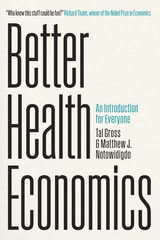
Better Health Economics
An Introduction for EveryoneTal Gross and Matthew J. Notowidigdo
University of Chicago Press, 2024
An ideal entry point into health economics for everyone from aspiring economists to healthcare professionals.
The economics of healthcare are messy. For most consumers, there’s little control over costs or services. Sometimes doctors are paid a lot; other times they aren’t paid at all. Insurance and drug companies are evil, except when they’re not. If economics is the study of market efficiency, how do we make sense of this?
Better Health Economics is a warts-and-all introduction to a field that is more exceptions than rules. Economists Tal Gross and Matthew J. Notowidigdo offer readers an accessible primer on the field’s essential concepts, a review of the latest research, and a framework for thinking about this increasingly imperfect market.
A love letter to a traditionally unlovable topic, Better Health Economics provides an ideal entry point for students in social science, business, public policy, and healthcare. It’s a reminder that healthcare may be a failed market—but it’s our failed market.
Better Health Economics
An Introduction for EveryoneTal Gross and Matthew J. Notowidigdo
University of Chicago Press, 2024
This is an auto-narrated audiobook version of this book.
An ideal entry point into health economics for everyone from aspiring economists to healthcare professionals.
The economics of healthcare are messy. For most consumers, there’s little control over costs or services. Sometimes doctors are paid a lot; other times they aren’t paid at all. Insurance and drug companies are evil, except when they’re not. If economics is the study of market efficiency, how do we make sense of this?
Better Health Economics is a warts-and-all introduction to a field that is more exceptions than rules. Economists Tal Gross and Matthew J. Notowidigdo offer readers an accessible primer on the field’s essential concepts, a review of the latest research, and a framework for thinking about this increasingly imperfect market.
A love letter to a traditionally unlovable topic, Better Health Economics provides an ideal entry point for students in social science, business, public policy, and healthcare. It’s a reminder that healthcare may be a failed market—but it’s our failed market.
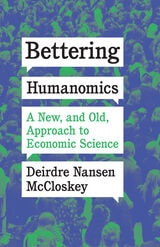
Bettering Humanomics
A New, and Old, Approach to Economic ScienceDeirdre Nansen McCloskey
University of Chicago Press, 2021
Economic historian Deirdre Nansen McCloskey has distinguished herself through her writing on the Great Enrichment and the betterment of the poor—not just materially but spiritually. In Bettering Humanomics she continues her intellectually playful yet rigorous analysis with a focus on humans rather than the institutions. Going against the grain of contemporary neo-institutional and behavioral economics which privilege observation over understanding, she asserts her vision of “humanomics,” which draws on the work of Bart Wilson, Vernon Smith, and most prominently, Adam Smith. She argues for an economics that uses a comprehensive understanding of human action beyond behaviorism.
McCloskey clearly articulates her points of contention with believers in “imperfections,” from Samuelson to Stiglitz, claiming that they have neglected scientific analysis in their haste to diagnose the ills of the system. In an engaging and erudite manner, she reaffirms the global successes of market-tested betterment and calls for empirical investigation that advances from material incentives to an awareness of the human within historical and ethical frameworks. Bettering Humanomics offers a critique of contemporary economics and a proposal for an economics as a better human science.
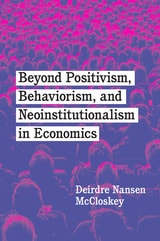
Beyond Positivism, Behaviorism, and Neoinstitutionalism in Economics
Deirdre Nansen McCloskey
University of Chicago Press, 2022
In Beyond Positivism, Behaviorism, and Neoinstitutionalism in Economics, Deirdre Nansen McCloskey zeroes in on the authoritarian cast of recent economics, arguing for a re-focusing on the liberated human. The behaviorist positivism fashionable in the field since the 1930s treats people from the outside. It yielded in Williamson and North a manipulative neo-institutionalism. McCloskey argues that institutions as causes are mainly temporary and intermediate, not ultimate. They are human-made, depending on words, myth, ethics, ideology, history, identity, professionalism, gossip, movies, what your mother taught you. Humans create conversations as they go, in the economy as in the rest of life.
In engaging and erudite prose, McCloskey exhibits in detail the scientific failures of neo-institutionalism. She proposes a “humanomics,” an economics with the humans left in. Humanomics keeps theory, quantification, experiment, mathematics, econometrics, though insisting on more true rigor than is usual. It adds what can be learned about the economy from history, philosophy, literature, and all the sciences of humans. McCloskey reaffirms the durability of “market-tested innovation” against the imagined imperfections to be corrected by a perfect government. With her trademark zeal and incisive wit, she rebuilds the foundations of economics.

Black Feminist Anthropology
Theory, Politics, Praxis, and PoeticsMcClaurin, Irma
Rutgers University Press, 2001
In this volume, Irma McClaurin has collected-for the first time-essays that explore the role and contributions of black feminist anthropologists. She has asked her contributors to disclose how their experiences as black women have influenced their anthropological practice in Africa, the Caribbean, and the United States, and how anthropology has influenced their development as black feminists. Every chapter is a unique journey that enables the reader to see how scholars are made. The writers present material from their own fieldwork to demonstrate how these experiences were shaped by their identities. Finally, each essay suggests how the author's field experiences have influenced the theoretical and methodological choices she has made throughout her career.
Not since Diane Wolf's Feminist Dilemmas in the Field or Hortense Powdermaker's Stranger and Friend have we had such a breadth of women anthropologists discussing the critical (and personal) issues that emerge when doing ethnographic research.

Black Power Praxis
Theory, Practice, and Activist Intellectuals in Detroit's Black Power MovementMatt Birkhold
University of Michigan Press, 2026
Black Power Praxis shows how four groups of activist-intellectuals—James and Grace Lee Boggs, Richard and Milton Henry, Reverend Albert Cleage, and a group of college students called Uhuru—shifted the consciousness and political perspectives of Black Detroiters in the 1960s and 1970s. By developing theories that they could unite with community-organizing practices, these activist-intellectuals turned the focus of the grassroots movement for racial equality from Civil Rights to Black Power. Following the 1967 Detroit Rebellion, these Black Power activist-intellectuals were already positioned to harness the energy that emerged from the uprising and directed it into the city’s first citywide Black Power organization, the Citywide Citizens Action Committee.
Even as Black Power theories became dominant over Detroit’s grassroots movement, their influence faltered when they failed to develop community organizing practices corresponding to the lived experiences of Black Detroiters. Black Power Praxis reveals how the relationships between ideas, practices, leadership, material reality, and consciousness drove the historical development of Black Power. Ideal for readers curious about social movements, Detroit history, African American history, and African American Studies, the book sheds light on how, why, and when Detroit’s activist-intellectual leaders successfully showed everyday people how their power might be used in transformative ways.
Bodies of Knowledge
Embodied Rhetorics in Theory and PracticeA. Abby Knoblauch
Utah State University Press, 2021
The pieces in Bodies of Knowledge draw explicit attention to the impact of the body on text, the impact of the body in text, the impact of the body as text, and the impact of the body upon textual production. The contributors investigate embodied rhetorics through the lenses of race and ethnicity, gender and sexuality, disability and pain, technologies and ecologies, clothing and performance, and scent, silence, and touch. In doing so, they challenge the (false) notion that academic knowledge—that is, “real” knowledge—is disembodied and therefore presumed white, middle class, cis-het, able-bodied, and male. This collection lays bare how myriad bodies invent, construct, deliver, and experience the processes of knowledge building.
Experts in the field of writing studies provide the necessary theoretical frameworks to better understand productive (and unproductive) uses of embodied rhetorics within the academy and in the larger social realm. To help meet the theoretical and pedagogical needs of the discipline, Bodies of Knowledge addresses embodied rhetorics and embodied writing more broadly though a rich, varied, and intersectional approach. These authors address larger questions around embodiment while considering the various impacts of the body on theories and practices of rhetoric and composition.
Contributors: Scot Barnett, Margaret Booker, Katherine Bridgman, Sara DiCaglio, Kristie S. Fleckenstein, Vyshali Manivannan, Temptaous Mckoy, Julie Myatt, Julie Nelson, Ruth Osorio, Kate Pantelides, Caleb Pendygraft, Nadya Pittendrigh, Kellie Sharp-Hoskins, Anthony Stagliano, Megan Strom
Bodies of the Text
Dance as Theory, Literature as DanceEdited by Ellen W Goellner
Rutgers University Press, 1995
Bridging the Multimodal Gap
From Theory to PracticeSantosh Khadka
Utah State University Press, 2018
After an introductory section reviewing the theory literature, chapters present research on implementing multimodal composition in diverse contexts. Contributors address starter subjects like using comics, blogs, or multimodal journals; more ambitious topics such as multimodal assignments in online instruction or digital story telling; and complex issues like assessment, transfer, and rhetorical awareness.
Bridging the Multimodal Gap translates theory into practice and will encourage teachers, including WPAs, TAs, and contingent faculty, to experiment with multiple modes of communication in their projects.
Contributors: Sara P. Alvarez, Steven Alvarez, Michael Baumann, Joel Bloch, Aaron Block, Jessie C. Borgman, Andrew Bourelle, Tiffany Bourelle, Kara Mae Brown, Jennifer J. Buckner, Angela Clark-Oates, Michelle Day, Susan DeRosa, Dànielle Nicole DeVoss, Stephen Ferruci, Layne M. P. Gordon, Bruce Horner, Matthew Irwin, Elizabeth Kleinfeld, Ashanka Kumari, Laura Sceniak Matravers, Jessica S. B. Newman, Mark Pedretti, Adam Perzynski, Breanne Potter, Caitlin E. Ray, Areti Sakellaris, Khirsten L. Scott, Rebecca Thorndike-Breeze, Jon Udelson, Shane A. Wood, Rick Wysocki, Kathleen Blake Yancey
Building Your Play
Theory and Practice for the Beginning PlaywrightDavid Rush
Southern Illinois University Press, 2010
David Rush takes beginning playwrights through the first draft of a play and deep into the revision process. Drawing on examples from such classics as Othello and The Glass Menagerie, Rush provides detailed models for writers to evaluate their work for weaknesses and focus on the in-depth development of their plays.
Rush encourages writers to make sure their plays are clear and focused. He shows how to keep plays dramatically compelling and offers ways to avoid common mistakes that make them dull, confusing, or ineffective. He then distills the essence of traditional revision into key questions and discusses frequently overlooked tools, terms, and strategies that go beyond established methods of evaluation.
Business Cycles
Theory, History, Indicators, and ForecastingVictor Zarnowitz
University of Chicago Press, 1992
With characteristic insight, Zarnowitz examines theories of the business cycle, including Keynesian and monetary theories and more recent rational expectation and real business cycle theories. He also measures trends and cycles in economic activity; evaluates the performance of leading indicators and their composite measures; surveys forecasting tools and performance of business and academic economists; discusses historical changes in the nature and sources of business cycles; and analyzes how successfully forecasting firms and economists predict such key economic variables as interest rates and inflation.
Buying and Believing
Sri Lankan Advertising and Consumers in a Transnational WorldSteven Kemper
University of Chicago Press, 2001
Drawing upon fieldwork conducted over thirty years, Kemper examines the Sri Lankan advertising industry to show how executives draw on their skills as folk ethnographers to "Sri Lankanize" commodities and practices to make them locally desirable, essentially producing new forms of Sri Lankan culture. Addressing many of the most pressing agendas of contemporary anthropology, Buying and Becoming breaks new ground in studies of culture and globalization.