Results by title
171 books match the query 'True Crime' and 10 start with b
Bad Blood
Freedom and Death in the White MountainsCasey Sherman
University Press of New England, 2012
Barbarous Souls
David L. Strauss
Northwestern University Press, 2010
Barbarous Souls tells the story of Darrel Parker’s wrongful conviction for Nancy’s murder. Lincoln native David Strauss weaves a shocking true crime story with an exposé of still-prevalent methods of interrogation—methods that often lead to false confessions and the conviction of innocent suspects. After he was convicted, Parker served thirteen years of a life sentence before agreeing to a deal that would free him but not clear his record. It was later discovered that a murderer who died in prison in 1988 had taped a confession to the crime.
A roller-coaster ride in the tradition of John Grisham’s The Innocent Man, Barbarous Souls is a thorough examination of a wrongful conviction based on a false confession, and an illuminating portrayal of a widespread phenomenon that still plagues the justice system.
Bath Massacre, New Edition
America's First School BombingArnie Bernstein
University of Michigan Press, 2022
On May 18, 1927, the small town of Bath, Michigan, was forever changed when Andrew Kehoe set off a cache of explosives concealed in the basement of the local school. Thirty-eight children and six adults were dead, among them Kehoe, who had literally blown himself to bits by setting off a dynamite charge in his car. The next day, on Kehoe's farm, what was left of his wife—burned beyond recognition after Kehoe set his property and buildings ablaze—was found tied to a handcart, her skull crushed. With seemingly endless stories of school violence and suicide bombers filling today's headlines, Bath Massacre serves as a reminder that terrorism and large-scale murder are nothing new.
Bath Massacre
America's First School BombingArnie Bernstein
University of Michigan Press, 2009
---Gregg Olsen, New York Times best-selling author of Starvation Heights
"A chilling and historic character study of the unfathomable suffering that desperation and fury, once unleashed inside a twisted mind, can wreak on a small town. Contemporary mass murderers Timothy McVeigh, Columbine's Dylan Klebold, and Virginia Tech's Seung-Hui Cho can each trace their horrific genealogy of terror to one man: Bath school bomber Andrew Kehoe."
---Mardi Link, author of When Evil Came to Good Hart
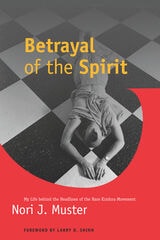
Betrayal of the Spirit
My Life behind the Headlines of the Hare Krishna MovementNori J. Muster
University of Illinois Press, 1996
Combining behind-the-scenes coverage of an often besieged religious group with a personal account of one woman's struggle to find meaning in it, Betrayal of the Spirit takes readers to the center of life in the Hare Krishna movement.
Nori J. Muster joined the International Society of Krishna Consciousness (ISKCON)--the Hare Krishnas--in 1978, shortly after the death of the movement's spiritual master, and worked for ten years as a public relations secretary and editor of the organization's newspaper, the ISKCON World Review. In this candid and critical account, Muster follows the inner workings of the movement and the Hare Krishnas' progressive decline.
Combining personal reminiscences, published articles, and internal documents, Betrayal of the Spirit details the scandals that beset the Krishnas--drug dealing, weapons stockpiling, deceptive fundraising, child abuse, and murder within ISKCON–as well as the dynamics of schisms that forced some 95 percent of the group's original members to leave. In the midst of this institutional disarray, Muster continued her personal search for truth and religious meaning as an ISKCON member until, disillusioned at last with the movement's internal divisions, she quit her job and left the organization.
In a new preface to the paperback edition, Muster discusses the personal circumstances that led her to ISKCON and kept her there as the movement's image worsened. She also talks about "the darkest secret"–child abuse in the ISKCON parochial schools--that was covered up by the public relations office where she worked.

Blood Ties
Sex, Scandal, and Serial Murder at the Turn of the Twentieth CenturyHarold Schechter
University of Iowa Press, 2027

Bloody Williamson
A Chapter in American LawlessnessPaul M. Angle; Introduction by John Y. Simon
University of Illinois Press, 1952
"In Williamson County some men took to violence almost as a way of life. A shocking story, well told."--New Yorker
Williamson County in southern Illinois has been the scene of almost unparalleled violence, from the Bloody Vendetta between two families in the 1870s through the Herrin Massacre of 1922, Ku Klux Klan activities that ended in fatalities, and the gang war of the 1920s between the Charlie Birger and Shelton brothers gangs. Paul Angle was fascinated by this more-than-fifty-year history, and his account of this violence has become a classic.
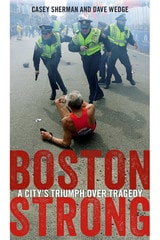
Boston Strong
A City's Triumph over TragedyCasey Sherman and Dave Wedge
University Press of New England, 2015
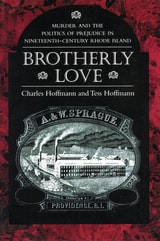
Brotherly Love
Murder and the Politics of Prejudice in Nineteenth-Century Rhode IslandCharles Hoffmann
University of Massachusetts Press, 1993
Brotherly Love is a graphic reconstruction of the crime, its social and economic background, and the subsequent trials. The story reveals the antagonism between native-born Yankees, who commanded great power, and the growing number of Irish Catholic immigrants, most of whom worked in the textile mills. Indeed, the economic, political, and religious dimensions of the conflict are all evident in the trials.
The authors argue persuasively that the Gordons were victims of bigotry and circumstantial evidence, serving as convenient scapegoats to appease a community outraged over the murder of its wealthiest citizen. In telling the story of this notorious case, Brotherly Love reveals the politics of prejudice in nineteenth-century New England as played out in community and courtroom.
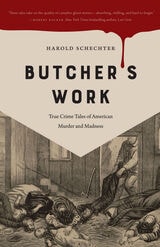
Butcher's Work
True Crime Tales of American Murder and MadnessHarold Schechter
University of Iowa Press, 2022