Results by title
65 books match the query 'Water-supply' and 2 start with b
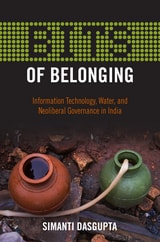
BITS of Belonging
Information Technology, Water, and Neoliberal Governance in IndiaSimanti Dasgupta
Temple University Press, 2015
India’s global success in the Information Technology industry has also prompted the growth of neoliberalism and the re-emergence of the middle class in contemporary urban areas, such as Bangalore. In her significant study, BITS of Belonging, Simanti Dasgupta shows that this economic shift produces new forms of social inequality while reinforcing older ones. She investigates this economic disparity by looking at IT and water privatization to explain how these otherwise unrelated domains correspond to our thinking about citizenship, governance, and belonging.
Dasgupta’s ethnographic study shows how work and human processes in the IT industry intertwine to meet the market stipulations of the global economy. Meanwhile, in the recasting of water from a public good to a commodity, the middle class insists on a governance and citizenship model based upon market participation. Dasgupta provides a critical analysis of the grassroots activism involved in a contested water project where different classes lay their divergent claims to the city.
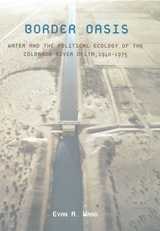
Border Oasis
Water and the Political Ecology of the Colorado River Delta, 1940–1975Evan R. Ward
University of Arizona Press, 2003
Evan Ward explores the rapid development of this region, examining the ways in which regional politics and international relations created a garden in the Mexicali, Yuma, and Imperial Valleys while simultaneously threatening the life of the Colorado River. Tracing the transformation of the delta by irrigated agribusiness through the twentieth century, he draws on untapped archival resources from both sides of the border to offer a new look at one of the world's most contested landscapes.
Border Oasis tells how two very different nations developed the delta into an agricultural oasis at enormous environmental cost. Focusing on the years 1940 to 1975—including the disastrous salinity crisis of the 1960s and 1970s—it combines Mexican, Native American, and U.S. perspectives to demonstrate that the political and diplomatic influences on the delta played as much a part in the region's transformation as did irrigation. Ward reveals how mistrust among political and economic participants has been fueled by conflict between national and local officials on both sides of the border, by Mexican nationalism, and by a mutual recognition that water is the critical ingredient for regional economic development.
With overemphasis on development in both nations leading to an ecological breaking point, Ward demonstrates that conflicting interests have made sound binational management of the delta nearly impossible. By weaving together all of these threads that have produced the fabric of today's lower Colorado, his study shows that the environmental history of the delta must be understood as a whole, not from the standpoint of only one of many competing interests.