Results by title
52 books match the query 'Women, Black' and 11 start with b
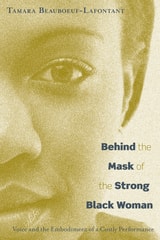
Behind the Mask of the Strong Black Woman
Voice and the Embodiment of a Costly PerformanceTamara Beauboeuf-Lafontant
Temple University Press, 2009
The author, a noted sociologist, interviews 58 Black women about being strong and proud, to illustrate their “performance” of invulnerability. Beauboeuf-Lafontant explains how such behavior leads to serious symptoms for these women, many of whom suffer from eating disorders and depression.
Drawing on Black feminist scholarship, cultural studies, and women’s history, Behind the Mask of the Strong Black Woman traces the historical and social influences of normative Black femininity, looking at how notions of self-image and strength create a distraction from broader forces of discrimination and power.

Beyond Bondage
Free Women of Color in the AmericasEdited by David Barry Gaspar and Darlene Clark Hine
University of Illinois Press, 2004
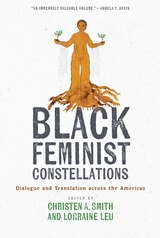
Black Feminist Constellations
Dialogue and Translation across the AmericasEdited by Christen A. Smith and Lorraine Leu
University of Texas Press, 2023
A collection of essays, interviews, and conversations by and between scholars, activists, and artists from Latin America and the Caribbean that paints a portrait of Black women's experiences across the region.
Black women in Latin America and the Caribbean suffer a triple erasure: as Black people, as women, and as non-English speakers in a global environment dominated by the Anglophone North. Black Feminist Constellations is a passionate and necessary corrective. Focused on and written by Black women of the southern Americas, the original works composing this volume make legible the epistemologies that sustain radical scholarship, art, and political organizing by Black women everywhere.
In essays, poems, and dialogues, the writers in Black Feminist Constellations reimagine liberation from the perspectives of radical South American and Caribbean Black women thinkers. The volume’s methodologically innovative approach reflects how Black women come together to theorize the world and challenges the notion that the university is the only site where knowledge can emerge. A major work of intellectual history, Black Feminist Constellations amplifies rarely heard voices, centers the uncanonized, and celebrates the overlooked work of Black women.
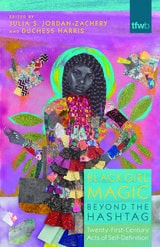
Black Girl Magic Beyond the Hashtag
Twenty-First-Century Acts of Self-DefinitionEdited by Julia S. Jordan-Zachery and Duchess Harris; Foreword by Janell Hobson; Afterword by Tammy Owens
University of Arizona Press, 2019
The essays in this volume move us beyond social media. They offer critical analyses and representations of the multiplicities of Black femmes’, girls’, and women’s lived experiences. Together the chapters demonstrate how Black girl magic is embodied by four elements enacted both on- and offline: building community, challenging dehumanizing representations, increasing visibility, and offering restorative justice for violence.
Black Girl Magic Beyond the Hashtag shows how Black girls and women foster community, counter invisibility, engage in restorative acts, and create spaces for freedom. Intersectional and interdisciplinary, the contributions in this volume bridge generations and collectively push the boundaries of Black feminist thought.

Black Women against the Land Grab
The Fight for Racial Justice in BrazilKeisha-Khan Y. Perry
University of Minnesota Press, 2013
In Brazil and throughout the African diaspora, black women, especially poor black women, are rarely considered leaders of social movements let alone political theorists. But in the northeastern city of Salvador, Brazil, it is these very women who determine how urban policies are established. Focusing on the Gamboa de Baixo neighborhood in Salvador’s city center, Black Women against the Land Grab explores how black women’s views on development have radicalized local communities to demand justice and social change.
In Black Women against the Land Grab, Keisha-Khan Y. Perry describes the key role of local women activists in the citywide movement for land and housing rights. She reveals the importance of geographic location for understanding the gendered aspects of urban renewal and the formation of black women–led social movements. How have black women shaped the politics of urban redevelopment, Perry asks, and what does this kind of political intervention tell us about black women’s agency? Her work uncovers the ways in which political labor at the neighborhood level is central to the mass mobilization of black people against institutional racism and for citizenship rights and resources in Brazil.
Highlighting the political life of black communities, specifically those in urban contexts often represented as socially pathological and politically bankrupt, Black Women against the Land Grab offers a valuable corrective to how we think about politics and about black women, particularly poor black women, as a political force.
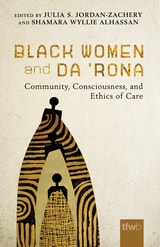
Black Women and da ’Rona
Community, Consciousness, and Ethics of CareEdited by Julia S. Jordan-Zachery and Shamara Wyllie Alhassan
University of Arizona Press, 2023
Recognizing that Black women have been living in pandemics as far back as colonialism and enslavement, this volume acknowledges that records of the past—from the 1918 flu pandemic to the onset of the HIV/AIDS epidemic—often erase the existence and experiences of Black women as a whole. Writing against this archival erasure, this collection consciously recenters the real-time experiences and perspectives of care, policy concerns, grief, and joy of Black women throughout the COVID-19 pandemic.
Nineteen contributors from interdisciplinary fields and diverse backgrounds explore Black feminine community, consciousness, ethics of care, spirituality, and social critique. They situate Black women’s multidimensional experiences with COVID-19 and other violences that affect their lives. The stories they tell are connected and interwoven, bound together by anti-Black gendered COVID necropolitics and commitments to creating new spaces for breathing, healing, and wellness.
Ultimately, this time-warping analysis shows how Black women imagine a more just society, rapidly adapt to changing experiences, and innovate ethics of care even in the midst of physical distancing, which can be instructive for thinking of new ways of living both during and beyond the era of COVID-19.
Contributors
Shamara Wyllie Alhassan
Sharnnia Artis
Keisha L. Bentley-Edwards
Candace S. Brown
Jenny Douglas
Kaja Dunn
Onisha Etkins
Rhonda M. Gonzales
Endia Hayes
Ashley E. Hollingshead
Kendra Jason
Julia S. Jordan-Zachery
Stacie LeSure
Janaka B. Lewis
Michelle Meggs
Nitya Mehrotra
Sherine Andreine Powerful
Marjorie Shavers
Breauna Marie Spencer
Tehia Starker Glass
Amber Walker
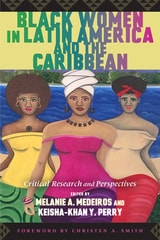
Black Women in Latin America and the Caribbean
Critical Research and PerspectivesMelanie A. Medeiros
Rutgers University Press, 2023
Black Women, Identity, and Cultural Theory
(Un)Becoming the SubjectKevin Everod Quashie
Rutgers University Press, 2004
In Black Women, Identity, and Cultural Theory, Kevin Everod Quashie explores the metaphor of the “girlfriend” as a new way of understanding three central concepts of cultural studies: self, memory, and language. He considers how the work of writers such as Toni Morrison, Ama Ata Aidoo, Dionne Brand, photographer Lorna Simpson, and many others, inform debates over the concept of identity. Quashie argues that these authors and artists replace the notion of a stable, singular identity with the concept of the self developing in a process both communal and perpetually fluid, a relationship that functions in much the same way that an adult woman negotiates with her girlfriend(s). He suggests that memory itself is corporeal, a literal body that is crucial to the process of becoming. Quashie also explores the problem language poses for the black woman artist and her commitment to a mastery that neither colonizes nor excludes.
The analysis throughout interacts with schools of thought such as psychoanalysis, postmodernism, and post-colonialism, but ultimately moves beyond these to propose a new cultural aesthetic, one that ultimately aims to center black women and their philosophies.

Borders of Visibility
Haitian Migrant Women and the Dominican Nation-Stateby Jennifer L. Shoaff
University of Alabama Press, 2018
An anthropological study of Haitian migrant women in the Dominican Republic.
Borders of Visibility offers extremely timely insight into the Dominican Republic’s racist treatment of Haitian descendants within its borders. Jennifer L. Shoaff employs multisited feminist research to focus on the geographies of power that intersect to inform the opportunities and constraints that migrant women must navigate to labor and live within a context that largely denies their human rights, access to citizenship, and a sense of security and belonging.
Paradoxically, these women are both hypervisible because of the blackness that they embody and invisible because they are marginalized by intersecting power inequalities. Haitian women must contend with diffuse legal, bureaucratic and discursive state-local practices across “border” sites that situate them as a specific kind of threat that must be contained. Shoaff examines this dialectic of mobility and containment across various sites in the northwest Dominican Republic, including the official border crossing, transborder and regional used-clothing markets, migrant settlements (bateyes), and other rural-urban contexts.
Shoaff combines ethnographic interviews, participant observation, institutional analyses of state structures and nongovernmental agencies, and archival documentation to bring this human rights issue to the fore. Although primarily grounded in critical ethnographic practice, this work contributes to the larger fields of transnational feminism, black studies, migration and border studies, political economy, and cultural geography. Borders of Visibility brings much needed attention to Haitian migrant women’s economic ingenuity and entrepreneurial savvy, their ability to survive and thrive, their often impossible choices whether to move or to stay, returning them to a place of visibility, while exposing the very structures that continue to render them invisible and, thus, expendable over time.
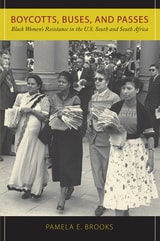
Boycotts, Buses, and Passes
Black Women's Resistance in the U.S. South and South AfricaPamela E. Brooks
University of Massachusetts Press, 2008
In the mid-1950s, as many developing nations sought independence from colonial rule, black women in the American South and in South Africa launched parallel campaigns to end racial injustice within their respective communities. Just as the dignified obstinacy of Mrs. Rosa Parks sparked the Montgomery bus boycott in 1955, the 20,000 South African women who marched in Pretoria a year later to protest the pass laws signaled a new wave of resistance to the system of apartheid. In both places women who had previously been consigned to subordinate roles brought fresh leadership to the struggle for political freedom and social equality.
In this book, Pamela E. Brooks tells their story, documenting the extraordinary achievements of otherwise ordinary women. In comparing the experiences of black women activists in two different parts of the African diaspora, Brooks draws heavily on oral histories that provide clear, and often painful, insight into their backgrounds, their motives, their hopes, and their fears. We learn how black women from all walks of life—domestic and factory workers, householders, teachers, union organizers, churchwomen, clubwomen, rural and urban dwellers alike—had to overcome their class differences and work through the often difficult gender relations within their families and communities. Yet eventually they came together to forge their own political organizations, such as the Women's Political Council and the Federation of South African Women, or joined orga-nizations of women and men, such as the Montgomery Improvement Association and the African National Congress, to advance the common agenda of black liberation.By tracing the dual rise of political consciousness and activism among the black women of the U.S. South and South Africa, Brooks not only illuminates patterns that have long been overlooked but places that shared history within the context of a larger global struggle to bring an end to the vestiges of European colonialism.
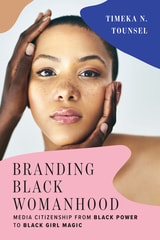
Branding Black Womanhood
Media Citizenship from Black Power to Black Girl MagicTimeka N. Tounsel
Rutgers University Press, 2022
Beginning with the inception of the Essence brand in the late 1960s, Timeka N. Tounsel examines the individuals and institutions that have reconfigured Black women’s empowerment as a business enterprise. Ultimately, these commercial gatekeepers have constructed an image economy that operates as both a sacred space for Black women and an easy hunting ground for their dollars.