Results by title
3703 books match the query '19th Century' and 152 start with b
Beyond Practical Virtue
A Defense of Liberal Democracy through LiteratureJoel A. Johnson
University of Missouri Press, 2007
Why hasn’t democracy been embraced worldwide as the best form of government?
Aesthetic critics of democracy such as Carlyle and Nietzsche have argued that modern democracy, by removing the hierarchical institutions that once elevated society’s character, turns citizens into bland, mediocre souls. Joel A. Johnson now offers a rebuttal to these critics, drawing surprising inspiration from American literary classics.
Addressing the question from a new perspective, Johnson takes a fresh look at the worth of liberal democracy in these uncertain times and tackles head-on the thorny question of cultural development. Examining the novels of James Fenimore Cooper, Mark Twain, and William Dean Howells, he shows that through their fiction we can gain a better appreciation of the rich detail of everyday life, making the debate relevant to contemporary discussions of liberal democracy.
Johnson focuses on an issue that liberals have inadequately addressed: whether people tend to develop fully as individuals under liberal democracy when such a regime does little formally to encourage their development. He argues that, though the liberal fear of state-guided culture is well founded, it should not prevent us from evaluating liberalism’s effect on individual flourishing. By extending the debate over the worthiness of liberal democracy to include democracy’s effect on individual development, he contends that the democratic experience is much fuller than the aristocratic one and thus expands the faculties of its citizens.
Critics of American democracy such as John Rawls have sought to transform it into a social or egalitarian democracy in the European style. Johnson shows that neither the debate between Rawls and his communitarian critics nor the ongoing discussion of the globalization of American values adequately addresses the fundamental critique of democratic culture advanced by the aesthetic critics. Johnson’s cogent analysis reaches out to those readers who are ready for a more comprehensive evaluation of liberal democracy, offering new insight into the relationship between the state and the individual while blazing new trails in the intersection of politics and literature.
Beyond Redemption
Race, Violence, and the American South after the Civil WarCarole Emberton
University of Chicago Press, 2013
Beyond Respectability
The Intellectual Thought of Race WomenBrittney C. Cooper
University of Illinois Press, 2017
Beyond the Binary
Reconstructing Cultural Identity In a Multicultural ContextEdited by Timothy B. Powell
Rutgers University Press, 1999
"Beyond the Binary offers a coherently presented collection of uniformly strong essays that speak to what is perhaps the most widely discussed, contested and conflicted topic in the study of US culture. It joins the growing body of work that seeks to move beyond identity politics and racial essentialism to formulate racial identity as a more complex series of social, cultural and political gestures." -Priscilla Wald, author of Constituting Americans: Cultural Anxiety and Narrative Form and Constituting Americans
Cultural studies have reached a theoretical impasse. As scholars continue to topple the previously entrenched concept of Eurocentrism, this field has fragmented into works covering many separate cultural enclaves. In the first wave of this "post-Eurocentric" scholarship, a binary model ensued, using the designations of "Self" and "Other:" i.e., black/white, gay/straight. This model, however, also has found disfavor. As a result, recent scholarship has focused on a single group studied in isolation.
What is needed is a new critical phase of reconstruction that will bring discussion of these disparate cultural enclaves back into a more organized, critical sphere. Researchers must have the necessary conceptual tools so they can study the ways in which cultures overlap, intersect, or else violently conflict with one another.
Beyond the Binary: Reconstructing Cultural Identity in a Multicultural Context addresses this theoretical impasse by proposing new critical models that fully engage the dilemmas posed by multiculturalism. Rather than becoming entangled in the polarizing rhetoric of the culture wars, these essays are firmly grounded in the lived perplexities of specific historical moments. One piece, for example, considers the cultural identity of "freaks" exhibited in P. T. Barnum's circus, the contested place of hemophiliacs within Queer Nation, and "white" working-class musicians who proudly proclaim themselves to be "black lesbians."
Beyond the Binary is meant to be read in its entirety as a many-voiced narrative dedicated to bringing the divisions within cultural studies back into contact with one another. By doing so, Powell ushers in a new era of multicultural analysis that recognizes the historical existence of racism, yet also acknowledges the dynamic fluidity of cultural identity.

Beyond the Field
How Soccer Built Community in the United StatesBrian D. Bunk
University of Illinois Press, 2025
Played by both migrants and native-born Americans, soccer created communities across the United States. Brian D. Bunk ranges from Pawtucket to Honolulu as he illuminates the deep and diverse origins of the American sport.
Soccer took root as immigration, urbanization, and industrialization triggered immense changes across society. Matches built local pride as teams battled rival neighborhoods and towns. Teammates and supporters shared meals, raised money for fallen players, and attended each other’s weddings and funerals. If sometimes damaged by economic depression or shattered by war, clubs often bounced back to provide a steadying, resilient force in their towns. Bunk follows the story from the 1880s through World War I by profiling the struggles and joys of players while also tracing the overlooked impact of people of African, Chinese, Hawaiian, Jewish, and Filipino descent on American soccer culture.
Engaging and rich in detail, Beyond the Field draws on extensive original research to expand our idea of the people and places that formed the American game.
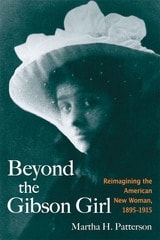
Beyond the Gibson Girl
Reimagining the American New Woman, 1895-1915Martha H. Patterson
University of Illinois Press, 2005
Challenging monolithic images of the New Woman as white, well-educated, and politically progressive, this study focuses on important regional, ethnic, and sociopolitical differences in the use of the New Woman trope at the turn of the twentieth century. Using Charles Dana Gibson's "Gibson Girls" as a point of departure, Martha H. Patterson explores how writers such as Pauline Hopkins, Margaret Murray Washington, Sui Sin Far, Mary Johnston, Edith Wharton, Ellen Glasgow, and Willa Cather challenged and redeployed the New Woman image in light of other “new” conceptions: the "New Negro Woman," the "New Ethics," the "New South," and the "New China."
As she appears in these writers' works, the New Woman both promises and threatens to effect sociopolitical change as a consumer, an instigator of evolutionary and economic development, and (for writers of color) an icon of successful assimilation into dominant Anglo-American culture. Examining a diverse array of cultural products, Patterson shows how the seemingly celebratory term of the New Woman becomes a trope not only of progressive reform, consumer power, transgressive femininity, modern energy, and modern cure, but also of racial and ethnic taxonomies, social Darwinist struggle, imperialist ambition, assimilationist pressures, and modern decay.
Biographical Passages
Essays on Victorian and Modernist BiographyEdited by Joe Law & Linda K. Hughes
University of Missouri Press, 2000
In the last two decades, biographies have grown in popularity, often eclipsing the novel in sales and accessibility to specialists and the general public alike. Widely regarded as a distinctly modern form, today's biographies are marked by their willingness to "tell all" or to pursue overt political aims. But how new, how unprecedented, are today's biographies? Biographical Passages addresses this important question by juxtaposing Victorian and Modernist biography from diverse perspectives.
Challenging the view that modern biographies are radically different from the straitlaced and ponderous Victorian tomes, Joe Law and Linda K. Hughes illustrate that continuities in biographical practice do exist, proving, for example, that the "tell-all" biography is not the exclusive preserve of the twentieth century. Enlisting the talents of such acclaimed biographers and scholars as P. N. Furbank and Michael Holroyd, Biographical Passages is a true exploration of the art and craft of biography. Essays on the usefulness of biography in approaching late Victorian artists provide a detailed scrutiny of modern biography across disciplines and from a rich array of vantage points. Additional essays on E. M. Forster and the relations between England and India analyze the role of cultural difference in biography.
Law and Hughes conclude Biographical Passages with an epilogue in tribute to a scholar whose work is closely connected to all the essays in this collection—Mary Lago. Widely known for her important contributions to studies of late Victorian and Edwardian literature, art, music, and Anglo-Indian relations, Lago is the author of biographies of Christina Herringham and E. M. Forster.
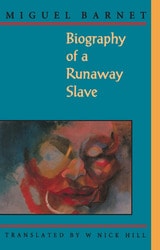
Biography of a Runaway Slave
Miguel Barnet
Northwestern University Press, 2002
In this remarkable testimony, Cuban novelist and anthropologist Miguel Barnet presents the narrative of 105-year-old Esteban Montejo, who lived as a slave, as fugitive in the wilderness, and as a soldier in the Cuban War of Independence. Honest, blunt, compassionate, shrewd, and engaging, his voice provides an extraordinary insight into the African culture that took root in the Caribbean.
Biography of a Runaway Slave
Fiftieth Anniversary EditionMiguel Barnet; Translated from the Spanish by W. Nick Hill; Introduction by William Luis
Northwestern University Press, 2016
Fiftieth Anniversary Edition
Originally published in 1966, Miguel Barnet’s Biography of a Runaway Slave provides the written history of the life of Esteban Montejo, who lived as a slave, as a fugitive in the wilderness, and as a soldier fighting against Spain in the Cuban War of Independence. A new introduction by one of the most preeminent Afro-Hispanic scholars, William Luis, situates Barnet’s ethnographic strategy and lyrical narrative style as foundational for the tradition of testimonial fiction in Latin American literature. Barnet recorded his interviews with the 103-year-old Montejo at the onset of the Cuban Revolution. This insurgent’s history allows the reader into the folklore and cultural history of Afro-Cubans before and after the abolition of slavery. The book serves as an important contribution to the archive of black experience in Cuba and as a reminder of the many ways that the present continues to echo the past.

Biology Takes Form
Animal Morphology and the German Universities, 1800-1900Lynn K. Nyhart
University of Chicago Press, 1995
Although there were neither professors of morphology nor a morphologists' society, morphologists achieved influence by "colonizing" niches in a variety of disciplines. Scientists in anatomy, zoology, natural history, and physiology considered their work morphological, and the term encompassed research that today might be classified as embryology, systematics, functional morphology, comparative physiology, ecology, behavior, evolutionary theory, or histology. Nyhart draws on research notes, correspondence, and other archival material to examine how these scientists responded to new ideas and to the work of colleagues. She examines the intertwined histories of morphology and the broader biological enterprise, demonstrating that the study of form was central to investigations of such issues as the relationships between an animal's structure and function, between an organism and its environment, and between living species and their ancestors.
Bismarck and His Times
George O. Kent
Southern Illinois University Press, 1978
A new account of the life and policies of the first German chancellor, Otto von Bismarck, this concise historical-biography reflects, for the first time in English, the historical shift in emphasis from the traditional political-economic approach to the more complex social-economic one of post—World War II scholarship.
Since the middle of the 1950s, much new material on Bismarck and nineteenth-century Germany and new interpretations of existing material have been published in Germany, Great Britain, and the United States. Professor George O. Kent’s brilliant synthesis, drawing on this mass of material, examines changes in emphasis in post—World War II scholarship. The book, particularly in the historiographical notes and bibliographical essay, provides the serious student with an invaluable guide to the intricacies of recent Bismarckian scholarship. For the general reader, the main text presents a picture of the man, the issues, and the age in the light of modern scholarship.
The major shift in historical emphasis described in this new account is the importance scholars give to the period 1877–79, the years of change from free trade to protectionism, rather than to 1870–71 the founding of the Reich. Bismarck’s political machinations, particularly his willingness to explore the possibilities of a coup d’état, are more fully discussed here than in any other book.
Black Atlas
Geography and Flow in Nineteenth-Century African American LiteratureJudith Madera
Duke University Press, 2015
Black Bangor
African Americans in a Maine Community, 1880-1950Maureen Elgersman Lee
University of New Hampshire Press, 2005
Blacks have lived and worked in Maine as early as the seventeenth century, but historically have constituted less than one percent of Maine's population. Probably for this reason, books on Blacks in New England have largely ignored the experience of African American Mainers. Black Bangor is the first major published study of a Black community in Maine.
This tightly woven case study examines the African American community in Bangor during its heyday, 1880–1950, the period that saw an unprecedented migration of Blacks to that city. Blacks migrated to Bangor not just from other New England states, but from the Caribbean and Canadian Maritime Provinces as well, creating a heterogeneous community with roots in two hemispheres. Constituting an “ultraminority” in Bangor (according to the census, Blacks never numbered more than 300 souls during this period), this diverse community nonetheless came together to establish an impressive range of institutions, including local chapters of the NAACP and Odd Fellows, as well as of Mothers and Junior Mothers Clubs. Concentrated in an area known as the Parker Street neighborhood, Black women in Bangor became domestics and cooks, caterers and beauticians, clerks and stenographers. Men worked as loggers, teamsters, porters, chefs, and barbers; a few owned businesses.
Organized thematically, with sections on migration, labor, daily life, and community, Black Bangor's topics include not just migration patterns, work, and religious and cultural organizations, but also African American homes, furniture, clothing, and foodways. Elgersman Lee also examines race relations and depictions of Blacks in the local media, and draws comparisons between the experiences of Bangor's African American population and those of Blacks in other New England cities.
This fascinating and exhaustive study will appeal to anyone from Maine, as well as those interested in African American history and the rich texture of the region's cultural life.
Black Bodies, White Gold
Art, Cotton, and Commerce in the Atlantic WorldAnna Arabindan-Kesson
Duke University Press, 2021
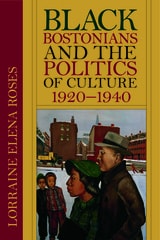
Black Bostonians and the Politics of Culture, 1920-1940
Lorraine Elena Roses
University of Massachusetts Press, 2017
In the 1920s and 1930s Boston became a rich and distinctive site of African American artistic production, unfolding at the same time as the Harlem Renaissance and encompassing literature, theater, music, and visual art. Owing to the ephemeral nature of much of this work, many of the era's primary sources have been lost.
In this book, Lorraine Elena Roses employs archival sources and personal interviews to recover this artistic output, examining the work of celebrated figures such as Dorothy West, Helene Johnson, Meta Warrick Fuller, and Allan Rohan Crite, as well as lesser-known artists including Eugene Gordon, Ralf Coleman, Gertrude “Toki” Schalk, and Alvira Hazzard. Black Bostonians and the Politics of Culture, 1920–1940 demonstrates how this creative community militated against the color line not solely through powerful acts of civil disobedience but also by way of a strong repertoire of artistic projects.
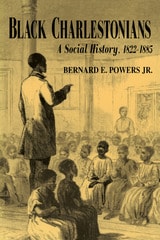
Black Charlestonians
A Social History, 1822-1885Bernard E. Powers
University of Arkansas Press, 2016
This revisionist work delineates the major social and economic contours of the large black population in the pivotal Southern city of Charleston, South Carolina., historic seaport center for the slave trade. It draws upon census data, manuscript collections, and newspaper accounts to expand our knowledge of this particular community of nineteenth-century black urbanites.
Although the federal government codified the rights of African-Americans into law following the Civil War, it was the initiatives taken by black men and women that actually transformed the theoretical benefits of emancipation into clear achievement.
Because of its large free black population, Charleston provided a case study of black social class stratification and social mobility even before the war. Reconstruction only emphasized that stratification, and Powers examines in detail the aspirations and concessions that shaped the lives of the newly freed blacks, who were led by a black upper class tat sometimes seemed more inclined to emulate white social mores than act as a vanguard for fundamental social change.
Unlike most Reconstruction studies, which concentrate on politics, Black Charlestonians explores the era’s vital socioeconomic challenges for blacks as they emerged into full citizenship in an important city in the South.
Choice’s 1996 Outstanding Academic Books List
Black Chicago's First Century
1833-1900Christopher Robert Reed
University of Missouri Press, 2005
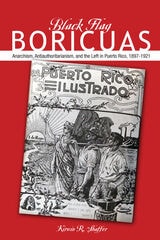
Black Flag Boricuas
Anarchism, Antiauthoritarianism, and th eLeft in Puerto Rico, 1897-1921Kirwin R. Shaffer
University of Illinois Press, 2013

Black Flag Over Dixie
Racial Atrocities and Reprisals in the Civil WarEdited by Gregory J. W. Urwin
Southern Illinois University Press, 2004
Black Flag over Dixie: Racial Atrocities and Reprisals in the Civil War highlights the central role that race played in the Civil War by examining some of the ugliest incidents that played out on its battlefields. Challenging the American public’s perception of the Civil War as a chivalrous family quarrel, twelve rising and prominent historians show the conflict to be a wrenching social revolution whose bloody excesses were exacerbated by racial hatred.
Edited by Gregory J. W. Urwin, this compelling volume focuses on the tendency of Confederate troops to murder black Union soldiers and runaway slaves and divulges the details of black retaliation and the resulting cycle of fear and violence that poisoned race relations during Reconstruction. In a powerful introduction to the collection, Urwin reminds readers that the Civil War was both a social and a racial revolution. As the heirs and defenders of a slave society’s ideology, Confederates considered African Americans to be savages who were incapable of waging war in a civilized fashion. Ironically, this conviction caused white Southerners to behave savagely themselves. Under the threat of Union retaliation, the Confederate government backed away from failing to treat the white officers and black enlisted men of the United States Colored Troops as legitimate combatants. Nevertheless, many rebel commands adopted a no-prisoners policy in the field. When the Union’s black defenders responded in kind, the Civil War descended to a level of inhumanity that most Americans prefer to forget.
In addition to covering the war’s most notorious massacres at Olustee, Fort Pillow, Poison Spring, and the Crater, Black Flag over Dixie examines the responses of Union soldiers and politicians to these disturbing and unpleasant events, as well as the military, legal, and moral considerations that sometimes deterred Confederates from killing all black Federals who fell into their hands. Twenty photographs and a map of massacre and reprisal sites accompany the volume.
The contributors are Gregory J. W. Urwin, Anne J. Bailey, Howard C. Westwood, James G. Hollandsworth Jr., David J. Coles, Albert Castel, Derek W. Frisby, Weymouth T. Jordan Jr., Gerald W. Thomas, Bryce A. Suderow, Chad L. Williams, and Mark Grimsley.
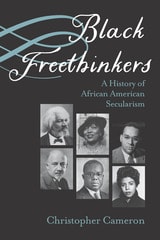
Black Freethinkers
A History of African American SecularismChristopher Cameron
Northwestern University Press, 2019
Christopher Cameron suggests an alternative origin of nonbelief and religious skepticism in America, namely the brutality of the institution of slavery. He also traces the growth of atheism and agnosticism among African Americans in two major political and intellectual movements of the 1920s: the New Negro Renaissance and the growth of black socialism and communism. In a final chapter, he explores the critical importance of freethought among participants in the civil rights and Black Power movements of the 1960s and 1970s.
Examining a wealth of sources, including slave narratives, travel accounts, novels, poetry, memoirs, newspapers, and archival sources such as church records, sermons, and letters, the study follows the lives and contributions of well-known figures, including Frederick Douglass, Zora Neale Hurston, James Baldwin, and Alice Walker, as well as lesser-known thinkers such as Louise Thompson Patterson, Sarah Webster Fabio, and David Cincore.
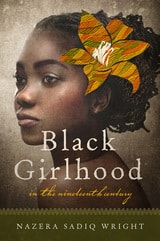
Black Girlhood in the Nineteenth Century
Nazera Sadiq Wright
University of Illinois Press, 2016
As Wright shows, the figure of the black girl in African American literature provided a powerful avenue for exploring issues like domesticity, femininity, and proper conduct. The characters' actions, however fictional, became a rubric for African American citizenship and racial progress. At the same time, their seeming dependence and insignificance allegorized the unjust treatment of African Americans. Wright reveals fascinating girls who, possessed of a premature knowing and wisdom beyond their years, projected a courage and resiliency that made them exemplary representations of the project of racial advance and citizenship.
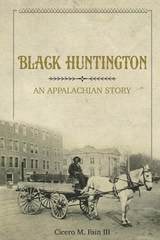
Black Huntington
An Appalachian StoryCicero M. Fain III
University of Illinois Press, 2019
How African Americans thrived in a West Virginia city
By 1930, Huntington had become West Virginia's largest city. Its booming economy and relatively tolerant racial climate attracted African Americans from across Appalachia and the South. Prosperity gave these migrants political clout and spurred the formation of communities that defined black Huntington--factors that empowered blacks to confront institutionalized and industrial racism on the one hand and the white embrace of Jim Crow on the other. Cicero M. Fain III illuminates the unique cultural identity and dynamic sense of accomplishment and purpose that transformed African American life in Huntington. Using interviews and untapped archival materials, Fain details the rise and consolidation of the black working class as it pursued, then fulfilled, its aspirations. He also reveals how African Americans developed a host of strategies--strong kin and social networks, institutional development, property ownership, and legal challenges--to defend their gains in the face of the white status quo. Eye-opening and eloquent, Black Huntington makes visible another facet of the African American experience in Appalachia.

Black Identity
Rhetoric, Ideology, and Nineteenth-Century Black NationalismDexter B. Gordon
Southern Illinois University Press, 2006
Exploring the role of rhetoric in African American identity and political discourse
Dexter B. Gordon’s Black Identity: Rhetoric, Ideology, and Nineteenth-Century Black Nationalism explores the problem of racial alienation and the importance of rhetoric in the formation of black identity in the United States. Faced with alienation and disenfranchisement as a part of their daily experience, African Americans developed collective practices of empowerment that cohere as a constitutive rhetoric of black ideology. Exploring the origins of that rhetoric, Gordon reveals how the ideology of black nationalism functions in contemporary African American political discourse.
Rooting his study in the words and works of nineteenth-century black abolitionists such as Maria Stewart, David Walker, and Henry Garnet, Gordon explores the rapprochement between rhetorical theory, race, alienation, and the role of public memory in identity formation. He argues that abolitionists used language in their speeches, pamphlets, letters, petitions, and broadsides that established black identity in ways that would foster liberation and empowerment. The arguments presented here constitute the only sustained treatment of nineteenth-century black activists from a rhetorical perspective.
Gordon demonstrates the pivotal role of rhetoric in African American efforts to create a viable public voice. Understanding nineteenth-century black alienation—and its intersection with twentieth-century racism—is crucial to understanding the continued sense of alienation that African Americans express about their American experience. Gordon explains how the ideology of black nationalism disciplines and describes African American life for its own ends, exposing a central piece of the ideological struggle for the soul of America. The book is both a platform for further discussion and an invitation for more voices to join the discourse as we search for ways to comprehend the sense of alienation experienced and expressed by African Americans in contemporary society.

Black Labor in Richmond, 1865-1890
Peter J. Rachleff
University of Illinois Press, 1989
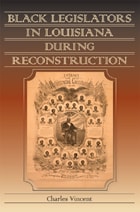
Black Legislators in Louisiana during Reconstruction
Charles Vincent
Southern Illinois University Press, 2011
Now updated with a new preface, this volume endures as an important work that illustrates the strength of minorities in state government during Reconstruction. It focuses on the achievements of the black representatives and senators in the Louisiana legislature who, through tireless fighting, were able to push forward many progressive reforms, such as universal public education, and social programs for the less fortunate.
Black New Orleans, 1860-1880
John W. Blassingame
University of Chicago Press, 1976
“Blending historical and sociological perspectives, and drawing with skill and imagination upon a variety of sources, [Blassingame] offers fresh insights into an oft-studied period of Southern history. . . . In both time and place the author has chosen an extraordinarily revealing vantage point from which to view his subject. ”—Neil R. McMillen, American Historical Review
Black Powder, White Lace
The du Pont Irish and Cultural Identity in Nineteenth-Century AmericaMargaret M. Mulrooney
University of Delaware Press, 2023
Black Soldiers of the Queen
The Natal Native Contingent in the Anglo-Zulu WarP. S. Thompson
University of Alabama Press, 2006
Africans who fought alongside the British against the Zulu king
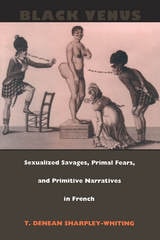
Black Venus
Sexualized Savages, Primal Fears, and Primitive Narratives in FrenchT. Denean Sharpley-Whiting
Duke University Press, 1999
The book opens with an exploration of scientific discourse on black females, using Sarah Bartmann, the so-called Hottentot Venus, and natural scientist Georges Cuvier as points of departure. To further show how the image of a savage was projected onto the bodies of black women, Sharpley-Whiting moves into popular culture with an analysis of an 1814 vaudeville caricature of Bartmann, then shifts onto the terrain of canonical French literature and colonial cinema, exploring the representation of black women by Baudelaire, Balzac, Zola, Maupassant, and Loti. After venturing into twentieth-century film with an analysis of Josephine Baker’s popular Princesse Tam Tam, the study concludes with a discussion of how black Francophone women writers and activists countered stereotypical representations of black female bodies during this period. A first-time translation of the vaudeville show The Hottentot Venus, or Hatred of Frenchwomen supplements this critique of the French male gaze of the nineteenth and early twentieth centuries.
Both intellectually rigorous and culturally intriguing, this study will appeal to students and scholars in the fields of nineteenth- and twentieth-century French literature, feminist and gender studies, black studies, and cultural studies.
Black Victorians / Black Victoriana
Edited by Gretchen Holbrook Gerzina
Rutgers University Press, 2003
The essays taken as a whole also highlight prevailing Victorian attitudes toward race by focusing on the ways in which empire building spawned a "subculture of blackness" consisting of caricature, exhibition, representation, and scientific racism absorbed by society at large. This misrepresentation made it difficult to be both black and British while at the same time it helped to construct British identity as a whole. Covering many topics that detail the life of blacks during this period, Black Victorians/Black Victoriana will be a landmark contribution to the emergent field of black history in England.
Black Women’s Intellectual Traditions
Speaking Their MindsEdited by Kristin B. Waters and Carol B. Conaway
University Press of New England, 2007
Black Women’s Intellectual Traditions
Speaking Their MindsEdited by Kristin Waters and Carol B. Conaway
Brandeis University Press, 2022
An astonishing wealth of literary and intellectual work by nineteenth-century Black women is being rediscovered and restored to print in scholarly and popular editions. In Kristin Waters’s and Carol B. Conaway’s landmark edited collection, Black Women’s Intellectual Traditions: Speaking Their Minds, sophisticated commentary on this rich body of work chronicles a powerful and interwoven legacy of activism based in social and political theories that helped shape the history of North America. The book meticulously reclaims this American legacy, providing a collection of critical analyses of the primary sources and their vital traditions. Written by leading scholars, Black Women’s Intellectual Traditions is particularly powerful in its exploration of the pioneering thought and action of the nineteenth-century Black woman lecturer and essayist Maria W. Stewart, abolitionist Sojourner Truth, novelist and poet Frances Ellen Watkins Harper, educator Anna Julia Cooper, newspaper editor Mary Ann Shadd Cary, and activist Ida B. Wells. The distinguished contributors are Hazel V. Carby, Patricia Hill Collins, Karen Baker-Fletcher, Kristin Waters, R. Dianne Bartlow, Carol B. Conaway, Olga Idriss Davis, Vanessa Holford Diana, Evelyn Simien, Janice W. Fernheimer, Michelle N. Garfield, Joy James, Valerie Palmer-Mehta, Carla L. Peterson, Marilyn Richardson, Evelyn M. Simien, Ebony A. Utley, Mary Helen Washington, Melina Abdullah, and Lena Ampadu. The volume will interest scholars and readers of African-American and women’s studies, history, rhetoric, literature, poetry, sociology, political science, and philosophy. This updated edition features a new preface by the editors in the light of new developments in current scholarship.

Black and White Strangers
Race and American Literary RealismKenneth W. Warren
University of Chicago Press, 1993

Black devil and iron angel
the railway in nineteenth-century German realismPaul A. Youngman
Catholic University of America Press, 2005
Black, White, and Huckleberry Finn
Re-imagining the American DreamElaine Mensh
University of Alabama Press, 2001
Takes a hard, systematic look at the depiction of blacks, whites, and race relations in Mark Twain's classic novel, raising questions about its canonical status in American literature
Huckleberry Finn, one of the most widely taught novels in American literature, has long been the subject of ongoing debates over issues ranging from immorality to racism. Here, Elaine Mensh and Harry Mensh enter the debate with a careful and thoughtful examination of racial messages imbedded in the tale of Huck and Jim.Using as a gauge for analysis the historical record left by both slaves and slaveholders, the Menshes compare Twain's depiction with historical reality, attempting to determine where the book either undermines or upholds traditional racial attitudes. Surveying the opinions of fellow critics, they challenge the current consensus that Huckleberry Finn fosters rapport between blacks and whites, arguing that the book does not subvert ingrained beliefs about race, and demonstrating that the argument over black-white relations in the novel is also an argument over non-fictional racial relations and conflicting perceptions of racial harmony.
Reading the novel in its historical context, the Menshes conclude that Twain, in the character of Huck, never questions the institution of slavery, and even supports it in both thought and action. In response to student and parent challenges to the inclusion of the book in literature classes, they suggest that it should remain in school libraries but not be required reading.Of importance to scholars of Mark Twain and American literature, African American cultural studies, or anyone interested in issues of literature and race, this book adds a strong voice to the long-ranging debate over Huckleberry Finn.
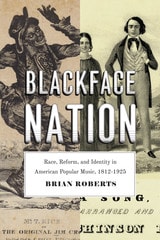
Blackface Nation
Race, Reform, and Identity in American Popular Music, 1812-1925Brian Roberts
University of Chicago Press, 2017
The Hutchinson Family Singers, the Northeast’s most popular middle-class singing group during the mid-nineteenth century, is perhaps the best example of the first strain of music. The group’s songs expressed an American identity rooted in communal values, with lyrics focusing on abolition, women’s rights, and socialism. Blackface minstrelsy, on the other hand, emerged out of an audience-based coalition of Northern business elites, Southern slaveholders, and young, white, working-class men, for whom blackface expressed an identity rooted in individual self-expression, anti-intellectualism, and white superiority. Its performers embodied the love-crime version of racism, in which vast swaths of the white public adored African Americans who fit blackface stereotypes even as they used those stereotypes to rationalize white supremacy. By the early twentieth century, the blackface version of the American identity had become a part of America’s consumer culture while the Hutchinsons’ songs were increasingly regarded as old-fashioned. Blackface Nation elucidates the central irony in America’s musical history: much of the music that has been interpreted as black, authentic, and expressive was invented, performed, and enjoyed by people who believed strongly in white superiority. At the same time, the music often depicted as white, repressed, and boringly bourgeois was often socially and racially inclusive, committed to reform, and devoted to challenging the immoralities at the heart of America’s capitalist order.
Blacks on the Border
The Black Refugees in British North America, 1815–1860Harvey Whitfield
University Press of New England, 2006

Blacks, Coloureds and National Identity in Nineteenth-century Latin America
Edited by Nancy Priscilla Naro
University of London Press, 2003
Blake, Nationalism, and the Politics of Alienation
Julia M. Wright
Ohio University Press, 2027
William Blake’s reputation as a staunch individualist is based in large measure on his repeated attacks on institutions and belief systems that constrain the individual’s imagination. Blake, however, rarely represents isolation positively, suggesting that the individual’s absolute freedom from communal pressures is not the ideal. Instead, as Julia Wright argues in her award-winning study Blake, Nationalism, and the Politics of Alienation, Blake’s concern lies with the kind of community that is being established. Moreover, writing at the moment of the emergence of modern nationalism, Blake reveals a concern with the national community in particular.
Beginning with a discussion of the priority of national narrative in late-eighteenth-century art theory and antiquarianism, Blake, Nationalism, and the Politics of Alienation traces its relevance in Blake’s printed works, from The Poetical Sketches and the Lambeth Prophecies to The Laocoön. Professor Wright then turns to Europe, America, and Visions of the Daughters of Albion, focusing on Blake’s portrayals of particular characters’ alienation from the groups and ideologies represented in the texts. The book closes by arguing that Blake’s major printed works, Milton and Jerusalem, are explicit and extensive engagements with the question of nation—and empire.
Although nationalism existed in various forms during the Romantic period, Blake’s contemporaries generally assumed that nations should progress continuously, producing a clear narrative line from an auspicious origin to the perfect fulfillment of that promise. Wright argues that these mutually determining constructs of national character and national narrative inform Blake’s handling of the problem of the individual-within-a-community.
Blazing Cane
Sugar Communities, Class, and State Formation in Cuba, 1868–1959Gillian McGillivray
Duke University Press, 2009
Focusing on sugar communities in eastern and central Cuba, McGillivray recounts how farmers and workers pushed the Cuban government to move from exclusive to inclusive politics and back again. The revolutionary caudillo networks that formed between 1895 and 1898, the farmer alliances that coalesced in the 1920s, and the working-class groups of the 1930s affected both day-to-day local politics and larger state-building efforts. Not limiting her analysis to the island, McGillivray shows that twentieth-century Cuban history reflected broader trends in the Western Hemisphere, from modernity to popular nationalism to Cold War repression.
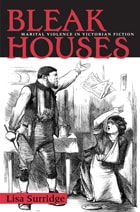
Bleak Houses
Marital Violence in Victorian FictionLisa Surridge
Ohio University Press, 2005
The Offenses Against the Person Act of 1828 opened magistrates' courts to abused working-class wives. Newspapers in turn reported on these proceedings, and in this way the Victorian scrutiny of domestic conduct began. But how did popular fiction treat “private” family violence? Bleak Houses: Marital Violence in Victorian Fiction traces novelists' engagement with the wife-assault debates in the public press between 1828 and the turn of the century.
Lisa Surridge examines the early works of Charles Dickens and reads Dombey and Son and Anne Brontë's The Tenant of Wildfell Hall in the context of the intense debates on wife assault and manliness in the late 1840s and early 1850s. Surridge explores George Eliot's Janet's Repentance in light of the parliamentary debates on the 1857 Divorce Act. Marital cruelty trials provide the structure for both Wilkie Collins's The Woman in White and Anthony Trollope's He Knew He Was Right.
Locating the New Woman fiction of Mona Caird and the reassuring detective investigations of Sherlock Holmes in the context of late-Victorian feminism and the great marriage debate in the Daily Telegraph, Surridge illustrates how fin-de-siècle fiction brought male sexual violence and the viability of marriage itself under public scrutiny. Bleak Houses thus demonstrates how Victorian fiction was concerned about the wife-assault debates of the nineteenth century, debates which both constructed and invaded the privacy of the middle-class home.

Bleak Liberalism
Amanda Anderson
University of Chicago Press, 2016
Amanda Anderson examines canonical works of high realism, political novels from England and the United States, and modernist works to argue that liberalism has engaged sober and even stark views of historical development, political dynamics, and human and social psychology. From Charles Dickens’s Bleak House and Hard Times to E. M. Forster’s Howards End to Doris Lessing’s The Golden Notebook, this literature demonstrates that liberalism has inventive ways of balancing sociological critique and moral aspiration. A deft blend of intellectual history and literary analysis, Bleak Liberalism reveals a richer understanding of one of the most important political ideologies of the modern era.

Blockaders, Refugees, and Contrabands
Civil War on Florida's Gulf Coast, 1861-1865George E. Buker
University of Alabama Press, 2004
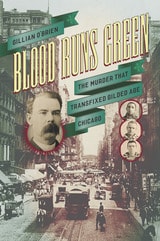
Blood Runs Green
The Murder That Transfixed Gilded Age ChicagoGillian O'Brien
University of Chicago Press, 2015
It was the biggest funeral Chicago had seen since Lincoln’s. On May 26, 1889, four thousand mourners proceeded down Michigan Avenue, followed by a crowd forty thousand strong, in a howl of protest at what commentators called one of the ghastliest and most curious crimes in civilized history. The dead man, Dr. P. H. Cronin, was a respected Irish physician, but his brutal murder uncovered a web of intrigue, secrecy, and corruption that stretched across the United States and far beyond.
Blood Runs Green tells the story of Cronin’s murder from the police investigation to the trial. It is a story of hotheaded journalists in pursuit of sensational crimes, of a bungling police force riddled with informers and spies, and of a secret revolutionary society determined to free Ireland but succeeding only in tearing itself apart. It is also the story of a booming immigrant population clamoring for power at a time of unprecedented change.
From backrooms to courtrooms, historian Gillian O’Brien deftly navigates the complexities of Irish Chicago, bringing to life a rich cast of characters and tracing the spectacular rise and fall of the secret Irish American society Clan na Gael. She draws on real-life accounts and sources from the United States, Ireland, and Britain to cast new light on Clan na Gael and reveal how Irish republicanism swept across the United States. Destined to be a true crime classic, Blood Runs Green is an enthralling tale of a murder that captivated the world and reverberated through society long after the coffin closed.
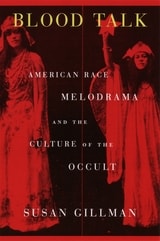
Blood Talk
American Race Melodrama and the Culture of the OccultSusan Gillman
University of Chicago Press, 2003
Blood Talk shows how race melodrama emerged from abolitionist works such as Uncle Tom's Cabin and surprisingly manifested itself in a set of more aesthetically and politically varied works, such as historical romances, sentimental novels, the travel literature of Mark Twain, the regional fiction of Kate Chopin and George Washington Cable, and the work of W. E. B. Du Bois. Gillman then uses the race melodrama to show how racial discourses in the United States have been entangled with occultist phenomena, from the rituals of the Ku Klux Klan and the concept of messianic second-sight to the production of conspiracy theories and studies of dreams and trances.
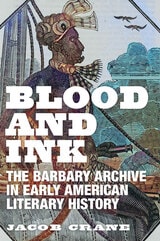
Blood and Ink
The Barbary Archive in Early American Literary HistoryJacob Crane
University of Massachusetts Press, 2023
In the late eighteenth and early nineteenth centuries, Algerian piracy in the Mediterranean loomed large in the American imagination. An estimated seven hundred American citizens, sailors, and naval officers were taken captive over the course of the Barbary Crises (1784–1815), and this overseas danger threatened to grow and irreparably harm the young republic.
Blood and Ink reconstructs the largely forgotten influence of these early American conflicts with North Africa on notions of publicity, print culture, and racial and national identity from independence to the Civil War. Exploring the extensive archive of texts inspired by the conflicts—from captivity narratives, novels, plays, and poems to broadsides, travel narratives, children’s literature, newspaper articles, and visual ephemera—Jacob Crane connects anxieties surrounding North African piracy and white slavery to both the development of American abolitionism and representations of transatlantic African and Jewish identities in the early national and antebellum periods.

Bloody Tyrants and Little Pickles
Stage Roles of Anglo-American Girls in the Nineteenth CenturyMarles Schweitzer
University of Iowa Press, 2020
Bloody Tyrants and Little Pickles traces the theatrical repertoire of a small group of white Anglo-American actresses as they reshaped the meanings of girlhood in Britain, North America, and the British West Indies during the first half of the nineteenth century. It is a study of the possibilities and the problems girl performers presented as they adopted the manners and clothing of boys, entered spaces intended for adults, and assumed characters written for men. It asks why masculine roles like Young Norval, Richard III, Little Pickle, and Shylock came to seem “normal” and “natural” for young white girls to play, and it considers how playwrights, managers, critics, and audiences sought to contain or fix the at-times dangerous plasticity they exhibited both on and off the stage.
Schweitzer analyzes the formation of a distinct repertoire for girls in the first half of the nineteenth century, which delighted in precocity and playfulness and offered up a model of girlhood that was similarly joyful and fluid. This evolving repertoire reflected shifting perspectives on girls’ place within Anglo-American society, including where and how they should behave, and which girls had the right to appear at all.
Bloomer Girls
Women Baseball PioneersDebra A Shattuck
University of Illinois Press, 2017
Debra A. Shattuck pulls from newspaper accounts and hard-to-find club archives to reconstruct a forgotten era in baseball history. Her fascinating social history tracks women players who organized baseball clubs for their own enjoyment and even found roster spots on men's teams. Entrepreneurs, meanwhile, packaged women's teams as entertainment, organizing leagues and barnstorming tours. If the women faced financial exploitation and indignities like playing against men in women's clothing, they and countless ballplayers like them nonetheless staked a claim to the nascent national pastime. Shattuck explores how the determination to take their turn at bat thrust female players into narratives of the women's rights movement and transformed perceptions of women's physical and mental capacity.
Vivid and eye-opening, Bloomer Girls is a first-of-its-kind portrait of America, its women, and its game.

Bluejackets in the Blubber Room
A Biography of the William Badger,1828-1865Kurtz, Peter
University of Alabama Press, 2013
Boarding Out
Inhabiting the American Urban Literary Imagination, 1840-1860David Faflik
Northwestern University Press, 2012