Results by title
1048 books match the query 'African American & Black' and 108 start with b
Black Madness
: Mad BlacknessTherí Alyce Pickens
Duke University Press, 2019
Black Manhood in James Baldwin, Ernest J. Gaines, and August Wilson
Keith Clark
University of Illinois Press, 2002
Challenging the standard portrayals of Black men in African American literature
From Frederick Douglass to the present, the preoccupation of black writers with manhood and masculinity is a constant. Black Manhood in James Baldwin, Ernest J. Gaines, and August Wilson explores how in their own work three major African American writers contest classic portrayals of black men in earlier literature, from slave narratives through the great novels of Richard Wright and Ralph Ellison.
Keith Clark examines short stories, novels, and plays by Baldwin, Gaines, and Wilson, arguing that since the 1950s the three have interrupted and radically dismantled the constricting literary depictions of black men who equate selfhood with victimization, isolation, and patriarchy. Instead, they have reimagined black men whose identity is grounded in community, camaraderie, and intimacy.
Delivering original and startling insights, this book will appeal to scholars and students of African American literature, gender studies, and narratology.
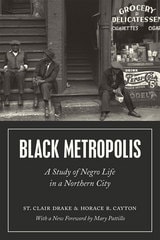
Black Metropolis
A Study of Negro Life in a Northern CitySt. Clair Drake and Horace R. Cayton
University of Chicago Press, 2015
Black Metropolis has been a foundational work for the study of race and urban life since its publication in 1945, and it remains indispensable today. Few studies since have been able to match its scope and magnitude, offering one of the most comprehensive looks at black life in America. Based on research conducted by Works Progress Administration field workers, it is a sweeping historical and sociological account of the people of Chicago's South Side from the 1840s through the 1930s. Its findings offer a comprehensive analysis of black migration, settlement, community structure, and black-white race relations in the first half of the twentieth century. It offers a dizzying and dynamic world filled with captivating people and startling revelations.
A new foreword from sociologist Mary Pattillo places the study in modern context, updating the story with the current state of black communities in Chicago and the larger United States and exploring what this means for the future. As the country continues to struggle with race and our treatment of black lives, Black Metropolis continues to be a powerful contribution to the conversation.

Black Minded
The Political Philosophy of Malcolm XMichael E. Sawyer
Pluto Press, 2020
Michael Sawyer argues that the foundational concepts of Malcolm X's political philosophy - economic and social justice, strident opposition to white supremacy and Black internationalism - are often obscured by an emphasis on biography. The text demonstrates the way in which Malcolm X's philosophy lies at the intersection of the thought of W.E.B. Du Bois and Frantz Fanon and is an integral part of the revolutionary politics formed to alleviate the plight of people of African descent globally.
Exploring themes of ontology, the body, geographic space and revolution, Black Minded provides a much-needed appraisal of Malcolm X's political philosophy.

Black Moods
Collected PoemsFrank Marshall Davis
University of Illinois Press, 2001
John Edgar Tidwell’s introduction examines both Davis’s poetry and his politics, presenting a subtle portrait of a complex writer devoted to exposing discriminatory practices and reaffirming the humanity of the common people.
Black Movements
Performance and Cultural PoliticsColbert, Soyica Diggs
Rutgers University Press, 2017
Black Movements analyzes how artists and activists of recent decades reference earlier freedom movements in order to imagine and produce a more expansive and inclusive democracy. The post–Jim Crow, post–apartheid, postcolonial era has ushered in a purportedly color blind society and along with it an assault on race-based forms of knowledge production and coalition formation. Soyica Diggs Colbert argues that in the late twentieth century race went “underground,” and by the twenty-first century race no longer functioned as an explicit marker of second-class citizenship.
The subterranean nature of race manifests itself in discussions of the Trayvon Martin shooting that focus on his hoodie, an object of clothing that anyone can choose to wear, rather than focusing on structural racism; in discussions of the epidemic proportions of incarcerated black and brown people that highlight the individual’s poor decision making rather than the criminalization of blackness; in evaluations of black independence struggles in the Caribbean and Africa that allege these movements have accomplished little more than creating a black ruling class that mirrors the politics of its former white counterpart. Black Movements intervenes in these discussions by highlighting the ways in which artists draw from the past to create coherence about blackness in present and future worlds.
Through an exploration of the way that black movements create circuits connecting people across space and time, Black Movements offers important interventions into performance, literary, diaspora, and African American studies.
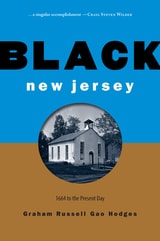
Black New Jersey
1664 to the Present DayGraham Russell Gao Hodges
Rutgers University Press, 2019
Black New Jersey tells the rich and complex story of the African American community’s remarkable accomplishments and the colossal obstacles they faced along the way. Drawing from rare archives, historian Graham Russell Gao Hodges brings to life the courageous black men and women who fought for their freedom and eventually built a sturdy and substantial middle class. He explores how the state’s unique mix of religious, artistic, and cultural traditions have helped to produce such world-renowned figures as Paul Robeson, Cory Booker, and Queen Latifah, as well as a host of lesser-known but equally influential New Jersey natives.
Black Paper
Writing in a Dark TimeTeju Cole
University of Chicago Press, 2021
“Darkness is not empty,” writes Teju Cole in Black Paper, a book that meditates on what it means to sustain our humanity—and witness the humanity of others—in a time of darkness. One of the most celebrated essayists of his generation, Cole here plays variations on the essay form, modeling ways to attend to experience—not just to take in but to think critically about what we sense and what we don’t.
Wide-ranging but thematically unified, the essays address ethical questions about what it means to be human and what it means to bear witness, recognizing how our individual present is informed by a collective past. Cole’s writings in Black Paper approach the fractured moment of our history through a constellation of interrelated concerns: confrontation with unsettling art, elegies both public and private, the defense of writing in a time of political upheaval, the role of the color black in the visual arts, the use of shadow in photography, and the links between literature and activism. Throughout, Cole gives us intriguing new ways of thinking about blackness and its numerous connotations. As he describes the carbon-copy process in his epilogue: “Writing on the top white sheet would transfer the carbon from the black paper onto the bottom white sheet. Black transported the meaning.”
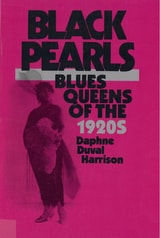
Black Pearls
Blues Queens of the 1920sDaphne Duval Harrison
Rutgers University Press, 1990
Blues music spawned legendary performers whose influence has been felt in many musical forms here and around the world. Until now the important role of the great women blues singers has largely gone unexplored. This book tells of the cultural and social impact of the blues during the 1920s when the genre was dominated by women, both on stage and on record. Harrison (Afro-American Studies Department, University of Maryland) writes with authority, focusing particularly on Sippie Wallace, Edith Wilson, Victoria Spivey, and Alberta Hunter as she analyzes the music and the collective black experience out of which it grew. A significant book, particularly for collections of music history, black studies, and women's studies. -- Library Journal
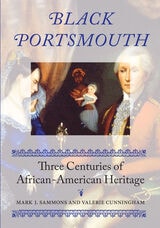
Black Portsmouth
Three Centuries of African-American HeritageMark J. Sammons
University of New Hampshire Press, 2004
Few people think of a rich Black heritage when they think of New England. In the pioneering book Black Portsmouth, Mark J. Sammons and Valerie Cunningham celebrate it, guiding the reader through more than three centuries of New England and Portsmouth social, political, economic, and cultural history as well as scores of personal and site-specific stories.
Here, we meet such Africans as the likely negro boys and girls from Gambia, who debarked at Portsmouth from a slave ship in 1758, and Prince Whipple, who fought in the American Revolution. We learn about their descendants, including the performer Richard Potter and John Tate of the People's Baptist Church, who overcame the tragedies and challenges of their ancestors' enslavement and subsequent marginalization to build communities and families, found institutions, and contribute to their city, region, state, and nation in many capacities. Individual entries speak to broader issues—the anti-slavery movement, American religion, and foodways, for example. We also learn about the extant historical sites important to Black Portsmouth—including the surprise revelation of an African burial ground in October 2003—as well as the extraordinary efforts being made to preserve remnants of the city's early Black heritage.
Black Post-Blackness
The Black Arts Movement and Twenty-First-Century AestheticsMargo Natalie Crawford
University of Illinois Press, 2017
Black Power Praxis
Theory, Practice, and Activist Intellectuals in Detroit's Black Power MovementMatt Birkhold
University of Michigan Press, 2026
Black Power Praxis shows how four groups of activist-intellectuals—James and Grace Lee Boggs, Richard and Milton Henry, Reverend Albert Cleage, and a group of college students called Uhuru—shifted the consciousness and political perspectives of Black Detroiters in the 1960s and 1970s. By developing theories that they could unite with community-organizing practices, these activist-intellectuals turned the focus of the grassroots movement for racial equality from Civil Rights to Black Power. Following the 1967 Detroit Rebellion, these Black Power activist-intellectuals were already positioned to harness the energy that emerged from the uprising and directed it into the city’s first citywide Black Power organization, the Citywide Citizens Action Committee.
Even as Black Power theories became dominant over Detroit’s grassroots movement, their influence faltered when they failed to develop community organizing practices corresponding to the lived experiences of Black Detroiters. Black Power Praxis reveals how the relationships between ideas, practices, leadership, material reality, and consciousness drove the historical development of Black Power. Ideal for readers curious about social movements, Detroit history, African American history, and African American Studies, the book sheds light on how, why, and when Detroit’s activist-intellectual leaders successfully showed everyday people how their power might be used in transformative ways.
Black Pulp
Genre Fiction in the Shadow of Jim CrowBrooks E. Hefner
University of Minnesota Press, 2021
A deep dive into mid-century African American newspapers, exploring how Black pulp fiction reassembled genre formulas in the service of racial justice
In recent years, Jordan Peele’s Get Out, Marvel’s Black Panther, and HBO’s Watchmen have been lauded for the innovative ways they repurpose genre conventions to criticize white supremacy, celebrate Black resistance, and imagine a more racially just world—important progressive messages widely spread precisely because they are packaged in popular genres. But it turns out, such generic retooling for antiracist purposes is nothing new.
As Brooks E. Hefner’s Black Pulp shows, this tradition of antiracist genre revision begins even earlier than recent studies of Black superhero comics of the 1960s have revealed. Hefner traces it back to a phenomenon that began in the 1920s, to serialized (and sometimes syndicated) genre stories written by Black authors in Black newspapers with large circulations among middle- and working-class Black readers. From the pages of the Pittsburgh Courier and the Baltimore Afro-American, Hefner recovers a rich archive of African American genre fiction from the 1920s through the mid-1950s—spanning everything from romance, hero-adventure, and crime stories to westerns and science fiction. Reading these stories, Hefner explores how their authors deployed, critiqued, and reassembled genre formulas—and the pleasures they offer to readers—in the service of racial justice: to criticize Jim Crow segregation, racial capitalism, and the sexual exploitation of Black women; to imagine successful interracial romance and collective sociopolitical progress; and to cheer Black agency, even retributive violence in the face of white supremacy.
These popular stories differ significantly from contemporaneous, now-canonized African American protest novels that tend to represent Jim Crow America as a deterministic machine and its Black inhabitants as doomed victims. Widely consumed but since forgotten, these genre stories—and Hefner’s incisive analysis of them—offer a more vibrant understanding of African American literary history.
Black Queer Flesh
Rejecting Subjectivity in the African American NovelAlvin J. Henry
University of Minnesota Press, 2021
A groundbreaking examination of how twentieth-century African American writers use queer characters to challenge and ultimately reject subjectivity
Black Queer Flesh reinterprets key African American novels from the Harlem Renaissance to Black Modernism to contemporary literature, showing how authors have imagined a new model of Black queer selfhood. African American authors blame liberal humanism’s model of subjectivity for double consciousness and find that liberal humanism’s celebration of individual autonomy and agency is a way of disciplining Black queer lives. These authors thus reject subjectivity in search of a new mode of the self that Alvin J. Henry names “Black queer flesh”—a model of selfhood that is collective, plural, fluctuating, and deeply connected to the Black queer past.
Henry begins with early twentieth-century authors such as Jessie Redmon Fauset and James Weldon Johnson. These authors adapted the Bildungsroman, the novel of self-formation, to show African Americans gaining freedom and agency by becoming a liberal, autonomous subjects. These authors, however, discovered that the promise of liberal autonomy held out by the Bildungsroman was yet another tool of antiblack racism. As a result, they tentatively experimented with repurposing the Bildungsroman to throw off subjectivity and its attendant double consciousness. In contrast, Nella Larsen, Henry shows, was the first author to fully reject subjectivity. In Quicksand and Passing, Larsen invented a new genre showing her queer characters—characters whose queerness already positioned them on the margins of subjectivity—escaping subjectivity altogether. Using Ralph Ellison’s archival drafts, Henry then powerfully rereads Invisible Man, revealing that the protagonist as a queer, disabled character taught by the novel’s many other queer, disabled characters to likewise seek a selfhood beyond subjectivity. Although Larsen and Ellison sketch glimpses of this selfhood beyond subjectivity, only Saidiya Hartman’s Wayward Lives, Beautiful Experiments shows a protagonist fully inhabiting Black queer flesh—a new mode of selfhood that is collective, plural, always evolving, and no longer alienated from the black past.
Black Queer Flesh is an original and necessary contribution to Black literary studies, offering new ways to understand and appreciate the canonical texts and far more.

Black Regions of the Imagination
African American Writers between the Nation and the WorldEve Dunbar
Temple University Press, 2012
Zora Neale Hurston, Richard Wright, James Baldwin, and Chester Himes were all pressured by critics and publishers to enlighten mainstream (white) audiences about race and African American culture. Focusing on fiction and non-fiction they produced between the Harlem Renaissance and the Black Arts Movement, Eve Dunbar’s important book, Black Regions of the Imagination, examines how these African American writers—who lived and traveled outside the United States—both document and re-imagine their “homegrown” racial experiences within a worldly framework.
From Hurston’s participant-observational accounts and Wright’s travel writing to Baldwin’s Another Country and Himes’ detective fiction, these writers helped develop the concept of a “region” of blackness that resists boundaries of genre and geography. Each writer represents—and signifies—blackness in new ways and within the larger context of the world. As they negotiated issues of “belonging,” these writers were more critical of social segregation in America as well as increasingly resistant to their expected roles as cultural “translators.”

Black Savannah, 1788–1864
Whittington Johnson
University of Arkansas Press, 1999
Fourth in the University of Arkansas Press series in Black Community Studies, this examination of the black community of Savannah, Georgia, during the antebellum and the Civil War periods is a groundbreaker. It begins in 1788 with the founding of Savannah’s first black public institution, an independent church, and closes in 1864 with Gen. William Tecumseh Sherman’s capture of Savannah and the subsequent end to slavery.
Using a wide range of primary sources, including the little-used Southern Claims Case Files, and a vast number of secondary sources, Whittington Johnson gracefully elucidates the most important features of slave and free African-American life in this period. Johnson maintains that, unlike Charleston and New Orleans, Savannah had a comparatively small population of free blacks, containing only a slim majority of mulattoes and few large property owners, a demographic that greatly affected the contours of the black class structure. Among the most interesting groups that created Savannah’s community were “nominal slaves,” slaves in name only, who lived apart from their masters, seeking and finding their own employment.
Black Savannah focuses upon efforts of African Americans, free and slave, who worked together to establish and maintain a variety of religious, social, and cultural institutions; to carve out niches in the larger economy; and to form cohesive families. The result was an autonomous black community in a key city of the Old South.
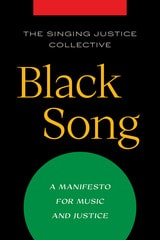
Black Song
A Manifesto for Music and JusticeThe Singing Justice Collective
University of Michigan Press, 2026
Black Song: A Manifesto for Music and Justice centers acts of musical creation and performance that emerge from Black experiences, affirm Black humanity, and connect to Black communities. Written for scholars, performers, and music fans, the book shows that learning about Black Song and its creation is central to understanding both American music and Black American experiences. By providing a more inclusive, just, and accurate understanding of the art of Black Song, the authors disrupt and expand musical canons.
Black Song shines a spotlight on the response, resistance, and community building that occur in musical creation in Black spaces, past and present. The authors explore histories and performances across musical styles—from classical to country to hip-hop to opera to jazz to gospel to many others. They offer practical advice on how to perform, research, teach, and listen to this music. As they center Black Song in American history and music, they show that this music is a valuable tool for promoting productive and healing dialogues about race, justice, and history. Encouraging empathy and understanding, Black Song shows how to approach Black music and spaces with knowledge and respect.
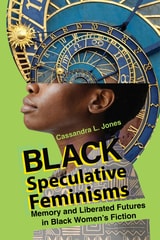
Black Speculative Feminisms
Memory and Liberated Futures in Black Women's FictionCassandra L. Jones
The Ohio State University Press, 2024
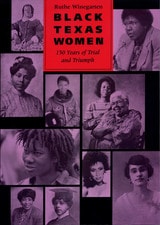
Black Texas Women
150 Years of Trial and TriumphBy Ruthe Winegarten, Janet G. Humphrey & Frieda Werden, consulting editors
University of Texas Press, 1994
Women of all colors have shaped families, communities, institutions, and societies throughout history, but only in recent decades have their contributions been widely recognized, described, and celebrated. This book presents the first comprehensive history of black Texas women, a previously neglected group whose 150 years of continued struggle and some successes against the oppression of racism and sexism deserve to be better known and understood.
Beginning with slave and free women of color during the Texas colonial period and concluding with contemporary women who serve in the Texas legislature and the United States Congress, Ruthe Winegarten organizes her history both chronologically and topically. Her narrative sparkles with the life stories of individual women and their contributions to the work force, education, religion, the club movement, community building, politics, civil rights, and culture. The product of extensive archival and oral research and illustrated with over 200 photographs, this groundbreaking work will be equally appealing to general readers and to scholars of women's history, black history, American studies, and Texas history.

Black Unhappiness
The Philosophy of W. E. B. Du BoisGrant Farred
Duke University Press, 2027
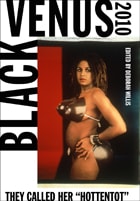
Black Venus 2010
They Called Her "Hottentot"Edited by Deborah Willis
Temple University Press, 2010
As a young South African woman of about twenty, Saartjie Baartman, the so-called “Hottentot Venus,” was brought to London and placed on exhibit in 1810. Clad in the Victorian equivalent of a body stocking, and paraded through the streets and on stage in a cage she became a human spectacle in London and Paris. Baartman’s distinctive physique became the object of ridicule, curiosity, scientific inquiry, and desire until and after her premature death. The figure of Sarah Baartman was reduced to her sexual parts.
Black Venus 2010 traces Baartman’s memory in our collective histories, as well as her symbolic history in the construction and identity of black women as artists, performers, and icons. The wide-ranging essays, poems, and images in Black Venus 2010 represent some of the most compelling responses to Baartman. Each one grapples with the enduring legacy of this young African woman who forever remains a touchstone for black women.
Contributors include: Elizabeth Alexander, Holly Bass, Petrushka A Bazin, William Jelani Cobb, Lisa Gail Collins, Renée Cox, J. Yolande Daniels, Carole Boyce Davies, Leon de Wailly, Manthia Diawara, Diana Ferrus, Cheryl Finley, Nikky Finney, Kianga K. Ford, Terri Francis, Sander Gilman, Renée Green, Joy Gregory, Lyle Ashton Harris, Michael D. Harris, Linda Susan Jackson, Kellie Jones, Roshini Kempadoo, Simone Leigh, Zine Magubane, E. Ethelbert Miller, Robin Mitchell, Charmaine Nelson, Tracey Rose, Radcliffe Roye, Bernadette Searle, Lorna Simpson, Debra S. Singer, Penny Siopis, Hank Willis Thomas, Kara Walker, Michele Wallace, Carla Williams, Carrie Mae Weems, J. T. Zealy, and the editor.
Black Visual Cultures of the Midwest
Freda L. Fair
University of Minnesota Press, 2027
Recentering black creativity and resistance in the history of the Midwest
African American creators have unsettled and upended racism in the Midwest region since as far back as 1787, and Black Visual Cultures of the Midwest examines the work of many such innovators, presenting an unruly, transgressive, and defiant vision of queer blackness that complicates fundamental American ideals of liberty, progress, life, and property.
Spanning the nineteenth century to the present, Freda L. Fair draws from a broad array of sources, including film, visual art, and even arrest records to examine concepts of freedom and resistance grounded in black cultural production in the Midwest. Through subjects such as Joshua Glover, who escaped slavery in Missouri and relocated to Wisconsin; sex workers in the Twin Cities; Ruth Ellis, a black lesbian elder in Detroit; and Nick Cave, who created Soundsuits in response to the police beating of Rodney King, Fair challenges monolithic formulations of blackness and black culture. Fair also queers Midwest history, engaging an LGBTQ lens to reexamine Wisconsin’s 1854 decision to declare the Fugitive Slave Act of 1850 unconstitutional, the Springfield Race Riot of 1908, and other historic moments.
Revealing how black visual cultures in the Midwest both illuminate black gendered and sexual difference and actively resist antiblackness, Fair shows that the region is a site that can advance freedom and social change.
Retail e-book files for this title are screen-reader friendly with images accompanied by short alt text and/or extended descriptions.
Black Wellness
Health Beyond OutcomesGerShun Avilez
University of Minnesota Press, 2027
Revealing how contemporary Black creatives explore personal and collective wellness within anti-Black societies
Black Wellness tracks how Black artists, writers, poets, and other cultural producers explore Black health as feeling good while attending to underlying physical and mental exhaustion resulting from racism, homophobia, and sexism. Considering depictions of and discourse about pain, HIV/AIDS, Covid-19, cancer, and diabetes, GerShun Avilez moves beyond pathologies of Black illness and the outcome-motivated medical field to delineate the nature of Black wellness as the basis for artistic experiments, envisioning manifold expressions of health.
Responding to the history and impact of racial health disparities, Avilez locates a complex interplay between pain and care, stigma and pleasure, self-management and blame, and isolation and contact. In Black Wellness, he delves into innovative literary writing and digital projects: poetry by Danez Smith, Claudia Rankine, and Bettina Judd; personal reflections by Zadie Smith, Audre Lorde, and Yohanes Godanna Gatiso; novels by Toni Cade Bambara and Masande Ntshanga; and video, theatrical, and multimedia projects by Faithe Daye, Seth E. Davis, and Robbie McCauley.
Reading and thinking across borders to analyze African diasporic artists originating from the United States, Jamaica, South Africa, Ethiopia, and the United Kingdom, Avilez highlights how interconnected histories of racialization, minoritization, and colonization contextualize the lived experiences of Black wellness and illness. By deemphasizing—but not discounting—health outcomes, Black Wellness argues that cultural acts of envisioning and communicating Black health are always double pronged, simultaneously attending to states of debility and vitality in Black bodies.
Retail e-book files for this title are screen-reader friendly.
Black Woman in Green
Gloria Brown and the Unmarked Trail to Forest Service LeadershipGloria D. Brown
Oregon State University Press, 2020
As scholars awaken to the racist history of public land management and the ways that people of color have been excluded from contemporary notions of nature and wilderness, Brown’s story provides valuable insight into the roles that African Americans have carved out in the outdoors generally and in the field of environmental policy and public lands management specifically. Drawing on her powerful communication and listening skills, her sense of humor, and her willingness to believe in the basic goodness of humanity, Brown conducted civil rights trainings and shattered glass ceilings, all while raising her children alone.
Written in an engaging and accessible style with historian Donna Sinclair, Brown’s story provides a fascinating case study for public administration and contributes to a deeper understanding of the environmental and civil rights movements of the twentieth century, particularly the role that racial discrimination has played in national forests, parks, and other wilderness spaces. It also highlights issues of representation in the federal government, women’s history, the history of the American West, and literature associated with African American experiences in predominately white societies.
Black Women Legacies
Public History Sites Seen and UnseenAlexandria Russell
University of Illinois Press, 2024
Intersectional and original, Black Women Legacies explores the memorialization of African American women and its distinctive impact on physical and cultural landscapes throughout the United States.
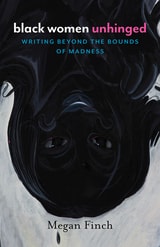
Black Women Unhinged
Writing Beyond the Bounds of MadnessMegan Finch
University of Minnesota Press, 2027
Rethinking the theoretical and political deployment of madness in the late twentieth century through the critical work of black women novelists
Black Women Unhinged revisits the “black women’s literary renaissance” to offer new terms at the intersection of gender, race, and madness before and beyond its crystallization into discourses of mental health and disability. Reconstructing the cultural zeitgeist of the 1960s–1980s, when madness emerged as a radical position in the work of Michel Foucault, Gilles Deleuze, Luce Irigaray, and David Cooper, and in the politics of feminists and Black Power activists, Black Women Unhinged reassesses black women’s overlooked contributions to this politics of madness. Megan Finch reads this renaissance’s catalogue of ostensibly mad literary characters—schizophrenic girls, infanticidal and drug-addicted mothers, castrating murderesses, and suicidal revolutionaries—beyond madness’s philosophical and political bounds.
Centering the relationship between Reason and the multiple forms of unReason central to modern politics, Finch traces the deployment of madness by the Black Power/Art’s movements and second-wave feminists to fortify black men’s and white women’s civic inclusion while dismissing black women’s politics as irremediable folly. Finch argues that black women’s novels of the period—including Toni Morrison’s The Bluest Eye and Beloved, Gayl Jones’s Corregidora and Eva’s Man, Toni Cade Bambara’s The Salt Eaters, and Nettie Jones’s Fish Tales—depict characters who exceed the category of madness and are unhinged from the curative politics of inclusion purchased through another’s abjection. Black Women Unhinged reckons with black women’s literary and theoretical contributions to the politics of madness and their attempts, past and present, to move beyond them to something akin to freedom.
Retail e-book files for this title are screen-reader friendly.
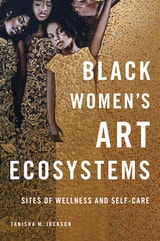
Black Women's Art Ecosystems
Sites of Wellness and Self-CareTanisha M. Jackson
University of Illinois Press, 2025

Black Women’s Health in the Age of Hip Hop and HIV/AIDS
A Narrative RemixNghana tamu Lewis
The Ohio State University Press, 2025
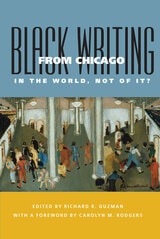
Black Writing from Chicago
In the World, Not of It?Edited by Richard R. Guzman. Foreword by Carolyn M. Rodgers
Southern Illinois University Press, 2006
Black Writing from Chicago: In the World, Not of It? takes readers on a cultural trip through Chicago’s literary history. Editor Richard R. Guzman compiles the first comprehensive collection of the works of Chicago’s black writers from 1861 to the present day. The anthology, which includes works from newspaper writing, poetry, fiction, drama, essays, and historical and social commentary, seeks not only to represent a broad range of writings but also to focus tightly on such themes as hope and despair, racism and equality, spirituality and religion. More than sixty writers, from the anonymous “J. W. M. (Colored)” to Ken Green, unfold a story that reflects the literary periods in black American history. Each author’s selection is preceded by a biographical and a bibliographical introduction. Readers interested in Chicago, race relations, and literature, as well as scholars of history, sociology, urban studies, and cultural studies, will find the collection invaluable.

Black Yankees
The Development of an Afro-American Subculture in Eighteenth-Century New EnglandWilliam D. Piersen
University of Massachusetts Press, 1988
On the face of it, the master class called the tunes and slaves danced the beat. Blacks who were taken into New England's bondage were clearly engulfed in a pervasive, narrow-minded Euro-American society that had no interest in fostering Afro-American autonomy. The New England experience was often cruel, and the numbers alone suggest it was among the most unequal of black/white cultural contacts in the New World. Nonetheless, despite the strictures of bondage, the black Yankees of eighteenth-century New England created a sustaining folk culture of their own.

Black and Blur
Fred Moten
Duke University Press, 2017
In Black and Blur—the first volume in his sublime and compelling trilogy consent not to be a single being—Fred Moten engages in a capacious consideration of the place and force of blackness in African diaspora arts, politics, and life. In these interrelated essays, Moten attends to entanglement, the blurring of borders, and other practices that trouble notions of self-determination and sovereignty within political and aesthetic realms. Black and Blur is marked by unlikely juxtapositions: Althusser informs analyses of rappers Pras and Ol' Dirty Bastard; Shakespeare encounters Stokely Carmichael; thinkers like Kant, Adorno, and José Esteban Muñoz and artists and musicians including Thornton Dial and Cecil Taylor play off each other. Moten holds that blackness encompasses a range of social, aesthetic, and theoretical insurgencies that respond to a shared modernity founded upon the sociological catastrophe of the transatlantic slave trade and settler colonialism. In so doing, he unsettles normative ways of reading, hearing, and seeing, thereby reordering the senses to create new means of knowing.
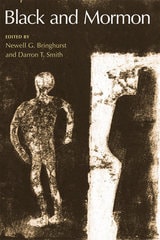
Black and Mormon
Edited by Newell G. Bringhurst and Darron T. Smith
University of Illinois Press, 2004
This challenging collection is required reading for anyone concerned with the history of racism, discrimination, and the Latter-day Saints.

Black and White Strangers
Race and American Literary RealismKenneth W. Warren
University of Chicago Press, 1993
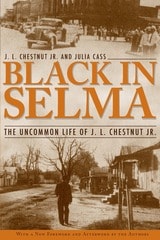
Black in Selma
The Uncommon Life of J. L. Chestnut Jr.J. L. Chestnut
University of Alabama Press, 2007
One man’s fight for justice. One town’s reckoning with history.
Born in Selma in 1930, J. L. Chestnut left home to study law at Howard University in Washington, DC. Returning to Selma, Chestnut was the town’s first and only African American attorney in the late 1950s. As the turbulent struggle for civil rights spread across the South, Chestnut became an active and ardent promoter of social and legal equality in his hometown. A key player on the local and state fronts, Chestnut accrued deep insights into the racial tensions in his community and deftly opened paths toward a more equitable future.
Though intimately involved in many events that took place in Selma, Chestnut was nevertheless often identified in history books simply as “a local attorney.” Black in Selma reveals his powerful yet little-known story.
In the 2014 film Selma, director Ava DuVernay takes audiences to the climactic confrontation between civil rights advocates and the state’s security forces of March 1965. Readers looking for a deeper understanding of the events that preceded that epic moment, as well as how racial integration unfolded in Selma in the decades that followed, will find Chestnut’s story and memories both a vital primary source and an inspiration.

Black in White Space
The Enduring Impact of Color in Everyday LifeElijah Anderson
University of Chicago Press, 2021
A birder strolling in Central Park. A college student lounging on a university quad. Two men sitting in a coffee shop. Perfectly ordinary actions in ordinary settings—and yet, they sparked jarring and inflammatory responses that involved the police and attracted national media coverage. Why? In essence, Elijah Anderson would argue, because these were Black people existing in white spaces.
In Black in White Space, Anderson brings his immense knowledge and ethnography to bear in this timely study of the racial barriers that are still firmly entrenched in our society at every class level. He focuses in on symbolic racism, a new form of racism in America caused by the stubbornly powerful stereotype of the ghetto embedded in the white imagination, which subconsciously connects all Black people with crime and poverty regardless of their social or economic position. White people typically avoid Black space, but Black people are required to navigate the “white space” as a condition of their existence. From Philadelphia street-corner conversations to Anderson’s own morning jogs through a Cape Cod vacation town, he probes a wealth of experiences to shed new light on how symbolic racism makes all Black people uniquely vulnerable to implicit bias in police stops and racial discrimination in our country.
An unwavering truthteller in our national conversation on race, Anderson has shared intimate and sharp insights into Black life for decades. Vital and eye-opening, Black in White Space will be a must-read for anyone hoping to understand the lived realities of Black people and the structural underpinnings of racism in America.
Black, Brown, & Beige
Surrealist Writings from Africa and the DiasporaEdited by Franklin Rosemont and Robin D.G. Kelley
University of Texas Press, 2009
Surrealism as a movement has always resisted the efforts of critics to confine it to any static definition—surrealists themselves have always preferred to speak of it in terms of dynamics, dialectics, goals, and struggles. Accordingly, surrealist groups have always encouraged and exemplified the widest diversity—from its start the movement was emphatically opposed to racism and colonialism, and it embraced thinkers from every race and nation.
Yet in the vast critical literature on surrealism, all but a few black poets have been invisible. Academic histories and anthologies typically, but very wrongly, persist in conveying surrealism as an all-white movement, like other "artistic schools" of European origin. In glaring contrast, the many publications of the international surrealist movement have regularly featured texts and reproductions of works by comrades from Martinique, Haiti, Cuba, Puerto Rico, South America, the United States, and other lands. Some of these publications are readily available to researchers; others are not, and a few fall outside academia's narrow definition of surrealism.
This collection is the first to document the extensive participation of people of African descent in the international surrealist movement over the past seventy-five years. Editors Franklin Rosemont and Robin D. G. Kelley aim to introduce readers to the black, brown, and beige surrealists of the world—to provide sketches of their overlooked lives and deeds as well as their important place in history, especially the history of surrealism.
Black, White, and in Color
Essays on American Literature and CultureHortense J. Spillers
University of Chicago Press, 2003
Black, White, and in Color offers a long-awaited collection of major essays by Hortense Spillers, one of the most influential and inspiring black critics of the past twenty years. Spanning her work from the early 1980s, in which she pioneered a broadly poststructuralist approach to African American literature, and extending through her turn to cultural studies in the 1990s, these essays display her passionate commitment to reading as a fundamentally political act-one pivotal to rewriting the humanist project.
Spillers is best known for her race-centered revision of psychoanalytic theory and for her subtle account of the relationships between race and gender. She has also given literary criticism some of its most powerful readings of individual authors, represented here in seminal essays on Ralph Ellison, Gwendolyn Brooks, and William Faulkner. Ultimately, the essays collected in Black, White, and in Color all share Spillers's signature style: heady, eclectic, and astonishingly productive of new ideas. Anyone interested in African American culture and literature will want to read them.

Blessed Are the Peacemakers
PoemsBrionne Janae
Northwestern University Press, 2022
Winner of the 2020 Cave Canem Northwestern University Press Poetry Prize
At once interested in the cyclical nature of domestic dysfunction and what we do when secrets of buried harm come to light, Blessed Are the Peacemakers asks what it means to make peace in the wake of intrafamilial violence and child sexual assault. These poems explore the ways the truth is often hidden behind layers of bleach and shame, and the ways we fail survivors by dismissing their stories and tolerating their abusers.
Filled with elegies to the people who have been murdered by state violence, racism, and anti-Blackness in the United States, Blessed Are the Peacemakers interrogates the lengths and limitations of grace. Brionne Janae examines what it means to survive—particularly as a Black girl, woman, queer person, or human—and uses self-portraiture to explore how familial and communal trauma plague our mental health. How do we survive the grief of the past and present without becoming numb to or consumed by it? How do we remember, despite our pain, to enjoy our bodies and our lives while we still have them?
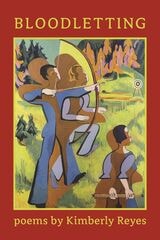
Bloodletting
Kimberly Reyes
Omnidawn, 2025
This is a collection of poems about how we find and cultivate love amid wars, including wars that often go ignored. Throughout Bloodletting, Kimberly Reyes considers how we define love and who gets to experience it, paying special attention to the ways that race and sex influence how we are perceived and valued by society. Through the voice of a Black woman coming to terms with her own perspectives on relationship-building, Reyes shows the damage that contemporary culture can do to women, and Black women in particular. Resisting passivity, Reyes’s poetry cuts through pervasive doom scrolling, virtue signaling, and parasocial relationships, inviting readers to remember what care is really supposed to feel like.

Blue Futures, Break Open
A NovelZoë Gadegbeku
West Virginia University Press, 2025
2026 IPPY Awards Gold Medal Winner, Visionary/New Age Fiction
Blue Basin Island is the final resting spot of formerly enslaved Africans whose souls have flown from Earth—not to heaven or purgatory but toward freedom and a new life. Lucille, the island’s seamstress, takes two forms. She lives among the inhabitants in human form and, along with the evil-repelling blue of the houses, her divine form protects people from the violence of the their former lives. Yet, even there, outside of time, the souls are not totally insulated from the world in which they were enslaved. Each time a Black person anywhere is harmed, a piece of Blue Basin disintegrates: an earthquake leaves hundreds of thousands dead, and bricks crumble on the island; when police kill a Black child asleep in her bed, the blue paint on homes throughout the island drips and then runs from the walls. Lucille must hold the island together, but she struggles to juggle the responsibility of ensuring everyone’s safety while also seeking and losing her own private love. Grounding the story in African folklore and dipping into the rich literary tradition around African people with the power of flight, Zoë Gadegbeku visualizes the destination at the end of the flight and the new life that awaits them.

Blues in the Blood
Julien Delmaire
Seagull Books, 2023
Blues in the Blood is an ode to the spring of 1932 in the Mississippi delta, when stifling heat crushed the countryside and threatened the harvest, pervasive injustice ruled the day, and ghostly riders of the Ku Klux Klan spread terror. A panoramic historical and musical portrait, Blues in the Blood follows a poor young Black couple who believe their love for each other will save them from this devastation. Julien Delmaire introduces us to a gallery of figures: Blacks, Whites, Native Americans, mulattos, landowners, itinerant bluesmen, preachers, witches, corrupt politicians, prisoners, bootleggers, and Legba, the voodoo god, “master of crossroads,” who, like an otherworldly detective, watches over people’s destinies. As the story unfolds, a world is reborn: the delta, the birthplace of the blues, in which oppressed women and men rediscover the voices and rhythms of their humanity.

Blues, Ideology, and Afro-American Literature
A Vernacular TheoryHouston A. Baker Jr.
University of Chicago Press, 1987
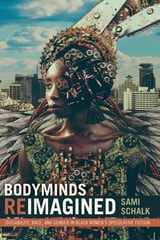
Bodyminds Reimagined
(Dis)ability, Race, and Gender in Black Women's Speculative FictionSami Schalk
Duke University Press, 2018
Booker T. Washington Papers Volume 1
The Autobiographical WritingsBooker T. Washington
University of Illinois Press, 1972
Volume 1 contains Washington's Up from Slavery, one of the most widely read American autobiographies, in addition to The Story of My Life and Work, and six other autobiographical writings. Together, the selections provide readers with a first step toward understanding Washington and his immense impact. These writings reveal the moral values he absorbed from his mid-nineteenth-century experiences and teachers. As importantly, they present him to the world as he wished to be seen: as the black version of the American success hero and an exemplar of the Puritan work ethic that he believed to be the secret of his success. These works, along with so much of Washington's writing, served as a model for many black Americans striving to overcome poverty and prejudice.
Booker T. Washington Papers Volume 3
1889-95. Assistant editors, Stuart B. Kaufman and Raymond W. SmockBooker T. Washington. Edited by Louis R. Harlan, Assistant editors, Stuart B. Kaufman and Raymond W. Smock
University of Illinois Press, 1974
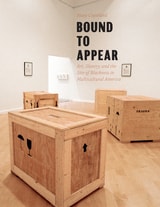
Bound to Appear
Art, Slavery, and the Site of Blackness in Multicultural AmericaHuey Copeland
University of Chicago Press, 2013
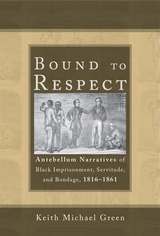
Bound to Respect
Antebellum Narratives of Black Imprisonment, Servitude, and Bondage, 1816–1861Keith Michael Green
University of Alabama Press, 2015
WINNER OF THE ELIZABETH AGEE PRIZE IN AMERICAN LITERATURE
Challenges the commonplace narrative that the African American experience of captivity in the United States is reducible to the legal institution of slavery, a status remedied through emancipation
In Bound to Respect: Antebellum Narratives of Black Imprisonment, Servitude, and Bondage, 1816–1861, Keith Michael Green examines key texts that illuminate forms of black bondage and captivity that existed within and alongside slavery. In doing so, he restores to antebellum African American autobiographical writing the fascinating heterogeneity lost if the historical experiences of African Americans are attributed to slavery alone.
The book’s title is taken from the assertion by US Supreme Court chief justice Roger B. Taney in his 1857 Dred Scott decision that blacks had no rights that whites were “bound to respect.” This allusion highlights Green’s critical assertion that the dehumanizing absurdities to which defenders of slavery resorted to justify slavery only brought into more stark relief the humanity of African Americans.
A gifted storyteller, Green examines four forms of captivity: incarceration, enslavement to Native Americans, child indentured servitude, and maritime capture. By illuminating this dense penumbra of captivity beyond the strict definitions of slavery, he presents a fluid and holistic network of images, vocabulary, narratives, and history. By demonstrating how these additional forms of confinement flourished in the era of slavery, Green shows how they persisted beyond emancipation, in such a way that freed slaves did not in fact partake of “freedom” as white Americans understood it. This gap in understanding continues to bedevil contemporary American society, and Green deftly draws persuasive connections between past and present.
A vital and convincing offering to readers of literary criticism, African American studies, and American history, Green’s Bound to Respect brings fresh and nuanced insights to this fundamental chapter in the American story.
Brave Humanism
Black Women Rewriting the Human in the Age of Jane CrowMollie Godfrey
The Ohio State University Press, 2025
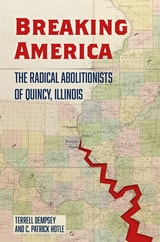
Breaking America
The Radical Abolitionists of Quincy, IllinoisTerrell Dempsey
University of Missouri Press, 2026
In this engaging new work, Terrell Dempsey and Patrick Hotle draw from newly discovered and underutilized primary sources to craft a detailed narrative history of the rise of a group of radical abolitionists in Quincy, Illinois, and the outsized, if mostly overlooked, influence they had on the dissolution of the Union.
The story begins with the 1830 arrival in Marion County, Missouri, of Dr. David Nelson, a Presbyterian minister and supporter of the American Colonization Society. After hearing a speech by Theodore B. Weld, Nelson was converted to the abolitionist cause and went on to recruit Elijah Lovejoy into the region’s nascent anti-slavery movement. Nelson’s activities resulted in the creation of an active anti-abolitionist organization in Northeast Missouri that ended up running him out of the state and across the river to Quincy, Illinois, at the same time Lovejoy sought shelter in Alton, Illinois.
In Quincy, Nelson and a group of like-minded moderate anti-slavery activists opened a manual labor school called the Mission Institute. Following the murder of Lovejoy by a pro-slavery mob, a small band of abolitionists at the Mission Institute became radicalized and decided to aid enslaved people in their quest for freedom. After three of these abolitionists were captured in Missouri and sentenced to twelve years in prison, others at the Mission Institute published a call for the Illinois Anti-Slavery Society to organize an underground railroad in Illinois. The Society officially committed to assisting enslaved people to escape slavery in May of 1842, which triggered a hostile reaction from enslavers in Missouri who went on to organize patrols, seek stricter state laws, and attempt to sabotage the underground railroad in neighboring Illinois.
In Breaking America, Dempsey and Hotle demonstrate the impact of the Quincy abolitionists on the later Dred Scott cases. The authors trace a sequence of revivals, public meetings, daring escapes, over-reactions, judicial decisions, and violence, providing a roadmap for how Missouri judicial opinion changed from “once free, always free” to “once a slave, always a slave” under Missouri Law. Breaking America is an important new addition to the history of abolitionism, the Dred Scott decision, and the eventual dissolution of the Union.
Breaking the World
Black Insecurity and the Horizons of Speculative FictionJustin L. Mann
Duke University Press, 2026