Results by title
3071 books match the query 'Business & Economics' and 122 start with b
Beyond the Typewriter
Gender, Class, and the Origins of Modern American Office Work, 1900-1930Sharon Hartman Strom
University of Illinois Press, 1992
Beyond the World Bank Agenda
An Institutional Approach to DevelopmentHoward Stein
University of Chicago Press, 2008
Drawing on the examples of Africa, Asia, Latin America, and transitional European economies, this revolutionary volume proposes an alternative vision of institutional development with chapter-length applications to finance, state formation, and health care to provide a holistic, contextualized solution to the problems of developing nations. Beyond the World Bank Agenda will be essential reading for anyone concerned with forging a new strategy for sustainable development.

Big Box USA
The Environmental Impact of America’s Biggest Retail StoresBart Elmore
University of Wyoming Press, 2023
The rise of big box retail since the 1960s has transformed environments on both local and global scales. Almost everyone has explored the aisles of big box stores. The allure of “everyday low prices” and brightly colored products of every kind connect shoppers with a global marketplace. Contributors join a growing conversation between business and environmental history, addressing the ways American retail institutions have affected physical and cultural ecologies around the world. Essays on Walmart, Target, Cabela’s, REI, and Bass Pro Shops assess the “bigness” of these superstores from “smokestacks to coat racks” and contend that their ecological impacts are not limited to the footprints of parking lots and manufacturing but also play a didactic role in educating consumers about their relationships with the environment.
A model for historians seeking to bring business and environmental histories together in their analyses of merchant capital’s role in the landscapes of everyday life and how it has remade human relationships with nature, Big Box USA is a must-read for students and scholars of the environment, business, sustainability, retail professionals, and a general audience.
Big Data for Twenty-First-Century Economic Statistics
Edited by Katharine G. Abraham, Ron S. Jarmin, Brian C. Moyer, and Matthew D. Shapiro
University of Chicago Press, 2022
The existing infrastructure for the production of key economic statistics relies heavily on data collected through sample surveys and periodic censuses, together with administrative records generated in connection with tax administration. The increasing difficulty of obtaining survey and census responses threatens the viability of existing data collection approaches. The growing availability of new sources of Big Data—such as scanner data on purchases, credit card transaction records, payroll information, and prices of various goods scraped from the websites of online sellers—has changed the data landscape. These new sources of data hold the promise of allowing the statistical agencies to produce more accurate, more disaggregated, and more timely economic data to meet the needs of policymakers and other data users. This volume documents progress made toward that goal and the challenges to be overcome to realize the full potential of Big Data in the production of economic statistics. It describes the deployment of Big Data to solve both existing and novel challenges in economic measurement, and it will be of interest to statistical agency staff, academic researchers, and serious users of economic statistics.

Big Med
Megaproviders and the High Cost of Health Care in AmericaDavid Dranove and Lawton Robert Burns
University of Chicago Press, 2021
Drawing on decades of combined expertise in health care consolidation, Dranove and Burns trace Big Med’s emergence in the 1990s, followed by its swift rise amid false promises of scale economies and organizational collaboration. In the decades since, megaproviders have gobbled up market share and turned independent physicians into salaried employees of big bureaucracies, while delivering on none of their early promises. For patients this means higher costs and lesser care. Meanwhile, physicians report increasingly low morale, making it all but impossible for most systems to implement meaningful reforms.
In Big Med, Dranove and Burns combine their respective skills in economics and management to provide a nuanced explanation of how the provision of health care has been corrupted and submerged under consolidation. They offer practical recommendations for improving competition policies that would reform megaproviders to actually achieve the efficiencies and quality improvements they have long promised.
This is an essential read for understanding the current state of the health care system in America—and the steps urgently needed to create an environment of better care for all of us.

Big Med
Megaproviders and the High Cost of Health Care in AmericaDavid Dranove and Lawton Robert Burns
University of Chicago Press, 2021
This is an auto-narrated audiobook edition of this book.
There is little debate that health care in the United States is in need of reform. But where should those improvements begin? With insurers? Drug makers? The doctors themselves? In Big Med, David Dranove and Lawton Robert Burns argue that we’re overlooking the most ubiquitous cause of our costly and underperforming system: megaproviders, the expansive health care organizations that have become the face of American medicine. Your local hospital is likely part of one. Your doctors, too. And the megaproviders are bad news for your health and your wallet.
Drawing on decades of combined expertise in health care consolidation, Dranove and Burns trace Big Med’s emergence in the 1990s, followed by its swift rise amid false promises of scale economies and organizational collaboration. In the decades since, megaproviders have gobbled up market share and turned independent physicians into salaried employees of big bureaucracies, while delivering on none of their early promises. For patients this means higher costs and lesser care. Meanwhile, physicians report increasingly low morale, making it all but impossible for most systems to implement meaningful reforms.
In Big Med, Dranove and Burns combine their respective skills in economics and management to provide a nuanced explanation of how the provision of health care has been corrupted and submerged under consolidation. They offer practical recommendations for improving competition policies that would reform megaproviders to actually achieve the efficiencies and quality improvements they have long promised.
This is an essential read for understanding the current state of the health care system in America—and the steps urgently needed to create an environment of better care for all of us.

Big Oil Playground, Russian Bear Preserve or European Periphery?
The Russian Barents Sea Region towards 2015Bjørn Brunstad, Eivind Magnus, Philip Swanson, Geir Hønneland, and Indra Øverlan
Eburon Academic Publishers, 2005
The volume considers whether the international energy industry will transform Barents into a "big oil playground," if environmental protection rules will make it a "Russian bear preserve," or if integration into world trade will put it on the "European periphery." The result is a valuable resource for understanding the changing dynamics and challenges in modern public planning and a globalized economy.
Big Structures, Large Processes, Huge Comparisons
Charles Tilly
Russell Sage Foundation, 1984
BigLaw
Money and Meaning in the Modern Law FirmMitt Regan and Lisa H. Rohrer
University of Chicago Press, 2021

Bill Giles and Baseball
John B Lord
Temple University Press, 2014
Bill Giles oversaw one of the greatest eras of winning that the Philadelphia Phillies ever enjoyed. In Bill Giles and Baseball, John Lord chronicles Giles' remarkable career--which includes 44 years with the Phillies--to provide an insider's view of the business of the sport, which takes place off the field.
Based on extensive interviews, Bill Giles and Baseball spans Giles' life from his childhood growing up in the game to the tumultuous years he spent as the president and managing partner of the Phillies. Purchasing the team in 1981, when baseball experienced its first serious labor stoppages, Giles also watched baseball add franchises, grapple with franchise fees, realign the leagues, and restructure baseball's postseason. Yet Giles, the public face of the Phillies championship teams of 1980, 1983, and 1993, is best remembered for his critical role in creating innovative TV deals, and leading the efforts to build the Phillies' beautiful new ballpark.
A book about the business of baseball as seen through the eyes of one of the architects of the game, Bill Giles and Baseball captures the spectacle of the sport through fascinating behind-the-scenes stories of our national pastime.
Billionaires and Stealth Politics
Benjamin I. Page, Jason Seawright, and Matthew J. Lacombe
University of Chicago Press, 2018
Page, Seawright, and Lacombe argue that while political contributions offer a window onto billionaires’ influence, especially on economic policy, they do not present a full picture of policy preferences and political actions. That is because on some of the most important issues, including taxation, immigration, and Social Security, billionaires have chosen to engage in “stealth politics.” They try hard to influence public policy, making large contributions to political parties and policy-focused causes, leading policy-advocacy organizations, holding political fundraisers, and bundling others’ contributions—all while rarely talking about public policy to the media. This means that their influence is not only unequal but also largely unaccountable to and unchallengeable by the American people. Stealth politics makes it difficult for ordinary citizens to know what billionaires are doing or mobilize against it. The book closes with remedies citizens can pursue if they wish to make wealthy Americans more politically accountable, such as public financing of political campaigns and easier voting procedures, and notes the broader types of reforms, such as a more progressive income tax system, that would be needed to increase political equality and reinvigorate majoritarian democracy in the United States.

Biocapital
The Constitution of Postgenomic LifeKaushik Sunder Rajan
Duke University Press, 2006
Sunder Rajan’s ethnography informs his theoretically sophisticated inquiry into how the contemporary world is shaped by the marriage of biotechnology and market forces, by what he calls technoscientific capitalism. Bringing Marxian theories of value into conversation with Foucaultian notions of biopolitics, he traces how the life sciences came to be significant producers of both economic and epistemic value in the late twentieth century and early twenty-first.

Birth and Fortune
The Impact of Numbers on Personal WelfareRichard A. Easterlin
University of Chicago Press, 1987
"[Easterlin] has made clear, I think unambiguously, that the baby-boom generation is economically underprivileged merely because of its size. And in showing this, he demonstrates that population size can be as restrictive as a factor as sex, race, or class on equality of opportunity in the U.S."—Jeffrey Madrick, Business Week
Birth of Hegemony
Crisis, Financial Revolution, and Emerging Global NetworksAndrew C. Sobel
University of Chicago Press, 2012
Black Business in the New South
A Social History of the NC Mutual Life Insurance CompanyWalter B. Weare
Duke University Press, 1993
Black Entrepreneurs in America
Stories of Struggle and SuccessMichael D Woodard
Rutgers University Press, 1996
Black Star
African American Activism in the International Political EconomyRamla M. Bandele
University of Illinois Press, 2007
This book describes how the first African American mass political organization was able to gain support from throughout the African diaspora to finance the Black Star Line, a black merchant marine that would form the basis of an enclave economy after World War I. Ramla M. Bandele explores the concept of diaspora itself and how it has been applied to the study of émigré and other ethnic networks.
In characterizing the historical and political context of the Black Star Line, Bandele analyzes the international political economy during 1919-25 and considers the black politics of the era, focusing particularly on Marcus Garvey's Universal Negro Improvement Association for its creation of the Black Star Line. She offers an in-depth case study of the Black Star Line as an instance of the African diaspora attempting to link communities and carry out a transnational political and economic project. Arguing that ethnic networks can be legitimate actors in international politics and economics, Bandele also suggests, however, that activists in any given diaspora do not always function as a unit.
Blaming Teachers
Professionalization Policies and the Failure of Reform in American HistoryDiana D'Amico Pawlewicz
Rutgers University Press, 2020
Historically, Americans of all stripes have concurred that teachers were essential to the success of the public schools and nation. However, they have also concurred that public school teachers were to blame for the failures of the schools and identified professionalization as a panacea.
In Blaming Teachers, Diana D'Amico Pawlewicz reveals that historical professionalization reforms subverted public school teachers’ professional legitimacy. Superficially, professionalism connotes authority, expertise, and status. Professionalization for teachers never unfolded this way; rather, it was a policy process fueled by blame where others identified teachers’ shortcomings. Policymakers, school leaders, and others understood professionalization measures for teachers as efficient ways to bolster the growing bureaucratic order of the public schools through regulation and standardization. Beginning in the mid-nineteenth century with the rise of municipal public school systems and reaching into the 1980s, Blaming Teachers traces the history of professionalization policies and the discourses of blame that sustained them.

Bleakonomics
A Heartwarming Introduction to Financial Catastrophe, the Jobs Crisis and Environmental DestructionRob Larson
Pluto Press, 2012
Written for anyone who is wondering how we’ve come to this point, Rob Larson holds mainstream economic theory up against the grim reality of a planet in meltdown. He looks at scientists’ conclusions about climate change, the business world’s opinions about its own power, and reveals the fingerprints of finance on American elections.
With a unique and engaging approach to each crucial subject, students, academics and activists will find a lot to appreciate in this quiet call-to-arms for a saner and more stable world.
Blockade Runners of the Confederacy
Hamilton Cochran
University of Alabama Press, 2004
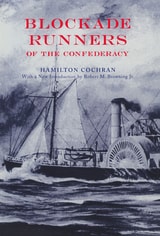
An authoritative account of blockade running in Civil War history.
Within four weeks of the fall of Fort Sumter, President Abraham Lincoln had declared a blockade of over four thousand miles of Confederate coastline, from Cape Henry in Virginia to the Mexican border. In response, professional runners, lured by both profits and patriotism, built faster, sleeker, low-profile ships and piloted them through the ever-thickening Northern cordon. The tonnage they imported, including items ranging from straight pins to marine engines, sustained the South throughout the conflict. This exciting chronicle of the men and ships that ran federal naval blockades during the Civil War also provides an overall assessment of the blockades conception, effectiveness, and impact on the Southern populace.

Blockchain Foundations
For the Internet of ValueMary C. Lacity
Epic Books, 2020

Blood on Their Hands
How Greedy Companies, Inept Bureaucracy, and Bad Science Killed Thousands of HemophiliacsWeinberg, Eric
Rutgers University Press, 2017
Blood on Their Hands is an inspiring, firsthand account of the legal battles fought on behalf of hemophiliacs who were unwittingly infected with tainted blood. As part of the team behind the key class action litigation filed by the infected, young New Jersey lawyer Eric Weinberg was faced with a daunting task: to prove the negligence of a powerful, well-connected global industry worth billions. Weinberg and journalist Donna Shaw tell the dramatic story of how idealistic attorneys and their heroic, mortally-ill clients fought to achieve justice and prevent further infections. A stunning exposé of one of the American medical system’s most shameful debacles, Blood on Their Hands is a rousing reminder that, through perseverance, the victims of corporate greed can sometimes achieve great victory.
Blood, Sweat, and Fear
Violence at Work in the North American Auto Industry, 1960-80Jeremy Milloy
University of Illinois Press, 2017
Explosive and original, Blood, Sweat, and Fear brings historical perspective to contemporary debates about North American workplace violence.

Blue Shadows Farm
A NovelJerry Apps
University of Wisconsin Press, 2009
Silas Starkweather, a Civil War veteran, is drawn to Wisconsin and homesteads 160 acres in Ames County, where he is known as the mysterious farmer forever digging holes. After years of hardship and toil, however, Silas develops a commitment to farming his land and respect for his new community. When Silas’s son Abe inherits Blue Shadows Farm he chooses to keep the land out of reluctant necessity, distilling and distributing “purified corn water” throughout Prohibition and the Great Depression in order to stay solvent. Abe’s daughter, Emma, willingly takes over the farm after her mother’s death. Emma’s love for this place inspires her to open the farm to school-children and families who share her respect for it. As she considers selling the land, Emma is confronted with a difficult question—who, through thick and thin, will care for Blue Shadows Farm as her family has done for over a century? In the midst of a controversy that disrupts the entire community, Emma looks into her family’s past to help her make crucial decisions about the future of its land.
Through the story of the Starkweather family’s changing fortunes, and each generation’s very different relationship with the farm and the land, Blue Shadows Farm is in some ways the narrative of all farmers and the increasingly difficult challenges they face as committed stewards of the land.

Blue Skies
A History of Cable TelevisionPatrick R. Parsons
Temple University Press, 2008
Since the 1960s, one of the pervasive visions of "cable" has been of a ubiquitous, flexible, interactive communications system capable of providing news, information, entertainment, diverse local programming, and even social services. That set of utopian hopes became known as the "Blue Sky" vision of cable television, from which the book takes its title.
Thoroughly documented and carefully researched, yet lively, occasionally humorous, and consistently insightful, Blue Skies is the genealogy of our media society.
Boggs
A Comedy of ValuesLawrence Weschler
University of Chicago Press, 1999
"Lawrence Weschler, who evidently admires [Boggs]-something not difficult to do-has written what may be the most extraordinary biography imaginable: "weird," to use a favourite Boggs word. It does something towards changing our entire outlook on money and its uses. And the reader is left with an uneasy feeling that anything in this world can be created by drawing it." —Ruth Rendell, Daily Telegraph
"As ideal a subject matter as money is for Boggs' genius, Boggs is as ideal a topic for Weschler's considerable talents. . . . A writer any less lucid than Weschler would smudge the lines, making of Boggs a counterculture caricature or a high-art huckster. And a writer any less confident would knock the balance, making academic mud pies of Boggs' enlightened chaos." —Jonathon Keats, San Francisco Chronicle Book Review
"[A] witty and engaging chronicle. . . . Weschler's fascinating account of the artist as agent provocateur demonstrates both the significance of Boggs's art and his determination to continue his unusual critique of the idea of money." —Henry Wessells, Washington Post Book World
"[A] witty, excellently written account of a bizarre and fascinating snippet of modern life." —Paul Ormerod, Times Higher Education Supplement
"The book, like the artist, challenges people to pause and consider the extent to which the economic bedrock of everyday life is in part a confusing welter of artistic abstractions. It's a work that is at once informative, entertaining, and provocative-a reading experience, one might say, of rather good value." —Toby Lester, Atlantic Monthly
"[A] fascinating tale, especially in these days of fluctuating currency rates, the euro, and inexplicable Net-stock valuations." —Paul Lukas, Fortune
Lawrence Weschler, a recipient of the prestigious Lannan Literary Award for 1998, is the author of numerous books, including Calamities of Exile: Three Nonfiction Novellas, and Mr. Wilson's Cabinet of Wonder, which was a finalist for both the Pulitzer Prize and the National Book Critics Circle Award.
Boomtown Columbus
Ohio’s Sunbelt City and How Developers Got Their WayKevin R. Cox
The Ohio State University Press, 2021
How have development interests become entwined with government? How has a policy of annexation reformed the city’s map? Why have airline service and major league prestige lagged behind its status as a regional center? And what, if anything, makes this city with a reputation for being average stand apart? In Boomtown Columbus, Cox applies both scholarly expertise and his personal experience as a long-time resident of the city to look at the real-life costs of policy. The resulting narrative will fascinate not only locals but anyone with a stake in understanding American cities and a path toward urban livability for all.
Bootlegging the Airwaves
Alternative Histories of Radio and Television DistributionEleanor Patterson
University of Illinois Press, 2024
Long before internet archives and the anytime, anywhere convenience of streaming, people collected, traded, and shared radio and television content via informal networks that crisscrossed transnational boundaries.
Eleanor Patterson’s fascinating cultural history explores the distribution of radio and TV tapes from the 1960s through the 1980s. Looking at bootlegging against the backdrop of mass media’s formative years, Patterson delves into some of the major subcultures of the era. Old-time radio aficionados felt the impact of inexpensive audio recording equipment and the controversies surrounding programs like Amos ‘n’ Andy. Bootlegging communities devoted to buddy cop TV shows like Starsky and Hutch allowed women to articulate female pleasure and sexuality while Star Trek videos in Australia inspired a grassroots subculture built around community viewings of episodes. Tape trading also had a profound influence on creating an intellectual pro wrestling fandom that aided wrestling’s growth into an international sports entertainment industry.
Border Economies
Cities Bridging the U.S.-Mexico DivideJames Gerber
University of Arizona Press, 2024
Enormous legal cross-border flows of people, goods, and finance are embedded in the region’s history and prompted by the need to respond to new opportunities and challenges that originate on the other side. In Border Economies James Gerber examines how the interactivity and sensitivity of communities to conditions across the border differentiates them from communities in the interiors of Mexico and the United States. Gerber explains what makes the region not only unique but uniquely interesting.
In Border Economies readers who want to understand the conditions that make the border controversial but also want to go beyond shallow political narratives will find an in-depth exploration of the economic forces shaping the region and an antidote to common prejudices and misunderstandings.
Both Hands Tied
Welfare Reform and the Race to the Bottom in the Low-Wage Labor MarketJane L. Collins and Victoria Mayer
University of Chicago Press, 2010
Both Hands Tied studies the working poor in the United States, focusing in particular on the relation between welfare and low-wage earnings among working mothers. Grounded in the experience of thirty-three women living in Milwaukee and Racine, Wisconsin, it tells the story of their struggle to balance child care and wage-earning in poorly paying and often state-funded jobs with inflexible schedules—and the moments when these jobs failed them and they turned to the state for additional aid.
Jane L. Collins and Victoria Mayer here examine the situations of these women in light of the 1996 national Personal Responsibility and Work Opportunity Reconciliation Act and other like-minded reforms—laws that ended the entitlement to welfare for those in need and provided an incentive for them to return to work. Arguing that this reform came at a time of gendered change in the labor force and profound shifts in the responsibilities of family, firms, and the state, Both Hands Tied provides a stark but poignant portrait of how welfare reform afflicted poor, single-parent families, ultimately eroding the participants’ economic rights and affecting their ability to care for themselves and their children.
Bourgeois Dignity
Why Economics Can't Explain the Modern WorldDeirdre Nansen McCloskey
University of Chicago Press, 2010
The big economic story of our times is not the Great Recession. It is how China and India began to embrace neoliberal ideas of economics and attributed a sense of dignity and liberty to the bourgeoisie they had denied for so long. The result was an explosion in economic growth and proof that economic change depends less on foreign trade, investment, or material causes, and a whole lot more on ideas and what people believe.
Or so says Deirdre N. McCloskey in Bourgeois Dignity, a fiercely contrarian history that wages a similar argument about economics in the West. Here she turns her attention to seventeenth- and eighteenth-century Europe to reconsider the birth of the industrial revolution and the rise of capitalism. According to McCloskey, our modern world was not the product of new markets and innovations, but rather the result of shifting opinions about them. During this time, talk of private property, commerce, and even the bourgeoisie itself radically altered, becoming far more approving and flying in the face of prejudices several millennia old. The wealth of nations, then, didn’t grow so dramatically because of economic factors: it grew because rhetoric about markets and free enterprise finally became enthusiastic and encouraging of their inherent dignity.
An utterly fascinating sequel to her critically acclaimed book The Bourgeois Virtues, Bourgeois Dignity is a feast of intellectual riches from one of our most spirited and ambitious historians—a work that will forever change our understanding of how the power of persuasion shapes our economic lives.
Bourgeois Equality
How Ideas, Not Capital or Institutions, Enriched the WorldDeirdre Nansen McCloskey
University of Chicago Press, 2016
Why? Most economists—from Adam Smith and Karl Marx to Thomas Piketty—say the Great Enrichment since 1800 came from accumulated capital. McCloskey disagrees, fiercely. “Our riches,” she argues, “were made not by piling brick on brick, bank balance on bank balance, but by piling idea on idea.” Capital was necessary, but so was the presence of oxygen. It was ideas, not matter, that drove “trade-tested betterment.” Nor were institutions the drivers. The World Bank orthodoxy of “add institutions and stir” doesn’t work, and didn’t. McCloskey builds a powerful case for the initiating role of ideas—ideas for electric motors and free elections, of course, but more deeply the bizarre and liberal ideas of equal liberty and dignity for ordinary folk. Liberalism arose from theological and political revolutions in northwest Europe, yielding a unique respect for betterment and its practitioners, and upending ancient hierarchies. Commoners were encouraged to have a go, and the bourgeoisie took up the Bourgeois Deal, and we were all enriched.
Few economists or historians write like McCloskey—her ability to invest the facts of economic history with the urgency of a novel, or of a leading case at law, is unmatched. She summarizes modern economics and modern economic history with verve and lucidity, yet sees through to the really big scientific conclusion. Not matter, but ideas. Big books don’t come any more ambitious, or captivating, than Bourgeois Equality.
Brain Culture
Neuroscience and Popular MediaDavi Johnson Thornton
Rutgers University Press, 2011
Brain Culture investigates the American obsession with the health of the brain. The brain has become more than a bodily organ, acquiring a near-mystical status. The message that this organ is the key to everything is everywhere--in self-help books that tell us to work on our brains to achieve happiness and enlightenment, in drug advertisements that promise a few tweaks to our brain chemistry will cure us of our discontents, and in politicians' speeches that tell us that our brains are national resources essential to our economic prosperity.
Davi Johnson Thornton looks at these familiar messages, tracing the ways that brain science and colorful brain images produced by novel scientific technologies are taken up and distributed in popular media. She tracks the impact of the message that, "you are your brain" across multiple contemporary contexts, analyzing its influence on child development, family life, education, and public policy. Brain Culture shows that our fixation on the brain is not simply a reaction to scientific progress, but a cultural phenomenon deeply tied to social and political values of individualism and limitless achievement.
Branding Black Womanhood
Media Citizenship from Black Power to Black Girl MagicTimeka N. Tounsel
Rutgers University Press, 2022
Beginning with the inception of the Essence brand in the late 1960s, Timeka N. Tounsel examines the individuals and institutions that have reconfigured Black women’s empowerment as a business enterprise. Ultimately, these commercial gatekeepers have constructed an image economy that operates as both a sacred space for Black women and an easy hunting ground for their dollars.
Branding Brazil
Transforming Citizenship on ScreenLeslie L. Marsh
Rutgers University Press, 2021

Brazil and South Korea
Economic Crisis and RestructuringEdited by Edmund Amann and Ha-Joon Chang
University of London Press, 2003
Contributors include Andre Averburg (United Nations Development Programme/ Banco Nacional de Desenvolvimento Economico e Social, Brazil), Fabio Giambiagi (Banco Nacional de Desenvolvimento Economico e Social), Andrea Goldstein (OECD Development Centre), Louise Haagh (Department of Politics, University of York, USA), Tat Yan Kong (School of Oriental and African Studies, University of London, UK), Jose Ricardo Ramalho (Federal University of Rio de Janeiro, Brazil), Ben Ross Schneider (Center for International and Comparative Studies, Northwestern University, USA), and Jaang-Sup Shin (Department of Economics, National University of Singapore).
Brazilians Working With Americans/Brasileiros que trabalham com americanos
Cultural Case Studies/Estudos de casos culturaisBy Orlando R. Kelm and Mary E. Risner
University of Texas Press, 2006
Doing business internationally requires understanding not only other languages, but even more so the business practices and cultures of other countries. In the case of Brazilians working with Americans, a fundamental difference for all parties to understand is that Brazilian business culture is based on developing personal relationships between business partners, while American businesspeople often prefer to get down to hard "facts and figures" quickly, with fewer personal preliminaries. Negotiating such differences is crucial to creating successful business relationships between the two countries, and this book is designed to help businesspeople do just that.
Brazilians Working With Americans presents ten short case studies that effectively illustrate many of the cultural factors that come into play when North American business professionals work in Brazil. The authors summarize each case and the aspects of culture it involves, and American and Brazilian executives comment on the cultural differences highlighted by that case. A list of topics and questions for discussion also help draw out the lessons of each business situation. To make the book equally useful to Brazilians and Americans (whether businesspeople or language students), the entire text is presented in both English and Portuguese. In addition, Apple QuickTime movies of the executives' comments, which allow viewers to see and hear native speakers of both languages, are available on the Internet at www.laits.utexas.edu/orkelm/casos/intro.html.
Bread and Work
The Experience of Unemployment 1918-39Matt Perry
Pluto Press, 2000
Looking beyond statistics and economic cycles, Perry investigates the human impact of unemployment. He uncovers the experience of being jobless from the perspective of those who lived through it, their employers and their communities. He uses oral history, memoirs, literary accounts, and newspaper articles to reveal the reality of unemployment.
Perry argues that the scale of the crisis has been minimised by historians who have tended to emphasise that prolonged unemployment was the problem of the distressed fringe.
Finally, Perry argues that the lessons of the 1930s have direct relevance today since the structural problems of industrial capitalism remain inherent.

Breaking Babe Ruth
Baseball's Campaign Against Its Biggest StarEdmund F. Wehrle
University of Missouri Press, 2025

Breaking Up America
Advertisers and the New Media WorldJoseph Turow
University of Chicago Press, 1997
"An important book for anyone wanting insight into the advertising and media worlds of today. In plain English, Joe Turow explains not only why our television set is on, but what we are watching. The frightening part is that we are being watched as we do it."—Larry King
"Provocative, sweeping and well made . . . Turow draws an efficient portrait of a marketing complex determined to replace the 'society-making media' that had dominated for most of this century with 'segment-making media' that could zero in on the demographic and psychodemographic corners of our 260-million-person consumer marketplace."—Randall Rothenberg, Atlantic Monthly
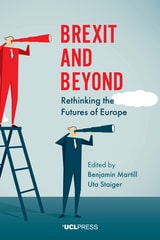
Brexit and Beyond
Rethinking the Futures of EuropeEdited by Benjamin Martill and Uta Staiger
University College London, 2018
Drawing the discussion of Brexit beyond Britain, Benjamin Martill, Uta Staiger, and a team of twenty-eight contributors explore the consequences for Europe and the European Union. Marshaling the perspectives and methodologies of a diverse range of disciplines, the contributors chart the likely effects of Brexit on institutional relations, law, political economy, foreign affairs, democratic governance, and the idea of Europe itself. While the contributors at times offer divergent predictions for the future of Europe after Brexit, they share the conviction that careful analysis is in needed—now more than ever—if we are to understand what lies ahead.
Brexit and Beyond is the first book to focus on the broader consequences of Brexit, and its clear, comprehensive, and trenchant analysis will be invaluable to understanding the complex effects.

Bringing in the Future
Strategies for Farsightedness and Sustainability in Developing CountriesWilliam Ascher
University of Chicago Press, 2009
Humans are plagued by shortsighted thinking, preferring to put off work on complex, deep-seated, or difficult problems in favor of quick-fix solutions to immediate needs. When short-term thinking is applied to economic development, especially in fragile nations, the results—corruption, waste, and faulty planning—are often disastrous. In Bringing in the Future, William Ascher draws on the latest research from psychology, economics, institutional design, and legal theory to suggest strategies to overcome powerful obstacles to long-term planning in developing countries.
Drawing on cases from Africa, Asia, and Latin America, Ascher applies strategies such as the creation and scheduling of tangible and intangible rewards, cognitive exercises to increase the understanding of longer-term consequences, self-restraint mechanisms to protect long-term commitments and enhance credibility, and restructuring policy-making processes to permit greater influence of long-term considerations. Featuring theoretically informed research findings and sound policy examples, this volume will assist policy makers, activists, and scholars seeking to understand how the vagaries of human behavior affect international development.
Britain and the Greek Economic Crisis, 1944-1947
From Liberation to the Truman DoctrineAthanasios Lykogiannis
University of Missouri Press, 2002

Britain's War on Poverty
Jane Waldfogel
Russell Sage Foundation, 2010
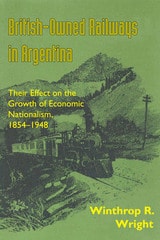
British-Owned Railways in Argentina
Their Effect on the Growth of Economic Nationalism, 1854-1948By Winthrop R. Wright
University of Texas Press, 1974
During the nineteenth century, British-owned railways grew under the protection of an Argentine ruling elite that considered railways both instruments and symbols of progress. Under this program of support for foreign enterprise, Argentina had by 1914 built the largest railway network in Latin America.
During the first decades of the twentieth century, the railways were successful in following a policy of calculated disregard for Argentine interests in general. However, following the end of World War I, the British economic empire began to decline and Argentine economic nationalism grew. A number of popularistic political movements incorporated economic nationalism into their platforms, and even among the ruling elite there were signs of increasing nationalistic sentiment.
Although most studies of economic nationalism have emphasized the importance of the middle-class Radical party in the rise of xenophobia, Winthrop R. Wright's study shows that antiforeign economic nationalism was not entirely a reaction to the conservative elite. Between 1932 and 1938 the nationalistic programs of General Agustin Justo's government—basically a conservative regime—led the British interests to decide to sell their holdings. The British govemment had arrived at a position of supporting the economic withdrawal of the large British-owned firms long before Juan D. Perón appeared on the political scene.
Perón combined traditional Argentine economic nationalism with his own scheme to gain power over all elements in Argentina. His solution to the railway problem, although more dramatically executed, did not differ greatly from that of the conservative Justo. Perón purchased the railways outright in 1947–1948, but his use of nationalism was in reality covering his own inability to outbargain Britain and the United States following the conclusion of World War II.

Broadcasting Hollywood
The Struggle over Feature Films on Early TVJennifer Porst
Rutgers University Press, 2021
Broadcasting, Voice, and Accountability
A Public Interest Approach to Policy, Law, and RegulationSteve Buckley, Kreszentia Duer, Toby Mendel, and Seán Ó Siochrú
University of Michigan Press, 2008
---Ruth Teer-Tomaselli, UNESCO Chair in Communication for Southern Africa, Culture, Communication and Media Studies, University of KwaZulu-Natal
digitalculturebooks is an imprint of the University of Michigan Press and the Scholarly Publishing Office of the University of Michigan Library dedicated to publishing innovative and accessible work exploring new media and their impact on society, culture, and scholarly communication. Visit the website at www.digitalculture.org.
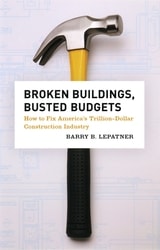
Broken Buildings, Busted Budgets
How to Fix America's Trillion-Dollar Construction IndustryBarry B. LePatner with Robert E. Wright and Timothy C. Jacobson
University of Chicago Press, 2007
With three decades of experience representing clients that include eminent architects and engineers, as well as corporations, institutions, and developers, LePatner has firsthand knowledge of the bad management, ineffective supervision, and insufficient investment in technology that plagues the risk-averse construction industry. In an engaging and direct style, he here pinpoints the issues that underlie the industry’s woes while providing practical tips for anyone in the business of building, including advice on the precise language owners should use during contract negotiations.
Armed with Broken Buildings, Busted Budgets, everyone involved in the purchase or renovation of a building or any structure—from homeowners seeking to remodel to civic developers embarking on large-scale projects—has the information they need to change this antiquated industry, one project at a time.
“LePatner describes what is wrong with the current system and suggests ways that architects can help—by retaking their rightful place as master builders.”—Fred A. Bernstein, Architect Magazine
Broken Promise
The Subversion Of U.S. Labor RelationsJames A. Gross
Temple University Press, 2003
The Wagner Act of 1935 (later the Wagner-Taft-Hartley Act of 1947) was intended to democratize vast numbers of American workplaces: the federal government was to encourage worker organization and the substitution of collective bargaining for employers' unilateral determination of vital work-place matters. Yet this system of industrial democracy was never realized; the promise was "broken." In this rare inside look at the process of government regulation over the last forty-five years, James A. Gross analyzes why the promise of the policy was never fulfilled.
Gross looks at how the National Labor Relations Board's (NLRB) policy-making has been influenced by the President, the Congress, the Supreme Court, public opinion, resistance by organized employers, the political and economic strategies of organized labor, and the ideological dispositions of NLRB appointees. This book provides the historical perspective needed for a reevaluation of national labor policy. It delineates where we are now, how we got here, and what fundamental questions must be addressed if policy-makers are to make changes consistent with the underlying principles of democracy.
Brokers and Bureaucrats
Building Market Institutions in RussiaTimothy Frye
University of Michigan Press, 2000