Results by title
3745 books match the query 'Europe' and 155 start with b

Between Church and State
The Lives of Four French Prelates in the Late Middle AgesBernard Guenée
University of Chicago Press, 1990
Guenée chooses as his frame the momentous period from the height of Saint Louis's reign in the mid-thirteenth century to the beginning of the Italian wars two hundred years later. During this time of schism in the church, of war between nascent states, and of treachery among princes, Bernard Gui (1261-1331), Gilles Le Muisit (1272-1353), Pierre D'Ailly (1351-1420), and Thomas Basin (1412-1490) all rose from modest circumstances to the dignity of office. Guenée shows us how these prelates used their talent, ambition, patrons, zeal, and experience to juggle the competing demands of obedience to church and state; to overcome competition from an upcoming new generation; and to cope with plague, war, and violence. Free of jargon yet steeped in learning, Between Church and State reveals the career patterns and politics of an era while forging a new model for points of departure in historical scholarship.
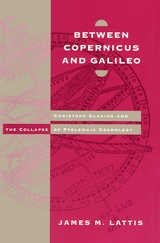
Between Copernicus and Galileo
Christoph Clavius and the Collapse of Ptolemaic CosmologyJames M. Lattis
University of Chicago Press, 1994
Though relatively unknown today, Clavius was enormously influential throughout Europe in the late sixteenth and early seventeenth centuries through his astronomy books—the standard texts used in many colleges and universities, and the tools with which Descartes, Gassendi, and Mersenne, among many others, learned their astronomy. James Lattis uses Clavius's own publications as well as archival materials to trace the central role Clavius played in integrating traditional Ptolemaic astronomy and Aristotelian natural philosophy into an orthodox cosmology. Although Clavius strongly resisted the new cosmologies of Copernicus and Tycho, Galileo's invention of the telescope ultimately eroded the Ptolemaic world view.
By tracing Clavius's views from medieval cosmology the seventeenth century, Lattis illuminates the conceptual shift from Ptolemaic to Copernican astronomy and the social, intellectual, and theological impact of the Scientific Revolution.
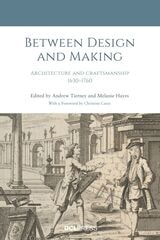
Between Design and Making
Architecture and Craftsmanship, 1630–1760Edited by Andrew Tierney and Melanie Hayes
University College London, 2024
The seventeenth and eighteenth centuries represent a high point in design and workmanship intersectionality. Skilled artisans worked across a spectrum of practices in design, supervision, and execution, and architects relied on this experience when building sites. However, this relationship has been under-studied in the architectural achievement of the early modern era.
Combining analysis of buildings, archival material, and eighteenth-century writings, editors Andrew Tierney and Melanie Hayes re-evaluate the social and professional fabric binding design to the act of making and reflect on the asymmetry between architecture and craft. They argue for a process-oriented understanding of architectural production that explores the scribbled and annotated beginnings of design; the debates and revisions in forging details; and the grappling with building materials that pushed projects from conception to completion.
Between Exile and Asylum
An Eastern EpistolaryPredrag Matvejevic
Central European University Press, 2004
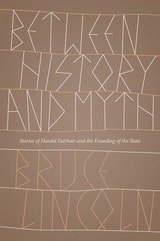
Between History and Myth
Stories of Harald Fairhair and the Founding of the StateBruce Lincoln
University of Chicago Press, 2014
Taking the story of how Harald Fairhair unified Norway in the ninth century as its central example, Bruce Lincoln illuminates the way a state’s foundation story blurs the distinction between history and myth and how variant tellings of origin stories provide opportunities for dissidence and subversion as subtle—or not so subtle—modifications are introduced through details of character, incident, and plot structure. Lincoln reveals a pattern whereby texts written in Iceland were more critical and infinitely more subtle than those produced in Norway, reflecting the fact that the former had a dual audience: not just the Norwegian court, but also Icelanders of the twelfth and thirteenth centuries, whose ancestors had fled from Harald and founded the only non-monarchic, indeed anti-monarchic, state in medieval Europe.
Between History and Myth will appeal not only to specialists in Scandinavian literature and history but also to anyone interested in memory and narrative.
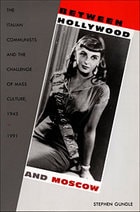
Between Hollywood and Moscow
The Italian Communists and the Challenge of Mass Culture, 1943-1991Stephen Gundle
Duke University Press, 2000
Gundle focuses on the theme of cultural policy, examining how the PCI’s political strategies incorporated cultural policies and activities that were intended to respond to the Americanization of daily life in Italy. In formulating this policy, Gundle contends, the Italian Communists were torn between loyalty to the alternative values generated by the Communist tradition and adaptation to the dominant influences of Italian modernization. This equilibrium eventually faltered because the attractive aspects of Americanization and pop culture proved more influential than the PCI’s intellectual and political traditions.
The first analysis in English of the cultural policies and activities of the PCI, this book will appeal to readers with an interest in modern Italy, the European left, political science, and media studies.
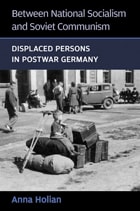
Between National Socialism and Soviet Communism
Displaced Persons in Postwar GermanyAnna Holian
University of Michigan Press, 2015
"Though its primary focus is on the immediate postwar, Between National Socialism and Soviet Communism will surely illuminate the contemporary crisis around citizenship and definitions of Germanness in the context of European Union and globalization."
---Geoff Eley, University of Michigan
In May of 1945, there were more than eight million "displaced persons" (or DPs) in Germany---recently liberated foreign workers, concentration camp prisoners, and prisoners of war from all of Nazi-occupied Europe, as well as eastern Europeans who had fled west before the advancing Red Army. Although most of them quickly returned home, it soon became clear that large numbers of eastern European DPs could or would not do so. In the aftermath of National Socialism, Germany thus ironically became a temporary home for a large population of "foreigners." Focusing on Bavaria, in the heart of the American occupation zone, Between National Socialism and Soviet Communism examines the cultural and political worlds that four groups of displaced persons---Polish, Ukrainian, Russian, and Jewish---created in Germany during the late 1940s and early 1950s. The volume investigates the development of refugee communities and how divergent interpretations of National Socialism and Soviet Communism defined these displaced groups.
Combining German and eastern European history, Anna Holian draws on a rich array of sources in cultural and political history and engages the broader literature on displacement in the fields of anthropology, sociology, political theory, and cultural studies. Her book will interest students and scholars of German, eastern European, and Jewish history; migration and refugees; and human rights.
Between Past and Future
The Revolution of 1989 and Their AftermathSorin Antohi
Central European University Press, 2000
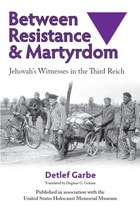
Between Resistance and Martyrdom
Jehovah's Witnesses in the Third ReichDetlef Garbe
University of Wisconsin Press, 2008
Although persecuted and banned from practicing their beliefs by the Nazi regime in 1933, the Jehovah’s Witnesses’ unified resistance has been largely forgotten. Basing his work on a wide range of sources, including documents and archives previously unconsidered as well as critical analyses of Jehovah’s Witness literature and survivor interviews, Detlef Garbe chronicles the Nazi’s relentless persecution of this religious group before and during World War II.
The English translation of this important work features a series of original photographs not published in the German edition. These striking images bring a sense of individual humanity to this story and help readers comprehend the reality of the events documented. Between Resistance and Martyrdom is an indispensable work that will introduce an English-speaking audience to this important but lesser-known part of Holocaust history.
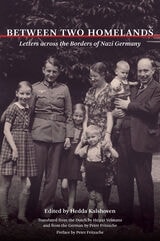
Between Two Homelands
Letters across the Borders of Nazi GermanyEdited by Hedda Kalshoven
University of Illinois Press, 2014
In 1920, at the age of thirteen, Irmgard Gebensleben first traveled from Germany to The Netherlands on a "war-children transport." She would later marry a Dutch man and live and raise her family there while keeping close to her German family and friends through the frequent exchange of letters. Yet during this period geography was not all that separated them. Increasing divergence in political opinions and eventual war between their countries meant letters contained not only family news but personal perspectives on the individual, local, and national choices that would result in the most destructive war in history.
This important collection, first assembled by Irmgard Gebensleben's daughter Hedda Kalshoven, gives voice to ordinary Germans in the Weimar Republic and the Third Reich and in the occupied Netherlands. The correspondence between Irmgard, her friends, and four generations of her family delve into their most intimate and candid thoughts and feelings about the rise of National Socialism. The responses to the German invasion and occupation of the Netherlands expose the deeply divided loyalties of the family and reveal their attempts to bridge them. Of particular value to historians, the letters evoke the writers' beliefs and their understanding of the events happening around them.
This first English translation of Ik denk zoveel aan jullie: Een briefwisseling tussen Nederland en Duitsland 1920-1949, has been edited, abridged, and annotated by Peter Fritzsche with the assent and collaboration of Hedda Kalshoven. After the book's original publication the diary of Irmgard's brother and loyal Wehrmacht soldier, Eberhard, was discovered and edited by Hedda Kalshoven. Fritzsche has drawn on this important additional source in his preface.
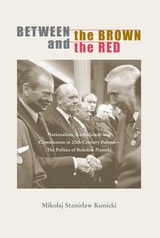
Between the Brown and the Red
Nationalism, Catholicism, and Communism in Twentieth-Century Poland—The Politics of Boleslaw PiaseckiMikolaj Stanislaw Kunicki
Ohio University Press, 2012
Between the Brown and the Red captures the multifaceted nature of church-state relations in communist Poland, relations that oscillated between mutual confrontation, accommodation, and dialogue. Ironically, under communism the bond between religion and nation in Poland grew stronger. This happened in spite of the fact that the government deployed nationalist themes in order to portray itself as more Polish than communist. Between the Brown and the Red also introduces one of the most fascinating figures in the history of twentieth-century Poland and the communist world.
In this study of the complex relationships between nationalism, communism, authoritarianism, and religion in twentieth-century Poland, Mikołaj Kunicki shows the ways in which the country’s communist rulers tried to adapt communism to local traditions, particularly ethnocentric nationalism and Catholicism. Focusing on the political career of Bolesław Piasecki, a Polish nationalist politician who began his surprising but illuminating journey as a fascist before the Second World War and ended it as a procommunist activist, Kunicki demonstrates that Polish communists reinforced an ethnocentric self-definition of Polishness and—as Piasecki’s case demonstrates—thereby prolonged the existence of Poland’s nationalist Right.
Between the Living and the Dead
A Perspective on Witches and Seers in the Early Modern AgeÉva Pócs
Central European University Press, 1998
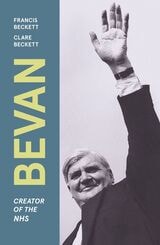
Bevan
Creator of the NHSFrancis Beckett and Clare Beckett
Haus Publishing, 2023
The creation of the National Health Service was the most significant of the many reforms of the post-war Labour government in the UK. The man responsible was Aneurin “Nye” Bevan. The son of a Welsh miner, he became a local trade union leader at only nineteen. In 1929, he was elected as a Labour MP. Bevan believed the war was Britain’s opportunity to create a new society, a position he maintained throughout the conflict. When the war ended in 1945, the landslide Labour victory gave him the chance to make this vision a reality. Known for his impassioned oratory, Bevan’s fundamental belief that the new NHS should be freely available to all was ultimately at odds with a government struggling to balance the books. He resigned in 1951 over the introduction of charges for prescriptions and glasses. With the NHS requiring an ever-increasing share of national income, this updated edition considers Bevan’s legacy as the future of the health service he created is fought over as never before.

Beyond Bach
Music and Everyday Life in the Eighteenth CenturyAndrew Talle
University of Illinois Press, 2018
Eschewing the great composer style of music history, Andrew Talle takes us on a journey that looks at how ordinary people made music in Bach's Germany. Talle focuses in particular on the culture of keyboard playing as lived in public and private. As he ranges through a wealth of documents, instruments, diaries, account ledgers, and works of art, Talle brings a fascinating cast of characters to life. These individuals--amateur and professional performers, patrons, instrument builders, and listeners--inhabited a lost world, and Talle's deft expertise teases out the diverse roles music played in their lives and in their relationships with one another. At the same time, his nuanced re-creation of keyboard playing's social milieu illuminates the era's reception of Bach's immortal works.
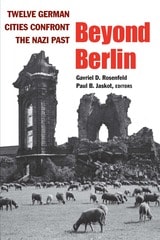
Beyond Berlin
Twelve German Cities Confront the Nazi PastGavriel D. Rosenfeld and Paul B. Jaskot, Editors
University of Michigan Press, 2015
Beyond Berlin breaks new ground in the ongoing effort to understand how memorials, buildings, and other spaces have figured in Germany's confrontation with its Nazi past. The contributors challenge reigning views of Germany's postwar memory work by examining how specific urban centers apart from the nation's capital have wrestled with their respective Nazi legacies. A wide range of West and East German cities is profiled in the volume: prominent metropolises like Hamburg, dynamic regional centers like Dresden, gritty industrial cities like Wolfsburg, and idyllic rural towns like Quedlinburg. In employing historical, art historical, anthropological, and geographical methodologies to examine these and other important urban centers, the volume's case studies shed new light upon the complex ways in which the confrontation with the Nazi past has directly shaped the German urban landscape since the end of the Second World War.
"Beyond Berlin is one of the most fascinating, deeply probing collections ever published on Germany's ongoing confrontation with its Nazi past. Its editors, Gavriel Rosenfeld and Paul Jaskot, have taken the exploration of Germany's urban memorial landscape to its highest level yet."
---James E. Young, Professor and Chair, Department of Judaic and Near Eastern Studies, University of Massachusetts Amherst, and author of The Texture of Memory and At Memory's Edge
"This is a top-notch collection of essays that positions itself in the populated field of memory studies by bringing together original contributions representing the best of new scholarship on architecture, urban design, monuments, and memory in East and West Germany. Taken together, the essays remind readers that the Nazi past is always present when German architects, urban planners, and politicians make decisions to tear down, rebuild, restore, and memorialize."
---S. Jonathan Wiesen, Department of History, Southern Illinois University, Carbondale
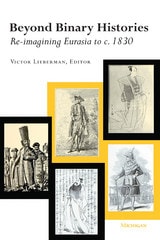
Beyond Binary Histories
Re-imagining Eurasia to c. 1830Victor Lieberman, Editor
University of Michigan Press, 1999
The collaborators of this project show, in varying degrees, that political centralization in these areas reflected and inspired the creation of vernacular literatures at the expense of more universal languages. They illustrate that societies in widely separated areas, with no obvious links, became more literate, mobile, specialized, and commercial at roughly the same time. And they point out that administrative development in many of these same areas showed curiously synchronized cycles. Finally, having defined Eurasian parallels and sketched their limits, they push on to explore the underlying dynamics of these discoveries, scrutinizing the role of guns, global climate, markets, new information networks, institutional pressures, and sixteenth-century messianism.
Insofar as similarities between some European and Asian areas exceeded those between different sectors of Asia, this collection invites historians to reject continental perspectives in favor of more thematic, contextually-specific categories. But at the same time, it raises the possibility of a broad "early modern" period for Eurasia at large.
The contributors are Mary Elizabeth Berry (University of California, Berkeley), Peter Carey (University of Oxford), James B. Collins (Georgetown University), Valerie Kivelson (University of Michigan), R. I. Moore (University of Newcastle upon Tyne), Sanjay Subrahmanyam (Ecole des Hautes Etudes en Sciences Sociales, Paris), John K. Whitemore (University of Michigan), and David K. Wyatt (Cornell University).
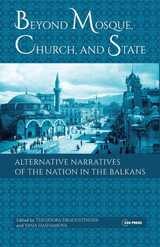
Beyond Mosque, Church, and State
Alternative Narratives of the Nation in the BalkansYana Hashamova
Central European University Press, 2016
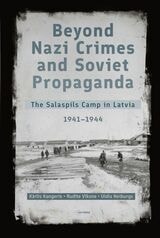
Beyond Nazi Crimes and Soviet Propaganda
The Salaspils Camp in Latvia, 1941-1944Karlis Kangeris
Central European University Press, 2027
The Salaspils camp near Riga, which was operated during the Nazi occupation of Latvia, has long been the subject ofcontrovery. Around 23,000 people were imprisoned there: half were political prisoners, labor resisters and convicted soldiers, the rest prisoners from special operations against civilians in Belarus, Russia and the Latgale region of Latvia. The death toll in the camp, including the number of Jews who died during construction, is well over 3,000 people.
Despite the relatively small size of this camp, it became a model for Russian remembrance policy. Soviet propaganda claimed that up to 100,000 prisoners were killed there, charged that children were used to extract blood, and greatly exaggerated the extent of the persecution of imprisoned lawbreakers and political dissidents . Salaspils became a myth in Russian-speaking society in Latvia that served to reinforce Soviet narratives of the “Great Patriotic War.”
The three authors drew on sources from the archives of Latvia, Germany and Russia and critically analyzed oral testimonies and earlier research to create a comprehensive account of the Salaspils camp in Nazi-occupied Latvia. Their book furthers the understanding of processes of deformation of collective memory and the techniques of memory politics from the Cold War to the present.
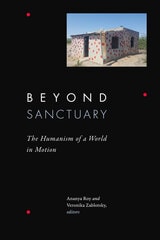
Beyond Sanctuary
The Humanism of a World in MotionAnanya Roy and Veronika Zablotsky, editors
Duke University Press, 2025
Contributors. Leisy Abrego, Damon Azali-Rojas, Amy Sara Carroll, Sharad Chari, Nicholas De Genova, Ricardo Dominguez, Lorgia García-Peña, Sarah Haley, Gaye Theresa Johnson, Moon-Kie Jung, Maria Kaika, Saree Makdisi, Kyle T. Mays, Ananya Roy, Charles Sepulveda, SA Smythe, Vanessa E. Thompson, Charalampos Tsavdaroglou, João H. Costa Vargas, Rinaldo Walcott, Veronika Zablotsky, Maite Zubiaurre
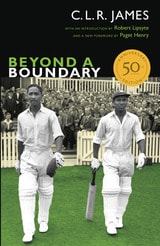
Beyond a Boundary
50th Anniversary EditionC. L .R. James
Duke University Press, 2013
Named one of the Top 50 Sports Books of All Time by Sports Illustrated
"Beyond a Boundary . . . should find its place on the team with Izaak Walton, Ivan Turgenev, A. J. Liebling, and Ernest Hemingway."—Derek Walcott, The New York Times Book Review
"As a player, James the writer was able to see in cricket a metaphor for art and politics, the collective experience providing a focus for group effort and individual performance. . . . [In] his scintillating memoir of his life in cricket, Beyond a Boundary (1963), James devoted some of his finest pages to this theme."—Edward Said, The Washington Post
"A work of double reverence—for the resilient, elegant ritualism of cricket and for the black people of the world."—Whitney Balliett, The New Yorker
"Beyond a Boundary is a book of remarkable richness and force, which vastly expands our understanding of sports as an element of popular culture in the Western and colonial world."—Mark Naison, The Nation
"Everything James has done has had the mark of originality, of his own flexible, sensitive, and deeply cultured intelligence. He conveys not a rigid doctrine but a delight and curiosity in all the manifestations of life, and the clue to everything lies in his proper appreciation of the game of cricket."—E. P. Thompson, author of The Making of the English Working Class
"Beyond a Boundary is . . . first and foremost an autobiography of a living legend—probably the greatest social theorist of our times."—Manning Marable, Journal of Sport & Social Issues
"The great triumph of Beyond a Boundary is its ability to rise above genre and in its very form explore the complex nature of colonial West Indian society."—Caryl Phillips, The New Republic

Beyond the Body
The Boundaries of Medicine and English Renaissance DramaWilliam Kerwin
University of Massachusetts Press, 2005
Drawing on research in the social history of medicine as well as a wide-ranging collection of primary narratives of medical encounters, Kerwin pursues the stories of several medical groups. Specifically, he examines women healers in terms of the changing place of women in the public sphere; the connections between drug sellers—apothecaries and alchemists—and an emerging modern economy; the role barbers and surgeons played in early modern concerns for protecting a new sense of privacy and interiority; the ways physicians defined their professional primacy through the language of theaters and actors; and the ways individual patients employed rhetorics of diagnosis as a way of participating in sectarian religious battles. The study moves from the dynamics of medical politics to the work drama does in exposing those dynamics. In addition to offering astute readings of works by Shakespeare and Ben Jonson, the book pays substantial attention to plays by Samuel Daniel, John Fletcher, John Ford, Thomas Heywood, John Lyly, Philip Massinger, and John Webster.
Beyond the Body complements the wealth of recent critical attention given to the body. Kerwin attends to a different sort of material politics; as the book's title suggests, he asks a reader interested in the politics of medicine to look not at the practitioner treating the body but at the social forces influencing the practitioner. Beyond the Body works to erode a widespread cultural bias toward giving medicine deference as a self-defining profession.

Beyond the Subtitle
Remapping European Art CinemaMark Betz
University of Minnesota Press, 2009
A provocative rethinking of national cinema, authorship, and the discipline of film studies
Examining European art films of the 1950s and 1960s, Mark Betz argues that it is time for film analysis to move beyond prevailing New Wave historiography, mired in outdated notions of nationalism and dragged down by decades of auteurist criticism. Focusing on the cinemas of France and Italy, Betz reveals how the flowering of European art films in the postwar era is inseparable from the complex historical and political frameworks of the time.
Remapping the practices and paradigms of film history, Beyond the Subtitle calls into question the concept of national cinema and explores the largely neglected subjects of subtitling, dubbing, and art film coproductions. Betz also analyzes the iconic figure of the “wandering woman,” or flanêuse, who appears in many of the films under consideration, in light of the postwar boom, modernization, and decolonization. Finally, he rescues the omnibus films to show the need for a new film studies approach. Beyond the Subtitle demonstrates how the geopolitical and institutional contexts that gave rise to these films and to academic film studies should be incorporated into future analysis in order to gain new insight into debates on race, gender, and imperialism.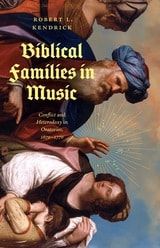
Biblical Families in Music
Conflict and Heterodoxy in Oratorios, 1670–1770Robert L. Kendrick
University of Chicago Press, 2025
Based to a great extent on the Old Testament, the largely Catholic musical-dramatic genre was popular in Italy, Austria, and southern Germany in the seventeenth and eighteenth centuries. Biblical Families in Music reveals how difficult stories of fratricide, child sacrifice, death, and forbidden love performed a didactic function in oratorios, teaching early modern audiences about piety and the rules of proper family life.
In the century after 1670, the heavily adapted tales of Abraham and Isaac, Cain and Abel, and the Egyptian slave Hagar and her son Ishmael were set to music by figures such as Alessandro Scarlatti and Antonio Sacchini and performed during Lent in churches and other sacred spaces for an audience of court nobility, clergy, and the urban patriciate. By examining the resonance of Catholic oratorios within predominantly upper-class social realities, the book broadens our cultural understanding of the early modern European family and underscores the centrality of family and familial relation to social position, devotional taste, and identity.
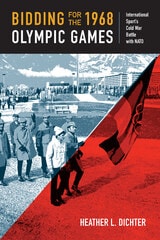
Bidding for the 1968 Olympic Games
International Sport's Cold War Battle with NATOHeather L. Dichter
University of Massachusetts Press, 2021
During the Cold War, political tensions associated with the division of Germany came to influence the world of competitive sport. In the 1950s, West Germany and its NATO allies refused to recognize the communist East German state and barred its national teams from sporting competitions. The construction of the Berlin Wall in 1961 further exacerbated these pressures, with East German teams denied travel to several world championships. These tensions would only intensify in the run-up to the 1968 Olympics.
In Bidding for the 1968 Olympic Games, Heather L. Dichter considers how NATO and its member states used sport as a diplomatic arena during the height of the Cold War, and how international sport responded to political interference. Drawing on archival materials from NATO, foreign ministries, domestic and international sport functionaries, and newspapers, Dichter examines controversies surrounding the 1968 Summer and Winter Olympic Games, particularly the bidding process between countries to host the events. As she demonstrates, during the Cold War sport and politics became so intertwined that they had the power to fundamentally transform each other.

Birkenau
The Camp of DeathMarco Nahon, translated from the French by Jacqueline Bowers, edited and with an introduction by Steven B. Bowan
University of Alabama Press, 1989
Step into Birkenau, Marco Nahon’s unflinching memoir of survival in Auschwitz, where a Greek doctor bears witness to brutality, loss, and endurance—preserving forgotten voices and compelling readers to confront history through one unforgettable, human testimony
Birkenau is a searing firsthand Holocaust memoir by Greek physician Marco Nahon, recounting his deportation to Auschwitz-Birkenau and survival of one of history’s most lethal extermination camps. Writing soon after liberation, Nahon offers a deeply personal chronicle of Nazi persecution. He recounts the occupation of Greece, the ghettoization of Greek Jews, their transport to German death camps, and the daily horrors of camp life. He documents the dehumanization and destruction of Greek Jews while preserving the memory of those who perished.
Nahon presents his story episodically, guiding readers through his arrest, transport, forced labor, and survival. He illuminates the historical context of the Holocaust with vivid stories from daily life in the death camps. Rounding out the work are maps, appendices, and Bowman’s introduction, which provides background on Greek Jewry—whose complex story is little known—and describes the progress of the Nazi occupation of Greece and the Balkans.
Nahon, an MD trained in Beirut who lost much of his family, writes with restrained objectivity that heightens the emotional force of his account, while the translation and editorial framing make this early memoir accessible to modern readers.
This book will resonate with scholars of the Holocaust, students of World War II, and general readers seeking an authentic survivor voice. It is especially valuable for those interested in lesser-known aspects of the genocide, such as the fate of Greek Jewish communities. Both an indispensable historical document and a powerful act of remembrance, it speaks urgently to anyone committed to understanding—and never forgetting—the human realities of genocide.
Birth Weight and Economic Growth
Women's Living Standards in the Industrializing WestW. Peter Ward
University of Chicago Press, 1993
Drawing on clinical records from urban maternity hospitals and outpatient services, Ward compares birth weight between cities and traces changes in fetal size during a period in which some cities experienced dramatic economic development while others stagnated. Because fetal growth is strongly affected by maternal nutrition, Ward's research sheds new light on the well-being of working-class women whose living conditions have long been obscure and exceedingly difficult to examine.
This book will interest social and economic historians, as well as scholars of women's studies and the history of medicine, and its lessons on the distribution of social benefits during economic change have immidiate relevance for today's developing countries.
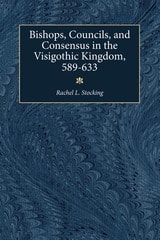
Bishops, Councils, and Consensus in the Visigothic Kingdom, 589-633
Rachel L. Stocking
University of Michigan Press, 2001
This eloquently presented, exhaustive study concludes that legislation, however persistently enacted, was unequal to the task of remedying a lack of unity and other social and political ills. Notions of consensus are explored as a way of maintaining community cohesion and order in the absence of strong central authorities. Other issues the author confronts are Catholic tolerance and intolerance toward heterodox and non-Christian "others;" the transformation and transmission of ancient ideals and social structures from the Roman to the later medieval worlds; and the position of medieval Spain in relation to the mainstream of western European history.
This nuanced study is a must-read for anyone interested in medieval life, politics, religion, and the precarious nature of the medieval state.
Rachel Stocking is Professor of History, Southern Illinois University at Carbondale.
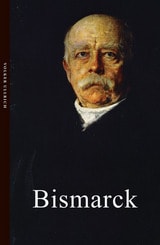
Bismarck
Volker Ullrich
Haus Publishing, 2015
A leading historian of nineteenth- and twentieth-century history, Ullrich demonstrates that the “Founder of the Reich” was in fact an opponent of liberal German nationalism. After the wars of 1866 and 1870, Bismarck spent the rest of his career working to preserve peace in Europe and protect the empire he had created. Despite his reputation as an enemy of socialism, he introduced comprehensive health and unemployment insurance for German workers. Far from being a “man of iron and blood,” Bismarck was in fact a complex statesman who was concerned with maintaining stability and harmony far beyond Germany’s newly unified borders.
Comprehensive and balanced, Bismarck shows us the post-reunification value of looking anew at this monumental figure’s role in European history.
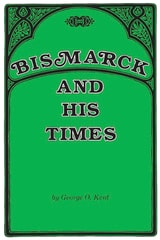
Bismarck and His Times
George O. Kent
Southern Illinois University Press, 1978
A new account of the life and policies of the first German chancellor, Otto von Bismarck, this concise historical-biography reflects, for the first time in English, the historical shift in emphasis from the traditional political-economic approach to the more complex social-economic one of post—World War II scholarship.
Since the middle of the 1950s, much new material on Bismarck and nineteenth-century Germany and new interpretations of existing material have been published in Germany, Great Britain, and the United States. Professor George O. Kent’s brilliant synthesis, drawing on this mass of material, examines changes in emphasis in post—World War II scholarship. The book, particularly in the historiographical notes and bibliographical essay, provides the serious student with an invaluable guide to the intricacies of recent Bismarckian scholarship. For the general reader, the main text presents a picture of the man, the issues, and the age in the light of modern scholarship.
The major shift in historical emphasis described in this new account is the importance scholars give to the period 1877–79, the years of change from free trade to protectionism, rather than to 1870–71 the founding of the Reich. Bismarck’s political machinations, particularly his willingness to explore the possibilities of a coup d’état, are more fully discussed here than in any other book.
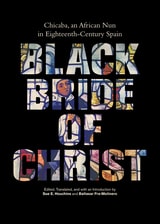
Black Bride of Christ
Chicaba, an African Nun in Eighteenth-Century SpainSue E. Houchins
Vanderbilt University Press, 2018
This volume, the first English translation of the Compendio, is a hagiography, an example of a biographical genre that recounts the lives and describes the spiritual practices of saints officially canonized by the Church, respected ecclesiastical leaders, or holy people informally recognized by local devotees. The effort to have Chicaba canonized continues today, as Fra-Molinero and Houchins explore in their introduction to the volume.
Black British Cultural Studies
A ReaderEdited by Houston A. Baker, Jr., Manthia Diawara, and Ruth H. Lindeborg
University of Chicago Press, 1996
From Stuart Hall's classic study of racially structured societies to an interview by Manthia Diawara with Sonia Boyce, a leading figure in the Black British arts movement, the papers included here have transformed cultural studies through their sustained focus on the issue of race. Much of the book centers on Black British arts, especially film, ranging from a historical overview of Black British cinema to a weighing of the costly burden on Black artists of representing their communities. Other essays consider such topics as race and representation and colonial and postcolonial discourse.
This anthology will be an invaluable and timely resource for everyone interested in cultural studies. It also has much to offer students of anthropology, sociology, media and film studies, and literary criticism.
Black Earth
A Journey through UkraineJens Mühling
Haus Publishing, 2018
“Will someone pay for the spilled blood? No. Nobody.” Mikhail Bulgakov composed this ominous and prophetic phrase in Kiev amid the turmoil of the Russian civil war. Since then, Ukrainian borders have shifted constantly, and its people have suffered numerous military foreign interventions. Ukraine has only existed as an independent state since 1991, and what exactly it was before then is controversial among its people as well as its European neighbors.
In Black Earth: A Journey through the Ukraine, journalist and celebrated travel writer Jens Mühling takes readers across the country amid the ousting of former president Viktor Yanukovych and the Russian annexation of Crimea. Mühling delves deep into daily life in Ukraine, narrating his encounters with Ukrainian nationalists and old communists, Crimean Tatars and Cossacks, smugglers, and soldiers. Black Earth connects all these stories to convey an unconventional and unfiltered view of Ukraine, a country at the crossroads of Europe and Asia and the center of countless conflicts.
In this paperback edition, a new preface is included that takes into account recent developments up to the 2022 war between Russia and Ukraine.
Black Europe and the African Diaspora
Edited by Darlene Clark Hine, Trica Danielle Keaton, and Stephen Small
University of Illinois Press, 2009
The presence of Blacks in a number of European societies has drawn increasing interest from scholars, policymakers, and the general public. This interdisciplinary and multi-disciplinary collection penetrates the multifaceted Black presence in Europe, and, in so doing, complicates the notions of race, belonging, desire, and identities assumed and presumed in revealing portraits of Black experiences in a European context. In focusing on contemporary intellectual currents and themes, the contributors theorize and re-imagine a range of historical and contemporary issues related to the broader questions of blackness, diaspora, hegemony, transnationalism, and "Black Europe" itself as lived and perceived realities.
Contributors are Allison Blakely, Jacqueline Nassy Brown, Tina Campt, Fred Constant, Alessandra Di Maio, Philomena Essed, Terri Francis, Barnor Hesse, Darlene Clark Hine, Dienke Hondius, Eileen Julien, Trica Danielle Keaton, Kwame Nimako, Tiffany Ruby Patterson, T. Denean Sharpley-Whiting, Stephen Small, Tyler Stovall, Alexander G. Weheliye, Gloria Wekker, and Michelle M. Wright.
Black Fox
A Life of Emilie Demant Hatt, Artist and EthnographerBarbara Sjoholm
University of Wisconsin Press, 2017
In recounting Demant Hatt's fascinating life, Barbara Sjoholm investigates the boundaries and influences between ethnographers and sources, the nature of authorship and visual representation, and the state of anthropology, racial biology, and politics in Scandinavia during the first half of the twentieth century.
Black France / France Noire
The History and Politics of BlacknessTrica Danielle Keaton, T. Denean Sharpley-Whiting and Tyler Stovall, eds.
Duke University Press, 2012
Contributors. Rémy Bazenguissa-Ganga, Allison Blakely, Jennifer Anne Boittin, Marcus Bruce, Fred Constant, Mamadou Diouf, Arlette Frund, Michel Giraud, Bennetta Jules-Rosette, Trica Danielle Keaton, Jake Lamar, Patrick Lozès, Alain Mabanckou, Elisabeth Mudimbe-Boyi, T. Denean Sharpley-Whiting, Tyler Stovall, Christiane Taubira, Dominic Thomas, Gary Wilder

Black People in the British Empire
Peter Fryer
Pluto Press, 1988
Black Studies in Europe
An Anthology of Soil and SeedsNicole Grégoire, Sarah Fila-Bakabadio, and Jacinthe Mazzocchetti (eds.)
Northwestern University Press, 2025
Long absent from research in the humanities and social sciences, Black people in continental Europe have become the focus of a growing body of literature in the past two decades that addresses their unique history and social positioning. Black Studies in Europe: An Anthology of Soil and Seeds brings together essays and case studies by a collective of scholars, writers, and activists to offer a critical overview of the emerging field of Black European studies and a vital reflection on contemporary epistemologies of European Blackness. This collection addresses key questions: What is Blackness from a European standpoint? Which epistemologies and theoretical tools have been used to offer a better understanding of Black experiences in Europe? How is this knowledge being produced and by whom? Can we define a common European conceptual framework for Black studies? Related to this work is an even more urgent enterprise: forging an epistemological distinction between the study of Black people and “Black studies” as an emancipatory project.
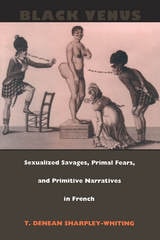
Black Venus
Sexualized Savages, Primal Fears, and Primitive Narratives in FrenchT. Denean Sharpley-Whiting
Duke University Press, 1999
The book opens with an exploration of scientific discourse on black females, using Sarah Bartmann, the so-called Hottentot Venus, and natural scientist Georges Cuvier as points of departure. To further show how the image of a savage was projected onto the bodies of black women, Sharpley-Whiting moves into popular culture with an analysis of an 1814 vaudeville caricature of Bartmann, then shifts onto the terrain of canonical French literature and colonial cinema, exploring the representation of black women by Baudelaire, Balzac, Zola, Maupassant, and Loti. After venturing into twentieth-century film with an analysis of Josephine Baker’s popular Princesse Tam Tam, the study concludes with a discussion of how black Francophone women writers and activists countered stereotypical representations of black female bodies during this period. A first-time translation of the vaudeville show The Hottentot Venus, or Hatred of Frenchwomen supplements this critique of the French male gaze of the nineteenth and early twentieth centuries.
Both intellectually rigorous and culturally intriguing, this study will appeal to students and scholars in the fields of nineteenth- and twentieth-century French literature, feminist and gender studies, black studies, and cultural studies.
Black Victorians / Black Victoriana
Edited by Gretchen Holbrook Gerzina
Rutgers University Press, 2003
The essays taken as a whole also highlight prevailing Victorian attitudes toward race by focusing on the ways in which empire building spawned a "subculture of blackness" consisting of caricature, exhibition, representation, and scientific racism absorbed by society at large. This misrepresentation made it difficult to be both black and British while at the same time it helped to construct British identity as a whole. Covering many topics that detail the life of blacks during this period, Black Victorians/Black Victoriana will be a landmark contribution to the emergent field of black history in England.
Bleak Houses
Marital Violence in Victorian FictionLisa Surridge
Ohio University Press, 2005
The Offenses Against the Person Act of 1828 opened magistrates' courts to abused working-class wives. Newspapers in turn reported on these proceedings, and in this way the Victorian scrutiny of domestic conduct began. But how did popular fiction treat “private” family violence? Bleak Houses: Marital Violence in Victorian Fiction traces novelists' engagement with the wife-assault debates in the public press between 1828 and the turn of the century.
Lisa Surridge examines the early works of Charles Dickens and reads Dombey and Son and Anne Brontë's The Tenant of Wildfell Hall in the context of the intense debates on wife assault and manliness in the late 1840s and early 1850s. Surridge explores George Eliot's Janet's Repentance in light of the parliamentary debates on the 1857 Divorce Act. Marital cruelty trials provide the structure for both Wilkie Collins's The Woman in White and Anthony Trollope's He Knew He Was Right.
Locating the New Woman fiction of Mona Caird and the reassuring detective investigations of Sherlock Holmes in the context of late-Victorian feminism and the great marriage debate in the Daily Telegraph, Surridge illustrates how fin-de-siècle fiction brought male sexual violence and the viability of marriage itself under public scrutiny. Bleak Houses thus demonstrates how Victorian fiction was concerned about the wife-assault debates of the nineteenth century, debates which both constructed and invaded the privacy of the middle-class home.

Blessed Mary and the Monks of England, 1000-1215
Matthew J. Mills
Catholic University of America Press, 2024
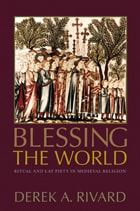
Blessing the World
Ritual and Lay Piety in Medieval ReligionDerek A. Rivard
Catholic University of America Press, 2009
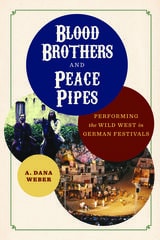
Blood Brothers and Peace Pipes
Performing the Wild West in German FestivalsA. Dana Weber
University of Wisconsin Press, 2019
This book, based on years of fieldwork observing and studying the festivals, plays, events, and groups that comprise this subculture, addresses a larger, timely issue: cultural transfer and appropriations. Are Germans dressing up in American Indian costumes paying tribute or offending the cultures they are representing? Avoiding simplistic answers, A. Dana Weber considers the complexity of cultural enactments as they relate both to the distinctly German phenomenon as well as to larger questions of cultural representations in American and European live performance traditions."
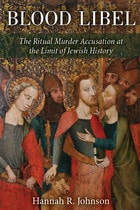
Blood Libel
The Ritual Murder Accusation at the Limit of Jewish HistoryHannah R. Johnson
University of Michigan Press, 2012
The ritual murder accusation is one of a series of myths that fall under the label blood libel, and describes the medieval legend that Jews require Christian blood for obscure religious purposes and are capable of committing murder to obtain it. This malicious myth continues to have an explosive afterlife in the public sphere, where Sarah Palin's 2011 gaffe is only the latest reminder of its power to excite controversy. Blood Libel is the first book-length study to analyze the recent historiography of the ritual murder accusation and to consider these debates in the context of intellectual and cultural history as well as methodology. Hannah R. Johnson articulates how ethics shapes methodological decisions in the study of the accusation and how questions about methodology, in turn, pose ethical problems of interpretation and understanding. Examining recent debates over the scholarship of historians such as Gavin Langmuir, Israel Yuval, and Ariel Toaff, Johnson argues that these discussions highlight an ongoing paradigm shift that seeks to reimagine questions of responsibility by deliberately refraining from a discourse of moral judgment and blame in favor of an emphasis on historical contingencies and hostile intergroup dynamics.
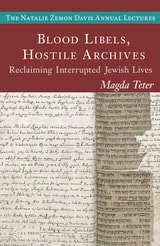
Blood Libels, Hostile Archives
Reclaiming Interrupted Jewish LivesMagda Teter
Central European University Press, 2025
As a minority group for most of their history, Jews were often marginalized and persecuted. Traces of their lives can be found in the archives of the dominant societies, but only as they intersected with the concerns of those in power. Just as Natalie Zemon Davis, Emmanuel Le Roy Ladurie, Carlo Ginzburg, and others recovered the voices of the peasants, so, too, scholars of Jewish history and culture have productively mined these reservoirs of evidence to retrieve glimpses of the ordinary lives of Jews. Blood Libels, Hostile Archives explores what can be reclaimed about everyday lives from what can be called “hostile archives”—from archival evidence produced and collected explicitly to manufacture malicious tales and pass them as “facts.” For Jewish history, in some places, these archival sources may be the only remaining records documenting the lives of Jews there.
The book explores two places: Trent, in northern Italy, and Sandomierz, in eastern Poland. Though hundreds of miles away, the towns have many things in common: both had been sites of anti-Jewish libels falsely accusing Jews of killing Christian children, Trent in 1475 and Sandomierz twice—in 1698 and 1710; in both, the instigators of the Jews’ persecution left unique and extensive archives, both towns have physical remnants of these deadly affairs, and, finally, neither town has an existing Jewish population. Yet, centuries later, these anti-Jewish libels have not been relegated to the past; in both towns, their legacies still reverberate today.
Blood Relations
Transfusion and the Making of Human GeneticsJenny Bangham
University of Chicago Press, 2020
Blood Runs Green
The Murder That Transfixed Gilded Age ChicagoGillian O'Brien
University of Chicago Press, 2015
It was the biggest funeral Chicago had seen since Lincoln’s. On May 26, 1889, four thousand mourners proceeded down Michigan Avenue, followed by a crowd forty thousand strong, in a howl of protest at what commentators called one of the ghastliest and most curious crimes in civilized history. The dead man, Dr. P. H. Cronin, was a respected Irish physician, but his brutal murder uncovered a web of intrigue, secrecy, and corruption that stretched across the United States and far beyond.
Blood Runs Green tells the story of Cronin’s murder from the police investigation to the trial. It is a story of hotheaded journalists in pursuit of sensational crimes, of a bungling police force riddled with informers and spies, and of a secret revolutionary society determined to free Ireland but succeeding only in tearing itself apart. It is also the story of a booming immigrant population clamoring for power at a time of unprecedented change.
From backrooms to courtrooms, historian Gillian O’Brien deftly navigates the complexities of Irish Chicago, bringing to life a rich cast of characters and tracing the spectacular rise and fall of the secret Irish American society Clan na Gael. She draws on real-life accounts and sources from the United States, Ireland, and Britain to cast new light on Clan na Gael and reveal how Irish republicanism swept across the United States. Destined to be a true crime classic, Blood Runs Green is an enthralling tale of a murder that captivated the world and reverberated through society long after the coffin closed.
Blood and Culture
Youth, Right-Wing Extremism, and National Belonging in Contemporary GermanyCynthia Miller-Idriss
Duke University Press, 2009
Miller-Idriss describes a new understanding of national belonging emerging among young Germans—one in which cultural assimilation takes precedence over blood or ethnic heritage. Moreover, she argues that teachers’ well-intentioned, state-sanctioned efforts to counter nationalist pride often create a backlash, making radical right-wing groups more appealing to their students. Miller-Idriss argues that the state’s efforts to shape national identity are always tempered and potentially transformed as each generation reacts to the official conception of what the nation “ought” to be.
Blood and Homeland
Eugenics and Racial Nationalism in Central and Southeast Europe, 1900-1940Paul J. Weindling
Central European University Press, 2007
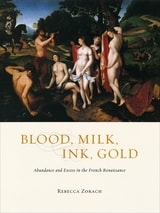
Blood, Milk, Ink, Gold
Abundance and Excess in the French RenaissanceRebecca Zorach
University of Chicago Press, 2005
Throughout the book, abundance and excess flow in liquids-blood, milk, ink, and gold-that highlight the materiality of objects and the human body, and explore the value (and values) accorded to them. The arts of the lavish royal court at Fontainebleau and in urban centers are here explored in a vibrant tableau that illuminates our own contemporary relationship to excess and desire.
From marvelous works by Francois Clouet to oversexed ornamental prints to Benvenuto Cellini's golden saltcellar fashioned for Francis I, Blood, Milk, Ink, Gold covers an astounding range of subjects with precision and panache, producing the most lucid, well-rounded portrait of the cultural politics of the French Renaissance to date.