Results by title
5550 books match the query 'Biography & Autobiography' and 296 start with b
Bring Down the Little Birds
On Mothering, Art, Work, and Everything ElseCarmen Giménez Smith
University of Arizona Press, 2010
Writing in fragmented yet coherent sections, the author shares with us her interior monologue, affording the reader a uniquely honest, insightful, and deeply personal glimpse into a woman’s first and second journeys into motherhood. Giménez Smith begins Bring Down the Little Birds by detailing the relationship with her own mother, from whom her own concept of motherhood originated, a conception the author continually reevaluates and questions over the course of the book.
Combining fragments of thought, daydreams, entries from notebooks both real and imaginary, and real-life experiences, Giménez Smith interrogates everything involved in becoming and being a mother for both the first and second times. She wonders what her children will one day know about her own “secret life,” meditates on the physical effects of pregnancy, and questions the myths about, nostalgia for, and glorification of motherhood.
While Giménez Smith incorporates universal experiences of motherhood that other authors have detailed throughout literature, what separates her book from these many others is that her reflections are captured in a style that establishes an intimacy and immediacy between author and reader through which we come to know the secret life of a mother and are made to question our own conception of what motherhood really means.
Bringing Aztlan to Mexican Chicago
My Life, My Work, My ArtJose Gamaliel Gonzalez, Edited and with an Introduction by Marc Zimmerman
University of Illinois Press, 2010
Bringing Home the Wild
A Riparian Garden in a Southwest CityJuliet C. Stromberg
University of Arizona Press, 2023
When living in a large sprawling city, one may feel disconnected and adrift. Finding ways to belong and have positive effects is challenging. In Bringing Home the Wild, botanist Juliet C. Stromberg demonstrates how ecologically guided gardening develops a sense of place, restores connections to nature, and brings joy and meaning to our lives.
This book follows a two-decade journey in ecologically guided gardening on a four-acre irrigated parcel in Phoenix, Arizona, from the perspective of a retired botanist and her science historian partner. Through humor and playful use of language, Bringing Home the Wild not only introduces the plants who are feeding them, buffering the climate, and elevating their moods but also acknowledges the animals and fungi who are pollinating the plants and recycling the waste. Some of the plants featured are indigenous to the American Southwest, while others are part of the biocultural heritage of the cityscape. This book makes the case for valuing inclusive biodiversity and for respectful interactions with all wild creatures, regardless of their historical origin.
As author and partner learn to cohabit with the plants who feed them, calm them, entertain them, and protect them from the increasing heat, their desire to live sustainably, ethically, and close to the land becomes even stronger, revealing the importance of observing, appreciating, and learning from the ecosystems of which we are a part.
Bringing Montessori to America
S. S. McClure, Maria Montessori, and the Campaign to Publicize Montessori EducationGerald L. Gutek and Patricia A. Gutek
University of Alabama Press, 2016
2016 CHOICE OUTSTANDING ACADEMIC TITLE
The remarkable story of how Montessori education crossed the Atlantic and transformed American educational thought.
Born on the Adriatic, Montessori first entered the world stage in 1906 as the innovator of a revolutionary teaching method that creates an environment where children learn at their own pace and initiate skills like reading and writing in a spontaneous way. As her school in Rome swiftly attracted attention, curiosity, and followers, Montessori recruited disciples whom she immersed in a rigorous and detailed teacher-training regimen of her own creation.
McClure was an Irish-born media baron of America’s Gilded Age, best known as the founder and publisher of McClure’s Magazine. Against the backdrop of Theodore Roosevelt’s Bull Moose insurgency, the brilliant and mercurial McClure used his flagship publication as a vehicle to advance Progressive Party causes. After meeting in 1910, McClure and Montessori embarked on a five-year collaboration to introduce Montessori’s innovative teaching style in the United States.
Gerald and Patricia Gutek trace the dramatic arc of the partnership between the Italian teacher and American publisher united by a vision of educational change in the United States. After her triumphal lecture tour in 1913, Montessori, secure in her trust of her American partner, gave McClure her power of attorney and returned to Italy. The surge in popularity of Montessori education in America, however, deeply concerned Montessori, who had heretofore exerted total control over her method, apparatus, schools, and teacher training. The American entrepreneurial spirit, along with a desire to disseminate the Montessori method quickly, led to major conflicts between the Italian educator and American businesspeople, particularly McClure. Feeling betrayed, Montessori ended her relationship with her erstwhile collaborator.
Gutek and Gutek describe the fascinating story of this first wave of Montessori education in the United States, which did not sustain itself during Montessori’s lifetime. It would not be until the 1950s that Montessori education was revived with the successful establishment of Montessori academies throughout the United States.
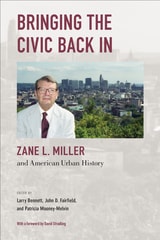
Bringing the Civic Back In
Zane L. Miller and American Urban HistoryEdited by Larry Bennett, John D. Fairfield, and Patricia Mooney-Melvin
Temple University Press, 2022
With the passing of Zane L. Miller in 2016, academia lost a renowned scholar and one of the key founders of new urban history—a branch of the discipline that placed urban life at the center of American history and treated the city as an arena for civic and political action. He was a devoted, tireless mentor who published or fostered dozens of books and articles on urban history. He also co-founded Temple University Press’ foundational series Urban Life, Landscape, and Policy.
Bringing the Civic Back In provides a critical overview, appreciation, and extension of Miller’s work as scholar, editor, mentor, colleague, and citizen. Included are three excerpts from Miller’s final, unfinished work, in which he presented cities as the source of a civic nationalism he viewed as fundamental to the development of American democracy. The editors—along with contributors Robert B. Fairbanks and Charles Lester—reflect on the life and work of their friend as well as his role in creating a Cincinnati school of urban history. These original essays by practitioners of Miller’s approach highlight the power of ideas to shape social change.

British Soldiers, American War
Voices of the American RevolutionDonald N. Hagist
Westholme Publishing, 2012
Nine Rare and Fascinating First-Person Profiles of Soldiers Who Fought for the British Crown
Much has been written about the colonists who took up arms during the American Revolution and the army they created. Far less literature, however, has been devoted to their adversaries. The professional soldiers that composed the British army are seldom considered on a personal level, instead being either overlooked or inaccurately characterized as conscripts and criminals. Most of the British Redcoats sent to America in defense of their government’s policies were career soldiers who enlisted voluntarily in their late teens or early twenties. They came from all walks of British life, including those with nowhere else to turn, those aspiring to improve their social standing, and all others in between. Statistics show that most were simply hardworking men with various amounts of education who had chosen
the military in preference to other occupations. Very few of these soldiers left writings from which we can learn their private motives and experiences.
British Soldiers, American War: Voices of the American Revolution is the first collection of personal narratives by British common soldiers ever assembled and published. Author Don N. Hagist has located first-hand accounts of nine soldiers who served in America in the 1770s and 1780s. In their own words we learn of the diverse population—among them a former weaver, a boy who quarelled with his family, and a man with wanderlust—who joined the army and served tirelessly and dutifully, sometimes faithfully and sometimes irresolutely, in the uniform of their nation. To accompany each narrative, the author provides a contextualizing essay based on archival research giving background on the soldier and his military service. Taken as a whole these true stories reveal much about the individuals who composed what was, at the time, the most formidable fighting force in the world.
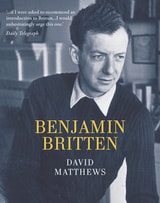
Britten
Centenary EditionDavid Matthews
Haus Publishing, 2013
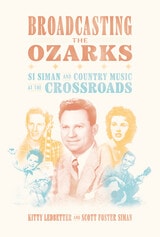
Broadcasting the Ozarks
Si Siman and Country Music at the CrossroadsKitty Ledbetter
University of Arkansas Press, 2024
“It’s good to see Si Siman and the Ozark Jubilee get their due in Broadcasting the Ozarks.”
—Willie Nelson
Broadcasting the Ozarks explores the vibrant country music scene that emerged in Springfield, Missouri, in the 1930s and thrived for half a century. Central to this history is the Ozark Jubilee (1955–60), the first regularly broadcast live country music show on network television. Dubbed the “king of the televised barn dances,” the show introduced the Ozarks to viewers across America and put Springfield in the running with Nashville for dominance of the country music industry—with the Jubilee’s producer, Si Siman, at the helm.
Siman’s life story is almost as remarkable as the show he produced. He was booking Tommy Dorsey, Ella Fitzgerald, and Glenn Miller during the mid-1930s while still a high school student and produced nationally syndicated country music radio shows in the decades that followed. Siman was a promotional genius with an ear for talent, a persuasive gift for gab, and the energy and persistence to make things happen for many future Country Music Hall of Famers, including Chet Atkins, Porter Wagoner, the Browns, and Brenda Lee. Following the Jubilee’s five-year run, Siman had a hand in some of the greatest hits of the twentieth century as a music publisher, collaborating with such songwriters as rockabilly legend and fellow Springfieldian Ronnie Self, who wrote Brenda Lee’s signature hit, “I’m Sorry,” and Wayne Carson, who wrote Willie Nelson’s “Always on My Mind.” Although Siman had numerous opportunities to find success in bigger cities, he chose to do it all from his hometown in the Ozarks.
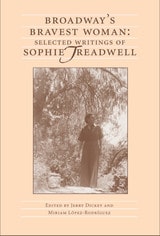
Broadway's Bravest Woman
Selected Writings of Sophie TreadwellEdited by Jerry Dickey and Miriam Lopez-Rodriguez
Southern Illinois University Press, 2006
This collection of plays, fiction, and journalistic essays by Sophie Treadwell provides an engaging portrait of one of America’s most innovative yet neglected feminists. Broadway’s Bravest Woman: Selected Writings of Sophie Treadwell is the first critical compilation of her prose and drama and highlights the most significant and formerly unavailable pieces of her work. Editors Jerry Dickey and Miriam López-Rodriguez place Treadwell within the context of the early twentieth century and outline four themes that infused her feminist ideology: the social positioning of women, ethnic identity in the United States, tensions between modern progressivism and conservatism, and the individual’s role in the face of social justice.
Treadwell’s critical reputation as a dramatist is largely based on the success of the 1928 expressionist drama Machinal, but little is known about her other dramas, much less her fiction and journalism. Drawing largely upon unpublished manuscripts, this volume documents the breadth of Treadwell’s work, from an investigative newspaper serial written in 1914 to selections from an autobiographical novel completed during World War II, which chronicled her development as a feminist.
In the introduction, Dickey and López-Rodriguez present a detailed portrait of Treadwell’s sensational but critically neglected journalistic career, from her 1915 serial on social welfare for prostitutes in San Francisco to her 1921 ground-breaking story on the Mexican revolutionary leader Pancho Villa. They also outline the personal and social factors that helped shape Treadwell’s feminist ideals.
Expanding the awareness of the feminist writer’s accomplishments, Broadway’s Bravest Woman is critical resource for students, scholars, and theatre artists. The collection, enhanced by six illustrations, not only offers the most complete portrait of Treadwell to date as a significant feminist voice in modern America but also provides a glimpse into the social life and international relations of the United States in the interwar period of the twentieth century.
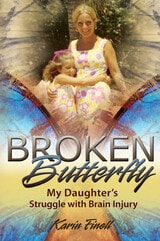
Broken Butterfly
My Daughter's Struggle with Brain InjuryKarin Finell
University of Missouri Press, 2012
“It all began with the bite of a mosquito. Yes, with a bite of this pesky, but seemingly so innocuous little insect that had been sucking her blood. Not just one, but hundreds had punctured her arms and legs with red marks which later swelled to small welts. Who would ever have thought that our family's life would become derailed, that its tightly woven fabric would eventually fray and break—all from the bite of a mosquito?”
Broken Contract
A Memoir of Harvard Law SchoolRichard D. Kahlenberg
University of Massachusetts Press, 1999
In 1986, 70 percent of the first-year class of Harvard Law School wanted to pursue careers in public-interest law. Ten years later, the same percentage of this class was pursuing careers in private corporate firms. How is it that these students began their careers interested in using law as a vehicle for social change, but ended up in those very law firms most resistant to change? How are law students able to reconcile liberal politics with careers in corporate law?
Richard D. Kahlenberg's Broken Contract serves to warn prospective law students on the transformation that happens during the second and third years. His memoir explores the intense competitiveness and insidious pressure leading to jobs that are lucrative, prestigious, and challenging, but ultimately unsatisfying.
Though Broken Contract doesn't seek to convince every law student to go into public service, Kahlenberg means to challenge and restructure our social institutions to make it easier to follow our impulses toward good instead of toward the goods.

Bronislava Nijinska
Early MemoirsIrina Nijinska, Jean Rawlinson, eds. and trans.
Duke University Press, 1992
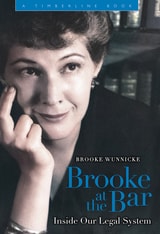
Brooke at the Bar
Inside Our Legal SystemBrooke Wunnicke
University Press of Colorado, 2023
Brooke shares vignettes of her early life—California in the Great Depression, college at Stanford, law school in Colorado during World War II, and the 1946 opening of her Cheyenne law office, a precedent for women in law. She vividly describes memorable and amusing experiences with clients, witnesses, lawyers, juries, and judges and explains some significant cases. She recounts important and dynamic events from her twelve years as Denver’s chief appellate deputy district attorney, an era during which she was an inestimable mentor to many young lawyers who became prominent in the private and public sectors.
Brooke passionately believed “the law has been and will continue to be civilization’s hope.” In her book’s final part, she demystifies many legal terms and procedures and describes the parts of a civil jury trial—including information for jurors and witnesses—and provides an enthusiastic and clear refresher on the US Constitution and Bill of Rights.
Brooke at the Bar is a unique and historically important contribution that will be of interest to general readers, scholars, and students interested in US law, political science, government, women’s history, twentieth-century western history, civil rights, and legal communities, including those in Wyoming and Colorado, where Brooke was “at the Bar.”
Brooklyn Odyssey
My Journey out of HasidismZalman Newfield
Temple University Press, 2026
Growing up in Crown Heights, Brooklyn as a member of the Chabad-Lubavitch Hasidic Orthodox Jewish community, Zalman Newfield was raised in an atmosphere of strict gender segregation, rigorous religious education, and nearly all-consuming ritual practices. Trained to be a Lubavitch emissary, he traveled around the world doing Jewish outreach to help usher in the messianic redemption. However, after exposure to the wider world, he abandoned the faith of his youth.
Brooklyn Odyssey is Newfield’s poignant and hopeful memoir about exiting Orthodoxy. He recounts asserting his individuality and taking the radical step of shaving his beard. Reflective about his upbringing, Newfield is open to and curious about a world beyond Brooklyn while also maintaining his profound bond with his family and Jewish tradition. He writes candidly about his emotional, intellectual, and social experiences in and out of the Lubavitch community.
From pivotal moments of devastation, including the illness and death of his younger brother and of his revered spiritual leader Rabbi Menachem Mendel Schneerson, to moments of joyful resolve, including the decision to pursue a doctorate and marry a non-Orthodox Jew, Newfield takes readers on his moving and impactful journey.
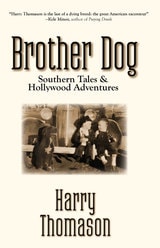
Brother Dog
Southern Tales and Hollywood AdventuresHarry Thomason
Parkhurst Brothers, Inc., 2019
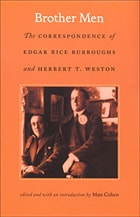
Brother Men
The Correspondence of Edgar Rice Burroughs and Herbert T. WestonEdgar Rice Burroughs and Herbert T. Weston
Duke University Press, 2005
The Burroughs-Weston letters trace a fascinating personal and business relationship that evolved as the two men and their wives embarked on joint capital ventures, traveled frequently, and navigated the difficult waters of child-rearing, divorce, and aging. Brother Men includes never-before-published images, annotations, and a critical introduction in which Cohen explores the significance of the sustained, emotional male friendship evident in the letters. Rich with insights related to visual culture and media technologies, consumerism, the history of the family, the history of authorship and readership, and the development of the West, these letters make it clear that Tarzan was only one small part of Edgar Rice Burroughs’s broad engagement with modern culture.
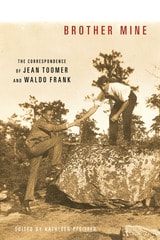
Brother Mine
The Correspondence of Jean Toomer and Waldo FrankEdited by Kathleen Pfeiffer
University of Illinois Press, 2010
The friendship of Jean Toomer and Waldo Frank was one of the most emotionally intense, racially complicated, and aesthetically significant relationships in the history of American literary modernism. Waldo Frank was an established white writer who advised and assisted the younger African American Jean Toomer as he pursued a literary career. They met in 1920, began corresponding regularly in 1922, and were estranged by the end of 1923, the same year that Toomer published his ambitiously modernist debut novel, Cane.
While individual letters between Frank and Toomer have been published separately on occasion, they have always been presented out of context. This volume presents for the first time their entire correspondence in chronological order, comprising 121 letters ranging from 200 to 800 words each. Kathleen Pfeiffer annotates and introduces the letters, framing the correspondence and explaining the literary and historical allusions in the letters themselves.
Reading like an epistolary novel, Brother Mine captures the sheer emotional force of the story that unfolds in these letters: two men discover an extraordinary friendship, and their intellectual and emotional intimacy takes shape before our eyes. This unprecedented collection preserves the raw honesty of their exchanges, together with the developing drama of their ambition, their disappointments, their assessment of their world, and ultimately, the betrayal that ended the friendship.

Brothers Grimm And Their Critics
Folktales And The Quest For MeaningChrista Kamenetsky
Ohio University Press, 1993
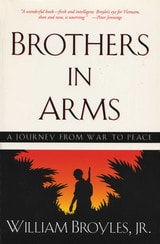
Brothers in Arms
A Journey from War to PeaceBy William Broyles, Jr.
University of Texas Press, 1996
Reviews of the Knopf edition:
"A wonderful book—fresh and intelligent. Broyles's eye for Vietnam, then and now, is unerring." —Peter Jennings
"[A] superbly written, often moving story of Broyles' journey back to the killing ground in Vietnam where he once served as a Marine lieutenant. A cool, clear meditation that stings the heart." —Kirkus Reviews
"A first-rate piece of work, infused with an ideal American common decency and common sense." —Kurt Vonnegut
"Exceptional and memorable." —Gay Talese
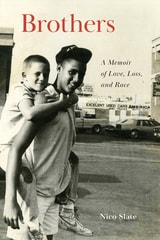
Brothers
A Memoir of Love, Loss, and RaceNico Slate
Temple University Press, 2023
Brothers is Nico Slate’s poignant memoir about Peter Slate, aka XL, a Black rapper and screenwriter whose life was tragically cut short. Nico and Peter shared the same White American mother but had different fathers. Nico’s was White; Peter’s was Black. Growing up in California in the 1980s and 1990s, Nico often forgot about their racial differences until one night in March 1994 when Peter was attacked by a White man in a nightclub in Los Angeles.
Nico began writing Brothers with the hope that investigating the attack would bring him closer to Peter. He could not understand that night, however, without grappling with the many ways race had long separated him from his brother.
This is a memoir of loss—the loss of a life and the loss at the heart of our racial divide—but it is also a memoir of love. The love between Nico and Peter permeates every page of Brothers. This achingly beautiful memoir presents one family’s resilience on the fault lines of race in contemporary America.
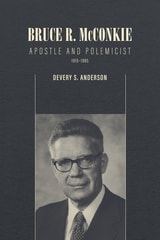
Bruce R. McConkie
Apostle and Polemicist, 1915–1985Anderson, Devery S.
Signature Books, 2024
Although he served as an apostle in the Church of Jesus Christ of Latter-day Saints for only twelve and a half years, Bruce R. McConkie’s twenty-six years’ service in the First Council of Seventy had already made him a household name within the church. Called to full-time church service at age thirty-one, McConkie quickly gained a reputation as a theologian and doctrinal teacher. He became a prolific writer, and his controversial book, Mormon Doctrine, remained a bestseller for decades. His writing style, dogmatic approach, and quickness to reprimand others he believed in error made him many enemies, while others endeared themselves to him because of those very traits.
McConkie the man was far more complex than the serious and focused general authority most church members saw and heard at the pulpit. Those who knew him best experienced his profound sense of humor. His passion for jogging, rock hounding, and jewelry making occupied much of his free time. Those who witnessed his final address delivered days before his death felt compassion toward him, no matter how they had always viewed him as a writer, speaker, or leader. Truly, to understand Bruce R. McConkie one must look closely at the entire picture.
Bruegel, or the Workshop of Dreams
A NovelClaude-Henri Rocquet
University of Chicago Press, 1991
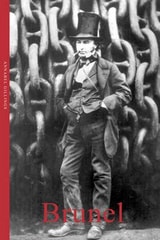
Brunel
Annabel Gillings
Haus Publishing, 2006
Bryher
Two Novels: Development And Two SelvesUniversity of Wisconsin Press, 2000
Bryher (born Annie Winifred Ellerman) is perhaps best known today as the lifelong partner of the poet H.D. She was, however, a central figure in modernist and avant-garde cultural experimentation in the early twentieth century; a prolific producer of poetry, novels, autobiography, and criticism; and an intimate and patron of such modernist artists as Gertrude Stein, Marianne Moore, and Dorothy Richardson. Bryher’s own path-breaking writing has remained largely neglected, long out of print, and inaccessible to those interested in her oeuvre. Now, for the first time since their original publication in the early 1920s, two of Bryher's pioneering works of fictionalized autobiography, titled Development and Two Selves, are reprinted in one volume for a new audience of readers, scholars, and critics.
Blending poetry, prose, and autobiographical details, Development and Two Selves together constitute a compelling bildungsroman that is among the first ever to follow a young woman's process of coming out. Through the fictionalized character Nancy, the novels trace Bryher’s life through her childhood and young adulthood, giving the reader an account of the development of a unique lesbian, feminist, and modernist consciousness. Development and Two Selves recover significant work by one of the first experimenters of the modernist movement and are a welcome reintroduction of the enigmatic Bryher.
Bub
Essays from Just North of NashvilleDrew Bratcher
University of Iowa Press, 2022
Seamlessly blending memoir and arts criticism and aiming at both the heart and the head, this is a book about listening closely to stories and songs, about leaving home in order to find home, and about how the melodies and memories absorbed along the way become “a living music that advances and prevails upon us at formative moments, corralling chaos into the simple, liberating stockade of verse, chorus, verse.”
Buckeye Women
The History of Ohio’s DaughtersStephane Elise Booth
Ohio University Press, 2001
By the last two decades of the twentieth century, Ohio women had held positions as university presidents, chief executive officers, judges, superintendents of schools, and lieutenant governor. They had won Pulitzer Prizes and, in one case, the Nobel Prize for Literature.
But these women stood on the shoulders of those who came before: the pioneering women who helped tame the Ohio frontier, who filled the breach, who worked for reform, and who struggled for their own rights as citizens of one of the most prosperous states in the Union.
Buckeye Women is an accessible and comprehensive account of the role Ohio women have assumed in the history of the state and a narrative of their hardships and of the victories that have been won in the past two hundred years.
In this timely contribution to the Ohio Bicentennial Series, Professor Stephane Booth has written a rich and well-researched volume, providing for the first time a record of the vast and pivotal accomplishments shared by the women of Ohio over the last two centuries and documenting their contribution to the state’s remarkable heritage.
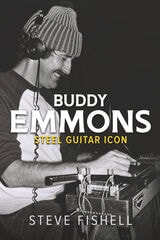
Buddy Emmons
Steel Guitar IconSteve Fishell
University of Illinois Press, 2022
The acknowledged maestro of the pedal steel guitar, Buddy Emmons lent his unparalleled virtuosity to over five decades of hit recordings and set standards that remain the benchmark for musicians today.
Steve Fishell’s merger of biography and memoir draws extensively on in-depth interviews with Emmons and the artist's autobiographical writings. Emmons went from playing strip clubs to a Grand Ole Opry debut with Little Jimmy Dickens at age 18. His restless experimentation led to work with Ernest Tubb and Ray Price--and established him in a career that saw him play alongside a who’s who of American music. Fishell weaves in stories and anecdotes from Willie Nelson, Brenda Lee, Linda Ronstadt, Pat Martino, and many others to provide a fascinating musical and personal portrait of an innovator whose peerless playing and countless recordings recognized no boundaries.
A one-of-a-kind life story, Buddy Emmons expands our view of a groundbreaking artist and his impact on country music, jazz, and beyond.

Building Bridges, Crossing Borders
One Young Deaf Woman’s EducationAnn Darby Getty
Gallaudet University Press, 2014
As soon as they realized that their daughter was deaf, Kyler’s parents, who were hearing, immediately began to learn sign language. They also engaged Darby, a parent/infant educator employed by the state school for the deaf, to work with Kyler. From the age of 13 months until Kyler’s college graduation 22 years later, Darby was involved in her education and development.
Despite living in a rural area, Kyler enjoyed an array of services, including parent/infant education, sign language interaction/modeling, speech and language therapy, and also a cochlear implant. At the same time that she developed her speech skills, sign language continued to be a critically important facet of her communication. In grade school, she learned with other deaf students, while in high school, she worked successfully in mainstream classrooms with interpreters and notetakers. As a college graduate, gifted artist, and veterinarian’s assistant today, Kyler exemplifies how a balanced approach to deaf education, using all resources at hand, can achieve remarkable results. Her story serves as a model for parents of other deaf children and the professionals who work with them.
Building Domestic Liberty
Charlotte Perkins Gilman's Architectural FeminismPolly Wynn Allen
University of Massachusetts Press, 1988
Building Domestic Liberty offers a critical and admiring analysis of feminist philosopher Charlotte Perkins Gilman (1860–1935). Polly Allen examines Gilman's approach to architecture, landscape, and neighborhood design and discusses Gilman's case against prevailing household design and looks at her philosophy of world improvement.
Building Taliesin
Frank Lloyd Wright’s Home of Love and LossRon McCrea
Wisconsin Historical Society Press, 2012

Building Tall
My Life and the Invention of Construction ManagementJohn L. Tishman and Tom Shachtman
University of Michigan Press, 2011
"John Tishman is a true pioneer in the Construction Management industry. Through his CM leadership, some of America's most well-known buildings have been brought to successful completion."
---Bruce D'Agostino, president and chief executive, Construction Management Association of America
"Building Tall will provide readers with insights into John Tishman's career as a visionary engineer, landmark builder, and great businessman. Responsible for some of the construction world's most magnificent projects, John is one of the preeminent alumni in the history of Michigan Engineering. His perspectives have helped me throughout my time as dean, and his impact will influence generations of Construction Management professionals and students."
---David C. Munson, Jr., Robert J. Vlasic Dean of Engineering, University of Michigan
In this memoir, University of Michigan graduate John L. Tishman recounts the experiences and rationale that led him to create the entirely new profession now recognized and practiced as Construction Management. It evolved from his work as the construction lead of the "owner/builder" firm Tishman Realty and Construction, and his personal role as hands-on Construction Manager in the building of an astonishing array of what were at the time the world's tallest and most complex projects. These include
- The world's first three 100-story towers---the original "twin towers" of the World Trade Center in Manhattan and the Hancock Tower in Chicago.
- The Epcot Center at Disney World.
- The Renaissance Center in Detroit.
- New York's Madison Square Garden.
Tishman interweaves the stories behind the construction of these and many other important buildings and projects with personal reminiscences of his dealings with Henry Ford, Jr., Disney's Michael Eisner, casino magnate Steve Wynn, and many others into a practical history of the field of Construction Management, which he pioneered.
This book will be of interest not only to a general public interested in the stories and personalities behind many of the most iconic construction projects of the post–World War II period in the United States but to students of engineering and architecture and members of the new field of Construction Management.
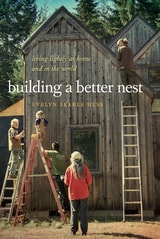
Building a Better Nest
Living Lightly at Home and in the WorldEvelyn Searle Hess
Oregon State University Press, 2015
What does it mean to build a better nest? Better for whom? Is it better for the individual or family? The planet? Green building and sustainable design are popular buzzwords, but to Hess, sustainable building is not a simple matter of buying and installing the latest recycled flooring products. It is also about cooperative work: working together in employment, in research, in activism, and in life. Hess is concerned with her local watershed, but also with the widening income gap, disappearing species, and peak resources. She actively works to reduce overconsumption and waste. For Hess, these problems are both philosophical and practical.
As Hess and her husband age, the questions of how to live responsibly arise with greater frequency and urgency. With unfailing wit and humor, she looks for answers in such places as neuroscience, Buddhism, and her ancestral legacy. Building a Better Nest will appeal to anyone with an interest in sustainable building, off-grid living, or alternative communities. The questions it asks about the way we live are earnest and important, from an author whose voice is steeped in wisdom and gratitude.
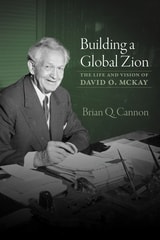
Building a Global Zion
The Life and Vision of David O. McKayBrian Q. Cannon
Signature Books, 2025
Called as an apostle in 1906, David O. McKay devoted the remaining sixty-four years of his life to serving in the Church of Jesus Christ of Latter-day Saints, including nineteen as church president. That lengthy tenure, combined with his warmth, extensive personal ministry, broadmindedness, deep spirituality, and unprecedented global travel made him one of the church’s most beloved and influential leaders of all time. When he died in 1970, roughly 60 percent of the church’s membership had known no other church president. Memories of McKay’s teachings and ministry remain a taproot for the spiritual convictions and values of many Latter-day Saints.
Brian Q. Cannon’s biography offers a fresh perspective on important features of McKay’s life, showing how his mission to Scotland, round-the-world tour as an apostle, and service as president of the European Mission shaped his global vision and priorities. Building a Global Zion illuminates previously underappreciated facets of McKay’s reach, including his crusades against alcohol consumption and political corruption, his long-term administration of missionary work, his spiritual impressions, his personnel decisions, and his mediation of interpersonal impasses in administrative settings. Cannon carefully reconstructs facets of McKay’s vast ministry to individuals, highlights distinctive themes of his teachings, and explores challenges that confronted McKay’s associates as his health and acuity waned.
Bull Connor
William A. Nunnelley
University of Alabama Press, 1990
Nunnelley’s biography covers Connor’s early life as a sportscaster, his years as a nearly pathological police chief, and his reign as president of a corrupt public service commission.While providing the first published biographical study of Connor, Bull also traces the evolution of the civil rights movement in Birmingham. The book amplifies traditional one-dimensional accounts through the use of such primary sources a s Connor FBI files gained from a Freedom of Information request, Connor papers discovered in an old fire station about to be demolished, files from a law firm which represented Connor, interviews, and newspaper files. Connor’s racist image remains intact, but a more complete portrait of the controversial commissioner emerges.
Eugene “Bull” Connor gained infamy during the spring of 1963 as the heavy-handed Birmingham police commissioner who turned power hoses and police dogs on the black demonstrators led by Martin Luther King, Jr. Bull Connor and Birmingham symbolized hard-line Southern racism. Connor’s actions received national and international media coverage, which dramatized the plight of black people in segregated areas, giving the civil rights movement much-needed attention. After viewing television reports of the fire-hose and police-dogs episode, President John Kennedy said, “The civil rights movement should thank God for Bull Connor. He helped is as much as Abraham Lincoln.”
Bull Connor was an unlikely catalyst for the civil rights movement. Rather than forestalling integration, his response to the 1963 demonstrations hastened the demise of the dual society of which he became a symbol. Within weeks of King’s much-publicized Birmingham campaign, Congress took the first steps toward enacting the most sweeping civil rights legislation in American history. Birmingham was a turning point in the civil rights struggle, and Connor was the movement’s perfect adversary.
Buried Indians
Digging Up the Past in a Midwestern TownLaurie Hovell McMillin
University of Wisconsin Press, 2006
In Buried Indians, Laurie Hovell McMillin presents the struggle of her hometown, Trempealeau, Wisconsin, to determine whether platform mounds atop Trempealeau Mountain constitute authentic Indian mounds. This dispute, as McMillin subtly demonstrates, reveals much about the attitude and interaction-past and present-between the white and Indian inhabitants of this Midwestern town.
McMillin's account, rich in detail and sensitive to current political issues of American Indian interactions with the dominant European American culture, locates two opposing views: one that denies a Native American presence outright and one that asserts its long history and ruthless destruction. The highly reflective oral histories McMillin includes turn Buried Indians into an accessible, readable portrait of a uniquely American culture clash and a dramatic narrative grounded in people's genuine perceptions of what the platform mounds mean.
Burn, Baby! BURN!
The Autobiography of Magnificent MontagueMagnificent Montague with Bob Baker
University of Illinois Press, 2009
Like many black disc jockeys of his day, Montague played a role in his community beyond simply spreading the music of James Brown, Otis Redding, Aretha Franklin, and other prominent artists. Montague served as an unofficial spokesman for his black listeners, reflecting their beliefs and acting as a sounding board for their concerns.
Montague was based in Los Angeles in 1965 when the Watts rioters seized on his incendiary slogan, turning the shout of musical appreciation into a rallying cry for racial violence. In Burn, Baby! BURN! Montague recalls these tumultuous times, including the personal struggle he faced over whether to remain true to his listeners or bend to political pressure and stop shouting his suddenly controversial slogan.
Since the mid-1950s Montague had also expressed his passion for African American culture by becoming a zealous collector of artifacts of black history. He has built a monumental collection, taking time out from his collecting to become only the second African American to build his own radio station literally from the ground up.
A compelling account of a rich and varied life, Burn, Baby! BURN! gives an insider's view of half a century of black history, told with on-the-air zest by the DJ/historian who was there to see it unfold.
Burnham of Chicago
Architect and PlannerThomas S. Hines
University of Chicago Press, 1979
"Professor Hines has written what may prove to be an epoch-making book in the study of American civilization."—Reyner Banham, Times Literary Supplement
"Indeed, the book as a whole is a model of the balanced portrait, sure of Burnham's importance but always conscious of his failings."—Paul Goldberger, New York Times Book Review
"In every sense this is the definitive biography, and it is long overdue."—Harry Weese, Chicago Tribune
"This is a many-faceted book. Even if one were not interested in architecture or city planning, nor especially in Burnham the man, one would likely find the book rewarding because of the window it provides on a significant period of American history. . . . Hines brings alive many of the forces that were beating upon Burnham and his contemporaries, and which are shaping our lives today."—Edmund M. Bacon, Architectural Record
"Hines has provided an intelligently organized, well-written, and fascinating account of Burnham's entire career. The analysis [is] a model of scholarship, good judgment, and literary grace that satisfies a long felt need."—Kenneth T. Jackson, American Historical Review
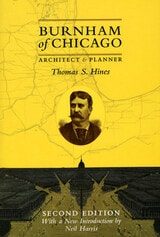
Burnham of Chicago
Architect and Planner, Second EditionThomas S. Hines
University of Chicago Press, 2008
“In every sense this is the definitive biography.”—Harry Weese, Chicago Tribune
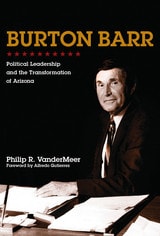
Burton Barr
Political Leadership and the Transformation of ArizonaPhilip R. VanderMeer, Foreword by Alfredo Gutierrez
University of Arizona Press, 2014
Considered perhaps the most influential person in Arizona’s political development, Burton Barr represented north central Phoenix in the Arizona House of Representatives for the twenty-two years from 1964 to 1986. As the Republican House Majority Leader for twenty of those years, he left his fingerprints on every major piece of legislation during those decades, covering such issues as air pollution, health care for indigents, school aid, the tax code, prison reform, child care, groundwater management, and freeway funding.
Burton Barr’s political life unfolded during the very time his state and region shifted from being outliers to trendsetters. His choices in policy making and his leadership style were both an outcome and a creator of his sociopolitical environment. Arizona politics in the 1960s and ’70s was a rich brew of key elements, a time when the economy was being transformed, the nature and distribution of populations shifted, partisan politics were in flux, and the very lifeblood of the West—water—was being contested under increasing pressures of usage and depletion.
How Barr successfully responded to those challenges is the story of Arizona’s development during those years. At the heart of it, Barr’s political life and personality are inextricably bound up with the life of the West.
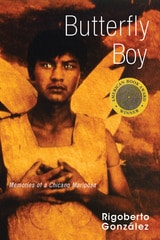
Butterfly Boy
Memories of a Chicano MariposaRigoberto Gonzalez
University of Wisconsin Press, 2011
Winner of the American Book Award

Buying the Farm
Peace and War on a Sixties CommuneTom Fels
University of Massachusetts Press, 2012
With deft individual portraits, Fels reveals the social dynamics of the group and explores the ongoing difficulties faced by a commune that was founded in idealism and sought to operate on the model of a leaderless democracy. He draws on a large body of farm-family and 1960s-related writing and the notes of community members to present a variety of points of view. The result is an absorbing narrative that chronicles the positive aspects of Montague Farm while documenting the many challenges and disruptions that marked its history.
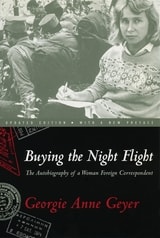
Buying the Night Flight
The Autobiography of a Woman Foreign CorrespondentGeorgie Anne Geyer
University of Chicago Press, 2001
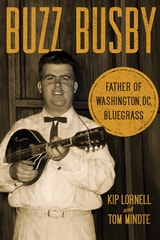
Buzz Busby
Father of Washington, DC, BluegrassKip Lornell and Tom Mindte
University of Illinois Press, 2026
Buzz Busby’s move to Washington, D.C., in 1951 helped launch bluegrass in the nation’s capital while the intensity of his mandolin playing drew raves for its unrelenting pace and innovative style. His high lonesome singing rivaled that of Bill Monroe. Kip Lornell and Tom Mindte draw on interviews and some fifty hours of Busby speaking about his life to tell the story of a largely forgotten bluegrass virtuoso.
Busby and his band the Bayou Boys stood front and center on a mid-1950s D.C.-area TV show that, though short-lived, catalyzed the formation of the city’s bluegrass community. Time with the Louisiana Hayride and classic if little-heard bluegrass sides like “Lonesome Wind” seemed to promise a bright future. But a devastating car wreck and a host of legal and personal troubles triggered a long decline into drug and alcohol abuse that undermined Busby’s career and led him to sum up, “I started at the top and diligently worked my way to the bottom.”
Entertaining and vivid, Buzz Busby tells the story of a musician’s musician and his hardscrabble life in bluegrass.

By Accident or Design
Challenges and Coincidences in My LifeRosemary Sassoon
Intellect Books, 2018
By Those Who Knew Them
French Modernists Left, Right, and CenterHarvey Hill
Catholic University of America Press, 2008
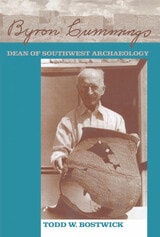
Byron Cummings
Dean of Southwest ArchaeologyTodd W. Bostwick
University of Arizona Press, 2006
This book presents the first comprehensive examination of Cummings’ life, offering readers a greater understanding of his trailblazing work. Todd Bostwick elucidates Cummings’ many intellectual and cultural contributions, investigates the controversies in which he was embroiled, and describes his battles to wrest control of Arizona archaeology from eastern institutions that had long dominated Southwest archaeology.
Cummings saw the Southwest as an American wilderness where the story of cultural development revealed by the archaeologist and anthropologist was as important as it was in Europe. Bostwick’s meticulous account of his life reflects his great reverence for the region and pays tribute to a man whose dedication, mentoring, and friendship have forever sealed his place as The Dean.