Results by title
28167 books match the query 'History' and 1262 start with b
Becoming the Voinovich School
A History of Ohio University’s Voinovich School of Leadership and Public ServiceR. Gregory Browning, Ph.D.
Ohio University Press, 0
The evolution of a university-based public service model that integrates leadership, applied research, and regional engagement in Appalachian Ohio
Becoming the Voinovich School chronicles the evolution of Ohio University’s Voinovich School of Leadership and Public Service, a pioneering institution that blends academic rigor with hands-on public engagement. Founded on the vision of political scientist Mark Weinberg and inspired by the leadership philosophy of former US senator and Ohio governor George V. Voinovich, the school has become a national model for university-based public service.
From its modest beginnings in 1976—when Weinberg was hired to build a public administration program from scratch—the school has grown into a dynamic “do tank” serving the Appalachian Ohio region and beyond. Early initiatives like the Institute for Local Government Administration and Rural Development laid the groundwork for a new kind of academic center: one that connects faculty expertise with real-world problem-solving. Through applied research, GIS analysis, leadership training, and program evaluation, the school has become a trusted convener and catalyst for change.
The Voinovich School’s mission spans five key sectors: economic development, community development, education and child wellness, environmental restoration, and health and well-being. Its work is rooted in a commitment to empowering communities, especially those facing the economic and health challenges of postindustrial Appalachia. By pairing grant-funded projects with experiential education, the school has created opportunities for students to engage directly with pressing public issues while building leadership capacity across the region.
In 2007, the center was formally renamed the Voinovich School, reflecting its expanded scope and growing impact. Over the next decade, it launched new graduate programs, raised its national ranking, and became the educational partner for the Ohio Economic Development Institute. Today, the school continues to leverage state and federal funding, private-sector partnerships, and alumni networks to address complex challenges with innovative, community-driven solutions.
This book offers a compelling account of how one university unit transformed public service education—and how its legacy continues to shape leadership and policy in and beyond Ohio.

Bede the Theologian
History, Rhetoric, and SpiritualityJohn P. Bequette
Catholic University of America Press, 2022

Bedrooms of the Fallen
Ashley Gilbertson
University of Chicago Press, 2014
The book’s wide-format black-and-white images depict the bedrooms of forty fallen soldiers—the equivalent of a single platoon—from the United States, Canada, and several European nations. Left intact by families of the deceased, the bedrooms are a heartbreaking reminder of lives cut short: we see high school diplomas and pictures from prom, sports medals and souvenirs, and markers of the idealism that carried them to war, like images of the Twin Towers and Osama Bin Laden. A moving essay by Gilbertson describes his encounters with the families who preserve these private memorials to their loved ones, and shares what he has learned from them about war and loss.
Bedrooms of the Fallen is a masterpiece of documentary photography, and an unforgettable reckoning with the human cost of war.
Beekmantown, New York
Forest Frontier to Farm CommunityBy Philip L. White
University of Texas Press, 1979
This volume reports in detail how a particular portion of the American wilderness developed into a settled farming community. To fully comprehend the history of the American people in the early national period, an understanding of this transformation from forest to community—and the pattern of life within such communities where the vast majority of the people live—is essential.
Three major conclusions emerge from Philip L. White's study of Beekmantown, New York. First, the economic advantages of the frontier attracted a first generation of settlers relatively high in social and economic status, but the disappearance of frontier conditions brought a second generation of settlers appreciably lower in status. Second, White rejects the romantic notion that the frontier fostered equality and argues instead that the frontier's economic opportunities fostered inequality. Finally, in contrast to revisionist arguments, he affirms that in Beekmantown the Jacksonian period does indeed warrant characterization as the era of the "common man."
This book represents a model in community history: the narrative is full of human interest; the scholarship is prodigious; the applications are universal.

Beer Ghosts
In Search of Lost Hops and the Women Who Grew ThemJennifer A. Jordan
University of Chicago Press, 2026
The little-known story of the young women who played a vital role in the rise of America’s great breweries.
Water, malt, yeast, and hops: these are essential ingredients of beer. Hops, specifically, play an outsized role in determining its flavor and aroma. In Beer Ghosts, Jennifer Jordan takes us back to a brief but pivotal moment in the nineteenth century when Wisconsin produced much of the hops grown in the United States. Yet those long-ago hops are not the only ghosts in Jordan’s story. Haunting the pages of this book are the young women whose work at harvest time was key to the rise of the American beer industry.
Until the early twentieth century, the work of picking hops was a time-consuming process that could only be done by hand, one cone at a time. In nineteenth-century Wisconsin, that work was performed almost exclusively by women and girls, who traveled to hop farms in droves as summer came to a close and the harvest began. At the height of the hop boom in the 1860s, farmers and their families laid out beds and prepared food for tens of thousands of seasonal laborers, and hosted parties and dances well into the night. Despite the scale of Wisconsin’s hop boom (and subsequent crash), the industry left behind little trace aside from local records and archives. And it is that barely discernible trace that lures Jordan to dig deeper.
Jordan’s vivid prose takes us back to this era by drawing on a rich trove of archival sources, from the thousands of hop farmers in the agricultural census to the extraordinary diary of a single hop picker, a young woman named Ella. The history of beer is incomplete without the history of Ella and the others who labored in the hop fields and in the houses that hosted them. In this book, Jordan gives life and voice to these beer ghosts who call to us from the past, showing the rich connections between a nation’s beer and the lives that made it possible.
Beer and Revolution
The German Anarchist Movement in New York City, 1880-1914Tom Goyens
University of Illinois Press, 2007
Beer and Revolution examines the rollicking life and times of German immigrant anarchists in New York City from 1880 to 1914. Offering a new approach to an often misunderstood political movement, Tom Goyens puts a human face on anarchism and reveals a dedication less to bombs than to beer halls and saloons where political meetings, public lectures, discussion circles, fundraising events, and theater groups were held.
Goyens brings to life the fascinating relationship between social space and politics by examining how the intersection of political ideals, entertainment, and social activism embodied anarchism not as an abstract idea, but as a chosen lifestyle for thousands of women and men. He shows how anarchist social gatherings were themselves events of defiance and resistance that aimed at establishing anarchism as an alternative lifestyle through the combination of German working-class conviviality and a dedication to the principle that coercive authority was not only unnecessary, but actually damaging to full and free human development as well. Goyens also explores the broader circumstances in both the United States and Germany that served as catalysts for the emergence of anarchism in urban America and how anarchist activism was hampered by police surveillance, ethnic insularity, and a widening gulf between the anarchists' message and the majority of American workers.

Beethoven in Beijing
Stories from the Philadelphia Orchestra's Historic Journey to ChinaJennifer Lin
Temple University Press, 2022
In 1973, Western music was banned in the People’s Republic of China. But in a remarkable breakthrough cultural exchange, the Philadelphia Orchestra conducted a tour of closed-off China, becoming the first American orchestra to visit the communist nation. Jennifer Lin’s Beethoven in Beijing provides a fabulous photo-rich oral history of this boundary-breaking series of concerts the orchestra performed under famed conductor Eugene Ormandy.
Lin draws from interviews, personal diaries, and news accounts to give voice to the American and Chinese musicians, diplomats, journalists, and others who participated in and witnessed this historic event. Beethoven in Beijing is filled with glorious images as well as anecdotes ranging from amusing sidewalk Frisbee sessions and acupuncture treatments for sore musicians to a tense encounter involving Madame Mao dictating which symphony was to be played at a concert.
A companion volume to the film of the same name, Beethoven in Beijing shows how this 1973 tour came at the dawn of a resurgence of interest in classical music in China—now a vital source of revenue for touring orchestras.

Beethoven's French Piano
A Tale of Ambition and FrustrationTom Beghin
University of Chicago Press, 2022
In 1803 Beethoven acquired a French piano from the Erard Frères workshop in Paris. The composer was “so enchanted with it,” one visitor reported, “that he regards all the pianos made here as rubbish by comparison.” While Beethoven loved its sound, the touch of the French keyboard was much heavier than that of the Viennese pianos he had been used to. Hoping to overcome this drawback, he commissioned a local technician to undertake a series of revisions, with ultimately disappointing results. Beethoven set aside the Erard piano for good in 1810.
Beethoven’s French Piano returns the reader to this period of Beethoven’s enthusiasm for all things French. What traces of the Erard’s presence can be found in piano sonatas like his “Waldstein” and “Appassionata”? To answer this question, Tom Beghin worked with a team of historians and musicians to commission the making of an accurate replica of the Erard piano. As both a scholar and a recording artist, Beghin is uniquely positioned to guide us through this key period of Beethoven’s work. Whether buried in archives, investigating the output of the French pianists who so fascinated Beethoven, or seated at the keyboard of his Erard, Beghin thinks and feels his way into the mind of the composer, bringing startling new insights into some of the best-known piano compositions of all time.
Beethoven
A Political Artist in Revolutionary TimesWilliam Kinderman
University of Chicago Press, 2021
William Kinderman presents Beethoven as a civically engaged thinker faced with severe challenges. The composer lived through many tumultuous events—the French Revolution, the rise and fall of Napoleon Bonaparte, and the Congress of Vienna among them. Previous studies of Beethoven have emphasized the importance of his personal suffering and inner struggles; Kinderman instead establishes that musical tensions in works such as the Eroica, the Appassionata, and his final piano sonata in C minor reflect Beethoven’s attitudes toward the political turbulence of the era. Written for the 250th anniversary of his birth, Beethoven takes stock of the composer’s legacy, showing how his idealism and zeal for resistance have ensured that masterpieces such as the Ninth Symphony continue to inspire activists around the globe. Kinderman considers how the Fifth Symphony helped galvanize resistance to fascism, how the Sixth has energized the environmental movement, and how Beethoven’s civic engagement continues to inspire in politically perilous times. Uncertain times call for ardent responses, and, as Kinderman convincingly affirms, Beethoven’s music is more relevant today than ever before.
Before & After
The Architecture of DisasterEyal Weizman and Ines Weizman
Diaphanes, 2025
Catastrophes, bombed-out cities, large-scale political transformations: “Image complexes” of humanitarian and ecological upheaval document the world as a sequence of catastrophes. But who decides how events are presented, determines the resolution of our visual worlds, and controls the circulation or censorship of images?
Eyal and Ines Weizman trace the history of the before-and-after image from nineteenth-century photography to contemporary satellite images and discover a gap that not only conceals the devastating event: it is the human subject itself that is in danger of disappearing from the images. Does humanitarian work, the documentation and reconstruction of war crimes, in which people’s fates and rights should be at the center of attention, paradoxically enter a post-human phase? How can the gap between images become a site of critical counter-reading rather than a symbol of erasure?
In the context of their current research, Eyal and Ines Weizman discuss the history, present, and future of the paradigm of the before-and-after image in an exclusive conversation with Marie Glassl.

Before Amoris Laetitia
The Sources of the ControversyJaroslaw Kupczak
Catholic University of America Press, 2021
Before Before
A Story of Discovery and Loss in Sierra LeoneBetsy Small
University of Michigan Press, 2025
2025 Foreword INDIES Finalist for Political and Social Sciences
- 2026 Nautilus Silver Book Award in World Cultures' Transformational Growth & Development
Sierra Leone is often sensationalized as a place of extreme violence and suffering—of blood diamonds, child soldiers, war amputations, and Ebola and now the highly addictive drug Kush. Before Before captures daily life in a different country, one Betsy Small first encountered as a Peace Corps worker between 1984–1987, and then rediscovered when she returned decades later with her daughter. Living in Tokpombu, a remote community of forty rice-farming families, the author faced struggles that changed her forever and witnessed the growing tensions in this rainforest village—between the young and old, between the traditions of oral history and honoring the ancestors valued by the elders and the siren call of the illicit diamond mines faced by the youth.
Before Before offers a rare portrait of everyday people, with particular focus on the lives of women and girls, before the brutal war of 1991 tore the country apart. Through Small’s account of immersion in another world as she witnessed injustice and was welcomed as a friend, readers are invited to explore the shared ground of our humanity.

Before Bemberg
Women Filmmakers in ArgentinaMatt Losada
Rutgers University Press, 2020
Watch some of the films discussed in the book with English subtitles (https://www.youtube.com/channel/UCF_6F4am5024rklIWwExUVA?view_as=subscriber).
Before Brown
Civil Rights and White Backlash in the Modern SouthGlenn Feldman
University of Alabama Press, 2004
Details the ferment in civil rights that took place across the South before the momentous Brown vs. Board of Education decision in 1954
This collection refutes the notion that the movement began with the Supreme Court decision, and suggests, rather, that the movement originated in the 1930s and earlier, spurred by the Great Depression and, later, World War II—events that would radically shape the course of politics in the South and the nation into the next century.
This work explores the growth of the movement through its various manifestations—the activities of politicians, civil rights leaders, religious figures, labor unionists, and grass-roots activists—throughout the 1940s and 1950s. It discusses the critical leadership roles played by women and offers a new perspective on the relationship between the NAACP and the Communist Party.
Before Brown shows clearly that, as the drive toward racial equality advanced and national political attitudes shifted, the validity of white supremacy came increasingly into question. Institutionalized racism in the South had always offered white citizens material advantages by preserving their economic superiority and making them feel part of a privileged class. When these rewards were threatened by the civil rights movement, a white backlash occurred.
Before Brown
Heman Marion Sweatt, Thurgood Marshall, and the Long Road to JusticeBy Gary M. Lavergne
University of Texas Press, 2010
Winner, Coral Horton Tullis Memorial Prize for Best Book on Texas History, Texas State Historical Association, 2010
Carr P. Collins Award, Texas Institute of Letters, 2011
On February 26, 1946, an African American from Houston applied for admission to the University of Texas School of Law. Although he met all of the school's academic qualifications, Heman Marion Sweatt was denied admission because he was black. He challenged the university's decision in court, and the resulting case, Sweatt v. Painter, went to the U.S. Supreme Court, which ruled in Sweatt's favor. The Sweatt case paved the way for the landmark Brown v. Board of Education of Topeka rulings that finally opened the doors to higher education for all African Americans and desegregated public education in the United States.
In this engrossing, well-researched book, Gary M. Lavergne tells the fascinating story of Heman Sweatt's struggle for justice and how it became a milestone for the civil rights movement. He reveals that Sweatt was a central player in a master plan conceived by the National Association for the Advancement of Colored People (NAACP) for ending racial segregation in the United States. Lavergne masterfully describes how the NAACP used the Sweatt case to practically invalidate the "separate but equal" doctrine that had undergirded segregated education for decades. He also shows how the Sweatt case advanced the career of Thurgood Marshall, whose advocacy of Sweatt taught him valuable lessons that he used to win the Brown v. Board of Education case in 1954 and ultimately led to his becoming the first black Associate Justice of the Supreme Court.
Before Crips
Fussin', Cussin', and Discussin' among South Los Angeles Juvenile GangsJohn C. Quicker and Akil S. Batani-Khalfani
Temple University Press, 2022
This groundbreaking book opens the door on the missing record of South Los Angeles juvenile gangs. It is the result of the unique friendship that developed between John Quicker and Akil Batani-Khalfani, aka Bird, who collaborated to show how structural marginality transformed hang-out street groups of non-White juveniles into gangs, paving the way for the rise of the infamous Crips and Bloods. Before Crips uses a macro historical analysis to sort through political and economic factors to explain the nature of gang creation.
The authors mine a critical archive, using direct interviews with original gang members as well as theory and literature reviews, to contextualize gang life and gang formation. They discuss (and fuss and cuss about) topics ranging from the criminal economy and conceptions of masculinity to racial and gendered politics and views of violence. Their insider/outsider approach not only illuminates gang values and organization, but what they did and why, and how they grew in a backdrop of inequality and police brutality that came to a head with the 1965 Watts Rebellion.
Providing an essential understanding of early South Los Angeles gang life, Before Crips explains what has remained constant, what has changed, and the roots of the violence that continues.
Before Cultures
The Ethnographic Imagination in American Literature, 1865-1920Brad Evans
University of Chicago Press, 2005
In this work, Brad Evans weaves together the histories of American literature and anthropology. His study brings alive not only the regionalist and ethnographic fiction of the time but also revives a range of neglected materials, including the Zuni sketchbooks of anthropologist Frank Hamilton Cushing; popular magazines such as Century Illustrated Monthly, which published Cushing's articles alongside Henry James's; the debate between Joel Chandler Harris, author/collector of the Uncle Remus folktales, and John Wesley Powell, perhaps the most important American anthropologist of the time; and Du Bois's polemics against the culture concept as it was being developed in the early twentieth century.
Written with clarity and grace, Before Cultures will be of value to students of American literature, history, and anthropology alike.
Before Fidel
The Cuba I RememberBy Francisco José Moreno
University of Texas Press, 2007
Before Fidel Castro seized power, Cuba was an ebullient and chaotic society in a permanent state of turmoil, combining a raucous tropical nature with the evils of arbitrary and corrupt government. Yet this fascinating period in Cuban history has been largely forgotten or misrepresented, even though it set the stage for Castro's dramatic takeover in 1959. To reclaim the Cuba that he knew—and add color and detail to the historical record—distinguished political scientist Francisco José Moreno here offers his recollections of the Cuba in which he came of age personally and politically.
Moreno takes us into the little-known world of privileged, upper-middle-class, white Cubans of the 1930s through the 1950s. His vivid depictions of life in the family and on the streets capture the distinctive rhythms of Cuban society and the dynamics between parents and children, men and women, and people of different races and classes. The heart of the book describes Moreno's political awakening, which culminated during his student years at the University of Havana. Moreno gives a detailed, insider's account of the anti-Batista movement, including the Ortodoxos and the Triple A. He recaptures the idealism and naiveté of the movement, as well as its ultimate ineffectiveness as it fell before the juggernaut of the Castro Revolution. His own disillusionment and wrenching decision to leave Cuba rather than accept a commission in Castro's army poignantly closes the book.

Before Grenfell
Fire, Safety and Deregulation in Twentieth-Century BritainShane Ewen
University of London Press, 2023
The 2017 Grenfell tower fire in London was a “slow disaster,” the product of a long accumulation of faults and errors that resulted from erroneous assumptions and organizational and governmental decision-making. This book offers a critical perspective on the systematic failures that lead to one of the greatest tragedies in Britain in our time.
Before Grenfell is a poignant and timely analysis of risk, fire, and safety in postwar Britain. Tracing the evolution of state housing policy in relation to multistory housing since the mid-1950s, the book adds to a burgeoning history of the British experience of fire and safety in high-rises and investigates a latent housing crisis in contemporary Britain against a backdrop of increasingly deregulated urban building development. Drawing on public inquiries, newspaper accounts, and oral histories, Shane Ewen details other avoidable disasters, including the Ronan Point tower block explosion in 1968, the Summerland leisure center fire in 1972, and the Bradford City Football Club fire in 1985. The book closes with a powerful chapter on fire safety campaigners, including survivor groups, who are seeking justice for the victims of fire disasters. Before Grenfell aims to exert pressure on policy-makers to act on the lessons of fatal disasters in order to both prevent future casualties and establish a legacy for those who lost their lives.
Before Homosexuality in the Arab-Islamic World, 1500-1800
Khaled El-Rouayheb
University of Chicago Press, 2005
Attitudes toward homosexuality in the pre-modern Arab-Islamic world are commonly depicted as schizophrenic—visible and tolerated on one hand, prohibited by Islam on the other. Khaled El-Rouayheb argues that this apparent paradox is based on the anachronistic assumption that homosexuality is a timeless, self-evident fact to which a particular culture reacts with some degree of tolerance or intolerance. Drawing on poetry, biographical literature, medicine, dream interpretation, and Islamic texts, he shows that the culture of the period lacked the concept of homosexuality.
Before Intimacy
Asocial Sexuality in Early Modern EnglandDaniel Juan Gil
University of Minnesota Press, 2006
Engaging the poems of Wyatt, Sidney’s Astrophil and Stella, Spenser’s Amoretti and The Faerie Queene, and Shakespeare’s Troilus and Cressida and the Sonnets, Gil demonstrates how sexuality was conceived as a relationship system inhabited by men and women interchangeably—set apart from the “norm” and not institutionalized in a private or domestic realm. Going beyond the sodomy-as-transgression analytic, he asserts the existence of socially inconsequential sexual bonds while recognizing the pleasurable effects of violating the supposed traditional modes of bonding and ideals of universal humanity and social hierarchy.
Celebrating the ability of corporeal emotions to interpret connections between people who share nothing in terms of societal structure, Before Intimacy shows how these works of early modern literature provide a discourse of sexuality that strives to understand status differences in erotic contexts and thereby question key assumptions of modernity.
Daniel Juan Gil is assistant professor of English at TCU.
Before Journalism Schools
How Gilded Age Reporters Learned the RulesRandall S. Sumpter
University of Missouri Press, 2018
Before Lawrence v. Texas
The Making of a Queer Social MovementWesley G. Phelps
University of Texas Press, 2022
2024 Coral Horton Tullis Memorial Prize, Texas State Historical Association
2024 Award of Merit, The Philosophical Society of Texas Nonfiction Book Prize
The grassroots queer activism and legal challenges that led to a landmark Supreme Court decision in favor of gay and lesbian equality.
In 2003 the US Supreme Court overturned anti-sodomy laws across the country, ruling in Lawrence v. Texas that the Constitution protects private consensual sex between adults. To some, the decision seemed to come like lightning from above, altering the landscape of America’s sexual politics all at once. In actuality, many years of work and organizing led up to the legal case, and the landmark ruling might never have happened were it not for the passionate struggle of Texans who rejected their state’s discriminatory laws.
Before Lawrence v. Texas tells the story of the long, troubled, and ultimately hopeful road to constitutional change. Wesley G. Phelps describes the achievements, setbacks, and unlikely alliances along the way. Over the course of decades, and at great risk to themselves, gay and lesbian Texans and their supporters launched political campaigns and legal challenges, laying the groundwork for Lawrence. Phelps shares the personal experiences of the people and couples who contributed to the legal strategy that ultimately overturned the state’s discriminatory law. Even when their individual court cases were unsuccessful, justice seekers and activists collectively influenced public opinion by insisting that their voices be heard. Nine Supreme Court justices ruled, but it was grassroots politics that vindicated the ideal of equality under the law.
Before March Madness
The Wars for the Soul of College BasketballKurt Edward Kemper
University of Illinois Press, 2020
Kurt Edward Kemper tells the dramatic story of the clashes that shook college basketball at mid-century—and how the repercussions continue to influence college sports to the present day. Taking readers inside the competing factions, he details why historically black colleges and regional schools came to embrace commercialization. As he shows, the NCAA's strategy of co-opting its opponents gave each group just enough just enough to play along—while the victory of the big-time athletics model handed the organization the power to seize control of college sports.
An innovative history of an overlooked era, Before March Madness looks at how promises, power, and money laid the groundwork for an American sports institution.
Before Mark Twain
A Sampler of Old, Old Times on the MississippiEdited by John Francis McDermott
Southern Illinois University Press, 1998

Before Mickey
The Animated Film 1898-1928Donald Crafton
University of Chicago Press, 1993
This witty and fascinating study reminds us that there was animation before Disney: about thirty years of creativity and experimentation flourishing in such extraordinary work as Gertiethe Dinosaur and Felix the Cat. Before Mickey, the first in-depth history of animation from the turn of the century until the debut of Disney, includes accounts of mechanical ingenuity, marketing, and art. Donald Crafton is equally adept at explaining techniques of sketching and camera work, evoking characteristic styles of such pioneering animators as Winsor McCay and Ladislas Starevitch, placing work in its social and economic context, and unraveling the aesthetic impact of specific cartoons.
Before Motown
A History of Jazz in Detroit, 1920-60Lars Bjorn with Jim Gallert
University of Michigan Press, 2001
Before Nature
Cuneiform Knowledge and the History of ScienceFrancesca Rochberg
University of Chicago Press, 2016
Before the concept of nature formed over the long history of European philosophy and science, our ancestors in ancient Assyria and Babylonia developed an inquiry into the world in a way that is kindred to our modern science. With Before Nature, Francesca Rochberg explores that Assyro-Babylonian knowledge tradition and shows how it relates to the entire history of science. From a modern, Western perspective, a world not conceived somehow within the framework of physical nature is difficult—if not impossible—to imagine. Yet, as Rochberg lays out, ancient investigations of regularity and irregularity, norms and anomalies clearly established an axis of knowledge between the knower and an intelligible, ordered world. Rochberg is the first scholar to make a case for how exactly we can understand cuneiform knowledge, observation, prediction, and explanation in relation to science—without recourse to later ideas of nature. Systematically examining the whole of Mesopotamian science with a distinctive historical and methodological approach, Before Nature will open up surprising new pathways for studying the history of science.
Before Pictures
Douglas Crimp
University of Chicago Press, 2016
Before Pictures tells the story of Crimp’s life as a young gay man and art critic in New York City during the late 1960s through the turbulent 1970s. Crimp participated in all of what made the city so stimulating in that vibrant decade. The details of his professional and personal life are interwoven with this the particularly rich history of New York City at that time, producing a vivid portrait of both the critic and his adopted city. The book begins with his escape from his hometown in Idaho, and we quickly find Crimp writing criticism for ArtNews while working at the Guggenheim—where, as a young curatorial assistant, he was one of the few to see Daniel Buren’s Peinture-Sculpture before it was removed amid cries of institutional censorship. We also travel to the Chelsea Hotel (where Crimp helped the down-on-his-luck couturier Charles James organize his papers) through to his days as a cinephile and balletomane to the founding of the art journal October, where he remained a central figure for many years. As he was developing his reputation as a critic, he was also partaking of the New York night life, from drugs and late nights alongside the Warhol crowd at the Max’s Kansas City to discos, roller-skating, and casual sex with famous (and not-so-famous) men. As AIDS began to ravage the closely linked art and gay communities, Crimp eventually turned his attention to activism dedicated to rethinking AIDS.
Part biography and part cultural history, Before Pictures is a courageous account of an exceptional period in both Crimp’s life and the life of New York City. At the same time, it offers a deeply personal and engaging point of entry into important issues in contemporary art.
Before Porn Was Legal
The Erotica Empire of Beate UhseElizabeth Heineman
University of Chicago Press, 2011
Struggling to survive in post–World War II Germany, Beate Uhse (1919–2001)—a former Luftwaffe pilot, war widow, and young mother—turned to selling goods on the black market. A self-penned guide to the rhythm method found eager buyers and started Uhse on her path to becoming the world’s largest erotica entrepreneur. Battling restrictive legislation, powerful churches, and conservative social mores, she built a mail-order business in the 1950s that sold condoms, sex aids, self-help books, and more. The following decades brought the world’s first erotica shop, the legalization of pornography, the expansion of her business into eastern Germany, and web-based commerce.
Uhse was only one of many erotica entrepreneurs who played a role in the social and sexual revolution accompanying Germany’s transition from Nazism to liberal democracy. Tracing the activities of entrepreneurs, customers, government officials, and citizen-activists, Before Porn Was Legal brings to light the profound social, legal, and cultural changes that attended the growth of the erotica sector. Heineman’s innovative readings of governmental and industry records, oral histories, and the erotica industry’s products uncover the roots of today’s sexual marketplace and reveal the indelible ways in which sexual expression and consumption have become intertwined.
Before Shaughnessy
Basic Writing at Yale and Harvard, 1920-1960Kelly Ritter
Southern Illinois University Press, 2009
In Before Shaughnessy: Basic Writing at Yale and Harvard, 1920–1960, Kelly Ritter uses materials from the archives at Harvard and Yale and contemporary theories of writing instruction to reconsider the definition of basic writing and basic writers within a socio-historical context. Ritter challenges the association of basic writing with only poorly funded institutions and poorly prepared students.
Using Yale and Harvard as two sample case studies, Ritter shows that basic writing courses were alive and well, even in the Ivy League, in the early twentieth century. She argues not only that basic writers exist across institutional types and diverse student populations, but that the prevalence of these writers has existed far more historically than we generally acknowledge.
Uncovering this forgotten history of basic writing at elite institutions, Ritter contends that the politics and problems of the identification and the definition of basic writers and basic writing began long before the work of Mina Shaughnessy in Errors and Expectations and the rise of open admissions. Indeed, she illustrates how the problems and politics have been with us since the advent of English A at Harvard and the heightened consumer-based policies that resulted in the new admissions criteria of the early twentieth-century American university. In order to recognize this long-standing reality of basic writing, we must now reconsider whether the nearly standardized, nationalized definition of “basic” is any longer a beneficial one for the positive growth and democratic development of our first-year writing programs and students.
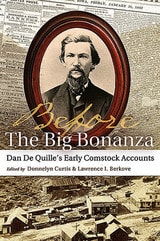
Before THE BIG BONANZA
Dan De Quille's Early Comstock AccountsEdited by Donnelyn Curtis and Lawrence I. Berkove
University of Missouri Press, 2015
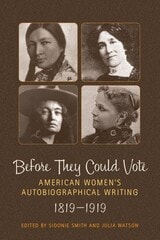
Before They Could Vote
American Women's Autobiographical Writing, 1819–1919Edited by Sidonie A. Smith and Julia Watson
University of Wisconsin Press, 2006
"This rich new anthology sets in motion an inter-textual conversation of remarkable vitality that will change the ways we understand gender, class, ethnicity, culture, and nation in nineteenth-century America."—Susanna Egan, author of Mirror-Talk
Before They Were Cardinals
Major League Baseball in Nineteenth-Century St. LouisJon David Cash
University of Missouri Press, 2002
Mark McGwire, Ozzie Smith, Lou Brock. These famous Cardinals are known by baseball fans around the world. But who and what were the predecessors of these modern-day players and their team? In Before They Were Cardinals, Jon David Cash examines the infancy of major-league baseball in St. Louis during the last quarter of the nineteenth century. His in-depth analysis begins with an exploration of the factors that motivated civic leaders to form the city's first major-league ball club. Cash delves into the economic trade rivalry between Chicago and St. Louis and examines how St. Louis's attempt to compete with Chicago led to the formation of the St. Louis Brown Stockings in 1875. He then explains why, three years later, despite its initial success, St. Louis baseball quickly vanished from the big-league map.
St. Louis baseball was revived with the arrival of German immigrant saloon owner Chris Von der Ahe. Cash explains how Von der Ahe, originally only interested in concession rights, purchased a controlling interest in the Brown Stockings. His riveting account follows the team after Von der Ahe's purchase, from the formation of the American Association, to its merger in 1891 with the rival National League. He chronicles Von der Ahe's monetary downturn, and the club's decline as well, following the merger.
Before They Were Cardinals provides vivid portraits of the ball players and the participants involved in the baseball war between the National League and the American Association. Cash points out significant differences, such as Sunday games and beer sales, between the two Leagues. In addition, excerpts taken from Chicago and St. Louis newspapers make the on-field contests and off-field rivalries come alive. Cash concludes this lively historical narrative with an appendix that traces the issue of race in baseball during this period.
The excesses of modern-day baseball—players jumping contracts or holding out for more money, gambling on games, and drinking to excess; owners stealing players and breaking agreements—were all present in the nineteenth-century sport. Players were seen then, as they are now, as an embodiment of their community. This timely treatment of a fascinating period in St. Louis baseball history will appeal to both baseball aficionados and those who want to understand the history of baseball itself.
Before Voltaire
The French Origins of “Newtonian” Mechanics, 1680-1715J.B. Shank
University of Chicago Press, 2017
Before Voltaire explores how Newton’s ideas made their way not just through the realm of French science, but into the larger world of society and culture of which Principia was an intertwined part. Shank also details a history of the beginnings of calculus-based mathematical physics that integrates it into the larger intellectual currents in France at the time, including the Battle of the Ancients and the Moderns, the emergence of wider audiences for science, and the role of the newly reorganized Royal Academy of Sciences. The resulting book offers an unprecedented cultural history of one the most important and influential elements of Enlightenment science.
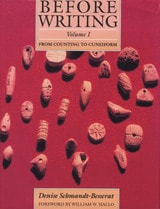
Before Writing, Vol. I
From Counting to CuneiformBy Denise Schmandt-Besserat
University of Texas Press, 1992
A fascinating book on the origins of writing.
Before Writing gives a new perspective on the evolution of communication. It points out that when writing began in Mesopotamia it was not, as previously thought, a sudden and spontaneous invention. Instead, it was the outgrowth of many thousands of years' worth of experience at manipulating symbols.
In Volume I: From Counting to Cuneiform, Denise Schmandt-Besserat describes how in about 8000 B.C., coinciding with the rise of agriculture, a system of counters, or tokens, appeared in the Near East. These tokens—small, geometrically shaped objects made of clay—represented various units of goods and were used to count and account for them. The token system was a breakthrough in data processing and communication that ultimately led to the invention of writing about 3100 B.C. Through a study of archaeological and epigraphic evidence, Schmandt-Besserat traces how the Sumerian cuneiform script, the first writing system, emerged from a counting device.
In Volume II: A Catalog of Near Eastern Tokens, Schmandt-Besserat presents the primary data on which she bases her theories. These data consist of several thousand tokens, catalogued by country, archaeological site, and token types and subtypes. The information also includes the chronology, stratigraphy, museum ownership, accession or field number, references to previous publications, material, and size of the artifacts. Line drawings and photographs illustrate the various token types.
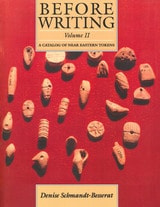
Before Writing, Vol. II
A Catalog of Near Eastern TokensBy Denise Schmandt-Besserat
University of Texas Press, 1992
Before Writing gives a new perspective on the evolution of communication. It points out that when writing began in Mesopotamia it was not, as previously thought, a sudden and spontaneous invention. Instead, it was the outgrowth of many thousands of years' worth of experience at manipulating symbols.
In Volume I: From Counting to Cuneiform, Denise Schmandt-Besserat describes how in about 8000 B.C., coinciding with the rise of agriculture, a system of counters, or tokens, appeared in the Near East. These tokens—small, geometrically shaped objects made of clay—represented various units of goods and were used to count and account for them. The token system was a breakthrough in data processing and communication that ultimately led to the invention of writing about 3100 B.C. Through a study of archaeological and epigraphic evidence, Schmandt-Besserat traces how the Sumerian cuneiform script, the first writing system, emerged from a counting device.
In Volume II: A Catalog of Near Eastern Tokens, Schmandt-Besserat presents the primary data on which she bases her theories. These data consist of several thousand tokens, catalogued by country, archaeological site, and token types and subtypes. The information also includes the chronology, stratigraphy, museum ownership, accession or field number, references to previous publications, material, and size of the artifacts. Line drawings and photographs illustrate the various token types.
Before the Closet
Same-Sex Love from "Beowulf" to "Angels in America"Allen J. Frantzen
University of Chicago Press, 1998
With its ambitious scope and elegant style, Before the Closet sets same-sex relations in Anglo-Saxon sources in relation to the sexual themes of contemporary opera, dance, and theatre. Frantzen offers a comprehensive analysis of sources from the seventh to the twelfth century and traces Anglo-Saxon same-sex behavior through the age of Chaucer and into the Renaissance.
"Frantzen's marvelous book . . . opens up a world most readers will never have even known was there. It's a difficult topic, but Frantzen's comprehensive, readable and even wryly funny treatment makes this an unexpected pleasure."—Publishers Weekly, starred review
Before the Curse
The Chicago Cubs' Glory Years, 1870-1945Edited by Randy Roberts and Carson Cunningham
University of Illinois Press, 2012
Before the Flood
The Itaipu Dam and the Visibility of Rural BrazilJacob Blanc
Duke University Press, 2019
Before the Ivy
The Cubs' Golden Age in Pre-Wrigley ChicagoLaurent Pernot
University of Illinois Press, 2015
BEHOLD the 1871 team as it plays for the title in nine different borrowed uniforms after losing everything in the Great Chicago Fire
ATTEND West Side Grounds at Polk and Wolcott with its barbershop quartet
MARVEL as superstar Cap Anson hits .399, makes extra cash running a ballpark ice rink, and strikes out as an elected official
WONDER at experiments with square bats and corked balls, the scandal of Sunday games and pre-game booze-ups, the brazen spitters and park dimensions changed to foil Ty Cobb
RAZZ Charles Comiskey as he adopts a Cubs hand-me-down moniker for his team's name
THRILL to the poetic double-play combo of Tinker, Evers, and Chance even as they throw tantrums at umpires and punches at each other
CHEER as Merkle's Boner and the Cubs' ensuing theatrics send the team to the 1908 World Series
Rich with Hall of Fame personalities and oddball stories, Before the Ivy opens a door to Chicago's own field of dreams and serves as every Cub fan's guide to a time when thoughts of "next year" filled rival teams with dread.

Before the Manifesto
The Life Writings of Mary Lois Walker MorrisMelissa Lambert Milewski
Utah State University Press, 2007
Mary Morris's memoir frames her 1879 to 1887 diary with both reflections on earlier years and passages that parallel entries in the day book, giving readers a better understanding of how she retrospectively saw her life. The thoroughly annotated diary offers the daily experience of a woman who kept a largely self-sufficient household, had a wide social network, ran her own business, wrote poetry, and was intellectually curious. The years of "the Raid" (federal prosecution of polygamists) led Mary and Elias Morris to hide their marriage on "the underground," and her to perjury in court during Elias's trial for unlawful cohabitation. The book ends with Mary Lois's arrival at the Salt Lake Depot after three years in exile in Mexico with a polygamist colony.
Before the Nation
Kokugaku and the Imagining of Community in Early Modern JapanSusan L. Burns
Duke University Press, 2003
Central to Burns's analysis is Motoori Norinaga’s Kojikiden, arguably the most important intellectual work of Japan's early modern period. Burns situates the Kojikiden as one in a series of attempts to analyze and interpret the mythohistories dating from the early eighth century, the Kojiki and Nihon shoki. Norinaga saw these texts as keys to an original, authentic, and idyllic Japan that existed before being tainted by "flawed" foreign influences, notably Confucianism and Buddhism. Hailed in the nineteenth century as the begetter of a new national consciousness, Norinaga's Kojikiden was later condemned by some as a source of Japan's twentieth-century descent into militarism, war, and defeat. Burns looks in depth at three kokugaku writers—Ueda Akinari, Fujitani Mitsue, and Tachibana Moribe—who contested Norinaga's interpretations and produced competing readings of the mythohistories that offered new theories of community as the basis for Japanese social and cultural identity. Though relegated to the footnotes by a later generation of scholars, these writers were quite influential in their day, and by recovering their arguments, Burns reveals kokugaku as a complex debate—involving history, language, and subjectivity—with repercussions extending well into the modern era.
Before the Storm
A Year in the Pribilof Islands, 1941-1942Fredericka Martin
University of Alaska Press, 2010
From June of 1941 through the following summer, Fredericka Martin lived with her husband, Dr. Samuel Berenberg, on remote St. Paul Island in Alaska. During that time, Martin delved into the complex history of the Unangan people, and Before the Storm draws from her personal accounts of that year and her research to present a fascinating portrait of a time and a people facing radical change. A government-ordered evacuation of all Aleuts from the island in the face of World War II, which Martin recounts in her journal, proved but the first step in a long struggle by native peoples to gain independence, and, as editor Raymond L. Hudson explains, Martin came to play a significant role in the effort.
Beginner's Luck
Dispatches from the Klamath MountainsMalcolm Terence
Oregon State University Press, 2018
In the late 1960s, Malcolm Terence left his job as a reporter for the Los Angeles Times to look for adventure and may have found more than he bargained for. The era had triggered unprecedented social and political changes in America, tectonic shifts that challenged war and the social order that oppressed people along lines of class, gender, and race. One branch was a back-to-the-land movement, and Terence, who had just traveled for a year managing a rock band, strayed into Black Bear Ranch, a commune just starting in a remote corner of the Klamath Mountains near the California-Oregon border.
Black Bear Ranch still exists, but many of its early residents eventually returned to urban civilization. A few, Terence among them, stayed on in neighboring river towns. Some tried logging, others gold mining, and some tried growing marijuana, all with mixed success. The local mining and timber communities had a checkered opinion of their new hippie neighbors, as did the Native tribes, but it was the kind of place where people helped each other out, even if they didn’t always agree.
When wildfires grew large, Terence and other veterans of the commune joined the fire crews run by the US Forest Service. In between, the Black Bear expats built homesteads, planted gardens, delivered babies, and raised their children. They gradually overcame the skepticism of the locals and joined them in political battles against the use of herbicides in the forest and the Forest Service’s campaign to close all the mining claims. As in the best of organizing efforts, the organizers learned as much as they led.
Beginner’s Luck will appeal to anyone who experienced life on a commune in the 1960s–1970s or who wants to learn about this chapter in modern American history. Terence offers insight into environmental activism and the long history of conflict between resource exploitation and Native American rights without lecturing or pontificating. With wit, humor, and humility, his anecdotal essays chronicle a time and place where disparate people came together to form an unlikely community.
Beginning the Quest
Law and Politics in the Early Work of Eric VoegelinBarry Cooper
University of Missouri Press, 2009
Beginning to End the Climate Crisis
A History of Our FutureLuisa Neubauer and Alexander Repenning
Brandeis University Press, 2023
“Act as though your house is on fire. Because it is.” Following Greta Thunberg, millions of young climate activists have been taking to the streets around the globe as part of the Fridays For Future movement. They demand that we “unite behind the science,” as, for too long, climate scientists have been ringing the alarm bells about rising temperatures, tipping points, and the devastating consequences of extreme weather—but politicians do nothing.
So how do you begin to end the climate crisis? Luisa Neubauer and Alexander Repenning begin by telling stories. Neubauer cofounded the youth climate activist group in Germany and has become its most prominent voice. In this book she and Repenning weave in personal accounts of their evolution as climate activists with a thorough analysis of how climate change impacts their generation, and what every one of us can and must do about it. The young and old in the United States and around the world can learn valuable lessons from their European counterparts.
Beheading the Saint
Nationalism, Religion, and Secularism in QuebecGeneviève Zubrzycki
University of Chicago Press, 2016
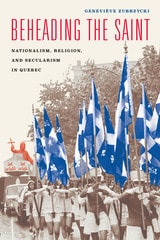
In Beheading the Saint, Geneviève Zubrzycki studies that transformation through a close investigation of the annual Feast of St. John the Baptist of June 24. The celebrations of that national holiday, she shows, provided a venue for a public contesting of the dominant ethno-Catholic conception of French Canadian identity and, via the violent rejection of Catholic symbols, the articulation of a new, secular Québécois identity. From there, Zubrzycki extends her analysis to the present, looking at the role of Québécois identity in recent debates over immigration, the place of religious symbols in the public sphere, and the politics of cultural heritage—issues that also offer insight on similar debates elsewhere in the world.
Behemoth or The Long Parliament
Thomas Hobbes
University of Chicago Press, 1990
In his insightful and substantial Introduction, Stephen Holmes examines the major themes and implications of Behemoth in Hobbes's system of thought. Holmes notes that a fresh consideration of Behemoth dispels persistent misreadings of Hobbes, including the idea that man is motivated solely by a desire for self-preservation. Behemoth, which is cast as a series of dialogues between a teacher and his pupil, locates the principal cause of the Civil War less in economic interests than in the stubborn irrationality of key actors. It also shows more vividly than any of Hobbe's other works the importance of religion in his theories of human nature and behavior.

Behind Closed Doors
IRBs and the Making of Ethical ResearchLaura Stark
University of Chicago Press, 2011