8113 books match the query 'Literary Criticism' and 307 start with b
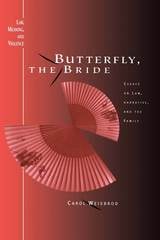
cover of Butterfly, the Bride: Essays on Law, Narrative, and the Family

Butterfly, the Bride

Essays on Law, Narrative, and the Family

Carol Weisbrod

University of Michigan Press, 2004

Carol Weisbrod uses a variety of stories to raise important questions about how society, through law, defines relationships in the family. Beginning with a story most familiar from the opera Madame Butterfly, Weisbrod addresses issues such as marriage, divorce, parent-child relations and abuses, and non-marital intimate contact. Each chapter works with fiction or narratives inspired by biography or myth, ranging from the Book of Esther to the stories of Kafka. Weisbrod frames the book with running commentary on variations of the Madame Butterfly story, showing the ways in which fiction better expresses the complexities of intimate lives than does the language of the law.

Butterfly, the Bride looks at law from the outside, using narrative to provide a fresh perspective on the issues of law and social structure---and individual responses to law. This book thoroughly explores relationships between inner and public lives by examining what is ordinarily classified as the sphere of private life---the world of family relationships.
Carol Weisbrod is Ellen Ash Peters Professor of Law at the University of Connecticut. Her other books include The Boundaries of Utopia and Emblems of Pluralism.
[more]
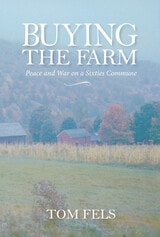
cover of Buying the Farm: Peace and War on a Sixties Commune

Buying the Farm

Peace and War on a Sixties Commune

Tom Fels

University of Massachusetts Press, 2012

This book tells the story of Montague Farm, an early back-to-the land communal experiment in western Massachusetts, from its beginning in 1968 through the following thirty-five years of its surprisingly long life. Drawing on his own experience as a resident of the farm from 1969 to 1973 and decades of contact with the farm's extended family, Tom Fels provides an insightful account of the history of this iconic alternative community. He follows its trajectory from its heady early days as a pioneering outpost of the counterculture through many years of change, including a period of renewed political activism and, later, increasing episodes of conflict between opposing factions to determine what the farm represented and who would control its destiny.

With deft individual portraits, Fels reveals the social dynamics of the group and explores the ongoing difficulties faced by a commune that was founded in idealism and sought to operate on the model of a leaderless democracy. He draws on a large body of farm-family and 1960s-related writing and the notes of community members to present a variety of points of view. The result is an absorbing narrative that chronicles the positive aspects of Montague Farm while documenting the many challenges and disruptions that marked its history.
[more]
cover of By Authors Possessed: The Demonic Novel in Russia

By Authors Possessed

The Demonic Novel in Russia

Adam Weiner

Northwestern University Press, 1998

By Authors Possessed examines the development of the demonic in key Russian novels from the last two centuries. Defining the demonic novel as one that takes as its theme an evil presence incarnated in the protagonists and attributed to the Judeo-Christian Devil, Adam Weiner investigates the way the content of such a book can compromise the moral integrity of its narration and its sense of authorship.

Weiner contends that the theme of demonism increasingly infects the narrative point of view from Gogol's Dead Souls to Dostoevsky's The Devils and Bely's Petersburg, until Nabokov exorcised the demonic novel through his fiction and his criticism. Starting from the premise that artistic creation has always been enshrouded in a haze of moral dilemma and religious doubt, Weiner's study of the demonic novel is an attempt to illuminate the potential ethical perils and aesthetic gains of great art.
[more]
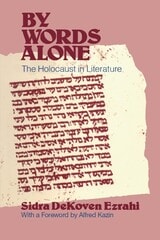
cover of By Words Alone: The Holocaust in Literature

By Words Alone

The Holocaust in Literature

Sidra DeKoven Ezrahi

University of Chicago Press, 1980
The creative literature that evolved from the Holocaust constitutes an unprecedented encounter between art and life. Those who wrote about the Holocaust were forced to extend the limits of their imaginations to encompass unspeakably violent extremes of human behavior. The result, as Ezrahi shows in By Words Alone, is a body of literature that transcends national and cultural boundaries and shares a spectrum of attitudes toward the concentration camps and the world beyond, toward the past and the future.
[more]
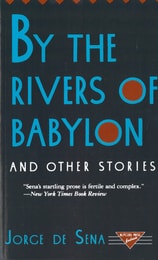
cover of By the Rivers of Babylon and Other Stories

By the Rivers of Babylon and Other Stories

Patai, Daphne

Rutgers University Press, 1991
This modest collection of short stories, written between 1946 and 1964, is the first by this influential Portuguese man of letters to be published in English. Their subjects often prominent historical figures, all are densely written, cerebral. The title story describes the tortured creative process of a famous 16th century Portuguese poet as he sets out to write his most celebrated poem. "A Night of Nativity" reports a fervent conversation between a Roman tribune and St. Paul. The whimsical "Sea of Stones" tells how the seventh century English monk, the Venerable Bede, forced the stones of an ancient Druid temple to speak. These 11 short stories are for the most part highly moralistic, at their best arguing the strict Catholic tenets of faith; less successful are the author's anguished attempts to describe the artistic temperament. Tantalizing by the promise they show, the short narratives are unfleshed, lacking the spark of animation. As a collection, with an informative foreword by the author's close colleague, they supplement our scant knowledge of this scholar and social activist.
[more]
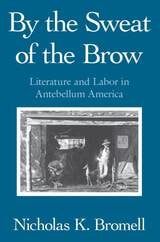
cover of By the Sweat of the Brow: Literature and Labor in Antebellum America

By the Sweat of the Brow

Literature and Labor in Antebellum America

Nicholas K. Bromell

University of Chicago Press, 1993

The spread of industrialism, the emergence of professionalism, and the challenge to slavery fueled an anxious debate about the meaning and value of work in antebellum America.

In chapters on Thoreau, Melville, Hawthorne, Rebecca Harding Davis, Susan Warner, Harriet Beecher Stowe, and Frederick Douglass, Nicholas Bromell argues that American writers generally sensed a deep affinity between the mental labor of writing and such bodily labors as blacksmithing, house building, housework, mothering, and farming. Combining literary and social history, canonical and noncanonical texts, primary source material, and contemporary theory, Bromell establishes work as an important subject of cultural criticism.
[more]
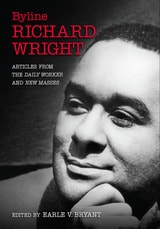
cover of Byline, Richard Wright: Articles from the DAILY WORKER and NEW MASSES

Byline, Richard Wright

Articles from the DAILY WORKER and NEW MASSES

Edited by Earle V. Bryant

University of Missouri Press, 2015

A writer perhaps best known for the revolutionary works Black Boy and Native Son, Richard Wright also worked as a journalist during one of the most explosive periods of the 20th century. From 1937 to 1938, Wright turned out more than two hundred articles for the Daily Worker, the newspaper that served as the voice of the American Communist Party. Byline, Richard Wright assembles more than one hundred of those articles plus two of Wright’s essays from New Masses, revealing to readers the early work of an American icon.

As both reporter and Harlem bureau chief, Wright covered most of the major and minor events, personalities, and issues percolating through the local, national, and global scenes in the late 1930s. Because the Daily Worker wasn’t a mainstream paper, editors gave Wright free rein to cover the stories he wanted, and he tackled issues that no one else covered. Although his peers criticized his journalistic writing, these articles offer revealing portraits of Depression-era America rendered in solid, vivid prose.

Featuring Earle V. Bryant’s informative, detailed introduction and commentary contextualizing the compiled articles, Byline, Richard Wright provides insight into the man before he achieved fame as a novelist, short story writer, and internationally recognized voice of social protest. This collection opens new territory in Wright studies, and fans of Wright’s novels will delight in discovering the lost material of this literary great.

[more]