Results by title
18284 books match the query 'United States' and 902 start with b
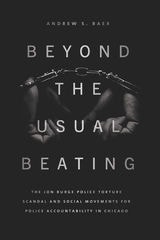
Beyond the Usual Beating
The Jon Burge Police Torture Scandal and Social Movements for Police Accountability in ChicagoAndrew S. Baer
University of Chicago Press, 2020
A story of institutionalized police brutality and how Chicago's public outcry led to long-lasting criminal justice reforms.
The malign and long-lasting influence of Chicago police commander Jon Burge cannot be overestimated, particularly as fresh examples of local and national criminal-justice abuse continue to surface with dismaying frequency. Burge’s decades-long tenure on the Chicago police force was marked by racist and barbaric interrogation methods, including psychological torture, burnings, and mock executions—techniques that went far “beyond the usual beating.” After being exposed in 1989, he became a symbol of police brutality and the unequal treatment of nonwhite people, and the persistent outcry against him led to reforms such as the abolition of the death penalty in Illinois.
But Burge hardly developed or operated in a vacuum, as Andrew S. Baer explores to stark effect here. He identifies the darkness of the Burge era as a product of local social forces, arising from a specific milieu beyond the nationwide racialized reactionary fever of the 1960s and 1970s. Similarly, the popular resistance movements that rallied in his wake actually predated Burge’s exposure but cohered with unexpected power due to the galvanizing focus on his crimes and abuses. For more than thirty years, a shifting coalition including torture survivors, their families, civil rights attorneys, and journalists helped to corroborate allegations of violence, free the wrongfully convicted, have Burge fired and incarcerated, and win passage of a municipal reparations package, among other victories. Beyond the Usual Beating reveals that though the Burge scandal underscores the relationship between personal bigotry and structural racism in the criminal justice system, it also shows how ordinary people held perpetrators accountable in the face of intransigent local power.
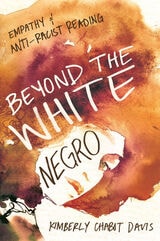
Beyond the White Negro
Empathy and Anti-Racist ReadingKimberly Chabot Davis
University of Illinois Press, 2014
Davis analyzes how white engagement with African American novels, film narratives, and hip-hop can help form anti-racist attitudes that may catalyze social change and racial justice. Though acknowledging past failures to establish cross-racial empathy, she focuses on examples that show avenues for future progress and change. Her study of ethnographic data from book clubs and college classrooms shows how engagement with African American culture and pedagogical support can lead to the kinds of white self-examination that make empathy possible. The result is a groundbreaking text that challenges the trend of focusing on society's failures in achieving cross-racial empathy and instead explores possible avenues for change.
Beyond the Whiteness of Whiteness
Memoir of a White Mother of Black SonsJane Lazarre
Duke University Press, 1996
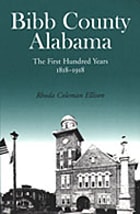
Bibb County, Alabama
The First Hundred YearsRhoda C. Ellison
University of Alabama Press, 1984
This model county history chronicles one hundred years in the life of a representative Deep South county
The history of Bibb County between 1818 and 1918 is in many ways representative of the experience of central Alabama during that period. Bibb County shares physical characteristics with the areas both to its north and to its south. In its northern section is a mineral district and in its southern valleys fertile farming country; therefore, its citizens have sometimes allied themselves with the hill counties and sometimes with their Black Belt neighbors.
Both sections of the county developed in step with the surrounding counties. Bibb's foundries were established during the same time and by the same iron masters as Shelby County, and its coal mines in the same decade as Jefferson County. Its farmers planted the same crops and faced the same problems as those in Perry, Autauga, and Tuscaloosa counties. Like Tuscaloosa, Bibb endeavored to promote river transportation for both its industrial and its agricultural products.
This carefully documented history is based on a variety of original sources, from personal letters to government records. It is generously illustrated with early maps and with old pictures of Bibb landmarks, many of which have now vanished.
Bible Believers
Fundamentalists in the Modern WorldNancy Tatom Ammerman
Rutgers University Press, 1987
Bible believer (also Bible-believer,Bible-believing Christian,Bible-believing Church) is a self-description by conservative Christians to differentiate their teachings from others who see non- or extrabiblical tradition as higher or equal in authority.
In normal usage, "Bible believer" means an individual or organisation that believes the Christian Bible is true in some significant way. However, this combination of words is given a unique meaning in fundamentalist Protestant circles, where it is equated with the belief that the Christian Bible "contains no theological contradictions, historical discrepancies, or other such 'errors'", otherwise known as biblical inerrancy.

Biblical Porn
Affect, Labor, and Pastor Mark Driscoll's Evangelical EmpireJessica Johnson
Duke University Press, 2018

Bibliographical Guide to the Study of the Literature of the USA, 5th ed., revised and enlarged
Clarence Gohdes and Sanford Marovitz
Duke University Press, 1984

Bibliography of Geography, Part 2
Regional. Volume 1. The United States of AmericaChauncey D. Harris
University of Chicago Press, 1984
Bibliography of Michigan Archaeology
Alexis A. Praus
University of Michigan Press, 1964
Bicentennial
A Revolutionary History of the 1970sMarc Stein
University of Chicago Press, 2026
“Utterly illuminating. . . . Just a really revelatory book.”—Jill Lepore, The New York Times, The “Book Review” Podcast • “As historian Stein traces in Bicentennial, a national birthday can launch a much broader, more inclusive, and ambitious national project.”—Rebecca Brenner Graham, The New Republic • “A comprehensive and critical look at the Spirit of 1976.”—Library Journal
As the United States marks its semiquincentennial in 2026, renowned historian Marc Stein looks back at the politics of another landmark celebration during a time of striking similarities and surprising differences: the US bicentennial in 1976.
In the aftermath of Vietnam and Watergate, the bicentennial sparked an extraordinary national conversation about the country’s past, present, and future. As patriots, planners, profiteers, and protesters argued about how to commemorate the national birthday, they collectively reimagined the promises and perils of democracy during a transformational decade.
From award-winning historian Marc Stein, Bicentennial: A Revolutionary History of the 1970s is an original, illuminating, and insightful study of that era. While focusing on festivities and fights in Philadelphia, the nation’s birthplace, the book also explores the many proposed and abandoned celebrations that percolated up around the country. It tells a broadly democratic story of both the “official” bicentennial and counter-bicentennial activism, offering revolutionary perspectives on national politics, social movements, and popular culture. From the queer courtship of President Richard Nixon and Philadelphia Mayor Frank Rizzo to parades and protests with millions of participants, and from a deadly outbreak of Legionnaires’ disease at Philadelphia’s most prestigious hotel to the establishment of groundbreaking African American, ethnic, and Jewish museums, the bicentennial reveals a kaleidoscope of American peculiarities, problems, and possibilities.
The lasting influence of 1976 on one of the nation’s great urban centers and the United States as a whole is undeniable. As the nation—once again enmeshed in political and social upheaval—marks its two-hundred-fiftieth birthday in 2026, there is no better time to look back at its two-hundredth and marvel at what has changed, and what has not.
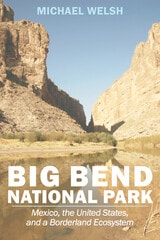
Big Bend National Park
Mexico, the United States, and a Borderland EcosystemMichael Welsh
University of Nevada Press, 2021
Big Bend National Park explores the cultural and diplomatic history of this transborder region that was designated a national park on the US side and the site of a long-hoped-for “international peace park” on the other. Michael Welsh demonstrates the challenges faced and lessons learned by both the US and Mexico as they struggled against political and environmental vicissitudes in their attempts to realize the creation of a shared frontier.
Geopolitical and environmental conflicts such as Cold War fears, immigration, the war on drugs, international water rights, and more stringent American border security measures after 9/11 all hindered relations between the two countries. But more recently, renewed cooperation and ongoing diplomatic relations have led to new developments. Mexican park personnel began assisting American officials with efforts to re-wild the American side of the river with animal species that had been eliminated, and the Obama administration relaxed some post-9/11 restrictions, allowing American visitors to cross over to the Mexican park and its nearby towns.
The ambition of developing a park for peace has yet to materialize, even as individuals and their governments continue to work toward an accord. Big Bend National Park provides a greater understanding of this complex borderland and hopes to help fulfill the aspiration of creating a shared ecosystem and the dream of a park for peace.

Big Bill Thompson, Chicago, and the Politics of Image
Douglas Bukowski
University of Illinois Press, 1998
A brilliant chameleon of a politician, Thompson could move from pro- to anti-prohibition, from opposing the Chicago Teachers Federation to opposing a superintendent hostile to it, from being anti-Catholic to winning, in huge numbers, the Catholic vote. Shape-shifter extraordinaire, Thompson stayed in power by repeatedly altering his political image. In Big Bill Thompson, Chicago, and the Politics of Image, Douglas Bukowski captures the essence of this wily urban politico as no other biographer or historian has. Using materials accessible only thanks to the Freedom of Information Act, Bukowski has fashioned an unforgettable story of a volatile Chicago leader and his era. And he does it with such grace and in such an irresistible style that readers will yearn to visit the local speakeasy and lift a glass to colorful politicians gone by.
Big Bosses
A Working Girl’s Memoir of Jazz Age AmericaAlthea McDowell Altemus
University of Chicago Press, 2016
Beginning with her employment as a private secretary to James Deering of International Harvester, whom she describes as “probably the world’s oldest and wealthiest bachelor playboy,” Altemus tells us much about high society during the time, taking us inside Deering’s glamorous Miami estate, Vizcaya, an Italianate mansion worthy of Gatsby himself. Later, we meet her other notable employers, including Samuel Insull, president of Chicago Edison; New York banker S. W. Straus; and real estate developer Fred F. French. We cinch up our trenchcoats and head out sleuthing in Chicago, hired by the wife of a big boss to find out how he spends his evenings (with, it turns out, a mistress hidden in an apartment within his office, no less). Altemus was also a struggling single mother, a fact she had to keep secret from her employers, and she reveals the difficulties of being a working woman at the time through glimpses into women’s apartments, their friendships, and the dangers—sexual and otherwise—that she and others faced. Throughout, Altemus entertains with a tart and self-aware voice that combines the knowledge of an insider with the wit and clarity of someone on the fringe.
Anchored by extensive annotation and an afterword from historian Robin F. Bachin, which contextualizes Altemus’s narrative, Big Bosses provides a one-of-a-kind peek inside the excitement, extravagances, and the challenges of being a working woman roaring through the ’20s.
Big Box USA
The Environmental Impact of America’s Biggest Retail StoresBart Elmore
University of Wyoming Press, 2023
The rise of big box retail since the 1960s has transformed environments on both local and global scales. Almost everyone has explored the aisles of big box stores. The allure of “everyday low prices” and brightly colored products of every kind connect shoppers with a global marketplace. Contributors join a growing conversation between business and environmental history, addressing the ways American retail institutions have affected physical and cultural ecologies around the world. Essays on Walmart, Target, Cabela’s, REI, and Bass Pro Shops assess the “bigness” of these superstores from “smokestacks to coat racks” and contend that their ecological impacts are not limited to the footprints of parking lots and manufacturing but also play a didactic role in educating consumers about their relationships with the environment.
A model for historians seeking to bring business and environmental histories together in their analyses of merchant capital’s role in the landscapes of everyday life and how it has remade human relationships with nature, Big Box USA is a must-read for students and scholars of the environment, business, sustainability, retail professionals, and a general audience.
Big Ears
Listening for Gender in Jazz StudiesNichole T. Rustin and Sherrie Tucker, eds.
Duke University Press, 2008
Scholars of music, ethnomusicology, American studies, literature, anthropology, and cultural studies approach the question of gender in jazz from multiple perspectives. One contributor scrutinizes the tendency of jazz historiography to treat singing as subordinate to the predominantly male domain of instrumental music, while another reflects on her doubly inappropriate position as a female trumpet player and a white jazz musician and scholar. Other essays explore the composer George Russell’s Lydian Chromatic Concept as a critique of mid-twentieth-century discourses of embodiment, madness, and black masculinity; performances of “female hysteria” by Les Diaboliques, a feminist improvising trio; and the BBC radio broadcasts of Ivy Benson and Her Ladies’ Dance Orchestra during the Second World War. By incorporating gender analysis into jazz studies, Big Ears transforms ideas of who counts as a subject of study and even of what counts as jazz.
Contributors: Christina Baade, Jayna Brown, Farah Jasmine Griffin, Monica Hairston, Kristin McGee, Tracy McMullen, Ingrid Monson, Lara Pellegrinelli, Eric Porter, Nichole T. Rustin, Ursel Schlicht, Julie Dawn Smith, Jeffrey Taylor, Sherrie Tucker, João H. Costa Vargas
Big House on the Prairie
Rise of the Rural Ghetto and Prison ProliferationJohn M. Eason
University of Chicago Press, 2017
In 2007, John M. Eason moved his family to Forrest City, Arkansas, in search of answers to key questions about this trend: Why is America building so many prisons? Why now? And why in rural areas? Eason quickly learned that rural demand for prisons is complicated. Towns like Forrest City choose to build prisons not simply in hopes of landing jobs or economic wellbeing, but also to protect and improve their reputations. For some rural leaders, fostering a prison in their town is a means of achieving order in a rapidly changing world. Taking us into the decision-making meetings and tracking the impact of prisons on economic development, poverty, and race, Eason demonstrates how groups of elite whites and black leaders share power. Situating prisons within dynamic shifts that rural economies are undergoing and showing how racially diverse communities lobby for prison construction, Big House on the Prairie is a remarkable glimpse into the ways a prison economy takes shape and operates.
Big House, Little House, Back House, Barn
The Connected Farm Buildings of New EnglandThomas C. Hubka
University Press of New England, 2004
Big House, Little House, Back House, Barn
The Connected Farm Buildings of New EnglandThomas C. Hubka
Brandeis University Press, 2022
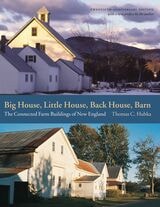
Big House, Little House, Back House, Barn portrays the four essential components of the stately and beautiful connected farm buildings made by nineteenth-century New Englanders that stand today as a living expression of a rural culture, offering insights into the people who made them and their agricultural way of life. A visual delight as well as an engaging tribute to our nineteenth-century forebears, this book, first published nearly forty years ago, has become one of the standard works on regional farmsteads in America. This new edition features a new preface by the author.

Big Med
Megaproviders and the High Cost of Health Care in AmericaDavid Dranove and Lawton Robert Burns
University of Chicago Press, 2021
Drawing on decades of combined expertise in health care consolidation, Dranove and Burns trace Big Med’s emergence in the 1990s, followed by its swift rise amid false promises of scale economies and organizational collaboration. In the decades since, megaproviders have gobbled up market share and turned independent physicians into salaried employees of big bureaucracies, while delivering on none of their early promises. For patients this means higher costs and lesser care. Meanwhile, physicians report increasingly low morale, making it all but impossible for most systems to implement meaningful reforms.
In Big Med, Dranove and Burns combine their respective skills in economics and management to provide a nuanced explanation of how the provision of health care has been corrupted and submerged under consolidation. They offer practical recommendations for improving competition policies that would reform megaproviders to actually achieve the efficiencies and quality improvements they have long promised.
This is an essential read for understanding the current state of the health care system in America—and the steps urgently needed to create an environment of better care for all of us.
Big Money Unleashed
The Campaign to Deregulate Election SpendingAnn Southworth
University of Chicago Press, 2023
The story of how the First Amendment became an obstacle to campaign finance regulation—a history that began much earlier than most imagine.
Americans across party lines believe that public policy is rigged in favor of those who wield big money in elections. Yet, legislators are restricted in addressing these concerns by a series of Supreme Court decisions finding that campaign finance regulations violate the First Amendment.
Big Money Unleashed argues that our current impasse is the result of a long-term process involving many players. Naturally, the justices played critical roles—but so did the attorneys who hatched the theories necessary to support the legal doctrine, the legal advocacy groups that advanced those arguments, the wealthy patrons who financed these efforts, and the networks through which they coordinated strategy and held the Court accountable.
Drawing from interviews, public records, and archival materials, Big Money Unleashed chronicles how these players borrowed a litigation strategy pioneered by the NAACP to dismantle racial segregation and used it to advance a very different type of cause.

Big Prisons, Big Dreams
Crime and the Failure of America's Penal SystemMichael J. Lynch
Rutgers University Press, 2007
The American prison system has grown tenfold since the 1970s, but crime rates in the United States have not decreased. This doesn't surprise Michael J. Lynch, a critical criminologist, who argues that our oversized prison system is a product of our consumer culture, the public's inaccurate beliefs about controlling crime, and the government's criminalizing of the poor.
While deterrence and incapacitation theories suggest that imprisoning more criminals and punishing them leads to a reduction in crime, case studies, such as one focusing on the New York City jail system between 1993 and 2003, show that a reduction in crime is unrelated to the size of jail populations. Although we are locking away more people, Lynch explains that we are not targeting the worst offenders. Prison populations are comprised of the poor, and many are incarcerated for relatively minor robberies and violence. America's prison expansion focused on this group to the exclusion of corporate and white collar offenders who create hazardous workplace and environmental conditions that lead to deaths and injuries, and enormous economic crimes. If America truly wants to reduce crime, Lynch urges readers to rethink cultural values that equate bigger with better.
Big Sister
Feminism, Conservatism, and Conspiracy in the HeartlandErin M. Kempker
University of Illinois Press, 2018
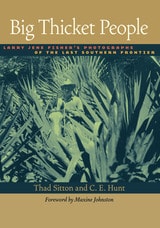
Big Thicket People
Larry Jene Fisher's Photographs of the Last Southern FrontierBy Thad Sitton and C.E. Hunt
University of Texas Press, 2008
Living off the land—hunting, fishing, and farming, along with a range of specialized crafts that provided barter or cash income—was a way of life that persisted well into the twentieth century in the Big Thicket of southeast Texas. Before this way of life ended with World War II, professional photographer Larry Jene Fisher spent a decade between the 1930s and 1940s photographing Big Thicket people living and working in the old ways. His photographs, the only known collection on this subject, constitute an irreplaceable record of lifeways that first took root in the southeastern woodlands of the colonial United States and eventually spread all across the Southern frontier.
Big Thicket People presents Fisher's photographs in suites that document a wide slice of Big Thicket life-people, dogs, camps, deer hunts, farming, syrup mills, rooter hogs and stock raising, railroad tie making, barrel stave making, chimney building, peckerwood sawmills, logging, turpentining, town life, church services and picnics, funerals and golden weddings, and dances and other amusements. Accompanying each suite of images is a cultural essay by Thad Sitton, who also introduces the book with a historical overview of life in the Big Thicket. C. E. Hunt provides an informative biography of Larry Jene Fisher.
Big Top Boss
JOHN RINGLING NORTH AND THE CIRCUSDavid Lewis Hammarstrom
University of Illinois Press, 1992
king John Ringling North explored the remarkable career of the man who ran Ringling
Bros. and Barnum & Baily for thirty years. David Lewis Hammarstrom details
how North guided the circus through adversities ranging from depressions and
wars to crippling labor strikes and rapidly changing trends in American entertainment.
Hammarstrom interviewed a host of circus figures including North himself; his
formers, directors, and department heads who were involved with the circus when
North owned and operated it.
Big Wonderful Thing
A History of TexasBy Stephen Harrigan
University of Texas Press, 2019
2020 Philosophical Society of Texas Nonfiction Book Prize
2019 Nonfiction Book Award Finalist, Writers’ League of Texas
2021 Citation from the San Antonio Conservation Society
"Harrigan, surveying thousands of years of history that lead to the banh mi restaurants of Houston and the juke joints of Austin, remembering the forgotten as well as the famous, delivers an exhilarating blend of the base and the ignoble, a very human story indeed. [ Big Wonderful Thing is] as good a state history as has ever been written and a must-read for Texas aficionados.”—Kirkus, Starred Review
The story of Texas is the story of struggle and triumph in a land of extremes. It is a story of drought and flood, invasion and war, boom and bust, and the myriad peoples who, over centuries of conflict, gave rise to a place that has helped shape the identity of the United States and the destiny of the world.
“I couldn’t believe Texas was real,” the painter Georgia O’Keeffe remembered of her first encounter with the Lone Star State. It was, for her, “the same big wonderful thing that oceans and the highest mountains are.”
Big Wonderful Thing invites us to walk in the footsteps of ancient as well as modern people along the path of Texas’s evolution. Blending action and atmosphere with impeccable research, New York Times best-selling author Stephen Harrigan brings to life with novelistic immediacy the generations of driven men and women who shaped Texas, including Spanish explorers, American filibusters, Comanche warriors, wildcatters, Tejano activists, and spellbinding artists—all of them taking their part in the creation of a place that became not just a nation, not just a state, but an indelible idea.
Written in fast-paced prose, rich with personal observation and a passionate sense of place, Big Wonderful Thing calls to mind the literary spirit of Robert Hughes writing about Australia or Shelby Foote about the Civil War. Like those volumes, it is a big book about a big subject, a book that dares to tell the whole glorious, gruesome, epically sprawling story of Texas.
Big Wonderful
Notes from WyomingKevin Holdsworth
University Press of Colorado, 2006
Growing up in Utah, Holdsworth couldn't wait to move away. Once ensconced on the East Coast, however, he found himself writing westerns and dreaming of the mountains he'd skied and climbed. Fed up with city life, he moved to a small Wyoming town.
In Big Wonderful, he writes of a mountaineering companion's death, the difficult birth of his son, and his father's terminal illness - encounters with mortality that sharpened his ideas about risk, care, and commitment. He puts a new spin on mountaineering literature, telling wild tales from his reunion with the mountains but also relating the surprising willpower it took to turn back from risks he would have taken before he became a father. He found he needed courage to protect and engage deeply with his family, his community, and the wild places he loves.
Holdsworth's essays and poems are rich with anecdotes, characters, and vivid images. Readers will feel as if they themselves watched a bear destroy an entire expedition's food, walked with his great-great-grandmother along the icy Mormon Trail, and tried to plant a garden in Wyoming's infamous wind.
Readers who love the outdoors will enjoy this funny and touching take on settling down and adventuring in the West's most isolated country.
BigLaw
Money and Meaning in the Modern Law FirmMitt Regan and Lisa H. Rohrer
University of Chicago Press, 2021
Bigfoot
The Life and Times of a LegendJoshua Blu Buhs
University of Chicago Press, 2009
Last August, two men in rural Georgia announced that they had killed Bigfoot. The claim drew instant, feverish attention, leading to more than 1,000 news stories worldwide—despite the fact that nearly everyone knew it was a hoax. Though Bigfoot may not exist, there’s no denying Bigfoot mania.
With Bigfoot, Joshua Blu Buhs traces the wild and wooly story of America’s favorite homegrown monster. He begins with nineteenth-century accounts of wildmen roaming the forests of America, treks to the Himalayas to reckon with the Abominable Snowman, then takes us to northern California in 1958, when reports of a hairy hominid loping through remote woodlands marked Bigfoot’s emergence as a modern marvel. Buhs delves deeply into the trove of lore and misinformation that has sprung up around Bigfoot in the ensuing half century. We meet charlatans, pseudo-scientists, and dedicated hunters of the beast—and with Buhs as our guide, the focus is always less on evaluating their claims than on understanding why Bigfoot has inspired all this drama and devotion in the first place. What does our fascination with this monster say about our modern relationship to wilderness, individuality, class, consumerism, and the media?
Writing with a scientist’s skepticism but an enthusiast’s deep engagement, Buhs invests the story of Bigfoot with the detail and power of a novel, offering the definitive take on this elusive beast.
Biggest Damned Hat
Tales from Alaska's Territorial Lawyers and JudgesPamela Cravez
University of Alaska Press, 2017
The Biggest Damned Hat presents a fascinating collection of stories ranging from the gold rush to the 1950s. Built on interviews and oral histories from more than fifty lawyers who worked in Alaska before 1959, and buttressed by research into legal history, the book offers a brilliantly multifaceted portrait of law in the territory—from laying the groundwork for strong civil and criminal law to helping to secure mining and fishing rights to the Alaska Court-Bar fight, which pitted Alaska’s community of lawyers against its nascent Supreme Court. Bringing to life a time long past—when some of the best lawyers had little formal legal education—The Biggest Damned Hat fills in a crucial part of the story of Alaska’s history.
Bike Lust
Harleys, Women, And American SocietyBarbara Joans
University of Wisconsin Press, 2001
Bike Lust roars straight into the world of women bikers and offers us a ride. In this adventure story that is also an insider’s study of an American subculture, Barbara Joans enters as a passenger on the back of a bike, but soon learns to ride her own. As an anthropologist she untangles the rules, rituals, and rites of passage of the biker culture. As a new member of that culture, she struggles to overcome fear, physical weakness, and a tendency to shoot her mouth off—a tendency that very nearly gets her killed.
Bike Lust travels a landscape of contradictions. Outlaws still chase freedom on the highway, but so do thousands of riders of all classes, races, and colors. Joans introduces us to the women who ride the rear—the biker chick, the calendar slut straddling the hot engine, the back-seat Betty at the latest rally, or the underage groupie at the local run. But she also gives us the first close look at women who ride in their own right, on their own bikes, as well as a new understanding of changing world of male bikers. These are ordinary women’s lives made extraordinary, adding a dimension of courage to the sport not experienced by males, risking life and limb for a glimpse of the very edge of existence. This community of riders exists as a primal tribute to humanity's lust for freedom.
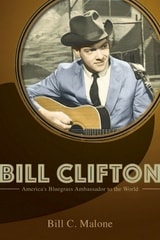
Bill Clifton
America's Bluegrass Ambassador to the WorldBill C Malone
University of Illinois Press, 2016
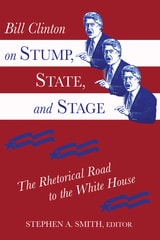
Bill Clinton on Stump, State, and Stage
The Rhetorical Road to the White HouseStephen A. Smith
University of Arkansas Press, 1994

Bill Giles and Baseball
John B Lord
Temple University Press, 2014
Bill Giles oversaw one of the greatest eras of winning that the Philadelphia Phillies ever enjoyed. In Bill Giles and Baseball, John Lord chronicles Giles' remarkable career--which includes 44 years with the Phillies--to provide an insider's view of the business of the sport, which takes place off the field.
Based on extensive interviews, Bill Giles and Baseball spans Giles' life from his childhood growing up in the game to the tumultuous years he spent as the president and managing partner of the Phillies. Purchasing the team in 1981, when baseball experienced its first serious labor stoppages, Giles also watched baseball add franchises, grapple with franchise fees, realign the leagues, and restructure baseball's postseason. Yet Giles, the public face of the Phillies championship teams of 1980, 1983, and 1993, is best remembered for his critical role in creating innovative TV deals, and leading the efforts to build the Phillies' beautiful new ballpark.
A book about the business of baseball as seen through the eyes of one of the architects of the game, Bill Giles and Baseball captures the spectacle of the sport through fascinating behind-the-scenes stories of our national pastime.
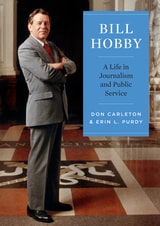
Bill Hobby
A Life in Journalism and Public ServiceDon Carleton and Erin L. Purdy
University of Texas Press, 2024
A comprehensive biography of a legendary lieutenant governor.
During his five terms as lieutenant governor of Texas, Bill Hobby became one of the most powerful political figures in the state’s history. He was first elected lieutenant governor of Texas in 1972 and served until 1990. Thanks to his brilliance as a political tactician and his personal integrity, Hobby was able to set the Senate’s agenda and garner respect from legislators on both sides of the aisle.
In Bill Hobby: A Life in Journalism and Public Service, Don Carleton and Erin Purdy document Hobby’s significant contributions to Texas as a journalist, politician, and philanthropist. Born into a prominent Texas family with a rich legacy of public service, he was the son of Houston newspaper publisher and former Texas governor William P. Hobby Sr., and Oveta Culp Hobby, who led the Women’s Army Corps during World War II and served in Eisenhower’s cabinet. After more than a decade as a journalist for the Houston Post, Hobby forged his own political path while also playing a prominent role in his family’s newspaper and television business.
Hobby was never shy about using his power to serve the people of Texas. Even after he left office, he continued to make a difference as a strong advocate for public education, including a term as chancellor of the University of Houston.
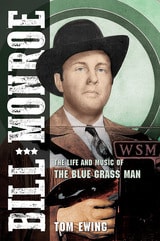
Bill Monroe
The Life and Music of the Blue Grass ManTom Ewing
University of Illinois Press, 2021
The Father of Bluegrass Music, Bill Monroe was a major star of the Grand Ole Opry for over fifty years; a member of the Country Music, Songwriters, and Rock and Roll Halls of Fame; and a legendary figure in American music. This authoritative biography sets out to examine his life in careful detail--to move beyond hearsay and sensationalism to explain how and why he accomplished so much.
Former Blue Grass Boy and longtime music journalist Tom Ewing draws on hundreds of interviews, his personal relationship with Monroe, and an immense personal archive of materials to separate the truth from longstanding myth. Ewing tells the story of the Monroe family's musical household and Bill's early career in the Monroe Brothers duo. He brings to life Monroe's 1940s heyday with the Classic Bluegrass Band, the renewed fervor for his music sparked by the folk revival of the 1960s, and his declining fortunes in the years that followed. Throughout, Ewing deftly captures Monroe's relationships and the personalities of an ever-shifting roster of band members while shedding light on his business dealings and his pioneering work with Bean Blossom and other music festivals.
Filled with a wealth of previously unknown details, Bill Monroe offers even the most devoted fan a deeper understanding of Monroe's towering achievements and timeless music.
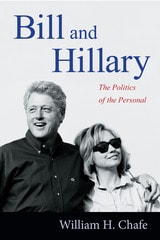
Bill and Hillary
The Politics of the PersonalWilliam H. Chafe
Duke University Press, 2012
Billionaires and Stealth Politics
Benjamin I. Page, Jason Seawright, and Matthew J. Lacombe
University of Chicago Press, 2018
Page, Seawright, and Lacombe argue that while political contributions offer a window onto billionaires’ influence, especially on economic policy, they do not present a full picture of policy preferences and political actions. That is because on some of the most important issues, including taxation, immigration, and Social Security, billionaires have chosen to engage in “stealth politics.” They try hard to influence public policy, making large contributions to political parties and policy-focused causes, leading policy-advocacy organizations, holding political fundraisers, and bundling others’ contributions—all while rarely talking about public policy to the media. This means that their influence is not only unequal but also largely unaccountable to and unchallengeable by the American people. Stealth politics makes it difficult for ordinary citizens to know what billionaires are doing or mobilize against it. The book closes with remedies citizens can pursue if they wish to make wealthy Americans more politically accountable, such as public financing of political campaigns and easier voting procedures, and notes the broader types of reforms, such as a more progressive income tax system, that would be needed to increase political equality and reinvigorate majoritarian democracy in the United States.
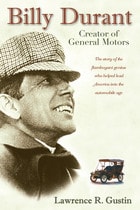
Billy Durant
Creator of General MotorsLawrence R. Gustin
University of Michigan Press, 2012
Praise for the first edition:
"A fascinating book [and] a sympathetic look at the man who glued General Motors together and in the process made Flint one of the great industrial centers of America."
---Detroit Free Press
"It is refreshing to report that Billy Durant is one of the best researched books dealing with an automotive giant."
---Antique Automobile
"Billy Durant fills in a masterly way the only important void remaining concerning the work of the motorcar pioneers."
---Richard Crabb, author of Birth of a Giant: The Men and Incidents That Gave America the Motorcar
What explains Billy Durant's powerful influence on the auto industry during its early days? And why, given Durant's impact, has he been nearly forgotten for decades?
In search of answers to these questions, Lawrence Gustin interviewed Durant's widow, who provided a wealth of previously unpublished autobiographical notes, letters, and personal papers. Gustin also interviewed two of Durant's personal secretaries and others who had known and worked with the man who created General Motors. The result is the amazing account of the mastermind behind what would become, as the twentieth century progressed, the world's largest company.
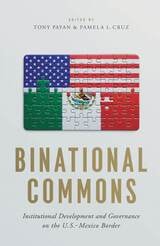
Binational Commons
Institutional Development and Governance on the U.S.-Mexico BorderEdited by Tony Payan and Pamela L. Cruz
University of Arizona Press, 2020
This volume addresses the most pertinent binational issues and how they are dealt with by both countries. In this important and timely volume, experts tackle the important problem of cross-border governance by an examination of formal and informal institutions, networks, processes, and mechanisms. Contributors also discuss various social, political, and economic actors and agencies that make up the increasingly complex governance space that is the U.S.-Mexico border.
Binational Commons focuses on whether the institutions that presently govern the U.S.-Mexico transborder space are effective in providing solutions to difficult binational problems as they manifest themselves in the borderlands. Critical for policy-making now and into the future, this volume addresses key binational issues. It explores where there are strong levels of institutional governance development, where it is failing, how governance mechanisms have evolved over time, and what can be done to improve it to meet the needs of the U.S.-Mexico borderlands in the next decades.
Contributors
Silvia M. Chavez-Baray
Kimberly Collins
Irasema Coronado
Guadalupe Correa-Cabrera
Pamela L. Cruz
Adrián Duhalt
James Gerber
Manuel A. Gutiérrez
Víctor Daniel Jurado Flores
Evan D. McCormick
Jorge Eduardo Mendoza Cota
Miriam S. Monroy
Eva M. Moya
Stephen Mumme
Tony Payan
Carla Pederzini Villarreal
Sergio Peña
Octavio Rodríguez Ferreira
Cecilia Sarabia Ríos
Kathleen Staudt
Binga
The Rise and Fall of Chicago's First Black BankerDon Hayner
Northwestern University Press, 2020
Binga is the definitive full-length biography of Jesse Binga, the first black banker in Chicago. Born into a large family in Detroit, Binga arrived in Chicago in 1892 in his late twenties with virtually nothing. Through his wits and resourcefulness, he rose to wealth and influence as a real estate broker, and in 1908 he founded the Binga Bank, the first black-owned bank in the city. But his achievements were followed by an equally notable downfall. Binga recounts this gripping story about race, history, politics, and finance.
The Black Belt, where Binga’s bank was located, was a segregated neighborhood on Chicago’s South Side—a burgeoning city within a city—and its growth can be traced through the arc of Binga’s career. He preached and embodied an American gospel of self-help and accrued wealth while expanding housing options and business opportunities for blacks. Devout Roman Catholics, he and his wife Eudora supported church activities and various cultural and artistic organizations; their annual Christmas party was the Black Belt’s social event of the year. But Binga’s success came at the price of a vicious backlash. After he moved his family into a white neighborhood in 1917, their house was bombed multiple times, his offices were attacked twice, and he became a lightning rod for the worst race riots in Chicago history, which took place in 1919. Binga persevered, but, starting with the stock market crash of October 1929, a string of reversals cost him his bank, his property, and his fortune.
A quintessentially Chicago story, Binga tells the history of racial change in one of the most segregated cities in America and how an extraordinary man stood as a symbol of hope in a community isolated by racial animosity.
Bio-Imperialism
Disease, Terror, and the Construction of National FragilityGwen Shuni D'Arcangelis
Rutgers University Press, 2021
Bio/Pics
How Hollywood Constructed Public HistoryGeorge Custen
Rutgers University Press, 1992
Bio/Pics is the first comprehensive study of a once important film genre, the biographical film. Using previously unavailable archival materials from Twentieth Century-Fox, Warner Bros., MGM, and RKO studios, as well as censorship files from the Production Code Administration, George Custen argues that, through these films, Hollywood manufactured a nearly monochromatic view of history that was systematically distorted in regard to race, gender, nationality, and profession.Utilizing a carefully selected sample of over 100 films produced during the Studio Era (1927-1960), Custen maintains that the biopic constructed a Hollywood code of history out of a tightly controlled reference system, glamorizing the producers' own personal visions of what constituted a great life. Custen's examination of production practices reveals that the machinery of public history operating through these films was fueled by difference sources. His analysis of the roles played by star personae, legal considerations, censorship practices, and the producers' own ideologies brings the world of biopic alive, even into the age of the made-for-TV movie.
Bioarchaeology of the American Southeast
Approaches to Bridging Health and Identity in the PastEdited by Shannon Chappell Hodge and Kristrina A. Shuler
University of Alabama Press, 2018
Building on the 1991 publication What Mean These Bones? Studies in Southeastern Bioarchaeology, this new edited collection from Shannon Chappell Hodge and Kristrina A. Shuler marks steady advances over the past three decades in the theory, methodology, and purpose of bioarchaeology in the southeastern United States and across the discipline. With a geographic scope that ranges from Louisiana to South Carolina and a temporal span from early prehistory through the nineteenth century, the coverage aims to be holistic.
Bioarchaeology of the American Southeast: Approaches to Bridging Health and Identity in the Past is organized into two main parts. The first, “Context and Culture History in Bioarchaeology,” focuses on the fundamentals of archaeology—figuring out who lived at an archaeological site, when they lived there, what they did, and how they lived their lives.
This builds the framework that allows archaeologists to answer deeper questions, such as the ones addressed in the second part, “Social Identities in Bioarchaeology.” Here contributors explore questions of identity, ethnicity, gender and the status of women, social status, class, power and exploitation, migration, and conflict. These chapters implement and contribute to anthropological theory and showcase improved methods, such as innovative statistical analyses, and incorporate newer technology, including a DNA and geographic information system applications.
Biomedicalization
Technoscience, Health, and Illness in the U.S.Adele E. Clarke, Laura Mamo, Jennifer Ruth Fosket, Jennifer R. Fishman, and Janet K. Shim, eds.
Duke University Press, 2010
Contributors. Natalie Boero, Adele E. Clarke, Jennifer R. Fishman, Jennifer Ruth Fosket, Kelly Joyce, Jonathan Kahn, Laura Mamo, Jackie Orr, Elianne Riska, Janet K. Shim, Sara Shostak

Biomedicine and Alternative Healing Systems in America
Issues of Class, Race, and GenderHans A. Baer
University of Wisconsin Press, 2001
Examining medical pluralism in the United States from the Revolutionary War period through the end of the twentieth century, Hans Baer brings together in one convenient reference a vast array of information on healing systems as diverse as Christian Science, osteopathy, acupuncture, Santeria, southern Appalachian herbalism, evangelical faith healing, and Navajo healing.
In a country where the dominant paradigm of biomedicine (medical schools, research hospitals, clinics staffed by M.D.s and R.N.s) has been long established and supported by laws and regulations, the continuing appeal of other medical systems and subsystems bears careful consideration. Distinctions of class, Baer emphasizes, as well as differences in race, ethnicity, and gender, are fundamental to the diversity of beliefs, techniques, and social organizations represented in the phenomenon of medical pluralism.
Baer traces the simultaneous emergence in the nineteenth century of formalized biomedicine and of homeopathy, botanic medicine, hydropathy, Christian Science, osteopathy, and chiropractic. He examines present-day osteopathic medicine as a system parallel to biomedicine with an emphasis on primary care; chiropractic, naturopathy, and acupuncture as professionalized heterodox medical systems; homeopathy, herbalism, bodywork, and lay midwifery in the context of the holistic health movement; Anglo-American religious healing; and folk medical systems, particularly among racial and ethnic minorities. In closing he focuses on the persistence of folk medical systems among working-class Americans and considers the growing interest of biomedical physicians, pharmaceutical and healthcare corporations, and government in the holistic health movement
Biotic Borders
Transpacific Plant and Insect Migration and the Rise of Anti-Asian Racism in America, 1890–1950Jeannie N. Shinozuka
University of Chicago Press, 2022
In the late nineteenth century, increasing traffic of transpacific plants, insects, and peoples raised fears of a "biological yellow peril" when nursery stock and other agricultural products shipped from Japan to meet the growing demand for exotics in the United States. Over the next fifty years, these crossings transformed conceptions of race and migration, played a central role in the establishment of the US empire and its government agencies, and shaped the fields of horticulture, invasion biology, entomology, and plant pathology. In Biotic Borders, Jeannie N. Shinozuka uncovers the emergence of biological nativism that fueled American imperialism and spurred anti-Asian racism that remains with us today.
Shinozuka provides an eye-opening look at biotic exchanges that not only altered the lives of Japanese in America but transformed American society more broadly. She shows how the modern fixation on panic about foreign species created a linguistic and conceptual arsenal for anti-immigration movements that flourished in the early twentieth century. Xenophobia inspired concerns about biodiversity, prompting new categories of “native” and “invasive” species that defined groups as bio-invasions to be regulated—or annihilated. By highlighting these connections, Shinozuka shows us that this story cannot be told about humans alone—the plants and animals that crossed with them were central to Japanese American and Asian American history. The rise of economic entomology and plant pathology in concert with public health and anti-immigration movements demonstrate these entangled histories of xenophobia, racism, and species invasions.
Bird Student
An AutobiographyAn Autobiography by George Miksch Sutton
University of Texas Press, 1980
At thirteen, George Miksch Sutton planned a school of ornithology centered around his collection of bird skins, feathers, bones, nests, eggs, and a prized stuffed crow. As an adult, he became one of the most prominent ornithologists and bird artists of the twentieth century. He describes his metamorphosis from amateur to professional in Bird Student.
Born in 1898, Sutton gives us his clearest memories of his boyhood in Nebraska, Minnesota, Oregon, Illinois, Texas, and West Virginia with his closely knit family. Recognizing birds, identifying them correctly, drawing them, and writing about them became more and more important to him. His intense admiration for Louis Agassiz Fuertes had a good deal to do with his beginning to draw birds in earnest, and his correspondence and his 1916 summer visit with the generous Fuertes taught him to look at birds with the eyes of a professional artist and to consider the possibility of making ornithology his career.
By 1918, Sutton had talked himself into a job at the Carnegie Museum of Natural History in Pittsburgh, which gave him fresh opportunities to learn and travel, and his 1920 field trip to the Labrador Peninsula stimulated his lifelong interest in arctic birds. Further expeditions to James Bay, the east coast of Hudson Bay—on leave from his job as state ornithologist of Pennsylvania—and Southampton Island at the north end of Hudson Bay, in search of the elusive blue goose and its nesting grounds, give us glimpses of field methods before the days of sophisticated equipment. Sutton ends his autobiography in 1935, with an account of his graduate days at Cornell University and his position as curator of the Fuertes Memorial Collection of Birds.
Bird Student is about raising young roadrunners and owls and prairie dogs, sailing (and being stranded) in arctic waters, preparing specimens in the hold of a ship, hunting birds and caribou and bears in almost inaccessible regions, canoeing in the Far North, camping in Florida, and delivering speeches in Pennsylvania. Sutton's gift for mixing facts and philosophy lets us see the evolution of a naturalist, as his inherent curiosity and innocent enjoyment of beauty led to a permanent desire to preserve this beauty.
Bird
The Life and Music of Charlie ParkerChuck Haddix
University of Illinois Press, 2013
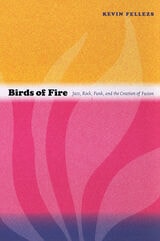
Birds of Fire
Jazz, Rock, Funk, and the Creation of FusionKevin Fellezs
Duke University Press, 2011
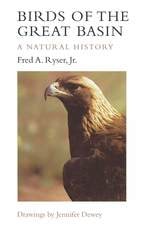
Birds of the Great Basin
A Natural HistoryFred A. Ryser
University of Nevada Press, 1985