Results by title
159 books match the query 'Academic writing' and 10 start with c
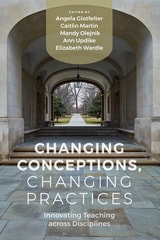
Changing Conceptions, Changing Practices
Innovating Teaching across Disciplinesedited by Angela Glotfelter, Caitlin Martin, Mandy Olejnik, Ann Updike & Elizabeth Wardle
Utah State University Press, 2022
The authors draw on the threshold concepts framework, research in writing studies, and theories of learning, leadership, and change to deftly explore why faculty are often stymied in their efforts to design meaningful curricula for deep learning and how carefully scaffolded professional development for faculty teams can help make such change possible. This book is a powerful demonstration of how faculty members can be empowered when professional development leaders draw on a range of scholarship that is not typically connected.
In today’s climate, courses, programs, and institutions are often assessed by and rewarded for proxy metrics that have little to do with learning, with grave consequences for students. The stakes have never been higher, particularly for public higher education. Faculty members need opportunities to work together using their own expertise and to enact meaningful learning opportunities for students. Professional developers have an important role to play in such change efforts.
WAC scholars and practitioners, leaders of professional development and centers for teaching excellence, program administrators and curriculum committees from all disciplines, and faculty innovators from many fields will find not only hope but also a blueprint for action in Changing Conceptions, Changing Practices.
Contributors: Juan Carlos Albarrán, José Amador, Annie Dell'Aria, Kate de Medeiros, Keith Fennen, Jordan A. Fenton, Carrie E. Hall, Elena Jackson Albarrán, Erik N. Jensen, Vrinda Kalia, Janice Kinghorn, Jennifer Kinney, Sheri Leafgren, Elaine Maimon, Elaine Miller, Gaile Pohlhaus Jr., Jennifer J. Quinn, Barbara J. Rose, Scott Sander, Brian D. Schultz, Ling Shao, L. James Smart, Pepper Stetler
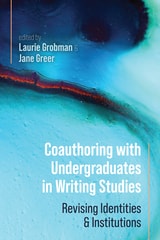
Coauthoring with Undergraduates in Writing Studies
Revising Identities and InstitutionsLaurie Grobman
Utah State University Press, 2025
In this book, faculty and undergraduates describe and theorize about their coauthoring experiences within a variety of institutional contexts including land-grant universities, Historically Black Colleges and Universities, Hispanic-Serving Institutions, religiously affiliated research universities, and regional campuses of statewide higher education systems. They explore the relationships between undergraduates and faculty that lead to coauthoring opportunities in a range of courses—first-year writing classes, general educational requirements in various disciplines, and upper-level offerings for English majors—as well as in other institutional spaces such as writing centers, community engagement initiatives, and assessment offices. The collection offers faculty and undergraduates models, ideas, and strategies for how to coauthor together while also preparing them for the challenges—pragmatic, intellectual, and ethical—that they may encounter.
Coauthoring with Undergraduates in Writing Studies showcases why and how coauthorship between faculty and undergraduates is a vital site for scholarly engagement, professional development, and socially just education. It boldly enacts rhetoric and composition’s commitment to collaborative scholarship and is significant for graduate students and faculty in rhetoric and writing studies, especially in community-engaged writing, undergraduate education, collaborative writing, and mentorship, as well as those interested in WAC, WID, and the scholarship of teaching and learning.
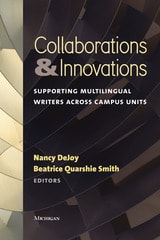
Collaborations & Innovations
Supporting Multilingual Writers across Campus UnitsNancy DeJoy and Beatrice Quarshie Smith
University of Michigan Press, 2017
The chapters in this volume demonstrate that teaching effective communication skills to all students in ways that recognize the needs of multiple language users requires a shift in perspective that approaches multilingualism as an opportunity that is enhanced by the internationalization of higher education because it makes transparent the problems of current structures and disciplinary approaches in accessing those opportunities. A goal of this collection is to address the economic, structural, disciplinary, and pedagogical challenges of making this type of shift in bold and compassionate ways.
Chapters are organized into these four parts--Program-Level Challenges and Opportunities, Opportunities for Enhancing Teacher Training, Multilingualism and the Revision of First-Year Writing, and Integrating Writing Center Insights—and reflect the perspectives of a variety of university language settings. The contributions feature collaborative models and illustrate the need to rethink structures, pedagogies, assessment/evaluation processes, and teacher training for graduate and undergraduate students who will teach writing and other forms of communication.
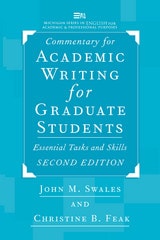
Commentary for Academic Writing for Graduate Students, 2d ed.
Essential Tasks and SkillsJohn M. Swales and Christine B. Feak
University of Michigan Press, 2004
Like its predecessor, this edition of Academic Writing for Graduate Students
"explains understanding the intended audience, the purpose of the paper, and academic genres.
"includes the use of task-based methodology, analytic group discussion, and genre consciousness-raising.
"shows how to write summaries and critiques.
"features "language focus" sections that address linguistic elements as they affect the wider rhetorical objectives.
"helps students position themselves as junior scholars in their academic communities.
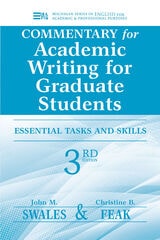
Commentary for Academic Writing for Graduate Students, 3rd Ed.
Essential Tasks and SkillsJohn M. Swales & Christine B. Feak
University of Michigan Press, 2012
The Commentary for the third edition of this successful guide to writing has been revised and expanded in many ways to provide more support for instructors; this includes additional tasks for Units Two and Four to supplement the main text. However, the collegial tone established in previous Commentaries between Swales & Feak and instructors has been retained.
This volume contains commentaries on each of the eight units plus the two appendixes. The format for each unit includes
- a summary of the main points of the unit along with a list of topics covered.
- a synopsis of activities, divided into Language Focus sections and description of tasks.
- some general notes designed to capture the character of the unit, to indicate alternative activities, or to anticipate problems that may arise.
- detailed commentary and discussion of individual tasks, including model or sample answers where possible.
Composition and Rhetoric in Contentious Times
Rachel McCabe
Utah State University Press, 2023
Editors Rachel McCabe and Jennifer Juszkiewicz consider how educators can respond to multiple current crises relating to composition and rhetoric with generosity and cautious optimism; in the process, they address the current concerns about the longevity of the humanities. By engaging with social constructivist, critical race, socioeconomic, and activist pedagogies, each chapter provides an answer to the question, How can our courses help students become stronger writers while contending with current social, environmental, and ethical questions posed by the world around them? The contributors consider this question from numerous perspectives, recognizing the important ways that power and privilege affect our varying means of addressing this question.
Relying on both theory and practice, Composition and Rhetoric in Contentious Times engages the future of composition and rhetoric as a discipline shaped by recent and current global events. This text appeals to early-career writing program administrators, writing center directors, and professional specialists, as well as Advanced Placement high school instructors, graduate students, and faculty teaching graduate-level pedagogy courses.
Composition, Rhetoric, and Disciplinarity
Rita Malenczyk
Utah State University Press, 2018
Edited by four nationally recognized leaders of composition scholarship, Composition, Rhetoric, and Disciplinarity asks a fundamental question: can Composition and Rhetoric, as a discipline, continue its historical commitment to pedagogy without sacrificing equal attention to other areas, such as research and theory? In response, contributors to the volume address disagreements about what it means to be called a discipline rather than a profession or a field; elucidate tensions over the defined breadth of Composition and Rhetoric; and consider the roles of research and responsibility as Composition and Rhetoric shifts from field to discipline.
Outlining a field with a complex and unusual formation story, Composition, Rhetoric, and Disciplinarity employs several lenses for understanding disciplinarity—theory, history, labor, and pedagogy—and for teasing out the implications of disciplinarity for students, faculty, institutions, and Composition and Rhetoric itself. Collectively, the chapters speak to the intellectual and embodied history leading to this point; to questions about how disciplinarity is, and might be, understood, especially with regard to Composition and Rhetoric; to the curricular, conceptual, labor, and other sites of tension inherent in thinking about Composition and Rhetoric as a discipline; and to the implications of Composition and Rhetoric’s disciplinarity for the future.
Contributors: Linda Adler-Kassner, Elizabeth H. Boquet, Christiane Donahue, Whitney Douglas, Doug Downs, Heidi Estrem, Kristine Hansen, Doug Hesse, Sandra Jamieson, Neal Lerner, Jennifer Helene Maher, Barry Maid, Jaime Armin Mejía, Carolyn R. Miller, Kelly Myers, Gwendolynne Reid, Liane Robertson, Rochelle Rodrigo, Dawn Shepherd, Kara Taczak
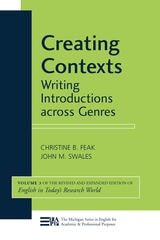
Creating Contexts
Writing Introductions across GenresChristine B. Feak & John M. Swales
University of Michigan Press, 2011
Research article introductions are central to Creating Contexts: Writing across Genres with the CaRS (creating a research space) model used as a starting point. This volume focuses on introductions for other kinds of texts that are also part of the graduate student writing experience such as course papers and critiques, proposals, and dissertations.
This volume represents a revision and expansion of the material on introductions that appeared in English in Today's Research World.
The material presented in this volume is appropriate for graduate students and others already working in their chosen academic fields. The material has, in fact, been used with each of these groups in both writing courses and writing workshops. We believe that the material would also be suitable for those wishing to pursue a course of self-study. To target these different possible uses, we have included a variety of topics and tasks that we hope will deepen users’ understanding of how to create a writing context for their work. Tasks range from evaluating text commentaries to open-ended questions and have been designed to generate lively classroom or workshop discussion as well as thoughtful consideration by an individual user.
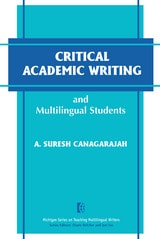
Critical Academic Writing and Multilingual Students
A. Suresh Canagarajah
University of Michigan Press, 2002
This volume facilitates teacher self-reflection and enables readers to better understand the motivations and pedagogical implications--especially for L2 writing--of a more openly pedagogical approach.
Critical Academic Writing and Multilingual Students explains what it means to commit to an academic pedagogy, in terms of form, self, content, and community--and what it can accomplish in the L2 writing classroom. It's a guide for writing teachers who wish to embark on a journey toward increased critical awareness of the role they play, or potentially could play, in the lives of their students.
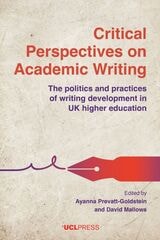
Critical Perspectives on Academic Writing
The politics and Practices of Writing Development in UK Higher EducationEdited by Ayanna Prevatt-Goldstein and David Mallows
University College London, 2026
This volume addresses the most pressing issues in higher education today, such as inclusion, academic integrity, and generative AI.
This timely collection explores the politics and practices of academic writing development in UK higher education. The volume addresses issues of access, equity, and generative AI in the context of student writing, to consider what makes writing academic, why it matters, and how we can change the field for the better.