Results by title
1563 books match the query 'African American & Black Studies' and 79 start with c
C. L. R. James in Imperial Britain
Christian Høgsbjerg
Duke University Press, 2014

COVID and...
How to Do Rhetoric in a PandemicEmily Winderman
Michigan State University Press, 2023
CROSS-CULTURAL VISIONS IN AFRICAN AMERICAN MODERNISM
FROM SPATIAL NARRATIVE TO JAZZ HAIKUYOSHINOBU HAKUTANI
The Ohio State University Press, 2006
In writing Black Boy, the centerpiece of the Chicago Renaissance, Wright was inspired by Theodore Dreiser. Because the European and African cultural visions that Wright, Ralph Ellison, Alice Walker, and Toni Morrison acquired were buttressed by the universal humanism that is common to all cultures, this ideology is shown to transcend the problems of society. Fascinated by Eastern thought and art, Wright, Walker, Sonia Sanchez, and James Emanuel wrote highly accomplished poetry and prose. Like Ezra Pound, Wright was drawn to classic haiku, as reflected in the 4,000 haiku he wrote at the end of his life. As W. B. Yeats’s symbolism was influenced by his cross-cultural visions of noh theatre and Irish folklore, so is James Emanuel’s jazz haiku energized by his cross-cultural rhythms of Japanese poetry and African American music.
The book demonstrates some of the most visible cultural exchanges in modern and postmodern African American literature. Such a study can be extended to other contemporary African American writers whose works also thrive on their cross-cultural visions, such as Amiri Baraka, Ishmael Reed, Charles Johnson, and haiku poet Lenard Moore.

Captive Ecologies
The Environmental Afterlives of SlaveryJennifer C. James
Duke University Press, 2026
Caribbean Crusaders and the Harlem Renaissance
Joyce Moore Turner
University of Illinois Press, 2005
To explore the roots of the Caribbean emigres' radical ideology and the strategies used to extend agitation from Harlem to national and international platforms, the study draws on the papers and writings of Hermina Huiswoud, Cyril Briggs, the Reverend E. Ethelred Brown, Langston Hughes, and Richard B. Moore, as well as from interviews and biographies of related contemporary figures. It also incorporates census records, FBI files, and hundreds of documents from the recently opened Russian Archive.
Through a focus on Otto Huiswoud, the sole African American charter member of the Communist Party, and his wife, Hermina, Turner exposes the complex developments within the socialist and communist parties on the question of race. The account ranges beyond Harlem to Europe, Africa, and the Soviet Union to reveal the breadth, depth, and nearly global reach of the Afro-Caribbean activists' activities.
Caste and Class in a Southern Town
John Dollard
University of Wisconsin Press, 1989
An extraordinary powerful exposition of social patterns in a small town, Caste and Class in a Southern Town has become a benchmark in social science methodology and a classic in American studies. Now fifty years after its original publication, John Dollard’s most famous work offers timeless insights and remains essential to those interested in race-related social issues.
In 1937, W. E. B. Du Bois observed, "Dr. Dollard’s study is one of the most interesting and penetrating that has been made concerning the South and is marked by courage and real insight. . . . Dr. Dollard’s book marks a distinct advance in the study of the Southern scene."
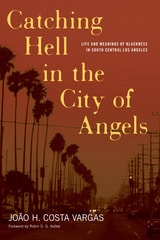
Catching Hell In The City Of Angels
Life And Meanings Of Blackness In South Central Los AngelesJoão H. Costa Vargas
University of Minnesota Press, 2006
Through compelling stories of South Central, including his own experience as an immigrant of color, Vargas presents portraits of four groups. He talks daily with women living in a low-income Watts apartment building; works with activists in a community organization against police brutality; interacts with former gang members trying to maintain a 1992 truce between the Bloods and the Crips; and listens to amateur jazz musicians who perform in a gentrified section of the neighborhood. In each case he describes the worldviews and the definitions of “blackness” these people use to cope with oppression. Vargas finds, in turn, that blackness is a form of racial solidarity, a vehicle for the renewal of African American culture, and a political expression of revolutionary black nationalism.
Vargas reveals that the social fault lines in South Central reflect both contemporary disparities and long-term struggles. In doing so, he shows both the racialized power that makes “blackness” a prized term of identity and the terrible price that African Americans have paid for this emphasis. Ultimately, Catching Hell in the City of Angels tells the story of urban America through the lives of individuals from diverse, overlapping, and vibrant communities.
João H. Costa Vargas is assistant professor in the Center for African and African American Studies and the department of anthropology at the University of Texas, Austin.
Robin D. G. Kelley is the William B. Ransford Professor of Cultural and Historical Studies at Columbia University. He is the author of numerous books, including Yo Mama's Disfunktional: Fighting the Culture Wars in Urban America.
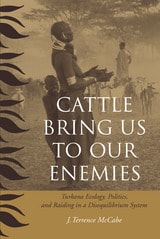
Cattle Bring Us to Our Enemies
Turkana Ecology, Politics, and Raiding in a Disequilibrium SystemJ. Terrence McCabe
University of Michigan Press, 2004
Based on sixteen years of fieldwork among the pastoral Turkana people, McCabe examines how individuals use the land and make decisions about mobility, livestock, and the use of natural resources in an environment characterized by aridity, unpredictability, insecurity, and violence. The Turkana are one of the world's most mobile peoples, but understanding why and how they move is a complex task influenced by politics, violence, historical relations among ethnic groups, and the government, as well as by the arid land they call home.
As one of the original members of the South Turkana Ecosystem Project, McCabe draws on a wealth of ecological data in his analysis. His long-standing relationship with four Turkana families personalize his insights and conclusions, inviting readers into the lives of these individuals, their families, and the way they cope with their environment and political events in daily life.
J. Terrence McCabe is Associate Professor of Anthropology, University of Colorado at Boulder.
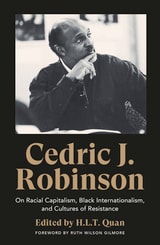
Cedric J. Robinson
On Racial Capitalism, Black Internationalism, and Cultures of ResistanceCedric J. Robinson
Pluto Press, 2019
"Like W. E. B. Du Bois, Michel Foucault, Sylvia Wynter, and Edward Said, Robinson was that rare polymath capable of seeing the whole....He left behind a body of work to which we must return constantly and urgently"—Robin D. G. Kelley, author of Freedom Dreams
Cedric J. Robinson is one of the doyens of Black Studies and a pioneer in study of the Black Radical Tradition. His works have been essential texts, deconstructing racial capitalism and inspiring insurgent movements from Ferguson, Missouri to the West Bank. For the first time, Robinson's essays come together, spanning over four decades and reflective of his diverse interests in the interconnections between culture and politics, radical social theory, and classic and modern political philosophy.
Themes explored include Africa and Black internationalism, World politics, race and US Foreign Policy, representations of blackness in popular culture, and reflections on popular resistance to racial capitalism, white supremacy and more. Essays here include:
*The Black Detective and American Memory
*Slavery and the Platonic Origins of Anti-Democracy
*Africa: In Hock to History and the Banks
*Blaxploitation and the Misrepresentation of Liberalism
*The Mulatta on Film
*Race, Capitalism, and Anti-democracy
*The Killing in Ferguson
*And much more!
Accompanied by an introduction by H. L. T. Quan and a foreword by Ruth Wilson Gilmore, this collection, which includes previously unpublished materials, extends the many contributions by a giant in Black radical thought.
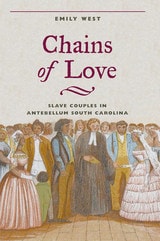
Chains of Love
Slave Couples in Antebellum South CarolinaEmily West
University of Illinois Press, 2004
Focusing on South Carolina, West deals directly with the most intimate areas of the slave experience including courtship, love and affection between spouses, the abuse of slave women by white men, and the devastating consequences of forced separations. Slaves fought these separations through cross-gender bonding and cross-plantation marriages, illustrating West's thesis about slave marriage as a fierce source of resistance to the oppression of slavery in general.
Making expert use of sources such as the Works Progress Administration narratives, slave autobiographies, slave owner records, and church records, this book-length study is the first to focus on the primacy of spousal support as a means for facing oppression. Chains of Love provides telling insights into the nature of the slave family that emerged from these tensions, celebrates its strength, and reveals new dimensions to the slaves' struggle for freedom.
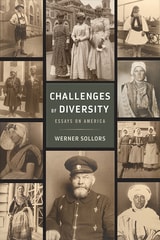
Challenges of Diversity
Essays on AmericaSollors, Werner
Rutgers University Press, 2017
What unites and what divides Americans as a nation? Who are we, and can we strike a balance between an emphasis on our divergent ethnic origins and what we have in common? Opening with a survey of American literature through the vantage point of ethnicity, Werner Sollors examines our evolving understanding of ourselves as an Anglo-American nation to a multicultural one and the key role writing has played in that process.
Challenges of Diversity contains stories of American myths of arrival (pilgrims at Plymouth Rock, slave ships at Jamestown, steerage passengers at Ellis Island), the powerful rhetoric of egalitarian promise in the Declaration of Independence and the heterogeneous ends to which it has been put, and the recurring tropes of multiculturalism over time (e pluribus unum, melting pot, cultural pluralism). Sollors suggests that although the transformation of this settler country into a polyethnic and self-consciously multicultural nation may appear as a story of great progress toward the fulfillment of egalitarian ideals, deepening economic inequality actually exacerbates the divisions among Americans today.
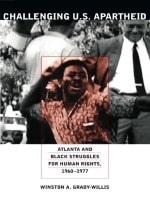
Challenging U.S. Apartheid
Atlanta and Black Struggles for Human Rights, 1960–1977Winston A. Grady-Willis
Duke University Press, 2006
Grady-Willis describes Black activism within a framework of human rights rather than in terms of civil rights. As he demonstrates, civil rights were only one part of a larger struggle for self-determination, a fight to dismantle a system of inequalities that he conceptualizes as “apartheid structures.” Drawing on archival research and interviews with activists of the 1960s and 1970s, he illuminates a wide range of activities, organizations, and achievements, including the neighborhood-based efforts of Atlanta’s Black working poor, clandestine associations such as the African American women’s group Sojourner South, and the establishment of autonomous Black intellectual institutions such as the Institute of the Black World. Grady-Willis’s chronicle of the politics within the Black freedom movement in Atlanta brings to light overlapping ideologies, gender and class tensions, and conflicts over divergent policies, strategies, and tactics. It also highlights the work of grassroots activists, who take center stage alongside well-known figures in Challenging U.S. Apartheid. Women, who played central roles in the human rights struggle in Atlanta, are at the foreground of this history.
Charisma and the Fictions of Black Leadership
Erica R. Edwards
University of Minnesota Press, 2012
Social and political change is impossible in the absence of gifted male charismatic leadership—this is the fiction that shaped African American culture throughout the twentieth century. If we understand this, Erica R. Edwards tells us, we will better appreciate the dramatic variations within both the modern black freedom struggle and the black literary tradition.
By considering leaders such as Marcus Garvey, Martin Luther King Jr., Malcolm X, and Barack Obama as both historical personages and narrative inventions of contemporary American culture, Edwards brings to the study of black politics the tools of intertextual narrative analysis as well as deconstruction and close reading. Examining a number of literary restagings of black leadership in African American fiction by W. E. B. Du Bois, George Schuyler, Zora Neale Hurston, William Melvin Kelley, Paul Beatty, and Toni Morrison, Edwards demonstrates how African American literature has contested charisma as a structuring fiction of modern black politics.
Though recent scholarship has challenged top-down accounts of historical change, the presumption that history is made by gifted men continues to hold sway in American letters and life. This may be, Edwards shows us, because while charisma is a transformative historical phenomenon, it carries an even stronger seductive narrative power that obscures the people and methods that have created social and political shifts.
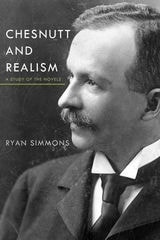
Chesnutt and Realism
A Study of the NovelsRyan Simmons
University of Alabama Press, 2006
Provides an important examination of Charles Chesnutt as a practitioner of realism
Although Chesnutt is typically acknowledged as the most prominent African American writer of the realist period, scholars have paid little attention to the central question of this study: what does it mean to call Chesnutt a realist? As a writer whose career was restricted by the dismal racial politics of his era, Chesnutt refused to conform to literary conventions for depicting race. Nor did he use his imaginative skills to evade the realities he and other African Americans faced. Rather, he experimented with ways of portraying reality that could elicit an appropriate, proportionate response to it, as Ryan Simmons demonstrates in extended readings of each of Chesnutt’s novels, including important unpublished works overlooked by previous critics.
In addition, Chesnutt and Realism addresses a curiously neglected subject in American literary studies—the relationship between American literary realism and race. By taking Chesnutt seriously as a contributor to realism, this book articulates the strategies by which one African American intellectual helped to define the discourses that influenced his fate.
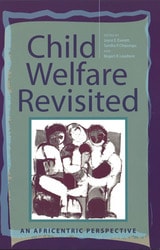
Child Welfare Revisited
An Africentric PerspectiveEverett, Joyce E
Rutgers University Press, 2004
Why are there proportionally more African American children in foster care than white children? Why are white children often readily adoptable, while African American children are difficult to place? Are these imbalances an indication of institutional racism or merely a coincidence?
In this revised and expanded edition of the classic volume, Child Welfare, twenty-one educators call attention to racial disparities in the child welfare system by demonstrating how practices that are successful for white children are often not similarly successful for African American children. Moreover, contributors insist that policymakers and care providers look at African American family life and child-development from a culturally-based Africentric perspective. Such a perspective, the book argues, can serve as a catalyst for creativity and innovation in the formulation of policies and practices aimed at improving the welfare of African American children.
Child Welfare Revisited offers new chapters on the role of institutional racism and economics on child welfare; the effects of substance abuse, homelessness, HIV/AIDS, and domestic violence; and the internal strengths and challenges that are typical of African American families. Bringing together timely new developments and information, this book will continue to be essential reading for all child welfare policymakers and practitioners.

Children Of Strangers
Kathryn Morgan
Temple University Press, 1981
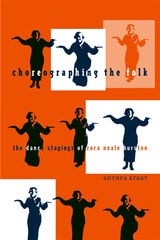
Choreographing the Folk
The Dance Stagings of Zora Neale HurstonAnthea Kraut
University of Minnesota Press, 2008
Recovers an important dimension of the work of the renowned African American artist
While Zora Neale Hurston and her 1937 novel Their Eyes Were Watching God have become widely celebrated, she was also a prolific stage director and choreographer. In the 1930s Hurston produced theatrical concerts that depicted a day in the life of a railroad work camp in Florida and featured a rousing Bahamian Fire Dance as the dramatic finale. In Choreographing the Folk, Anthea Kraut traces the significance and influence of Hurston’s little-known choreographic work.
Hurston’s concerts were concrete illustrations of the “real Negro art theatre” she was eager to establish, and they compellingly demonstrate how she used the arena of performance to advance a nuanced understanding of the black diaspora. Her version of the Fire Dance was staged in a variety of venues during the 1930s. In its multiple representations, Kraut asserts, the dance raised critical issues about ownership, artistry, and authenticity. Choreographing the Folk argues for the significance of Hurston’s choreography, and with perceptiveness, sensitivity, and originality, Kraut illuminates the important and often-contested place of black folk dance in American culture.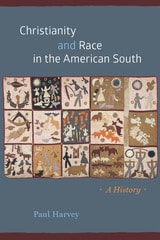
Christianity and Race in the American South
A HistoryPaul Harvey
University of Chicago Press, 2016
Harvey chronicles the diversity and complexity in the intertwined histories of race and religion in the South, dating back to the first days of European settlement. He presents a history rife with strange alliances, unlikely parallels, and far too many tragedies, along the way illustrating that ideas about the role of churches in the South were critically shaped by conflicts over slavery and race that defined southern life more broadly. Race, violence, religion, and southern identity remain a volatile brew, and this book is the persuasive historical examination that is essential to making sense of it.
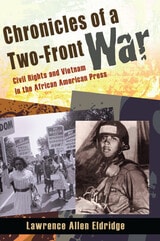
Chronicles of a Two-Front War
Civil Rights and Vietnam in the African American PressLawrence Allen Eldridge
University of Missouri Press, 2011
Eldridge reveals how the black press not only reported the war but also weighed its significance in the context of the civil rights movement.
Eldridge examines not only the role of reporters during the war, but also those of editors, commentators, and cartoonists. Especially enlightening is the research drawn from extensive oral histories by prominent journalist Ethel Payne, the first African American woman to receive the title of war correspondent. She described a widespread practice in black papers of reworking material from major white papers without providing proper credit, as the demand for news swamped the small budgets and limited staffs of African American papers. The author analyzes both the strengths of the black print media and the weaknesses in their coverage.
The black press ultimately viewed the Vietnam War through the lens of African American experience, blaming the war for crippling LBJ’s Great Society and the War on Poverty. Despite its waning hopes for an improved life, the black press soldiered on.
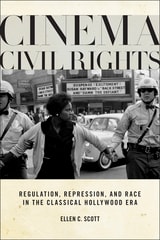
Cinema Civil Rights
Regulation, Repression, and Race in the Classical Hollywood EraScott, Ellen C
Rutgers University Press, 2015
Cistem Failure
Essays on Blackness and CisgenderMarquis Bey
Duke University Press, 2022
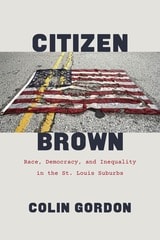
Citizen Brown
Race, Democracy, and Inequality in the St. Louis SuburbsColin Gordon
University of Chicago Press, 2019
Citizen Brown uncovers half a century of private practices and public policies that resulted in bitter inequality and sustained segregation in Ferguson and beyond. Gordon shows how municipal and school district boundaries were pointedly drawn to contain or exclude African Americans and how local policies and services—especially policing, education, and urban renewal—were weaponized to maintain civic separation. He also makes it clear that the outcry that arose in Ferguson was no impulsive outburst but rather an explosion of pent-up rage against long-standing systems of segregation and inequality—of which a police force that viewed citizens not as subjects to serve and protect but as sources of revenue was only the most immediate example. Worse, Citizen Brown illustrates the fact that though the greater St. Louis area provides some extraordinarily clear examples of fraught racial dynamics, in this it is hardly alone among American cities and regions.
Interactive maps and other companion resources to Citizen Brown are available at the book website.
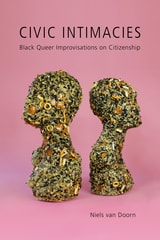
Civic Intimacies
Black Queer Improvisations on CitizenshipNiels van Doorn
Temple University Press, 2019
Black queer lives often exist outside conventional civic institutions and therefore have to explore alternative intimacies to experience a sense of belonging. Civic Intimacies examines how—and to what extent—these different forms of intimacy catalyze the values, aspirations, and collective flourishing of Black queer denizens of Baltimore. Niels van Doorn draws on 18 months of immersive ethnographic fieldwork for his innovative cross-disciplinary analysis of contemporary debates in political and cultural theory.
Van Doorn describes the way that these systematically marginalized communities improvise on citizenship not just to survive but also to thrive despite the proliferation of violence and insecurity in their lives. By reimagining citizenship as the everyday reparative work of building support structures, Civic Intimacies highlights the extent to which sex, kinship, memory, religious faith, and sexual health are rooted in collective practices that are deeply political. These systems sustain the lives of Black queer Baltimoreans who find themselves stuck in a city they cannot give up on—even though it has in many ways given up on them.
Civil Obedience
An Oral History of School Desegregation in Fayetteville, Arkansas, 1954–1965Julianne Lewis Adams
University of Arkansas Press, 1994
While school desegregation generated much noise and some violence elsewhere in the South, the city of Fayetteville, Arkansas confronted the issue and resolved it with a good deal of dignity and grace, becoming the first Southern city to accommodate the Brown decision.
Through this fascinating collection of interviews with those who were involved in the desegregation process—students, teachers, administrators, civic leaders, and members of local groups—we learn of the determination of citizens to obey the law of the land and to see that freedom and equality took priority over their commitment to a school system that patently discriminated against one group of citizens.
In our continuing efforts to create a society in which all races and cultures can coexist, Civil Obedience is a story worthy of our full attention.
Civil Rights and African Americans
A Documentary HistoryAlbert Blaustein and Robert L. Zangrando
Northwestern University Press, 1991
Many of the documents included were previously scattered in hard-to-find sources, not readily available to instructors and students. Civil Rights and African Americans is the first collection of all the seminal texts of the civil rights struggle, an invaluable scholarly reference and riveting reading for anyone interested in the history of racial conflict in the United States.
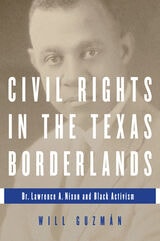
Civil Rights in the Texas Borderlands
Dr. Lawrence A. Nixon and Black ActivismWill Guzman
University of Illinois Press, 2016
Will Guzmán delves into Nixon's lifelong struggle against Jim Crow. Linking Nixon's activism to his independence from the white economy, support from the NAACP, and the man's own indefatigable courage, Guzmán also sheds light on Nixon's presence in symbolic and literal borderlands--as an educated professional in a time when few went to college, as an African American who made waves when most feared violent reprisal, and as someone living on the mythical American frontier as well as an international boundary.
A powerful addition to the literature on African Americans in the Southwest, Civil Rights in the Texas Borderlands explores seldom-studied corners of the Black past and the civil rights movement.
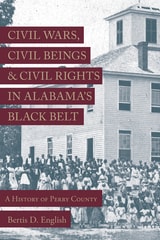
Civil Wars, Civil Beings, and Civil Rights in Alabama's Black Belt
A History of Perry CountyBertis D. English, Foreword by Wayne Flynt
University of Alabama Press, 2020
Reconstruction politics and race relations between freed blacks and the white establishment in Perry County, Alabama
In his fascinating, in-depth study, Bertis D. English analyzes why Perry County, situated in the heart of a violence-prone subregion of Alabama, enjoyed more peaceful race relations and less bloodshed than several neighboring counties. Choosing an atypical locality as central to his study, English raises questions about factors affecting ethnic disturbances in the Black Belt and elsewhere in Alabama. He also uses Perry County, which he deems an anomalous county, to caution against the tendency of some scholars to make sweeping generalizations about entire regions and subregions.
English contends Perry County was a relatively tranquil place with a set of extremely influential African American businessmen, clergy, politicians, and other leaders during Reconstruction. Together with egalitarian or opportunistic white citizens, they headed a successful campaign for black agency and biracial cooperation that few counties in Alabama matched. English also illustrates how a significant number of educational institutions, a high density of African American residents, and an unusually organized and informed African American population were essential factors in forming Perry County’s character. He likewise traces the development of religion in Perry, the nineteenth-century Baptist capital of Alabama, and the emergence of civil rights in Perry, an underemphasized center of activism during the twentieth century.
This well-researched and comprehensive volume illuminates Perry County’s history from the various perspectives of its black, interracial, and white inhabitants, amplifying their own voices in a novel way. The narrative includes rich personal details about ordinary and affluent people, both free and unfree, creating a distinctive resource that will be useful to scholars as well as a reference that will serve the needs of students and general readers.
Claiming Union Widowhood
Race, Respectability, and Poverty in the Post-Emancipation SouthBrandi Clay Brimmer
Duke University Press, 2020
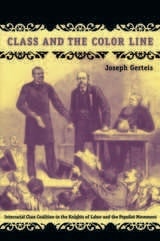
Class and the Color Line
Interracial Class Coalition in the Knights of Labor and the Populist MovementJoseph Gerteis
Duke University Press, 2007
While scholars have long debated whether the Knights and the Populists were genuine in their efforts to cross the color line, Joseph Gerteis shifts attention from that question to those of how, where, and when the movements’ organizers drew racial boundaries. Arguing that the movements were simultaneously racially inclusive and exclusive, Gerteis explores the connections between race and the movements’ economic and political interests in their cultural claims and in the dynamics of local organizing.
Interpreting data from the central journals of the Knights of Labor and the two major Populist organizations, the Farmers’ Alliance and the People’s Party, Gerteis explains how the movements made sense of the tangled connections between race, class, and republican citizenship. He considers how these collective narratives motivated action in specific contexts: in Richmond and Atlanta in the case of the Knights of Labor, and in Virginia and Georgia in that of the Populists. Gerteis demonstrates that the movements’ collective narratives galvanized interracial organizing to varying degrees in different settings. At the same time, he illuminates the ways that interracial organizing was enabled or constrained by local material, political, and social conditions.
Closing the Education Achievement Gaps for African American Males
Theodore S. Ransaw
Michigan State University Press, 2016
The distinguished and expert contributors whose work comprises this volume include an achievement-gap specialist for males of color, two psychologists, a math teacher, an electrical engineer, a former school principal, a social worker, and a former human rights commissioner. From black male learning styles to STEM, this book shows that issues pertaining to educational outcomes for black males are nuanced and complex but not unsolvable.
With its combination of fresh new approaches to closing achievement gaps and up-to-date views on trends, this volume is an invaluable resource on vital contemporary social and educational issues that aims to improve learning, equity, and access for African American males.
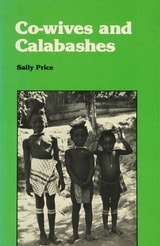
Co-wives and Calabashes
Sally Price
University of Michigan Press, 1984
Collected Prose
Robert Hayden
University of Michigan Press, 1984
Collective Action and the Civil Rights Movement
Dennis Chong
University of Chicago Press, 1991
Colonial Racial Capitalism
Susan Koshy, Lisa Marie Cacho, Jodi A. Byrd, and Brian Jordan Jefferson, editors
Duke University Press, 2022
Contributors. Joanne Barker, Jodi A. Byrd, Lisa Marie Cacho, Michael Dawson, Iyko Day, Ruth Wilson Gilmore, Alyosha Goldstein, Cheryl I. Harris, Kimberly Kay Hoang, Brian Jordan Jefferson, Susan Koshy, Marisol LeBrón, Jodi Melamed, Laura Pulido
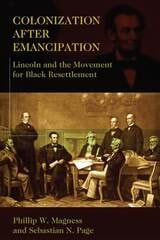
Colonization After Emancipation
Lincoln and the Movement for Black ResettlementPhillip W. Magness and Sebastian N. Page
University of Missouri Press, 2011
Colonization after Emancipation: Lincoln and the Movement for Black Resettlement explores the previously unknown truth about Lincoln’s attitude toward colonization. Scholars Phillip W. Magness and Sebastian N. Page combed through extensive archival materials, finding evidence, particularly within British Colonial and Foreign Office documents, which exposes what history has neglected to reveal—that Lincoln continued to pursue colonization for close to a year after emancipation. Their research even shows that Lincoln may have been attempting to revive this policy at the time of his assassination.
Using long-forgotten records scattered across three continents—many of them untouched since the Civil War—the authors show that Lincoln continued his search for a freedmen’s colony much longer than previously thought. Colonization after Emancipation reveals Lincoln’s highly secretive negotiations with the British government to find suitable lands for colonization in the West Indies and depicts how the U.S. government worked with British agents and leaders in the free black community to recruit emigrants for the proposed colonies. The book shows that the scheme was never very popular within Lincoln’s administration and even became a subject of subversion when the president’s subordinates began battling for control over a lucrative “colonization fund” established by Congress.
Colonization after Emancipation reveals an unexplored chapter of the emancipation story. A valuable contribution to Lincoln studies and Civil War history, this book unearths the facts about an ill-fated project and illuminates just how complex, and even convoluted, Abraham Lincoln’s ideas about the end of slavery really were.
Color of Privilege
Three Blasphemies on Race and FeminismAida Hurtado
University of Michigan Press, 1996
Colored Amazons
Crime, Violence, and Black Women in the City of Brotherly Love, 1880–1910Kali N. Gross
Duke University Press, 2006
Gross draws on prison records, trial transcripts, news accounts, and rare mug shot photographs. Providing an overview of Philadelphia’s black women criminals, she describes the women’s work, housing, and leisure activities and their social position in relation to the city’s native-born whites, European immigrants, and elite and middle-class African Americans. She relates how news accounts exaggerated black female crime, trading in sensationalistic portraits of threatening “colored Amazons,” and she considers criminologists’ interpretations of the women’s criminal acts, interpretations largely based on notions of hereditary criminality. Ultimately, Gross contends that the history of black female criminals is in many ways a history of the rift between the political rhetoric of democracy and the legal and social realities of those marginalized by its shortcomings.
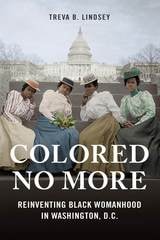
Colored No More
Reinventing Black Womanhood in Washington, D.C.Treva B. Lindsey
University of Illinois Press, 2017
Treva B. Lindsey presents New Negro womanhood as a multidimensional space that included race women, blues women, mothers, white collar professionals, beauticians, fortune tellers, sex workers, same-gender couples, artists, activists, and innovators. Drawing from these differing but interconnected African American women's spaces, Lindsey excavates a multifaceted urban and cultural history of struggle toward a vision of equality that could emerge and sustain itself. Upward mobility to equal citizenship for African American women encompassed challenging racial, gender, class, and sexuality status quos. Lindsey maps the intersection of these challenges and their place at the core of New Negro womanhood.
Colored Property
State Policy and White Racial Politics in Suburban AmericaDavid M. P. Freund
University of Chicago Press, 2007
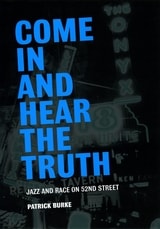
Come In and Hear the Truth
Jazz and Race on 52nd StreetPatrick Burke
University of Chicago Press, 2008
Come In and Hear the Truth uses a range of materials, from classic photographs to original interviews with musicians, to bring the street’s vibrant history to life and to shed new light on the interracial contacts and collaborations it generated.
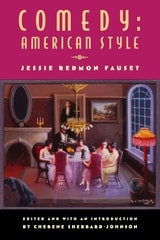
Comedy
American Style: Jessie Redmon FausetSherrard-Johnson, Cherene
Rutgers University Press, 2009
Cherene Sherrard-Johnson's introduction places this literary classic in both the new modernist and transatlantic contexts and will be embraced by those interested in earlytwentieth-century women writers, novels about passing, the Harlem Renaissance, the black/white divide, and diaspora studies. Selected essays and poems penned by Fauset are also included, among them "Yarrow Revisited" and "Oriflamme," which help highlight the full canon of her extraordinary contribution to literature and provide contextual background to the novel.
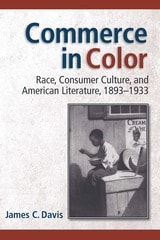
Commerce in Color
Race, Consumer Culture, and American Literature, 1893-1933James C. Davis
University of Michigan Press, 2010
Commerce in Color exploresthe juncture of consumer culture and race by examining advertising, literary texts, mass culture, and public events in the United States from 1893 to 1933. James C. Davis takes up a remarkable range of subjects—including the crucial role publishers Boni and Liveright played in the marketing of Harlem Renaissance literature, Henry James’s critique of materialism in The American Scene, and the commodification of racialized popular culture in James Weldon Johnson’s The Autobiography of anEx-Colored Man—as he argues that racial thinking was central to the emergence of U.S. consumerism and, conversely, that an emerging consumer culture was a key element in the development of racial thinking and the consolidation of racial identity in America. By urging a reassessment of the familiar rubrics of the “culture of consumption” and the “culture of segregation,” Dawson poses new and provocative questions about American culture and social history.
Both an influential literary study and an absorbing historical read, Commerce in Color proves that—in America—advertising, publicity, and the development of the modern economy cannot be understood apart from the question of race.
“A welcome addition to existing scholarship, Davis’s study of the intersection of racial thinking and the emergence of consumer culture makes connections very few scholars have considered.”
—James Smethurst, University of Massachusetts
James C. Davis is Assistant Professor of English at Brooklyn College.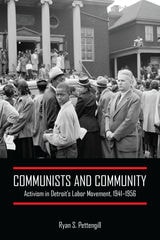
Communists and Community
Activism in Detroit's Labor Movement, 1941-1956Ryan S. Pettengill
Temple University Press, 2020
Communists and Community seeks to reframe the traditional chronology of the Communist Party in the United States as a means to better understand the change that occurred in community activism in the mid-twentieth century. Ryan Pettengill argues that Popular Front activism continued to flourish throughout the war years and into the postwar period. In Detroit, where there was a critical mass of heavy industry, Communist Party activists mobilized support for civil rights and affordable housing, brought attention to police brutality, sought protection for the foreign-born, and led a movement for world peace.
Communists and Community demonstrates that the Communist Party created a social space where activists became effective advocates for the socioeconomic betterment of a multiracial work force. Pettengill uses Detroit as a case study to examine how communist activists and their sympathizers maintained a community to enhance the quality of life for the city’s working class. He investigates the long-term effects of organized labor’s decision to force communists out of the unions and abandon community-based activism. Communists and Community recounts how leftists helped workers, people of color, and other under-represented groups became part of the mainstream citizenry in America.
Communists in Harlem during the Depression
Mark Naison
University of Illinois Press, 2004
Winner of the Ralph Bunche Award, American Political Science Association
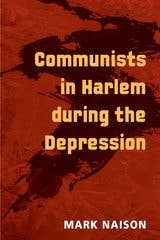
No socialist organization has ever had a more profound effect on black life than the Communist Party did in Harlem during the Depression. Mark Naison describes how the party won the early endorsement of such people as Adam Clayton Powell Jr. and how its support of racial equality and integration impressed black intellectuals, including Richard Wright, Langston Hughes, and Paul Robeson.
This meticulously researched work, largely based on primary materials and interviews with leading black Communists from the 1930s, is the first to fully explore this provocative encounter between whites and blacks. It provides a detailed look at an exciting period of reform, as well as an intimate portrait of Harlem in the 1920s and 30s, at the high point of its influence and pride.

Complete Poems
Claude Mckay. Edited and with an Introduction by William J. Maxwell.
University of Illinois Press, 2003
Containing more than three hundred poems, including nearly a hundred previously unpublished works, this unique collection showcases the intellectual range of Claude McKay (1889-1948), the Jamaican-born poet and novelist whose life and work were marked by restless travel and steadfast social protest. McKay's first poems were composed in rural Jamaican creole and launched his lifelong commitment to representing everyday black culture from the bottom up. Migrating to New York, he reinvigorated the English sonnet and helped spark the Harlem Renaissance with poems such as "If We Must Die." After coming under scrutiny for his communism, he traveled throughout Europe and North Africa for twelve years and returned to Harlem in 1934, having denounced Stalin's Soviet Union. By then, McKay's pristine "violent sonnets" were giving way to confessional lyrics informed by his newfound Catholicism.
McKay's verse eludes easy definition, yet this complete anthology, vividly introduced and carefully annotated by William J. Maxwell, acquaints readers with the full transnational evolution of a major voice in twentieth-century poetry.
Complex Commonwealth
Public History in PennsylvaniaEdited by Margaret Jerrido, Jeanine M. Mazak-Kahne, and Kristin O'Brassill-Kulfan
Temple University Press, 2027
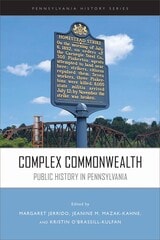
There are thousands of historic sites across Pennsylvania. The question of whose memories, what histories, and what local heritage deserve preservation has animated historians and communities for centuries. The editors and contributors to Complex Commonwealth provide a collection of accessible essays about public history in Pennsylvania that show how we have commemorated and preserved the state’s material culture, museums, monuments and memorials, parks, archives, libraries, and historic sites over centuries.
Chapters examine the Homestead Steel Strike, the Carlisle Indian School’s Digital Resource Center, and African American cemeteries and burial grounds, among other case studies. The methodologies these public historians use are as diverse as the various histories of labor, gender, religion, and race. It is by shedding light on these underseen histories that Complex Commonwealth affirms the importance of state and regional history to everyday Pennsylvanians.
Complex Commonwealth emphasizes the importance of place and space in shaping how we know what we know about the past and how that collectively shapes our future.
Contributors: Barbara Barksdale, Zachary L. Brodt, Steven Burg, Mary Catherine Foltz, Kelly C. George, James Gerencser, Alexandra Acri Godfrey, Kris Lowrey, Devin C. Manzullo-Thomas, Carol W. Smith, Frank Vitale IV, and the editors
Composition and Cornel West
Notes toward a Deep DemocracyKeith Gilyard
Southern Illinois University Press, 2008
Composition and Cornel West: Notes toward a Deep Democracy identifies and explains key aspects of the work of Cornel West—the highly regarded scholar of religion, philosophy, and African American studies—as they relate to composition studies, focusing especially on three rhetorical strategies that West suggests we use in our questioning lives as scholars, teachers, students, and citizens.
In this study, author Keith Gilyard examines the strategies of Socratic Commitment (a relentless examination of received wisdom), Prophetic Witness (an abiding concern with justice and the plight of the oppressed), and Tragicomic Hope (a keep-on-pushing sensibility reflective of the African American freedom struggle). Together, these rhetorical strategies comprise an updated form of cultural criticism that West calls prophetic pragmatism.
This volume, which contains the only interview in which Cornel West directly addresses the field of composition,sketches the development of Cornel West’s theories of philosophy, political science, religion, and cultural studies and restates the link between Deweyan notions of critical intelligence and the notion of critical literacy developed by Ann Berthoff, Ira Shor, and Henry Giroux. Gilyard provides examples from the classroom to illustrate the possibilities of Socratic Commitment as part of composition pedagogy, shows the alignment of Prophetic Witness with traditional aims of critical composition, and in his chapter on Tragicomic Hope, addresses African American expressive culture with an emphasis on music and artists such as Curtis Mayfield, Marvin Gaye, Aretha Franklin, and Kanye West.
The first book to comprehensively connect the ideas of one of America's premier scholars of religion, philosophy and African American studies with composition theory and pedagogy, Composition and Cornel West will be valuable to scholars, teachers, and students interested in race, class, critical literacy, and the teaching of writing.
Concordance
Black Lawmaking in the U.S. Congress from Carter to ObamaKatherine Tate
University of Michigan Press, 2014
During the height of the civil rights movement, Blacks were among the most liberal Americans. Since the 1970s, however, increasing representation in national, state, and local government has brought about a more centrist outlook among Black political leaders.
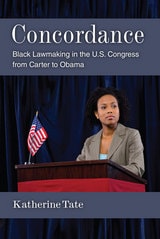
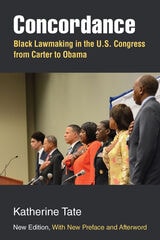
Focusing on the Congressional Black Caucus (CBC), Katherine Tate studies the ways in which the nation’s most prominent group of Black legislators has developed politically. Organized in 1971, the CBC set out to increase the influence of Black legislators. Indeed, over the past four decades, they have made progress toward the goal of becoming recognized players within Congress. And yet, Tate argues, their incorporation is transforming their policy preferences. Since the Clinton Administration, CBC members—the majority of whom are Democrats—have been less willing to oppose openly congressional party leaders and both Republican and Democratic presidents. Tate documents this transformation with a statistical analysis of Black roll-call votes, using the important Poole-Rosenthal scores from 1977 to 2010. While growing partisanship has affected Congress as a whole, not just minority caucuses, Tate warns that incorporation may mute the independent voice of Black political leaders.
Concordance
Black Lawmaking in the U.S. Congress from Carter to ObamaKatherine Tate
University of Michigan Press, 2020
Focusing on the Congressional Black Caucus (CBC), Katherine Tate studies the ways in which the nation’s most prominent group of Black legislators has developed politically. Organized in 1971, the CBC set out to increase the influence of Black legislators. Indeed, over the past four decades, they have made progress toward the goal of becoming recognized players within Congress. And yet, Tate argues, their incorporation is transforming their policy preferences. Since the Clinton Administration, CBC members—the majority of whom are Democrats—have been less willing to oppose openly congressional party leaders and both Republican and Democratic presidents. Tate documents this transformation with a statistical analysis of Black roll-call votes, using the important Poole-Rosenthal scores from 1977 to 2010. While growing partisanship has affected Congress as a whole, not just minority caucuses, Tate warns that incorporation may mute the independent voice of Black political leaders.
Conditions of the Present
Selected EssaysLindon Barrett
Duke University Press, 2018
Contributors. Elizabeth Alexander, Jennifer DeVere Brody, Daphne A. Brooks, Linh U. Hua, Janet Neary, Marlon B. Ross, Robyn Wiegman