Results by title
312 books match the query 'African American authors' and 22 start with c
CROSS-CULTURAL VISIONS IN AFRICAN AMERICAN MODERNISM
FROM SPATIAL NARRATIVE TO JAZZ HAIKUYOSHINOBU HAKUTANI
The Ohio State University Press, 2006
In writing Black Boy, the centerpiece of the Chicago Renaissance, Wright was inspired by Theodore Dreiser. Because the European and African cultural visions that Wright, Ralph Ellison, Alice Walker, and Toni Morrison acquired were buttressed by the universal humanism that is common to all cultures, this ideology is shown to transcend the problems of society. Fascinated by Eastern thought and art, Wright, Walker, Sonia Sanchez, and James Emanuel wrote highly accomplished poetry and prose. Like Ezra Pound, Wright was drawn to classic haiku, as reflected in the 4,000 haiku he wrote at the end of his life. As W. B. Yeats’s symbolism was influenced by his cross-cultural visions of noh theatre and Irish folklore, so is James Emanuel’s jazz haiku energized by his cross-cultural rhythms of Japanese poetry and African American music.
The book demonstrates some of the most visible cultural exchanges in modern and postmodern African American literature. Such a study can be extended to other contemporary African American writers whose works also thrive on their cross-cultural visions, such as Amiri Baraka, Ishmael Reed, Charles Johnson, and haiku poet Lenard Moore.

Canaan Bound
The African-American Great Migration NovelLawrence R. Rodgers
University of Illinois Press, 1997
The Great Migration--the exodus of more than six million blacks from
their southern homes hoping for better lives in the North--is a defining
event of post-emancipation African-American life and a central feature
of twentieth-century black literature. Lawrence Rodgers explores the historical
and literary significance of this event and in the process identifies
the Great Migration novel as a literary form that intertwines geography
and identity.
Drawing on a wide range of major literary voices, including Richard Wright,
Ralph Ellison, and Toni Morrison, as well as lesser-known writers such
as William Attaway (Blood on the Forge) and Dorothy West (The Living Is
Easy), Rodgers conducts a kind of literary archaeology of the Great Migration.
He mines the writers' biographical connections to migration and teases
apart the ways in which individual novels relate to one another, to the
historical situation of black America, and to African-American literature
as a whole.
In reading migration novels in relation to African-American literary
texts such as slave narratives, folk tales, and urban fiction, Rodgers
affirms the southern folk roots of African-American culture and argues
for a need to stem the erosion of southern memory.

Cannibal Democracy
Race and Representation in the Literature of the AmericasZita Nunes
University of Minnesota Press, 2008
Zita Nunes argues that the prevailing narratives of identity formation throughout the Americas share a dependence on metaphors of incorporation and, often, of cannibalism. From the position of the incorporating body, the construction of a national and racial identity through a process of assimilation presupposes a remainder, a residue.
Nunes addresses works by writers and artists who explore what is left behind in the formation of national identities and speak to the limits of the contemporary discourse of democracy. Cannibal Democracy tracks its central metaphor’s circulation through the work of writers such as Mário de Andrade, W. E. B. Du Bois, and Toni Morrison and journalists of the black press, as well as work by visual artists including Magdalena Campos-Pons and Keith Piper, and reveals how exclusion-understood in terms of what is left out-can be fruitfully understood in terms of what is left over from a process of unification or incorporation.
Nunes shows that while this remainder can be deferred into the future-lurking as a threat to the desired stability of the present-the residue haunts discourses of national unity, undermining the ideologies of democracy that claim to resolve issues of race.
Zita Nunes is associate professor of English at the University of Maryland, College Park.

Captive Ecologies
The Environmental Afterlives of SlaveryJennifer C. James
Duke University Press, 2026
Care at the End of the World
Dreaming of Infrastructure in Crip-of-Color WritingJina B. Kim
Duke University Press, 2025

Changing Our Own Words
Cheryl A. Wall
Rutgers University Press, 1991
Changing the Subject
Writing Women across the African DiasporaK. Merinda Simmons
The Ohio State University Press, 2014
The starting point for this study is the nineteenth-century Caribbean narrative The History of Mary Prince (1831). Simmons puts Prince’s narrative in conversation with three twentieth-century novels: Zora Neale Hurston’s Their Eyes Were Watching God, Gloria Naylor’s Mama Day, and Maryse Condé’s I, Tituba, Black Witch of Salem. She incorporates autobiography theory to shift the critical focus from the object of study—slave histories—to the ways people talk about those histories and to the guiding interests of such discourses. In its reframing of women’s migration narratives, Simmons’s study unsettles theoretical certainties and disturbs the very notion of a cohesive diaspora.
Charisma and the Fictions of Black Leadership
Erica R. Edwards
University of Minnesota Press, 2012
Social and political change is impossible in the absence of gifted male charismatic leadership—this is the fiction that shaped African American culture throughout the twentieth century. If we understand this, Erica R. Edwards tells us, we will better appreciate the dramatic variations within both the modern black freedom struggle and the black literary tradition.
By considering leaders such as Marcus Garvey, Martin Luther King Jr., Malcolm X, and Barack Obama as both historical personages and narrative inventions of contemporary American culture, Edwards brings to the study of black politics the tools of intertextual narrative analysis as well as deconstruction and close reading. Examining a number of literary restagings of black leadership in African American fiction by W. E. B. Du Bois, George Schuyler, Zora Neale Hurston, William Melvin Kelley, Paul Beatty, and Toni Morrison, Edwards demonstrates how African American literature has contested charisma as a structuring fiction of modern black politics.
Though recent scholarship has challenged top-down accounts of historical change, the presumption that history is made by gifted men continues to hold sway in American letters and life. This may be, Edwards shows us, because while charisma is a transformative historical phenomenon, it carries an even stronger seductive narrative power that obscures the people and methods that have created social and political shifts.
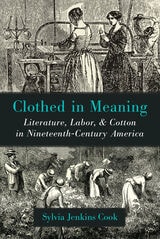
Clothed in Meaning
Literature, Labor, and Cotton in Nineteenth-Century AmericaSylvia Jenkins Cook
University of Michigan Press, 2020
Cloth and clothing provide potent tropes not only for physical but also for intellectual forms of self-expression. Drawing on sources ranging from fugitive slave narratives, newspapers, manifestos, and mill workers’ magazines to fiction, poetry, and autobiographies, Clothed in Meaning examines the significant part played by mill workers and formerly enslaved people, many of whom still worked picking cotton, in this revolution of literary self-expression. They created a new literature from their palpable daily intimacy with cotton, cloth, and clothing, as well as from their encounters with grimly innovative modes of work. In the materials of their labor they discovered vivid tropes for formulating their ideas and an exotic and expert language for articulating them. The harsh conditions of their work helped foster in their writing a trenchant irony toward the demeaning reduction of human beings to “hands” whose minds were unworthy of interest. Ultimately, Clothed in Meaning provides an essential examination of the intimate connections between oppression and luxury as recorded in the many different voices of nineteenth-century labor.
Codes of Conduct
Race, Ethics, and the Color of Our CharacterHolloway, Karla F. C.
Rutgers University Press, 1995
In Codes of Conduct, Karla Holloway meditates on the dynamics of race and ethnicity as they are negotiated in the realms of power. Her uniquely insightful and intelligent analysis guides us in a fresh way through Anita Hill’s interrogation, the assault on Tawana Brawley, the mass murders of Atlanta’s children, the schisms between the personal and public domains of her life as a black professor, and––in a moving epilogue––the story of her son’s difficulties growing up as a young black male in contemporary society. Its three main sections: “The Body Politic,” “Language, Thought, and Culture,” and “The Moral Lives of Children,” relate these issues to the visual power of the black and female body, the aesthetic resonance and racialized drama of language, and our children’s precarious habits of surviving. Throughout, Holloway questions the consequences in African-American community life of citizenship that is meted out sparingly when one’s ethnicity is colored.
This is a book of a culture’s stories––from literature, public life, contemporary and historical events, aesthetic expression, and popular culture––all located within the common ground of African-American ethnicity. Holloway writes with a passion, urgency, and wit that carry the reader swiftly through each chapter. The book should take its place among those other important contemporary works that speak to the future relationships between whites and blacks in this country.

Coming through the Fire
Surviving Race and Place in AmericaC. Eric Lincoln
Duke University Press, 1996
Coming through the Fire, with its fiercely intelligent, passionate, and clear-eyed view of race and class conflict, makes a major contribution to understanding—and thereby healing—the terrible rift that has opened up in the heart of America. Lincoln explores the nature of biracial relationships, the issue of transracial adoption, violence—particularly black-on-black violence—the “endangered” black male, racism as power, the relationship between Blacks and Jews, our multicultural melting pot, and Minister Louis Farrakhan.Without sidestepping painful issues, or sacrificing a righteous anger, the author argues for “no-fault reconciliation,” for mutual recognition of the human endowment we share regardless of race, preparing us as a nation for the true multiculture tomorrow will demand.
Readers familiar with Lincoln’s earlier groundbreaking work on the Black Muslims and on the black church will be eagerly awaiting the publication of Coming through the Fire. Others will simply find C. Eric Lincoln’s personal story and his exploration of survival and race in America to be absorbing and compelling reading.
Conditions of the Present
Selected EssaysLindon Barrett
Duke University Press, 2018
Contributors. Elizabeth Alexander, Jennifer DeVere Brody, Daphne A. Brooks, Linh U. Hua, Janet Neary, Marlon B. Ross, Robyn Wiegman
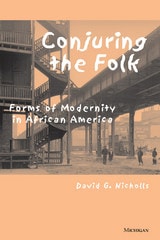
Conjuring the Folk
Forms of Modernity in African AmericaDavid G. Nicholls
University of Michigan Press, 2000
In a series of revisionary readings, Nicholls studies how the "folk" is shaped by the ideology of form. He examines the presence of a spectral "folk" in Toomer's modernist pastiche, Cane. He explores how Hurston presents folklore as a contemporary language of resistance in her ethnography, Mules and Men. In Claude McKay's naturalistic romance, Banana Bottom, Nicholls discovers the figuration of an alternative modernity in the heroine's recovery of her lost "folk" identity. He unearths the individualist ethos of Booker T. Washington in two novels by George Wylie Henderson. And he reveals how Richard Wright's photo-documentary history, 12 Million BlackVoices, places the "folk" in a Marxian narrative of modernization toward class-consciousness.
A provocative rereading of the cultural politics of the Harlem Renaissance, Conjuring the Folk offers a new way of understanding literary responses to migration, modernization, and the concept of the "folk" itself.
David G. Nicholls is a post-doctoral fellow in the Center for the Study of Race, Politics, and Culture, University of Chicago.
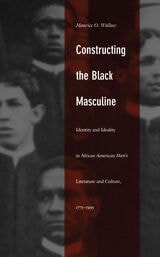
Constructing the Black Masculine
Identity and Ideality in African American Men’s Literature and Culture, 1775–1995Maurice O. Wallace
Duke University Press, 2002
Highlighting their chronic objectification under the gaze of white eyes, Wallace argues that black men suffer a social and representational crisis in being at once seen and unseen, fetish and phantasm, spectacle and shadow in the American racial imagination. Invisible and disregarded on one hand, black men, perceived as potential threats to society, simultaneously face the reality of hypervisibility and perpetual surveillance. Paying significant attention to the sociotechnologies of vision and image production over two centuries, Wallace shows how African American men—as soldiers, Freemasons, and romantic heroes—have sought both to realize the ideal image of the American masculine subject and to deconstruct it in expressive mediums like modern dance, photography, and theatre. Throughout, he draws on the experiences and theories of such notable figures as Frederick Douglass, W. E. B. Du Bois, Booker T. Washington, and James Baldwin.
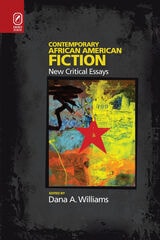
Contemporary African American Fiction
New Critical EssaysEdited by Dana A. Williams
The Ohio State University Press, 2009
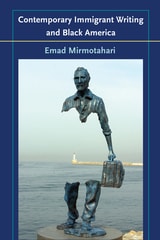
Contemporary Immigrant Writing and Black America
Mirmotahari, Emad
University of Iowa Press, 2026
Contemporary Immigrant Writing and Black America addresses how minoritized communities in the United States find each other, make sense of each other, and come together to confront the many guises of racism and racist practices. This book probes the life and writings of Korean immigrants, Indian immigrants, and various African immigrants for insights into the ways that they experience and express their new lives in the United States. More specifically, this book shows how immigrant communities come to understand their relationship with the Black American community; the relation that is key to finding their own voice about race, culture, and power in the United States.
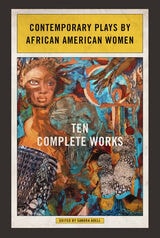
Contemporary Plays by African American Women
Ten Complete WorksEdited by Sandra Adell
University of Illinois Press, 2015
Selections: Blue Door, by Tanya Barfield; Levee James, by S. M. Shephard-Massat; Hoodoo Love, by Katori Hall; Carnaval, by Nikkole Salter; Single Black Female, by Lisa B. Thompson; Fabulation, or The Re-Education of Undine, by Lynn Nottage; BlackTop Sky, by Christina Anderson; Voyeurs de Venus, by Lydia Diamond; Fedra, by J. Nicole Brooks; and Uppa Creek: A Modern Anachronistic Parody in the Minstrel Tradition, by Keli Garrett.
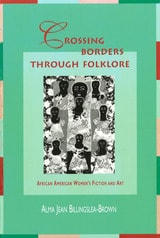
Crossing Borders through Folklore
African American Women's Fiction and ArtAlma Jean Billingslea-Brown
University of Missouri Press, 1999
Examining works by Toni Morrison, Paule Marshall, Faith Ringgold, and Betye Saar, this innovative book frames black women's aesthetic sensibilities across art forms. Investigating the relationship between vernacular folk culture and formal expression, this study establishes how each of the four artists engaged the identity issues of the 1960s and used folklore as a strategy for crossing borders in the works they created during the following two decades.
As a dynamic, open-ended process, folklore historically has enabled African-descended people to establish differential identity, resist dominance, and affirm group solidarity. This book documents the use of expressive forms of folklore in the fiction of Morrison and Marshall and the use of material forms of folklore in the visual representations of Ringgold and Saar. Offering a conceptual paradigm of a folk aesthetic to designate the practices these women use to revise and reverse meanings—especially meanings imposed on images such as Aunt Jemima and Sambo—Crossing Borders through Folklore explains how these artists locate sites of intervention and reconnection. From these sites, in keeping with the descriptive and prescriptive formulations for art during the sixties, Morrison, Marshall, Ringgold, and Saar articulate new dimensions of consciousness and creatively theorize identity.
Crossing Borders through Folklore is a significant and creative contribution to scholarship in both established and still- emerging fields. This volume also demonstrates how recent theorizing across scholarly disciplines has created elastic metaphors that can be used to clarify a number of issues. Because of its interdisciplinary approach, this study will appeal to students and scholars in many fields, including African American literature, art history, women's studies, diaspora studies, and cultural studies.
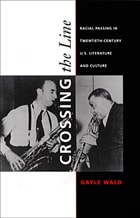
Crossing the Line
Racial Passing in Twentieth-Century U.S. Literature and CultureGayle Wald
Duke University Press, 2000
Wald begins her reading of twentieth-century passing narratives by analyzing works by African American writers James Weldon Johnson, Jessie Fauset, and Nella Larsen, showing how they use the “passing plot” to explore the negotiation of identity, agency, and freedom within the context of their protagonists' restricted choices. She then examines the 1946 autobiography Really the Blues, which details the transformation of Milton Mesirow, middle-class son of Russian-Jewish immigrants, into Mezz Mezzrow, jazz musician and self-described “voluntary Negro.” Turning to the 1949 films Pinky and Lost Boundaries, which imagine African American citizenship within class-specific protocols of race and gender, she interrogates the complicated representation of racial passing in a visual medium. Her investigation of “post-passing” testimonials in postwar African American magazines, which strove to foster black consumerism while constructing “positive” images of black achievement and affluence in the postwar years, focuses on neglected texts within the archives of black popular culture. Finally, after a look at liberal contradictions of John Howard Griffin’s 1961 auto-ethnography Black Like Me, Wald concludes with an epilogue that considers the idea of passing in the context of the recent discourse of “color blindness.”
Wald’s analysis of the moral, political, and theoretical dimensions of racial passing makes Crossing the Line important reading as we approach the twenty-first century. Her engaging and dynamic book will be of particular interest to scholars of American studies, African American studies, cultural studies, and literary criticism.
Crossroads Modernism
Descent And Emergence In African-American Literary CultureEdward M. Pavlic
University of Minnesota Press, 2002
An essential reconsideration of black literature and culture and its response to modernity
In the African American encounter with modernism, all was not confrontation. Rather, as Edward M. Pavli´c demonstrates here, African American artists negotiated the intersection of high modernism in Europe and American discourse to fashion their own distinctive response to American modernity. A deft repositioning of black literature and culture, Pavli´c’s book re-envisions the potentials and dilemmas where the different traditions of modernism meet and firmly establishes African American modernism at this cultural crossroads.
Offering new insights into the work of a variety of African American artists—including Ralph Ellison, Richard Wright, Zora Neale Hurston, James Baldwin, Toni Morrison, Robert Hayden, David Bradley, Yusef Komunyakaa, Romare Bearden, and John Coltrane—Pavli´c explores the complex ways in which key modernist philosophical ideas and creative techniques have informed black culture. Crossroads Modernism also provides an in-depth look at how West African cultural legacies are brought to bear in the structure of a truly African American modernist creative process. The book brings to light two interrelated strains of black modernism: Afro-Modernism, which employs established modernist concerns and conceits to illuminate internal and psychological experience; and Diasporic Modernism, which places greater emphasis on shared cultural space and builds on traditions rooted in West African cultures.Whereas much has been said about the (generally racist) use of "blackness" in constituting modernism, Crossroads Modernism is the first book to expose the key role that modernism has played in the constitution of "blackness" in African-American aesthetics. In light of this work, canonical texts in African American literature can no longer be read as devoid of their own singular contribution to international modernism.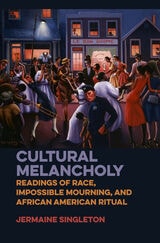
Cultural Melancholy
Readings of Race, Impossible Mourning, and African American RitualJermaine Singleton
University of Illinois Press, 2015
Singleton develops the concept of "cultural melancholy" as a response to scholarship that calls for the separation of critical race studies and psychoanalysis, excludes queer theoretical approaches from readings of African American literatures and cultures, and overlooks the status of racialized performance culture as a site of serious academic theorization. In doing so, he weaves critical race studies, psychoanalysis, queer theory, and performance studies into conversation to uncover a host of hidden dialogues—psychic and social, personal and political, individual and collective—for the purpose of promoting a culture of racial grieving, critical race consciousness, and collective agency.
Wide-ranging and theoretically bold, Cultural Melancholy counteracts the racial legacy effects that plague our twenty-first century multiculture.
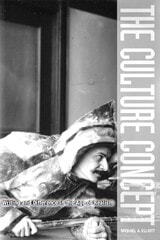
Culture Concept
Writing and Difference in the Age of RealismMichael A. Elliott
University of Minnesota Press, 2002
Examines the prehistory of the American struggle to address cultural difference.
"Culture" is a term we commonly use to explain the differences in our ways of living. In this book Michael A. Elliott returns to the moment this usage was first articulated, tracing the concept of culture to the writings-folktales, dialect literature, local color sketches, and ethnographies-that provided its intellectual underpinnings in turn-of-the-century America.
The Culture Concept explains how this now-familiar definition of "culture" emerged during the late nineteenth century through the intersection of two separate endeavors that shared a commitment to recording group-based difference-American literary realism and scientific ethnography. Elliott looks at early works of cultural studies as diverse as the conjure tales of Charles Chesnutt, the Ghost Dance ethnography of James Mooney, and the prose narrative of the Omaha anthropologist-turned-author Francis La Flesche. His reading of these works-which struggle to find appropriate theoretical and textual tools for articulating a less chauvinistic understanding of human difference-is at once a recovery of a lost connection between American literary realism and ethnography and a productive inquiry into the usefulness of the culture concept as a critical tool in our time and times to come.