Results by title
61 books match the query 'Agribusiness' and 10 start with c
Cheese War
Conflict and Courage in Tillamook County, OregonMarilyn Milne
Oregon State University Press, 2022
On one side of the battle was Beale Dixon, head of Tillamook County Creamery Association. Dixon set up a scheme to offer low-interest, low-collateral loans from TCCA’s largest member cooperative, Tillamook Cheese & Dairy Association, to the supermarkets that stocked Tillamook products. Dixon argued it was a cheap, easy way to ensure good will—and continued purchases—in a tight market. On the other side was George Milne, a respected farmer and board president of the cooperative. Milne supported his board’s decision that loans would require board approval and bank oversight. Dixon mostly ignored those requirements.
The discovery of more financial irregularities soon spiraled into a community-wide dispute, exacerbated by a complex web of family and business relationships. The Cheese War raged for the better part of a decade across board meetings, courtrooms, and the community itself. While largely unknown outside of Tillamook County, the Cheese War was so divisive that some families remain fractured today.
Sisters Marilyn Milne and Linda Kirk, children of the Cheese War, saw how it absorbed their parents. As adults, they set out to learn more about what had happened. The authors conducted years of research and have integrated it with tales of their experiences as farm kids living through the all-consuming fight. As Americans become ever more interested in food supply chains and ethical consumption, here is the story of the very human factors behind one of Oregon’s most iconic brands.

Cheese
The Making of a Wisconsin TraditionJerry Apps
University of Wisconsin Press, 2020
In this updated edition of a classic, Apps examines tumultuous changes in the business over the past twenty years, including the impacts of corporate megafarms and the rise of artisanal producers. Vivid historical photographs and striking portraits of modern family-operated factories reveal the delicate balance between art and science that goes into the process of turning ordinary milk into a wide variety of flavors, from the ubiquitous cheddar to sublime delicacies. Through these stories, we can come to better appreciate the remarkable farmers and producers that shaped cheesemaking into the thriving industry it is today.
Cigarettes, Inc.
An Intimate History of Corporate ImperialismNan Enstad
University of Chicago Press, 2018
In this startling account of innovation and expansion, Enstad uncovers a corporate network rooted in Jim Crow segregation that stretched between the United States and China and beyond. Cigarettes, Inc. teems with a global cast—from Egyptian, American, and Chinese entrepreneurs to a multiracial set of farmers, merchants, factory workers, marketers, and even baseball players, jazz musicians, and sex workers. Through their stories, Cigarettes, Inc. accounts for the cigarette’s spectacular rise in popularity and in the process offers nothing less than a sweeping reinterpretation of corporate power itself.
Climate Dependence and Food Problems in Russia, 1900-1990
The Interaction of Climate and Agricultural Policy and Their Effect on Food ProblemsNikolai M. Dronin
Central European University Press, 2006
Cooperatives across Clusters
Lessons from the Cranberry IndustryAnil Hira
Oregon State University Press, 2024
Most agricultural production is of commodity or undifferentiated products. Producers suffer from a roller-coaster ride of price swings, over- or under-production, weather and pest threats, and the inability of family famers to capture anything beyond a small percentage of the final price.
Cooperatives Across Clusters provides lessons from the cranberry industry, a commodity product organized mostly into family farms in seven different clusters around North America. The industry is remarkable in that it's substantially organized around one large cooperative, Ocean Spray. The authors examine how the cooperative came to be, the challenges of coordination and industry leadership across the diverging clusters, and the lessons for cooperation for other agricultural industries.
The book provides a multi-layered contribution to agricultural economics. First, it examines location decisions and what factors supersede growing conditions to allow industries to arise around production. Second, it explores pathways available for farmers to try to overcome, through cooperative organization, the natural boom-bust cycles of commodity price swings. Third, it looks at how cooperative decisions are made, and the challenges of providing industry leadership, including research and development and collective marketing, through a cooperative that faces continual defections and new problems. Finally, through in-depth historical, statistical, and field research, it provides a comprehensive study of the cranberry industry and suggests ways farmers can grow the industry. Agricultural policymakers, farmers, industry specialists, and researchers of agriculture and clusters more generally will find this to be an important and informative new resource.
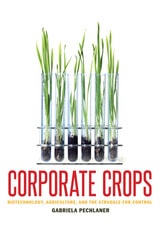
Corporate Crops
Biotechnology, Agriculture, and the Struggle for ControlBy Gabriela Pechlaner
University of Texas Press, 2012
Biotechnology crop production area increased from 1.7 million hectares to 148 million hectares worldwide between 1996 to 2010. While genetically modified food is a contentious issue, the debates are usually limited to health and environmental concerns, ignoring the broader questions of social control that arise when food production methods become corporate-owned intellectual property. Drawing on legal documents and dozens of interviews with farmers and other stakeholders, Corporate Crops covers four case studies based around litigation between biotechnology corporations and farmers. Pechlaner investigates the extent to which the proprietary aspects of biotechnologies—from patents on seeds to a plethora of new rules and contractual obligations associated with the technologies—are reorganizing crop production.
The lawsuits include patent infringement litigation launched by Monsanto against a Saskatchewan canola farmer who, in turn, claimed his crops had been involuntarily contaminated by the company’s GM technology; a class action application by two Saskatchewan organic canola farmers launched against Monsanto and Aventis (later Bayer) for the loss of their organic market due to contamination with GMOs; and two cases in Mississippi in which Monsanto sued farmers for saving seeds containing its patented GM technology. Pechlaner argues that well-funded corporate lawyers have a decided advantage over independent farmers in the courts and in creating new forms of power and control in agricultural production. Corporate Crops demonstrates the effects of this intersection between the courts and the fields where profits, not just a food supply, are reaped.
Creating Dairyland
How caring for cows saved our soil, created our landscape, brought prosperity to our state, and still shapes our way of life in WisconsinEdward Janus
Wisconsin Historical Society Press, 2011
The story of dairying in Wisconsin is the story of how our very landscape and way of life were created. By making cows the center of our farm life and learning how to care for them, our ancestors launched a revolution that changed much more than the way farmers earned their living — it changed us.
Creating Dairyland
How caring for cows saved our soil, created our landscape, brought prosperity to our state, and still shapes our way of life in WisconsinEdward Janus
Wisconsin Historical Society Press, 2011
The story of dairying in Wisconsin is the story of how our very landscape and way of life were created. By making cows the center of our farm life and learning how to care for them, our ancestors launched a revolution that changed much more than the way farmers earned their living — it changed us.
Creating Dairyland
How caring for cows saved our soil, created our landscape, brought prosperity to our state, and still shapes our way of life in WisconsinEdward Janus
Wisconsin Historical Society Press, 2012
The story of dairying in Wisconsin is the story of how our very landscape and way of life were created. By making cows the center of our farm life and learning how to care for them, our ancestors launched a revolution that changed much more than the way farmers earned their living — it changed us.
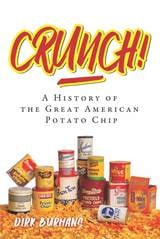
Crunch!
A History of the Great American Potato ChipDirk Burhans
University of Wisconsin Press, 2017
Crunch! also uncovers a dark side of potato chip history, including a federal investigation of the snack food industry in the 1990s following widespread allegations of antitrust activity, illegal buyouts, and predatory pricing. In the wake of these "Great Potato Chip Wars," corporate snack divisions closed and dozens of family-owned companies went bankrupt. Yet, despite consolidation, many small chippers persist into the twenty-first century, as mom-and-pop companies and upstart "boutique" businesses serve both new consumers and markets with strong regional loyalties.
Illustrated with images of early snack food paraphernalia and clever packaging from the glory days of American advertising art, Crunch! is an informative tour of large and small business in America and the vicissitudes of popular tastes.