Results by title
112 books match the query 'Americans' and 9 start with c

COME BACK IRISH
Wendy Rawlings
The Ohio State University Press, 2001
Chasing the American Dream in China
Chinese Americans in the Ancestral HomelandLeslie Kim Wang
Rutgers University Press, 2021
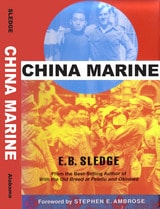
China Marine
E. B. Sledge
University of Alabama Press, 2002
From the respected author of one of the best books on World War II combat, comes an equally captivating saga of battle recovery, healing, and homecoming.
China Marine is the long-awaited sequel to E. B. Sledge’s critically acclaimed memoir, With the Old Breed at Peleliu and Okinawa. Picking up where his previous memoir leaves off, Sledge, a young marine in the First Division, traces his company’s movements and charts his own difficult passage to peace following his horrific experiences in the Pacific. He reflects on his duty in the ancient city of Peiping (now Beijing) and recounts the difficulty of returning to his hometown of Mobile, Alabama, and resuming civilian life haunted by the shadows of close combat.
Distinguished historians have praised Sledge’s first book as the definitive rifleman’s account of World War II, ranking it with the Civil War’s Red Badge of Courage and World War I’s All Quiet on the Western Front. Although With the Old Breed ends with the surrender of Japan, marines in the Pacific were still faced with the mission of disarming the immense Japanese forces on the Asian mainland and reestablishing order. For infantrymen so long engaged in the savage and surreal world of close combat, there remained the personal tasks of regaining normalcy and dealing with suppressed memories, fears, and guilt.
In China Marine, E. B. Sledge completes his story and provides emotional closure to the searing events detailed in his first memoir. He speaks frankly about the real costs of war, emotional and psychological as well as physical, and explains the lifetime loyalties that develop between men who face fear, loss, and horror together. That bond becomes one of the newfound treasures of life after battle.
With his hallmark style of simplicity, directness, and lack of sentimentality, "Sledgehammer" has given us yet another great document of war literature.

Cold War Exiles in Mexico
U.S. Dissidents and the Culture of Critical ResistanceRebecca M. Schreiber
University of Minnesota Press, 2008
As Schreiber recounts, the first exiles to arrive in Mexico after World War II were visual artists, many of them African-American, including Elizabeth Catlett, Charles White, and John Wilson. Individuals who were blacklisted from the Hollywood film industry, such as Dalton Trumbo and Hugo Butler, followed these artists, as did writers, including Willard Motley. Schreiber examines the artists’ work with the printmaking collective Taller de Gráfica Popular and the screenwriters’ collaborations with filmmakers such as Luis Buñuel, as well as the influence of the U.S. exiles on artistic and political movements.
The Cold War culture of political exile challenged American exceptionalist ideology and, as Schreiber reveals, demonstrated the resilience of oppositional art, literature, and film in response to state repression.
Cooling the Tropics
Ice, Indigeneity, and Hawaiian RefreshmentHi'ilei Julia Kawehipuaakahaopulani Hobart
Duke University Press, 2023
Corner of the Dead
Lynn Lurie
University of Massachusetts Press, 2008
"I use the camera to block my view," says Lisette. This is the start of her double vision—trying to forget and trying to recall—and her struggle to come to terms with the human capacity for cruelty. But the grim reality in Peru is so overpowering that she carries it with her back to New York and through the rest of her life. Having abandoned a lover along with the fight, she desperately tries to find meaning beyond that of mere survival.
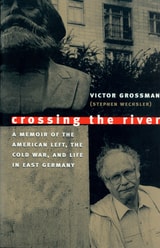
Crossing the River
A Memoir of the American Left, the Cold War, and Life in East GermanyVictor Grossman
University of Massachusetts Press, 2003
What could possibly impel a relatively privileged twenty-four-year-old American-serving in the U.S. Army in Germany in 1952 to swim across the Danube River to what was then referred to as the Soviet Zone? How are we to understand his decision to forsake the land of his birth and build a new life in the still young German Democratic Republic? These are the questions at the core of this memoir by Victor Grossman, who was born Stephen Wechsler but changed his name after defecting to the GDR.
A child of the Depression, Grossman witnessed firsthand the dislocations wrought by the collapse of the U.S. economy during the 1930s. Widespread unemployment and poverty, CIO sit-down strikes, and the fight to save Republican Spain from fascism-all made an indelible impression as he grew up in an environment that nurtured a commitment to left-wing causes. He continued his involvement with communist activities as a student at Harvard in the late 1940s and after graduation, when he took jobs in two factories in Buffalo, New York, and tried to organize their workers.
Fleeing McCarthyite America and potential prosecution, Grossman worked in the GDR with other Western defectors and eventually became, as he notes, the “only person in the world to attend Harvard and Karl Marx universities.” Later, he was able to establish himself as a freelance journalist, lecturer, and author. Traveling throughout East Germany, he evaluated the failures as well as the successes of the GDR's “socialist experiment.” He also recorded his experiences, observations, and judgments of life in East Berlin after reunification, which failed to bring about the post-Communist paradise so many had expected.
Written with humor as well as candor, Crossing the River provides a rare look at the Cold War from the other side of the ideological divide.
Mark Solomon, a distinguished historian of the American left, provides a historical afterword that places Grossman's experiences in a larger Cold War context.
Cruel Destiny and The White Negress
Two Novels by Cléante Desgraves ValcinAdam Nemmers
Rutgers University Press, 2024
Cruel Destiny (1929) tells the tragic love story of Armand and Adeline, drawn together by a magnetic attraction, yet kept apart by a dark family secret. Depicting the heavy expectations placed upon women in Haiti’s elite society, it also explores the troubled and twisted relationships between the Haitians and their former colonial masters, the French.
In The White Negress (1934), a Frenchwoman moves to Haiti and is torn between two very different men, a Black Haitian lawyer, and a white American carpetbagger. Putting a fresh spin on the tired tragic mulatta trope, Valcin reveals the racial prejudices, class tensions, and anti-colonial resentments of an island under American occupation.
Together, these two novels expand our understanding of Caribbean literature, as well as the political struggles and artistic triumphs of Black women in the Americas.
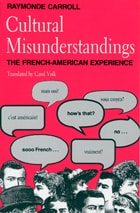
Cultural Misunderstandings
The French-American ExperienceRaymonde Carroll
University of Chicago Press, 1990
Raymonde Carroll presents an intriguing and thoughtful analysis of the many ways French and Americans—and indeed any members of different cultures—can misinterpret each other, even when ostensibly speaking the same language.Cultural misunderstandings, Carroll points out, can arise even where we least expect them—in our closest relationships. The revealing vignettes that Carroll relates, and her perceptive comments, bring to light some fundamental differences in French and American presuppositions about love, friendship, and raising children, as well as such everyday activities as using the telephone or asking for information.