Results by title
226 books match the query 'Anthologies (multiple authors)' and 18 start with c
Café Shapiro Anthology 2018
Theresa Stanko
Michigan Publishing Services, 2018
Café Shapiro Anthology 2019
Theresa Stanko
Michigan Publishing Services, 2019
Café Shapiro Anthology 2020
Theresa Stanko
Michigan Publishing Services, 2020
Café Shapiro Anthology 2022
Charles Saadiq
Michigan Publishing Services, 2022
Café Shapiro Anthology 2023
Charles Saadiq
Michigan Publishing Services, 2023
Café Shapiro began in February 1998 as part of the University’s “Year of the Humanities and Arts” (YoHA). and was originally conceived as a student coffee break. Café Shapiro takes place in the Shapiro Undergraduate Library during winter evenings in March. For many student writers, Café Shapiro is a first opportunity to read publicly from their work.
Café Shapiro Anthology 2024
Charles Saadiq
Michigan Publishing Services, 2024
Café Shapiro began in February 1998 as part of the University’s “Year of the Humanities and Arts” (YoHA). and was originally conceived as a student coffee break. Café Shapiro takes place in the Shapiro Undergraduate Library during winter evenings in March. For many student writers, Café Shapiro is a first opportunity to read publicly from their work.

Café Shapiro Anthology 2025
Charles Saadiq
Michigan Publishing Services, 2025
Café Shapiro is an annual event where undergraduate student writers, nominated by their instructors to participate, read from their creative works.
Café Shapiro began in February 1998 as part of the University’s “Year of the Humanities and Arts” (YoHA). and was originally conceived as a student coffee break. Café Shapiro takes place in the Shapiro Undergraduate Library during winter evenings in March. For many student writers, Café Shapiro is a first opportunity to read publicly from their work.
Café Shapiro features poems and short stories authored by University of Michigan students, becoming an annual celebration of undergraduate student writers as they think creatively and critically, reason, ask questions, and develop the skills that help them understand and participate in our world.
Café Shapiro Anthology 2026
Charles Saadiq
Michigan Publishing Services, 2026
Café Shapiro is an annual event where undergraduate student writers, nominated by their instructors to participate, read from their creative works.
Café Shapiro began in February 1998 as part of the University’s “Year of the Humanities and Arts” (YoHA). and was originally conceived as a student coffee break. Café Shapiro takes place in the Shapiro Undergraduate Library during winter evenings in March. For many student writers, Café Shapiro is a first opportunity to read publicly from their work.
Cage Of Fireflies
Modern Japanese HaikuLucien Stryk
Ohio University Press, 1993
In all arts — music, painting, dance, theatre — change has come with that startling moment of dissatisfaction when the artist upends complacency, shocks the old to its foundations, and emerges with clear vision. He has had the courage to rescue his art from dullness. Two of Japan’s “Great Four” of haiku, Basho (1644-94) and Shiki (1862-1902), were such revolutionaries, albeit two hundred years apart. Before Basho, haiku was but a pleasant occupation for the idle. He set about transforming it with such success that experts to this day agree that his were the first true haiku.
Shiki, who lived into the 20th century, was passionate in his attempt to salvage haiku from its past, sending out shock waves by dismissing virtually all earlier work, including most of Basho’s. He saw it as his mission to make a difference — to let nothing, not even the most revered, stand in the way. He proclaimed, “A poem has no meaning. It is feeling alone.” And he practiced what he preached.
Autumn wind:
gods, Buddha—
lies, lies, lies.
These modern Japanese poets, many of whom are translated here into English for the first time, learned as much from Basho as from Shiki, and from Buson (1715-83) and Issa (1763-1827), the “Great Four.” Yet in a sense they are followers of Shiki, in spite of the harshness of his views and the impossibly high standards he demanded. They were forced to reckon with him, became willing participants in a heated dialogue with him. They had to: his spirit dominated the age. Stryk captures that spirit here, in this Cage of Fireflies.
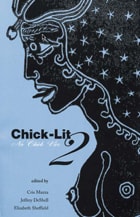
Chick Lit 2
No Chick VicsChris Mazza, Jeffrey DeShell, and Elisabeth Sheffield
University of Alabama Press, 1996
Chick-Lit 2: No Chick Vics features new work by Rikki Ducornet, Eurydice, Elizabeth Graver, Ursule Molinaro, and fourteen other witty and deadly serious writers.
Chick-Lit 2 discovers new and alternative voices in women’s fiction whose stories do not involve trauma that comes from the outside. As Mazza writes in her introduction, “Sexual assaults and harassments and injurious poor body images do exist and have waged a war on women (the American Medical Association says so). But for this book, I was interested in seeing what action(s) women characters can incite on their own, whether bad or good, hopeful or dead-end, progressive or destructive.”
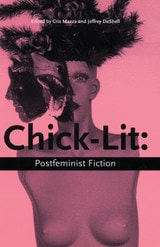
Chick Lit Postfeminist Fiction
Cris Mazza
University of Alabama Press, 2000
A provocative critique of chick lit’s glossy narratives and their complex relationship with postfeminist ideals.
Chick-Lit: Postfeminist Fiction is the fourth volume in “On the Edge: New Women’s Fiction,” FC2’s ongoing effort to discover new and innovative voices in women’s fiction. Determined to contradict the myth that “women don't write experimental fiction,” Chick-Lit discovers women writers with a fresh and irreverent wit and honesty, but no less powerful in their rendering of human experience.
Chick-Lit collects the original fiction of newly discovered writers, but also the award winning work of notable writers like Carole Maso, Jonis Agee, Stacy Levinne and Carolyn Banks. Marked by innovations in form and point-of-view, the writers in this collection are not satisfied with the terrain commonly referred to as “women’s writing.” Insane asylum sex, board games that control people’s lives, a masochistic pedophile humiliated by his victim, an obese woman paying nickels and quarters for attention from teenage girls, a deranged hair stylist and her disloyal dog, a men's impotence therapy group, a surreal landscape constantly producing the body of a woman's mother: this is writing that shouts, yes, there is such a thing as postfeminist fiction.
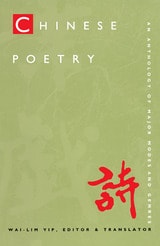
Chinese Poetry, 2nd ed., Revised
An Anthology of Major Modes and GenresWai-lim Yip, editor and translator
Duke University Press, 1997
Newly designed, the unique format of this volume will enhance its reputation as the definitive introduction to Chinese poetry, while its introductory essay on issues of Chinese aesthetics will continue to be an essential text on the problems of translating such works into English. Each poem is printed with the original Chinese characters in calligraphic form, coordinated with word-for-word annotations, and followed by an English translation. Correcting more than a century of distortion of the classical Chinese by translators unconcerned with the intricacies and aesthetics of the Chinese language, these masterful translations by Wai-lim Yip, a noted and honored translator and scholar, allow English readers to enter more easily into the dynamic of the original poems. Each section of the volume is introduced by a short essay on the mode or genre of poem about to be presented and is followed by a comprehensive bibliography.
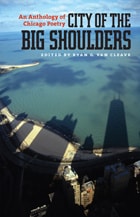
City of the Big Shoulders
An Anthology of Chicago PoetryRyan G. Van Cleave
University of Iowa Press, 2012
The cultural, ethnic, and aesthetic diversity in this gathering of poems springs from a variety of viewpoints, styles, and voices as multifaceted and energetic as the city itself. Cristin O’Keefe Aptowicz: “I want to eat / in a city smart enough to know that if you / are going to have that heart attack, you might / as well have the pleasure of knowing // you’ve really earned it”; Renny Golden: “In the heat of May 1937, my grandfather / sits in the spring grass of an industrial park / with hundreds of striking steelworkers”; Joey Nicoletti: “The wind pulls a muscle / as fans yell the vine off the outfield wall, / mustard-stained shirts, hot dog smiles, and all.”
The combined energies of these poems reveal the mystery and beauty that is Second City, the City by the Lake, New Gotham, Paris on the Prairie, the Windy City, the Heart of America, and Sandburg’s iconic City of the Big Shoulders.
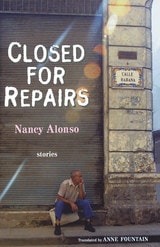
Closed for Repairs
Nancy Alonso, translated from the Spanish by Anne Fountain
Northwestern University Press, 2007
Closed for Repairs is a series of eleven vignettes that depict Cuban ingenuity in the face of urban problems. Each solution is framed with humor and irony and gives a glimpse of life on the island today.
In a clever fashion, Nancy Alonso shows us the spirit of resolve on the part of Cubans when faced with such issues as transportation problems, lack of water, and the shortage of consumer goods and construction materials caused by the embargo.
Illuminating the endurance and resilience of the Cuban people, these stories will make you chuckle. Alonso's sly wit is compelling as she satirizes the bureaucracy—an element of her work that will resonate universally.
Conceptualisms
The Anthology of Prose, Poetry, Visual, Found, E- & Hybrid Writing as Contemporary ArtEdited by Steve Tomasula
University of Alabama Press, 2022
A wide-ranging anthology of experimental writing—prose, poetry, and hybrid—from its most significant practitioners and innovators
A variety of names have been used to describe fiction, poetry, and hybrid writing that explore new forms and challenges mainstream traditions. Those phrases include experimental, conceptual, avant-garde, hybrid, surfiction, fusion, radical, slip-stream, avant-pop, postmodern, self-conscious, innovative, L=A=N=G=U=A=G=E writing, alternative, and anti- or new literature. Conceptualisms: The Anthology of Prose, Poetry, Visual, Found, E- & Hybrid Writing as Contemporary Art is the first major anthology of writing that offers readers an overview of this other tradition as it lives in the early decades of the 21st century.
Featuring over 100 pieces from more than 90 authors, this anthology offers a plethora of aesthetics and approaches to a wide variety subjects. Editor Steve Tomasula has gathered poems, prose, and hybrid pieces that all challenge our understanding of what literature means. Intended as a collection of the most exciting and bold literary work being made today, Tomasula has put a spotlight on the many possibilities available to writers and readers wishing for a glimpse of literature’s future.
Readers will recognize authors who have shaped contemporary writing, as among them Lydia Davis, Charles Bernstein, Jonathan Safran Foer, Shelley Jackson, Nathaniel Mackey, David Foster Wallace, and Claudia Rankine. Even seasoned readers will find authors, and responses to the canon, not yet encountered. Conceptualisms is a book of ideas for writers, teachers and scholars, as well as readers who wonder how many ways literature can live.
The text features headnotes to chapters on themes such as sound writing, electronic literature, found text, and other forms, offering accessible introductions for readers new to this work. An online companion presents statements about the work and biographies of the authors in addition to audio, video, and electronic writing that can’t be presented in print. Visit www.conceptualisms.info to read more.
Contemporary Francophone African Plays
An AnthologyJudith G. Miller
Bucknell University Press, 2024
Contemporary Korean Poetry
Won Ko
University of Iowa Press, 1970
The boundaries of poetry in English are expanded with Contemporary Korean Poetry, the first major scholarly anthology introducing twentieth century Korean poetry in English. In translating 181 poems by 140 poets, Ko Won manages to capture the feeling and mood of the original work, retaining the intended simplicity for effect.
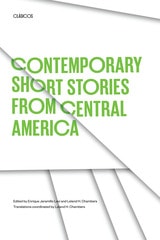
Contemporary Short Stories from Central America
Edited by Enrique Jaramillo Levi and Leland H. Chambers
University of Texas Press, 1993
This volume collects some of the best short fiction from the six Spanish-speaking countries of Central America—Guatemala, Honduras, El Salvador, Nicaragua, Costa Rica, and Panama. Selected from stories written between 1963 and 1988, it is a broad representation of active Central American writers.
Many of the stories are quite sophisticated and utilize elements of the absurd or techniques of magical realism. Some stories deal with war—the unending struggle against dictators and military power that engrosses Central Americans. Others explore the realm of the writer's imagination. Some of the writers included are Augusto Monterroso (Guatemala), Carmen Naranjo and Samuel Rovinski (Costa Rica), Rosa María Britton and Jaime García Saucedo (Panama), and Alfonso Quijada Urías (El Salvador).