Results by title
64 books match the query 'Architecture and society' and 10 start with c
Chicago 1890
The Skyscraper and the Modern CityJoanna Merwood-Salisbury
University of Chicago Press, 2009
Chicago’s first skyscrapers are famous for projecting the city’s modernity around the world. But what did they mean at home, to the Chicagoans who designed and built them, worked inside their walls, and gazed up at their façades? Answering this multifaceted question, Chicago 1890 reveals that early skyscrapers offered hotly debated solutions to the city’s toughest problems and, in the process, fostered an urban culture that spread across the country.
An ambitious reinterpretation of the works of Louis Sullivan, Daniel Burnham, and John Wellborn Root, this volume uses their towering achievements as a lens through which to view late nineteenth-century urban history. Joanna Merwood-Salisbury sheds new light on many of Chicago’s defining events—including violent building trade strikes, the Haymarket bombing, the World’s Columbian Exposition, and Burnham’s Plan of Chicago—by situating the Masonic Temple, the Monadnock Building, and the Reliance Building at the center of the city’s cultural and political crosscurrents.
While architects and property owners saw these pioneering structures as manifestations of a robust American identity, immigrant laborers and social reformers viewed them as symbols of capitalism’s inequity. Illuminated by rich material from the period’s popular press and professional journals, Merwood-Salisbury’s chronicle of this contentious history reveals that the skyscraper’s vaunted status was never as inevitable as today’s skylines suggest.
Chicago Architecture
Histories, Revisions, AlternativesEdited by Charles Waldheim and Katerina Ruedi Ray
University of Chicago Press, 2005
In Chicago Architecture, Charles Waldheim and Katerina Ruedi Ray revise and offer alternatives to the archetypal story of modern architecture in Chicago. They and an esteemed group of contributors assert that the mythic status of Chicago architecture has distorted our understanding of the historical circumstances in which it was realized. This searching volume illuminates the importance of photographs, books, magazines, and other media in the cultivation of an international audience for Chicago architecture; it explores the pivotal role of real estate developers, finance and insurance sectors, and speculative capital markets in the development of the city itself; and, perhaps most notably, it examines a wide variety of overlooked architectural works and their creators—individuals who did not fit into the dominant modernist narrative.
Offering new insights on Chicago public housing and O'Hare International Airport, on the Columbian Exposition and Marina City, on the city's grid system and the place of women architects in the story of Chicago modernism, and on the subjective experience of living inside Chicago's most well-known buildings, Chicago Architecture is a work of enormous scope and vision—a book as heady and towering as the skyline it considers.
Chicago Skyscrapers, 1934-1986
How Technology, Politics, Finance, and Race Reshaped the CityThomas Leslie
University of Illinois Press, 2023
Illustrated with more than 140 photographs, Chicago Skyscrapers, 1934–1986 tells the fascinating stories of the people, ideas, negotiations, decision-making, compromises, and strategies that changed the history of architecture and one of its showcase cities.
Chicagoland Dream Houses
How a Mid-Century Architecture Competition Reimagined the American HomeSiobhan Moroney
University of Illinois Press, 2024
Children of the Soil
The Power of Built Form in Urban MadagascarTasha Rijke-Epstein
Duke University Press, 2023
Cleveland Architecture 1890–1930
Building the City BeautifulJeannine deNobel Love
Michigan State University Press, 2020
Commodification and Spectacle in Architecture
A Harvard Design Magazine ReaderWilliam Saunders
University of Minnesota Press, 2005
Framed with a provocative introduction by Kenneth Frampton, the contributions to Commodification and Spectacle in Architecture stake out a variety of positions in the debate over the extent to which it is possible—or desirable—to escape from, resist, or suggest plausible alternatives to the dominant culture of consumer capitalism. Rejecting any dreamy nostalgia for an idealized present or past in which design is completely divorced from commerce—and, in some cases, celebrating the pleasures of spectacle—the individual essays range from indictments of particular architects and critiques of the profession to broader concerns about what the phenomenon of commodification means for the practice of democracy and the health of society.
Bringing together an impressive and varied group of critics and practitioners, Commodification and Spectacle in Architecture will help to sharpen the discussion of how design can respond to our hypercommodified culture.
Contributors: Michael Benedikt, Luis Fernández-Galiano, Thomas Frank, Kevin Ervin Kelley, Daniel Naegele, Rick Poynor, Michael Sorkin, Wouter Vanstiphout.
William S. Saunders is editor of Harvard Design Magazine and assistant dean for external relations at the Harvard Design School. He is the author of Modern Architecture: Photographs by Ezra Stoller.
Kenneth Frampton is Ware Professor of Architecture at Columbia University Graduate School of Architecture, Planning, and Preservation and author of many books, including Labour, Work, and Architecture.
Concrete Changes
Architecture, Politics, and the Design of Boston City HallBrian M. Sirman
University of Massachusetts Press, 2018
And yet Boston City Hall frequently ranks among the country's ugliest buildings. Concrete Changes seeks to answer a common question for contemporary viewers: How did this happen? In a lively narrative filled with big personalities and newspaper accounts, Brian M. Sirman argues that this structure is more than a symbol of Boston's modernization; it acted as a catalyst for political, social, and economic change.
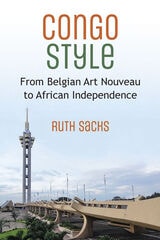
Congo Style
From Belgian Art Nouveau to African IndependenceRuth Sacks
University of Michigan Press, 2023
Congo Style presents a postcolonial approach to discussing the visual culture of two now-notorious regimes: King Leopold II’s Congo Colony and the state sites of Mobutu Sese Seko’s totalitarian Zaïre. Readers are brought into the living remains of sites once made up of ambitious modernist architecture and art in Kinshasa, Democratic Republic of the Congo. From the total artworks of Art Nouveau to the aggrandizing sites of post-independence Kinshasa, Congo Style investigates the experiential qualities of man-made environments intended to entertain, delight, seduce, and impress.
In her study of visual culture, Ruth Sacks sets out to reinstate the compelling wonder of nationalist architecture from Kinshasa’s post-independence era, such as the Tower of the Exchange (1974), Gécamines Tower (1977), and the artworks and exhibitions that accompanied them. While exploring post-independence nation-building, this book examines how the underlying ideology of Belgian Art Nouveau, a celebrated movement in Belgium, led to the dominating early colonial settler buildings of the ABC Hotels (circa 1908–13). Congo Style combines Sacks’s practice as a visual artist and her academic scholarship to provide an original study of early colonial and independence-era modernist sites in their African context.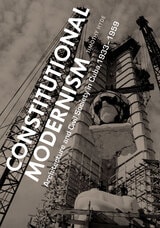
Constitutional Modernism
Architecture and Civil Society in Cuba, 1933-1959Timothy Hyde
University of Minnesota Press, 2013
How does architecture make its appearance in civil society? Constitutional Modernism pursues this challenging question by exploring architecture, planning, and law as cultural forces. Analyzing the complex entanglements between these disciplines in the Cuban Republic, Timothy Hyde reveals how architects joined with other professionals and intellectuals in efforts to establish a stable civil society, from the promulgation of a new Cuban Constitution in 1940 up until the Cuban Revolution.
By arguing that constitutionalism was elaborated through architectural principles and practices as well as legal ones, Hyde offers a new view of architectural modernism as a political and social instrument. He contends that constitutionalism produced a decisive confluence of law and architecture, a means for planning the future of Cuba. The importance of architecture in this process is laid bare by Hyde’s thorough scrutiny of a variety of textual, graphical, and physical artifacts. He examines constitutional articles, exhibitions, interviews, master plans, monuments, and other primary materials as acts of design.
Read from the perspective of architectural history, Constitutional Modernism demonstrates how the modernist concepts that developed as an international discourse before the Second World War evolved through interactions with other disciplines into a civil urbanism in Cuba. And read from the perspective of Cuban history, the book explains how not only material products such as buildings and monuments but also the immaterial methods of architecture as a cultural practice produced ideas that had consequential effects on the political circumstances of the nation.