Results by title
244 books match the query 'Arkansas' and 15 start with c
Camp Nine
A NovelVivienne Schiffer
University of Arkansas Press, 2011
Carry the Rock
Race, Football, and the Soul of an American CityJay Jennings
University of Arkansas Press, 2023
Carry the Rock tells the story of the dramatic ups and downs of a high school football season and reveals a city struggling with its legacy of racial discrimination and the complex issues of contemporary segregation. In the season Jennings masterfully chronicles, Cox finds his ideas sorely tested in his attempts to unify the team, and the result is an account brimming with humor, compassion, frustration, and honesty. What Friday Night Lights did for small-town Texas, Carry the Rock does for the urban South and for any place like Little Rock where sports, race, and community intersect.

Cattle on a Thousand Hills
A History of the Cattle Industry in ArkansasC.J. Brown
University of Arkansas Press, 1996
Champion Trees of Arkansas
An Artist's JourneyLinda Williams Palmer
University of Arkansas Press, 2016
In Champion Trees of Arkansas, Linda Williams Palmer explores the state’s largest trees of their species, registered with the Arkansas Forestry Commission as “champions.” Through her beautiful colored-pencil drawings, each magnificent tree is interpreted through the lens of season, location, history, and human connection.
Readers will get to know the cherrybark oak, rendered in fall colors, an avatar for the passing of seasons. The sugar maple, with its bare limbs and weather-beaten trunk, stands sentry over the headstones in a confederate cemetery. The 350-year-old white oak was once dubbed the Council Oak by Native Americans, and the post oak, cared for by generations of the same family, has its own story to tell.
Palmer travelled from Delta swamps to Ozark and Ouachita mountain ridges over a seven-year period to see and document the champions and to talk with property owners and others willing to share the stories of how these trees are beloved and protected by the community, and often entwined with its history. Champion Trees of Arkansas is sure to inspire art and nature lovers everywhere.
Charles Hillman Brough
A BiographyFoy Lisenby
University of Arkansas Press, 1996
Civil Obedience
An Oral History of School Desegregation in Fayetteville, Arkansas, 1954–1965Julianne Lewis Adams
University of Arkansas Press, 1994
While school desegregation generated much noise and some violence elsewhere in the South, the city of Fayetteville, Arkansas confronted the issue and resolved it with a good deal of dignity and grace, becoming the first Southern city to accommodate the Brown decision.
Through this fascinating collection of interviews with those who were involved in the desegregation process—students, teachers, administrators, civic leaders, and members of local groups—we learn of the determination of citizens to obey the law of the land and to see that freedom and equality took priority over their commitment to a school system that patently discriminated against one group of citizens.
In our continuing efforts to create a society in which all races and cultures can coexist, Civil Obedience is a story worthy of our full attention.
Civil War Arkansas
Beyond Battles and LeadersAnne Bailey
University of Arkansas Press, 2000
Competing Memories
The Legacy of Arkansas's Civil WarMark Christ
Butler Center for Arkansas Studies, 2016
Between 2011 and 2015, Arkansas commemorated the 150th anniversary of the American Civil War with re-enactments, lectures, placement of historical markers, and a wide variety of other events that were collectively attended by more than 375,000 people. While the sesquicentennial commemoration highlighted the Civil War events that occurred in the state and honored the people who experienced the war in Arkansas, the question of the war’s significance to modern Arkansas remained.
Competing Memories: The Legacy of Arkansas’s Civil War collects the proceedings of the final seminar sponsored by the Arkansas Civil War Sesquicentennial Commission, which sought to define the lasting impact that the nation’s deadliest conflict had on the state by bringing together some of the state’s leading historians.
In these essays, Thomas A. DeBlack explores the post-war lives of both Union and Confederate soldiers who played prominent roles in Civil War Arkansas. Cherisse Jones-Branch delves into the lives of black Arkansans during the war and Reconstruction. Jeannie Whayne discusses the many ways the Civil War affected the state’s economic development, while Kelly Houston Jones investigates the Civil War’s impact on Arkansas women. Mary Jane Warde examines the devastating effects of the Civil War on Native Americans in Arkansas and the Indian Territory. Elliott West scrutinizes Civil War Arkansas from a continental perspective, and Carl Moneyhon considers the evolution of how we remember the Civil War.
Together, the essays in Competing Memories: The Legacy of Arkansas’s Civil War provide a compelling account of how America’s bloodiest war continues to affect Arkansas and its people today.
Concentration Camps on the Home Front
Japanese Americans in the House of Jim CrowJohn Howard
University of Chicago Press, 2008
While the basic facts of Japanese-American incarceration are well known, John Howard’s extensive research gives voice to those whose stories have been forgotten or ignored. He highlights the roles of women, first-generation immigrants, and those who forcefully resisted their incarceration by speaking out against dangerous working conditions and white racism. In addition to this overlooked history of dissent, Howard also exposes the government’s aggressive campaign to Americanize the inmates and even convert them to Christianity. After the war ended, this movement culminated in the dispersal of the prisoners across the nation in a calculated effort to break up ethnic enclaves.
Howard’s re-creation of life in the camps is powerful, provocative, and disturbing. Concentration Camps on the Home Front rewrites a notorious chapter in American history—a shameful story that nonetheless speaks to the strength of human resilience in the face of even the most grievous injustices.
Confederate Arkansas
The People and Policies of a Frontier State in WartimeMichael B. Dougan
University of Alabama Press, 1990
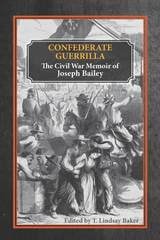
Confederate Guerrilla
The Civil War Memoir of Joseph M. BaileyT. Lindsay Baker
University of Arkansas Press, 2007
Joseph M. Bailey’s memoir, Confederate Guerrilla, provides a unique perspective on the fighting that took place behind Union lines in Federal-occupied northwest Arkansas during and after the Civil War. This story—now published for the first time—will appeal to modern readers interested in the grassroots history of the Trans-Mississippi war. Bailey participated in the Battle of Pea Ridge and the siege of Port Hudson, eventually escaping to northwest Arkansas where he fought as a guerrilla against Federal troops and civilian unionists. After Federal forces gained control of the area, Bailey rejoined the Confederate army and continued in regular service in northeast Texas until the end of the war.
Historians will find the descriptions of military campaigns and the observations on guerrilla war especially valuable. According to Bailey, Southern guerrillas were motivated less by a sense of loyalty to either the Confederate or Union side than by a determination to protect their families and neighbors from the “Mountain Federals.” This partisan war waged between the rebel guerrillas and Southern Unionists was essentially a “struggle for supremacy and revenge.”
Comprehensive annotations are provided by editor T. Lindsay Baker to illuminate the clarity and reliability of Bailey’s late-life memoir.

Couch People
A NovelWill Burns
University of Alabama Press, 2026
A darkly comic descent into Arkansas’s surreal criminal underworld through the eyes of a hapless, debt‑ridden hypochondriac
Couch People is a feverish, darkly comic novel that captures the anxious intensity of a world obsessed with wellness and control even as life keeps spinning into chaos. Prince, a debt-ridden drug dealer on probation, clings to vitamins and homeopathic rituals while stumbling through a surreal Arkansas underworld filled with criminal volatility and sudden violence.
As Prince fights to stay out of prison, recover his stolen money, and hold onto a fragile hope for love, he moves through a landscape populated by unforgettable misfits and bizarre dangers, including a system where snitches are cremated, turned into diamonds, and set into convicts’ teeth. Will Burns blends his satirical bite with unexpected tenderness, creating a narrative that prizes raw interiority and absurd humor over neat redemption. Couch People becomes a propulsive fever dream about love, loss, and the impossible effort to impose order on a world that refuses to make sense, inviting readers to embrace the beautiful mess of being alive without a manual, a map, or mercy.
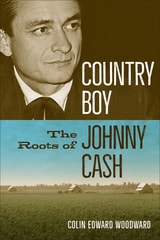
Country Boy
The Roots of Johnny CashColin Edward Woodward
University of Arkansas Press, 2022
Winner, 2023 J. G. Ragsdale Book Award from the Arkansas Historical Association
Because Johnny Cash cut his classic singles at Sun Records in Memphis and reigned for years as country royalty from his Nashville-area mansion, people tend to associate the Man in Black with Tennessee. But some of Cash’s best songs—including classics like “Pickin’ Time,” “Big River,” and “Five Feet High and Rising”—sprang from his youth in the sweltering cotton fields of northeastern Arkansas.
In Country Boy, Colin Woodward combines biography, history, and music criticism to illustrate how Cash’s experiences in Arkansas shaped his life and work. The grip of the Great Depression on Arkansas’s small farmers, the comforts and tragedies of family, and a bedrock of faith all lent his music the power and authenticity that so appealed to millions. Though Cash left Arkansas as an eighteen-year-old, he often returned to his home state, where he played some of his most memorable and personal concerts. Drawing upon the country legend’s songs and writings, as well as the accounts of family, fellow musicians, and chroniclers, Woodward reveals how the profound sincerity and empathy so central to Cash’s music depended on his maintaining a deep connection to his native Arkansas—a place that never left his soul.
Crisis of Conscience
Arkansas Methodists and the Civil Rights StruggleJames T. Clemons
Butler Center for Arkansas Studies, 2007
Cultural Encounters in the Early South
Indians and Europeans in ArkansasJeannie Whayne
University of Arkansas Press, 1995
Certificate of Commendation, American Association of State and Local History