Results by title
3258 books match the query 'Art' and 225 start with c
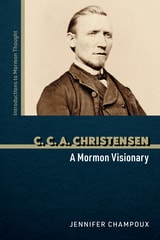
C. C. A. Christensen
A Mormon VisionaryJennifer Champoux
University of Illinois Press, 2026
Drawing on the artist’s voluminous writings, Jennifer Champoux illuminates Christensen’s influential art, including recently rediscovered works. Christensen received Church commissions and approval and helped shape Latter-day Saints’ vision of themselves. Over time the work of other artists eclipsed his achievements, but a twenty-first century revival of interest began to restore his reputation. Champoux also profiles how Christensen’s expansive activities outside of the art world gave him a unique vantage point for chronicling how the Latter-day Saint faith and culture evolved in Utah.
A revealing intellectual biography, C. C. A. Christensen offers a rare in-depth look at a major Latter-day Saint artist.
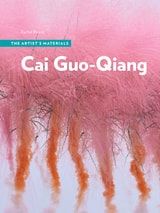
Cai Guo-Qiang
The Artist's MaterialsRachel Rivenc
J. Paul Getty Trust, The, 2025
Cai Guo-Qiang (China, b. 1957) is among the most prominent contemporary artists active today. His prolific, diverse creative practice—which includes gunpowder drawings and paintings, explosion events, videos, multimedia installations, and site-specific works—draws on a personal belief system that freely blends symbols and tenets from Eastern and Western traditions. Cai’s output seeks to establish dialogues among different cultures, different periods of time, and even different species—always while probing our shared humanity and the connections that can be divined across space and time, out of chaos and disorder. Based on in-depth interviews between the author and artist and with studio assistants, as well as extensive examination, sampling, and scientific analysis of a wide range of artworks, this publication addresses the implications of Cai’s distinctive materials and processes and their associated conservation issues.
Written for conservation scientists, conservators, specialists in contemporary art history, museum curators, collections managers, practicing artists, collectors, and art enthusiasts, this book offers insights into the life, methods, and materials of a leading figure in the art world. The technical discussions provide essential findings that will inform strategies for the future care of his works.
Calling Memory into Place
Dora Apel
Rutgers University Press, 2021
In this deeply personal work, acclaimed art historian Dora Apel examines how memorials, photographs, artworks, and autobiographical stories can be used to fuel a process of “unforgetting”—reinterpreting the past by recalling the events, people, perspectives, and feelings that get excluded from conventional histories. The ten essays in Calling Memory into Place feature explorations of the controversy over a painting of Emmett Till in the Whitney Biennial and the debates about a national lynching memorial in Montgomery, Alabama. They also include personal accounts of Apel’s return to the Polish town where her Holocaust survivor parents grew up, as well as the ways she found strength in her inherited trauma while enduring treatment for breast cancer.
These essays shift between the scholarly, the personal, and the visual as different modes of knowing, and explore the intersections between racism, antisemitism, and sexism, while suggesting how awareness of historical trauma is deeply inscribed on the body. By investigating the relations among place, memory, and identity, this study shines a light on the dynamic nature of memory as it crosses geography and generations.
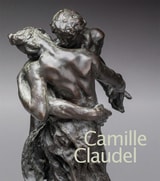
Camille Claudel
Emerson Bowyer
J. Paul Getty Trust, The, 2023
Camille Claudel (1864–1943) was among the most daring and visionary sculptors of the late nineteenth century. Although much attention has been paid to her tumultuous life—her affair with her mentor, Auguste Rodin; the premature end to her career; her thirty-year institutionalization in an asylum—her art remains little known outside of France. Memorably praised by critic Octave Mirbeau in 1895 as “a revolt of nature: a woman of genius,” Claudel was celebrated for her brilliance during a time when women sculptors were rare.
Featuring more than two hundred photographs along with contributions from leading experts, this publication accompanies the first comprehensive survey of Claudel’s oeuvre in nearly forty years. With essays exploring the many facets of her life, work, and reception; a biography; commentary by American sculptor Kiki Smith; and a fascinating appendix of documents written by Claudel and her contemporaries, this volume reevaluates the artist’s work on its own merits and repositions her legacy within a more complex genealogy of modernism.
This volume, copublished with The Art Institute of Chicago, accompanies an exhibition on view at The Art Institute of Chicago from October 7, 2023, to February 19, 2024 and at the J. Paul Getty Museum at the Getty Center from April 2 to July 21, 2024.
Can Virtue Make Us Happy?
The Art of Living and MoralityOtfried Hoffe
Northwestern University Press, 2010
Can one be happy and free, and nonetheless be moral? This question occurs at the core of daily life and is, as well, a question as old as philosophy itself. In Can Virtue Make Us Happy? The Art of Living and Morality, Otfried Höffe, one of Europe’s most well-known philosophers, offers a far-reaching and foundational work in philosophical ethics.
As long as one understands "happiness" purely as a feeling of subjective well-being, Höffe argues, there is at best only an accidental unity between it and morality. However, if one means by "happiness" the quality of doing well in the sense of one’s own successful existence, then one must include actions that undoubtedly have a moral character and are named virtues. He uses clear and general language to present what one understands by "happiness" and "freedom" while illuminating the blind alleys in the history of philosophy as well as the difficulties raised by the issues themselves. What has priority: good ends or right action? Is freedom always anarchy? Is it possible to think of a freedom enhanced by morality? Is "morality" only a pretty word for stupidity? Does humanity have a good or a bad character? Is there such a thing as evil? Höffe offers us enlightened philosophical reflection and foundational orientation but no simple formulas; this is precisely what is at stake because anyone who wishes to live a self-determined life rejects any and all formulas.

Canadian Art, Volume 1 (A-F)
Canadian Art: Volume I (A-F)Edited by Charles C. Hill and Pierre B. Landry
University of Chicago Press, 1988
Canaletto's Camera
Philip Steadman
University College London, 2025
Canaletto’s Camera provides a revelatory look at how the Venetian master Antonio Canaletto (1697–1768) used the camera obscura, a precursor to the modern camera, to create his meticulous cityscapes. Drawing on new research, Steadman examines Canaletto’s connections to contemporary scientists and his reliance on measured architectural drawings, discovering previously unrecognized techniques that shaped his iconic views of Venice and London.
By analyzing Canaletto’s sketches and reconstructing an 18th-century camera obscura, Steadman and his colleagues have recreated the artist’s process, demonstrating how he traced real scenes, altered them in his finished works, and even engaged in a form of early photomontage. Through digital overlays and side-by-side comparisons with contemporary photographs, the book challenges assumptions about Canaletto’s realism and artistic manipulation.
Lavishly illustrated and deeply engaging, Canaletto’s Camera is a compelling read for art historians, scholars of optical devices, and those fascinated by the intersection of art and science.
Canvases and Careers
Institutional Change in the French Painting WorldHarrison C. White and Cynthia A. White
University of Chicago Press, 1993
Originally published in 1965, this ground-breaking work is a classic piece of empirical research in the sociology of art. In this edition, Harrison C. White's new Foreword compares the marketing approaches of two contemporary painters, while Cynthia A. White's new Afterword reviews recent scholarship in the field.
Canyon de Chelly
Its People and Rock ArtCampbell Grant
University of Arizona Press, 1978
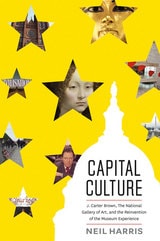
Capital Culture
J. Carter Brown, the National Gallery of Art, and the Reinvention of the Museum ExperienceNeil Harris
University of Chicago Press, 2013
Harris combines his in-depth knowledge of American history and culture with extensive archival research, and he has interviewed dozens of key players to reveal how Brown’s showmanship transformed the National Gallery. At the time of the Cold War, Washington itself was growing into a global destination, with Brown as its devoted booster. Harris describes Brown’s major role in the birth of blockbuster exhibitions, such as the King Tut show of the late 1970s and the National Gallery’s immensely successful Treasure Houses of Britain, which helped inspire similarly popular exhibitions around the country. He recounts Brown’s role in creating the award-winning East Building by architect I. M. Pei and the subsequent renovation of the West building. Harris also explores the politics of exhibition planning, describing Brown's courtship of corporate leaders, politicians, and international dignitaries.
In this monumental book Harris brings to life this dynamic era and exposes the creation of Brown's impressive but costly legacy, one that changed the face of American museums forever.
Capturing Troy
The Narrative Functions of Landscape in Archaic and Early Classical Greek ArtGuy Hedreen
University of Michigan Press, 2002
Guy Michael Hedreen is Professor of Art, Williams College.
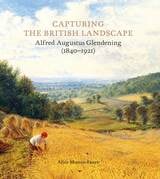
Capturing the British Landscape
Alfred Augustus Glendening (1840–1921)Alice Munro-Faure
Paul Holberton Publishing, 2022
Though critics often reviewed Alfred Augustus Glendening’s exhibitions, very little has been written about the artist himself. Here, new and extensive research removes layers of mystery and misinformation about his life, family, and career, accurately placing him amid the British art world during much of the nineteenth and into the twentieth century. Glendening was a man from humble origins, working full-time as a railway clerk when he managed to make his London exhibition debut at the age of twenty—a feat that would have been almost impossible before the Victorian era ushered in new possibilities of social mobility. Although his paintings show a tranquil and unspoiled landscape, his environment was rapidly being transformed by social, scientific, and industrial developments, while advances in transport, photography, and other technical discoveries undoubtedly influenced him and his fellow painters.
Celebrating his uniquely Victorian story, the book places Glendening within his proper historical context. Running alongside the main text is a timeline outlining significant landmarks, from political and social events to artistic and technical innovations. Thoroughly researched, the narrative explores why and for whom he painted, his artistic training, and his various inspirations. The book uncovers new information about the Victorian art world and embraces such aspects as Royal Academy prejudices, the popularity of Glendening’s work at home and abroad, his use of photography, and the sourcing of his art materials.
Cardiology
The Evolution of the Science and the ArtBing, Richard J.
Rutgers University Press, 1999
Caribes 2.0
New Media, Globalization, and the Afterlives of DisasterJossianna Arroyo
Rutgers University Press, 2023
Carnal Art
Orlan’s RefacingC. Jill O'Bryan
University of Minnesota Press, 2005
Carnalities
The Art of Living in LatinidadMariana Ortega
Duke University Press, 2025
Cartesian Poetics
The Art of ThinkingAndrea Gadberry
University of Chicago Press, 2020
Gadberry’s approach to seventeenth-century writings poses questions urgent for the twenty-first. Bringing literature and philosophy into rich dialogue, Gadberry centers close reading as a method uniquely equipped to manage skepticism, tolerate critical ambivalence, and detect feeling in philosophy. Helping us read classic moments of philosophical argumentation in a new light, this elegant study also expands outward to redefine thinking in light of its poetic formations.

Cartomancy and Tarot in Film
1940-2010Emily E. Auger
Intellect Books, 2016
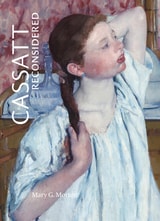
Cassatt Reconsidered
Mary G. Morton
J. Paul Getty Trust, The, 0
A sweeping reconsideration of the artist we thought we knew—and the forces that obscured her legacy.
Fiercely ambitious and independent, Mary Cassatt defied expectations to become one of the most radical artists of the Impressionist movement, though she was—and remains—the least understood. Cassatt commanded and manipulated strains of old master and contemporary painting to express her female subjectivity through a brilliantly modern oeuvre on par with those of the most revered Impressionists. However, mishandled by the Parisian art establishment during her lifetime, and later by art historians and curators, she became known almost exclusively as a sentimentalizing painter of mothers and children.
How did this happen to the most aspiring, revolutionary female artist of the late nineteenth and early twentieth centuries? In Cassatt Reconsidered, author Mary G. Morton probes this central question and more, demonstrating how Cassatt disturbed conventional ideals of femininity, childhood, and maternity, an uncompromising feat for which she paid dearly during her lifetime and in the annals of art historiography.
Vibrantly illustrated with more than 100 images, Cassatt Reconsidered rewards readers with a fuller understanding of an artist who stands apart for daring to express, on her own terms, the unique, intimate experiences of modern women.

Cataloging Cultural Objects
A Guide to Describing Cultural Works and Their ImagesMurtha Baca
American Library Association, 2006
Catalogue of the Roman Imperial Coins in the Charles University Collection (235–284 A.D.)
David Lužický
Karolinum Press, 2026
Spotlights over five hundred Roman Imperial coins from Charles University's vast collection of ancient coins.
Charles University’s collection of ancient coins in its present state has existed since l945. Greek, Roman, and other ancient coins were entrusted to the care of the Seminar for Ancient History and compiled into a single collection along with antique coins from the original collection of the Czech University. The collection contains about 4,000 pieces altogether, mostly in silver and bronze.
This publication presents a catalogue of 564 Roman Imperial coins dating from 235 to 284 A. D. and is part of efforts to gradually catalogue the entirety of Charles University’s collection of ancient coins, stored in the depository of the CU Institute of Greek and Latin Studies. The book builds upon Václav Marek’s 1985 monograph, The Roman Republican Coins in the Collection of Charles University, and Federico Gambacorta’s 2013 continuation titled Catalogue of the Late Roman, Byzantine and Barbaric Coins in the Charles University Collection (364–1092 A. D.).

Catawba Indian Pottery
The Survival of a Folk TraditionThomas John Blumer, with a foreword by William L. Harris
University of Alabama Press, 2004
Traces the craft of pottery making among the Catawba Indians of North Carolina from the late 18th century to the present
When Europeans encountered them, the Catawba Indians were living along the river and throughout the valley that carries their name near the present North Carolina-South Carolina border. Archaeologists later collected and identified categories of pottery types belonging to the historic Catawba and extrapolated an association with their protohistoric and prehistoric predecessors.
In this volume, Thomas Blumer traces the construction techniques of those documented ceramics to the lineage of their probable present-day master potters or, in other words, he traces the Catawba pottery traditions. By mining data from archives and the oral traditions of contemporary potters, Blumer reconstructs sales circuits regularly traveled by Catawba peddlers and thereby illuminates unresolved questions regarding trade routes in the protohistoric period. In addition, the author details particular techniques of the representative potters—factors such as clay selection, tool use, decoration, and firing techniques—which influence their styles.
Catharsis
On the Art of MedicineAndrzej Szczeklik
University of Chicago Press, 2005
The process of diagnosis, for instance, belongs to a world of magic and metaphor; the physician must embrace it like a poem or painting, with particular alertness and keen receptivity. Speculation on ways to slow aging through genetics, meanwhile, draws directly on the dream of immortality that artists and poets have nourished through the ages. And the concept of catharsis itself has made its way from the writings of Aristotle to today's growing interest in the benefits of music to health, especially in newborns. As Szczeklik explores such subjects as the mysteries of the heart rhythm, the secret history of pain relief, the enigmatic logic of epidemics, near-death or out-of-body experiences, and many more, he skillfully weaves together classical literature, the history of medicine, and moving anecdotes from his own clinical experiences. The result is a life-affirming book that will enrich the healing work of patients and doctors alike and make an invaluable contribution to our still-expanding vision of the art of medicine.
Celebrity Across the Channel, 1750–1850
Anaïs Pédron
University of Delaware Press, 2021

Ceramic Figures
A Directory of ArtistsFlynn, Michael
Rutgers University Press, 2002
Figurative ceramics is one of the most exciting and innovative areas of art today. Though ceramics has been unfashionable in the past, the last twenty-five years have seen a worldwide resurgence of interest in this art form among artists, galleries, and the public.
In this book, Michael Flynn looks back at the last twenty-five years and selects over one hundred of the most important artists working with ceramic figures. He also includes ceramicists from earlier in the century whose work has had an influence on the subject. The work ranges from porcelain to raku and from the small to the monumental.
Ceramic Figures is arranged alphabetically by last name, giving a thumbnail sketch of the artist and showing a variety of the artist’s work. Major galleries and collections where the pieces appear are also included. The result is a spectacular international survey of this most captivating of subjects.
Cezanne and Provence
The Painter in His CultureNina Maria Athanassoglou-Kallmyer
University of Chicago Press, 2003
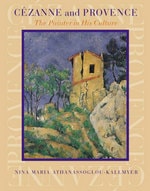
Like many of his childhood friends, Cézanne detested the homogenizing effects of modernism and bourgeois capitalism on the culture, people, and landscapes of his beloved Provence. Turning away from the mainstream modernist aesthetic of his impressionist years, Cézanne sought instead to develop a new artistic tradition more evocative of his Provençal heritage. Athanassoglou-Kallmyer shows that Provence served as a distinct and defining cultural force that shaped all aspects of Cézanne's approach to representation, including subject matter, style, and technical treatment. For instance, his self-portraits and portraits of family members reflect a specifically Provençal sense of identity. And Cézanne's Provençal landscapes express an increasingly traditionalist style firmly grounded in details of local history and even geology. These landscapes, together with images of bathers, cardplayers, and other figures, were key facets of Cézanne's imaginary reconstruction of Provence as primordial and idyllic—a modern French Arcadia.
Highly original and lavishly illustrated, Cézanne and Provence gives us an entirely new Cézanne: no longer the quintessential icon of generic, depersonalized modernism, but instead a self-consciously provincial innovator of mainstream styles deeply influenced by Provençal culture, places, and politics.
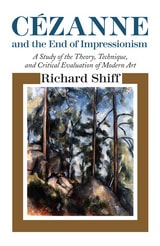
Cezanne and the End of Impressionism
A Study of the Theory, Technique, and Critical Evaluation of Modern ArtRichard Shiff
University of Chicago Press, 1984
Cezanne
A Study of His DevelopmentRoger Fry
University of Chicago Press, 1989
This study established Fry as a critical "father," the first of his line to explicate the ideas of "vision and design" in an attempt to understand modern art. His critical analysis has in many respects never been surpassed. Fry endeavored both to show the essential development of the painter's style and to approach individual works directly; he wrote that he would detect "the profound difference between Cézanne's message and what we have made of it." The result is a book, couched in Fry's most lucid, penetrating language, which is of great technical value to the painter and student and which offers the layman an illuminating demonstration of the remarkable force of Cézanne's art.
Champa and the Archaeology of M? So'n (Vietnam)
Edited by Andrew Hardy, Mauro Cucarzi, and Patrizia Zolese
National University of Singapore Press, 2009
Champion Trees of Arkansas
An Artist's JourneyLinda Williams Palmer
University of Arkansas Press, 2016
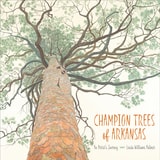
In Champion Trees of Arkansas, Linda Williams Palmer explores the state’s largest trees of their species, registered with the Arkansas Forestry Commission as “champions.” Through her beautiful colored-pencil drawings, each magnificent tree is interpreted through the lens of season, location, history, and human connection.
Readers will get to know the cherrybark oak, rendered in fall colors, an avatar for the passing of seasons. The sugar maple, with its bare limbs and weather-beaten trunk, stands sentry over the headstones in a confederate cemetery. The 350-year-old white oak was once dubbed the Council Oak by Native Americans, and the post oak, cared for by generations of the same family, has its own story to tell.
Palmer travelled from Delta swamps to Ozark and Ouachita mountain ridges over a seven-year period to see and document the champions and to talk with property owners and others willing to share the stories of how these trees are beloved and protected by the community, and often entwined with its history. Champion Trees of Arkansas is sure to inspire art and nature lovers everywhere.
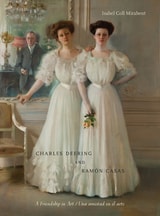
Charles Deering and Ramón Casas / Charles Deering y Ramón Casas
A Friendship in Art / Una amistad en el arteIsabel Coll Mirabent
Northwestern University Press, 2012
This lavishly illustrated, bilingual art book presents drawings by Ramón Casas in the Charles Deering McCormick Library of Special Collections at the Northwestern University Library and oil paintings by Casas from private collections and the Art Institute of Chicago.
Charles Deering and Ramón Casas follows the development and dramatic dissolution of a three-way friendship that connected the Spanish painter Ramón Casas (1866–1932); the Chicago industrialist Charles Deering (1852–1927), who was a collector and admirer of Casas’s work as well as a patron of Northwestern University; and the Spanish artist Miguel Utrillo (1862–1934), Casas’s lifelong friend and the father of the French painter Maurice Utrillo.
Casas introduced Deering to Sitges, a beach town near Barcelona, Spain, where the latter created a palatial estate with a museum to house his art collection. Miguel Utrillo served as director of the museum. The text explores the treasures housed at Maricel and what happened among the three men that led Casas to abandon Utrillo and Deering to depart Spain, taking his art collection with him.
Chicago Makes Modern
How Creative Minds Changed SocietyEdited by Mary Jane Jacob and Jacquelynn Baas
University of Chicago Press, 2012
Chicago is a city dedicated to the modern—from the skyscrapers that punctuate its skyline to the spirited style that inflects many of its dwellings and institutions, from the New Bauhaus to Hull-House. Despite this, the city has long been overlooked as a locus for modernism in the arts, its rich tradition of architecture, design, and education disregarded. Still the modern in Chicago continues to thrive, as new generations of artists incorporate its legacy into fresh visions for the future. Chicago Makes Modern boldly remaps twentieth-century modernism from our new-century perspective by asking an imperative question: How did the modern mind—deeply reflective, yet simultaneously directed—help to dramatically alter our perspectives on the world and make it new?
Returning the city to its rightful position at the heart of a multidimensional movement that changed the face of the twentieth century, Chicago Makes Modern applies the missions of a brilliant group of innovators to our own time. From the radical social and artistic perspectives implemented by Jane Addams, John Dewey, and Buckminster Fuller to the avant-garde designs of László Moholy-Nagy and Mies van der Rohe, the prodigious offerings of Chicago's modern minds left an indelible legacy for future generations. Staging the city as a laboratory for some of our most heralded cultural experiments, Chicago Makes Modern reimagines the modern as a space of self-realization and social progress—where individual visions triggered profound change. Featuring contributions from an acclaimed roster of contemporary artists, critics, and scholars, this book demonstrates how and why the Windy City continues to drive the modern world.
Chicago Reflected
A Skyline Drawing from the Chicago RiverRyan Chester
University of Chicago Press, 2023
As completed, Chester’s two-foot-high, fifty-five-foot-long drawing is a unique vision. In addition to dozens of accurately depicted buildings, Chester included pieces of Chicago’s past, including the Union Station Concourse Building that was demolished in 1969 and the immense SS Eastland, which sank in the river in 1915, killing hundreds of people. Recent architecture is featured as well, including Studio Gang’s St. Regis Chicago tower and the Bank of America Tower by Goettsch Partners.
An essay by acclaimed writer Thomas Dyja accompanies the accordion-fold presentation of Chester’s drawing, enhancing this remarkable volume that will delight any fan of Chicago, architecture, or art. Chicago Reflected opens up fresh vistas of the stunning, ever-evolving architectural landscape that can be found only in Chicago.
Chicago's Fabulous Fountains
Greg Borzo. Photographs by Julia Thiel. Foreword by Geoffrey Baer. Preface by Debra Shore.
Southern Illinois University Press, 2017
Winner, ISHS Annual Award for Other Publications, 2018
Most people do not realize it, but Chicago is home to many diverse, artistic, fascinating, and architecturally and historically important fountains. In this attractive volume, Greg Borzo reveals more than one hundred outdoor public fountains of Chicago with noteworthy, amusing, or surprising stories about these gems. Complementing Borzo’s engagingly written text are around one hundred beautiful fine-art color photos of the fountains, taken by photographer Julia Thiel for this book, and a smaller number of historical photos.
Greg Borzo begins by providing an overview of Chicago’s fountains and discussing the oldest ones, explaining who built them and why, how they survived as long as they have, and what they tell us about early Chicago. At the heart of the book are four thematic chapters on drinking fountains, iconic fountains, plaza fountains, and park and parkway fountains. Among the iconic fountains described are Buckingham (in Grant Park), Crown (in Millennium Park), Centennial (with its water cannon shooting over the Chicago River), and two fountains designed by famed sculptor Lorado Taft (Time and Great Lakes). Plazas all around Chicago—in the neighborhoods as well as downtown—have fountains that anchor communities or enhance the skyscrapers they adorn. Also presented are the fountains in Chicago’s parks, some designed by renowned artists and many often overlooked or taken for granted. A chapter on the self-proclaimed City of Fountains, Kansas City, Missouri, shows how Chicago’s city planners could raise public awareness and funding for the care and preservation of these important landmarks. Also covered are a brief period of fountain building and rehabbing (1997–2002) that vastly enriched the city; fountains that no longer exist; and proposed Chicago fountains that were never built, as well as the future of fountain design.
A beautiful photography book and a guide to the city’s many fountains, Chicago’s Fabulous Fountains also provides fascinating histories and behind-the-scenes stories of these underappreciated artistic and architectural treasures of the Windy City.
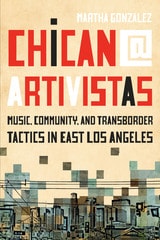
Chican@ Artivistas
Music, Community, and Transborder Tactics in East Los AngelesMartha Gonzalez
University of Texas Press, 2020
As the lead singer of the Grammy Award–winning rock band Quetzal and a scholar of Chicana/o and Latina/o studies, Martha Gonzalez is uniquely positioned to articulate the ways in which creative expression can serve the dual roles of political commentary and community building. Drawing on postcolonial, Chicana, black feminist, and performance theories, Chican@ Artivistas explores the visual, musical, and performance art produced in East Los Angeles since the inception of NAFTA and the subsequent anti-immigration rhetoric of the 1990s.
Showcasing the social impact made by key artist-activists on their communities and on the mainstream art world and music industry, Gonzalez charts the evolution of a now-canonical body of work that took its inspiration from the Zapatista movement, particularly its masked indigenous participants, and that responded to efforts to impose systems of labor exploitation and social subjugation. Incorporating Gonzalez’s memories of the Mexican nationalist music of her childhood and her band’s journey to Chiapas, the book captures the mobilizing music, poetry, dance, and art that emerged in pre-gentrification corners of downtown Los Angeles and that went on to inspire flourishing networks of bold, innovative artivistas.
Chicana Art
The Politics of Spiritual and Aesthetic AltaritiesLaura E. Pérez
Duke University Press, 2007
Creating an invaluable archive, Laura E. Pérez examines the work of more than forty Chicana artists across a variety of media including painting, printmaking, sculpture, performance, photography, film and video, comics, sound recording, interactive CD-ROM, altars and other installation forms, and fiction, poetry, and plays. While key works from the 1960s and 1970s are discussed, most of the pieces considered were produced between 1985 and 2001. Providing a rich interpretive framework, Pérez describes how Chicana artists invoke a culturally hybrid spirituality to challenge racism, bigotry, patriarchy, and homophobia. They make use of, and often radically rework, pre-Columbian Mesoamerican and other non-Western notions of art and art-making, and they struggle to create liberating versions of familiar iconography such as the Virgin of Guadalupe and the Sacred Heart. Filled with representations of spirituality and allusions to non-Western visual and cultural traditions, the work of these Chicana artists is a vital contribution to a more inclusive canon of American arts.
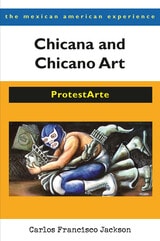
Chicana and Chicano Art
ProtestArteCarlos Francisco Jackson
University of Arizona Press, 2009
Although the word “Chicano” once held negative connotations, students—along with civil rights activists and artists—adopted it in the late 1960s in order to reimagine and redefine what it meant to be Mexican American in the United States. Chicanismo is the ideology and spirit behind the Chicano Movement and Chicanismo unites the artists whose work is revealed and celebrated in this book.
Jackson’s scope is wide. He includes paintings, prints, murals, altars, sculptures, and photographs—and, of course, the artists who created them. Beginning with key influences, he describes the importance of poster and mural art, focusing on the work of the Mexican artist José Guadalupe Posada and the significance of Mexican and Cuban talleres (print workshops). He examines the importance of art collectives in the United States, as well as Chicano talleres and community art centers, for the growth of the Chicano art movement. In conclusion, he considers how Chicano art has been presented to the general American public.
As Jackson shows, the visual arts have both reflected and created Chicano culture in the United States. For college students—and for all readers who want to learn more about this fascinating subject—his book is an ideal introduction to an art movement with a social conscience.
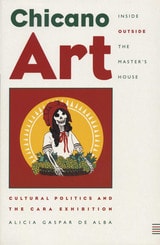
Chicano Art Inside/Outside the Master’s House
Cultural Politics and the CARA ExhibitionBy Alicia Gaspar de Alba
University of Texas Press, 1997
In the early 1990s, a major exhibition Chicano Art: Resistance and Affirmation, 1965-1985 toured major museums around the United States. As a first attempt to define and represent Chicano/a art for a national audience, the exhibit attracted both praise and controversy, while raising fundamental questions about the nature of multiculturalism in the U.S.
This book presents the first interdisciplinary cultural study of the CARA exhibit. Alicia Gaspar de Alba looks at the exhibit as a cultural text in which the Chicano/a community affirmed itself not as a "subculture" within the U.S. but as an "alter-Native" culture in opposition to the exclusionary and homogenizing practices of mainstream institutions. She also shows how the exhibit reflected the cultural and sexual politics of the Chicano Movement and how it serves as a model of Chicano/a popular culture more generally.
Drawing insights from cultural studies, feminist theory, anthropology, and semiotics, this book constitutes a wide-ranging analysis of Chicano/a art, popular culture, and mainstream cultural politics. It will appeal to a diverse audience in all of these fields.
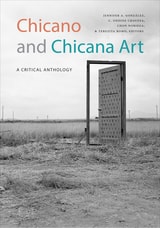
Chicano and Chicana Art
A Critical AnthologyJennifer A. Gonzalez, C. Ondine Chavoya, Chon Noriega, and Terezita Romo, editors
Duke University Press, 2019
Contributors. Carlos Almaraz, David Avalos, Judith F. Baca, Raye Bemis, Jo-Anne Berelowitz, Elizabeth Blair, Chaz Bojóroquez, Philip Brookman, Mel Casas, C. Ondine Chavoya, Karen Mary Davalos, Rupert García, Alicia Gaspar de Alba, Shifra Goldman, Jennifer A. González, Rita Gonzalez, Robb Hernández, Juan Felipe Herrera, Louis Hock, Nancy L. Kelker, Philip Kennicott, Josh Kun, Asta Kuusinen, Gilberto “Magu” Luján, Amelia Malagamba-Ansotegui, Amalia Mesa-Bains, Dylan Miner, Malaquias Montoya, Judithe Hernández de Neikrug, Chon Noriega, Joseph Palis, Laura Elisa Pérez, Peter Plagens, Catherine Ramírez, Matthew Reilly, James Rojas, Terezita Romo, Ralph Rugoff, Lezlie Salkowitz-Montoya, Marcos Sanchez-Tranquilino, Cylena Simonds, Elizabeth Sisco, John Tagg, Roberto Tejada, Rubén Trejo, Gabriela Valdivia, Tomás Ybarra-Frausto, Victor Zamudio-Taylor
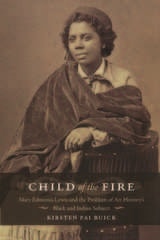
Child of the Fire
Mary Edmonia Lewis and the Problem of Art History's Black and Indian SubjectKirsten Pai Buick
Duke University Press, 2010
Buick considers the institutions and people that supported Lewis’s career—including Oberlin College, abolitionists in Boston, and American expatriates in Italy—and she explores how their agendas affected the way they perceived and described the artist. Analyzing four of Lewis’s most popular sculptures, each created between 1866 and 1876, Buick discusses interpretations of Hiawatha in terms of the cultural impact of Henry Wadsworth Longfellow’s epic poem The Song of Hiawatha; Forever Free and Hagar in the Wilderness in light of art historians’ assumptions that artworks created by African American artists necessarily reflect African American themes; and The Death of Cleopatra in relation to broader problems of reading art as a reflection of identity.
Chimera
The Expanded Body for a New Ecosophy of the ArtsMarco Mancuso
Intellect Books, 2026
Exploring the evolving relationship between the human body, technoscience, and the environment, Chimera introduces the concept of the “expanded body” as a transdisciplinary meeting point between art, design, technology, and science. Through a critical examination of developments such as biomechanics, prosthetics, body hacking, and biotechnology, the book investigates how these innovations alter our bodily, sensory, and cognitive capacities. Providing a unique methodological systematization of the main ecological and posthuman philosophy theories, it argues for a new framework in which the human is deeply entangled with both human and nonhuman elements in a shared environment.
Building on ideas from both past and present—ranging from twentieth-century research to current discussions in neuroscience, design, and media theory—Chimera offers a thoughtful response to common fears about futures driven by technology and science. Instead of imagining a world dominated by machines or centered only on human needs, the book imagines fluid, queer, and nonhierarchical relational models between human bodies and the environment. Essential reading for scholars and students in contemporary art, new media, science and technology studies, and environmental and posthuman studies, Chimera also speaks to a wider audience interested in how technology and science are reshaping our understanding of life, identity, and ethical coexistence.
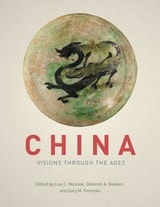
China
Visions through the AgesEdited by Lisa C. Niziolek, Deborah A. Bekken and Gary M. Feinman
University of Chicago Press, 2018
China’s long history is one of the richest and most complex in the known world, and the Cyrus Tang Hall of China offers visitors a wonderful, comprehensive survey of it through some 350 artifacts on display, spanning from the Paleolithic period to present day. Now, with China: Visions through the Ages, anyone can experience the marvels of this exhibition through the book’s beautifully designed and detailed pages. Readers will gain deeper insight into The Field Museum’s important East Asian collections, the exhibition development process, and research on key aspects of China’s fascinating history. This companion book, edited by the exhibition’s own curatorial team, takes readers even deeper into the wonders of the Cyrus Tang Hall of China and enables them to study more closely the objects and themes featured in the show. Mirroring the exhibition’s layout of five galleries, the volume is divided into five sections. The first section focuses on the Paleolithic and Neolithic periods; the second, the Bronze Age, the first dynasties, and early writing; the third, the imperial system and power; the fourth, religion and performance; and the fifth, interregional trade and the Silk Routes. Each section also includes highlights containing brief stories on objects or themes in the hall, such as the famous Lanting Xu rubbing.
With chapters from a diverse set of international authors providing greater context and historical background, China: Visions through the Ages is a richly illustrated volume that allows visitors, curious readers, and China scholars alike a chance to have an enduring exchange with the objects featured in the exhibition and with their multifaceted histories.
Chinese Paintings in Chinese Publications, 1956–1968
An Annotated Bibliography and Index to the PaintingsEllen Johnston Laing
University of Michigan Press, 1969
Chinese Silk
A Cultural HistoryShelagh Vainker
Rutgers University Press, 2004
Silk is one of China’s major contributions to world civilization, the secrets of its cultivation closely guarded for generations. The famous network of trade routes between West and East is still known as the Silk Road. The organization and techniques of Chinese silk production, the uses of the silk produced––both bolts and made-up pieces––and the types and styles of its ornament are celebrated in this richly illustrated and accessible book, the first general survey to be published in English.
Shelagh Vainker traces the cultural history of silk in China from its Neolithic origins to the twentieth century and considers its relationship to the other decorative arts. She traces the role of silk in Chinese history, trade, religion, and literature. Drawing on the most recent archaeological evidence from other, less perishable media such as jades and bronzes as well as paintings, poems, and other texts, Chinese Silk brings together material available until now only in Chinese, supplemented with recent acquisitions by public and private collections in the United States and Europe. The result is a book that illuminates the luxury of silk throughout the ages.
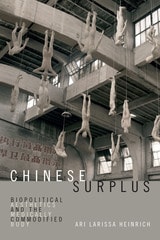
Chinese Surplus
Biopolitical Aesthetics and the Medically Commodified BodyAri Larissa Heinrich
Duke University Press, 2018
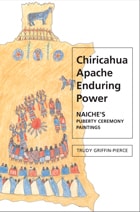
Chiricahua Apache Enduring Power
Naiche's Puberty Ceremony PaintingsTrudy Griffin-Pierce, foreword by J. Jefferson Reid and Stephanie M. Whittlesey
University of Alabama Press, 2006
A gripping story of the cultural resilience of the descendants of Geronimo and Cochise
This book reveals the conflicting meanings of power held by the federal government and the Chiricahua Apaches throughout their history of interaction. When Geronimo and Naiche, son of Cochise, surrendered in 1886, their wartime exploits came to an end, but their real battle for survival was only beginning. Throughout their captivity in Florida, Alabama, and Oklahoma, Naiche kept alive Chiricahua spiritual power by embodying it in his beautiful hide paintings of the Girl’s Puberty Ceremony—a ritual at the very heart of tribal cultural life and spiritual strength.
This narrative is a tribute to the Chiricahua people, who survive today, despite military efforts to annihilate them, government efforts to subjugate them, and social efforts to destroy their language and culture. Although federal policy makers brought to bear all the power at their command, they failed to eradicate Chiricahua spirit and identity nor to convince them that their lower status was just part of the natural social order. Naiche, along with many other Chiricahuas, believed in another kind of power. Although not known to have Power of his own in the Apache sense, Naiche’s paintings show that he believed in a vital source of spiritual strength. In a very real sense, his paintings were visual prayers for the continuation of the Chiricahua people. Accessible to individuals for many purposes, Power helped the Chiricahuas survive throughout their history.
Griffin-Pierce explores Naiche’s artwork through the lens of current anthropological theory on power, hegemony, resistance, and subordination. As she retraces the Chiricahua odyssey during 27 years of incarceration and exile by visiting their internment sites, she reveals how the Power was with them throughout their dark period. As it was when the Chiricahua warriors and their families struggled to stay alive, Power remains the centering focus for contemporary Chiricahua Apaches. Although never allowed to return to their beloved homeland, not only are the Chiricahua Apaches surviving today, they are keeping their traditions alive and their culture strong and vital.

Chitrakar
Benode Behari Mukherjee
Seagull Books, 2026
What happens when a passage from the world of light to the world of darkness opens onto a new chapter of life? A retrospective account of a pioneering Indian artist who continued to paint after losing his eyesight.
Benode Behari Mukherjee (1904–1980) was one of the most influential and highly regarded artists in the history of modern Indian art. Chitrakar brings together four broadly autobiographical pieces written by Benode Behari after he lost his eyesight in the summer of 1957. The Artist is a selective reminiscence recapturing various pictures from the years of his childhood, apprenticeship, and maturity, up to the time he became blind. Master of the Household is a candid and complex fictionalized account of his struggle to come to terms with his blindness and continue making art. The Creator is a simple, but telling, parable about the vanity of inordinate ambition. Finally, Art Quest outlines his philosophy of art and the basic elements of his work.
In the sensitive and empathetic hands of K. G. Subramanyan, once his student and later himself a major figure in the Indian art scene, this translation, appearing for the first time in English, is a precious and timeless document.
Christiana Herringham and the Edwardian Art Scene
Mary Lago
University of Missouri Press, 1995
Christiana Herringham (1852-1929), an expert copyist of the Italian Old Masters, was an extraordinary and accomplished woman. Her achievements required a delicate balance, for she had to negotiate old Victorian restrictions in order "to find and fortify a place for herself" in the male-dominated spheres of fine-art administration and public service.
Lady Herringham arrived on the Edwardian art scene with a translation of Il Libro dell' Arte o Trattato della Pittura, Cennini's fifteenth-century handbook on fresco and tempera. It aroused new interest in those techniques and led to the founding of the Society of Painters in Tempera in 1901. To preserve Britain's art heritage from buyers abroad, she provided the money that launched the National Art Collections Fund in 1903, creating what is still a vital and authoritative voice in Britain's cultural life. Her work as the only woman on the NACF's first executive committee prepared her to assist in founding the India Society, which urged respect for indigenous Indian traditions of the fine arts and encouraged appreciation for them in England.
Her concern for undervalued art led her to India to copy the Buddhist wall paintings in the Ajanta caves near Hyderabad. Her copies are the only color record of their condition during those years. Sadly, as she returned from India in 1911, Lady Herringham began to suffer from delusions of pursuit and persecution and withdrew to an asylum, where she remained until her death. There were then no satisfactory explanations for her symptoms, only the Victorian medical premise that insanity was an extension of physical illness.
A distinguished Edwardian scholar, Mary Lago has used her knowledge of the cultural history of the period to bring significant insight into the personal and professional conflicts Lady Herringham faced during a time of limited opportunities for women. Lago also discusses the issue of nationalism in art and the role of colonial imperialism in defining and preserving art. As a postscript, she presents the fascinating possibility that Christiana Herringham's experience may have inspired the character of Mrs. Moore in E. M. Forster's A Passage to India.
Chroma
A Book of ColorDerek Jarman
University of Minnesota Press, 2010
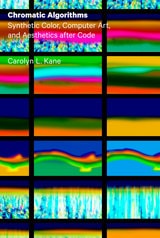
Chromatic Algorithms
Synthetic Color, Computer Art, and Aesthetics after CodeCarolyn L. Kane
University of Chicago Press, 2014
Chromatic Algorithms reveals the fascinating history behind digital color, tracing it from the work of a few brilliant computer scientists and experimentally minded artists in the late 1960s and early ‘70s through to its appearance in commercial software in the early 1990s. Mixing philosophy of technology, aesthetics, and media analysis, Carolyn Kane shows how revolutionary the earliest computer-generated colors were—built with the massive postwar number-crunching machines, these first examples of “computer art” were so fantastic that artists and computer scientists regarded them as psychedelic, even revolutionary, harbingers of a better future for humans and machines. But, Kane shows, the explosive growth of personal computing and its accompanying need for off-the-shelf software led to standardization and the gradual closing of the experimental field in which computer artists had thrived.
Even so, the gap between the bright, bold presence of color onscreen and the increasing abstraction of its underlying code continues to lure artists and designers from a wide range of fields, and Kane draws on their work to pose fascinating questions about the relationships among art, code, science, and media in the twenty-first century.