Results by title
435 books match the query 'Asian American & Pacific Islander Studies' and 39 start with c
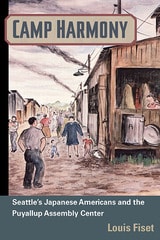
Camp Harmony
Japanese American Internment and the Puyallup Assembly CenterLouis Fiset
University of Illinois Press, 2009
This book is the first full portrait of a single assembly center--located at the Western Washington fairgrounds at Puyallup, outside Seattle--that held Japanese Americans for four months prior to their transfer to a relocation center during World War II. Gathering archival evidence and eyewitness accounts, Louis Fiset reconstructs the events leading up to the incarceration as they unfolded on a local level: arrests of Issei leaders, Nikkei response to the war dynamics, debates within the white community, and the forced evacuation of the Nikkei community from Bainbridge Island. The book explores the daily lives of the more than seven thousand inmates at "Camp Harmony," detailing how they worked, played, ate, and occasionally fought with each other and with their captors. Fiset also examines the inmates' community life, health care, and religious activities. He includes details on how army surveyors selected the center's site, oversaw its construction, and managed the transfer of inmates to the more permanent Minidoka Relocation Center in Idaho.
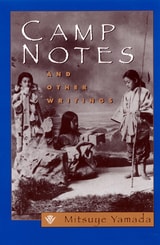
Camp Notes and Other Writings
Yamada, Mitsuye
Rutgers University Press, 1998
Honorable Mention of the 1999 Gustavus Myers Outstanding Book Awards
Two collections by an important Asian American writer -- Camp Notes and Other Poeems and Desert Run: Poems and Stories -- return to print in one volume.
Mitsuye Yamada was born in Kyushu, Japan, and raised in Seattle, Washington, until the outbreak of World War II when her family was removed to a concentration camp in Idaho. Camp Notes and Other Writings recounts this experience.
Yamada's poetry yields a terse blend of emotions and imagery. Her twist of words creates a twist of vision that make her poetry come alive. The weight of her cultural experience-the pain of being perceived as an outsider all of her life-permeates her work.
Yamada's strength as a poet stems from the fact that she has managed to integrate both individual and collective aspects of her background, giving her poems a double impact. Her strong portrayal of individual and collective life experience stands out as a distinct thread in the fabric of contemporary literature by women.
"The core poems of Camp Notes and the title come from the notes I had taken when I was in camp, and it wasn’t published until thirty years after most of it was written. I was simply describing what was happening to me, and my thoughts. But, in retrospect, the collection takes on a kind of expanded meaning about that period in our history. As invariably happens, because Japanese American internment became such an issue in American history, I suppose I will be forever identified as the author of Camp Notes. Of course, I try to show that it’s not the only thing I ever did in my whole life; I did other things besides go to an internment camp during World War II. So, in some ways I keep producing to counteract that one image that gets set in the public mind. At the time that I was writing it, I wasn’t necessarily a political person. Now, when I reread it, even to myself, I think it probably has a greater warning about the dangers of being not aware, not aware of one’s own rights, not aware of helping other people who may be in trouble. I think that it does speak to our present age very acutely." -- Mitsuye Yamada, "You should not be invisible”: An Interview with Mitsuye Yamada, Contemporary Women's Writing, March 2014, Vol. 8 Issue 1
Read the whole interview at: https://academic.oup.com/cww/article/8/1/1/414906/You-should-not-be-invisible-An-Interview-with
Campaigns of Knowledge
U.S. Pedagogies of Colonialism and Occupation in the Philippines and JapanMalini Johar Schueller
Temple University Press, 2019
The creation of a new school system in the Philippines in 1898 and educational reforms in occupied Japan, both with stated goals of democratization, speaks to a singular vision of America as savior, following its politics of violence with benevolent recuperation. The pedagogy of recovery—in which schooling was central and natives were forced to accept empire through education—might have shown how Americans could be good occupiers, but it also created projects of Orientalist racial management: Filipinos had to be educated and civilized, while the Japanese had to be reeducated and “de-civilized.”
In Campaigns of Knowledge, Malini Schueller contrapuntally reads state-sanctioned proclamations, educational agendas, and school textbooks alongside political cartoons, novels, short stories, and films to demonstrate how the U.S. tutelary project was rerouted, appropriated, reinterpreted, and resisted. In doing so, she highlights how schooling was conceived as a process of subjectification, creating particular modes of thought, behaviors, aspirations, and desires that would render the natives docile subjects amenable to American-style colonialism in the Philippines and occupation in Japan.
Cane Fires
The Anti-Japanese Movement in Hawaii, 1865-1945Gary Y. Okihiro
Temple University Press, 1992
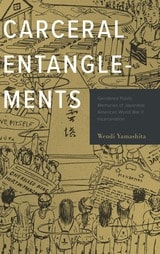
Carceral Entanglements
Gendered Public Memories of Japanese American World War II IncarcerationWendi Yamashita
Temple University Press, 2024
Carceral Entanglements features interviews, archival research, and texts to explore racial violence and patriotic masculinity and explain how Japanese American history and identity are publicly memorialized. Yamashita examines museums, digital archives, pilgrimages, and student-run and performed plays to understand how Japanese Americans occupy a “contradictory location” produced by the state. She also addresses historical erasure, race relations and the struggle for redress and reparations.
Carceral Entanglements is about the interlocking relationship Japanese American incarceration memories have to the prison industrial complex and the settler colonial logics that at times unknowingly sustain it.
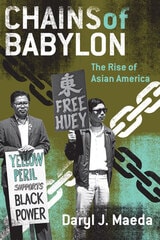
Chains of Babylon
The Rise of Asian AmericaDaryl J. Maeda
University of Minnesota Press, 2009
In Chains of Babylon, Daryl J. Maeda presents a cultural history of Asian American activism in the late 1960s and early 1970s, showing how the movement created the category of "Asian American" to join Asians of many ethnicities in racial solidarity. Drawing on the Black Power and antiwar movements, Asian American radicals argued that all Asians in the United States should resist assimilation and band together to oppose racism within the country and imperialism abroad.
As revealed in Maeda's in-depth work, the Asian American movement contended that people of all Asian ethnicities in the United States shared a common relationship to oppression and exploitation with each other and with other nonwhite peoples. In the early stages of the civil rights era, the possibility of assimilation was held out to Asian Americans under a model minority myth. Maeda insists that it was only in the disruption of that myth for both African Americans and Asian Americans in the 1960s and 1970s that the full Asian American culture and movement he describes could emerge. Maeda challenges accounts of the post-1968 era as hopelessly divisive by examining how racial and cultural identity enabled Asian Americans to see eye-to-eye with and support other groups of color in their campaigns for social justice.
Asian American opposition to the war in Vietnam, unlike that of the broader antiwar movement, was predicated on understanding it as a racial, specifically anti-Asian genocide. Throughout he argues that cultural critiques of racism and imperialism, the twin "chains of Babylon" of the title, informed the construction of a multiethnic Asian American identity committed to interracial and transnational solidarity.
Changing on the Fly
Hockey through the Voices of South Asian CanadiansCourtney Szto
Rutgers University Press, 2021
Hockey and multiculturalism are often noted as defining features of Canadian culture; yet, rarely are we forced to question the relationship and tensions between these two social constructs. This book examines the growing significance of hockey in Canada’s South Asian communities. The Hockey Night in Canada Punjabi broadcast serves as an entry point for a broader consideration of South Asian experiences in hockey culture based on field work and interviews conducted with hockey players, parents, and coaches in the Lower Mainland of British Columbia. This book seeks to inject more “color” into hockey’s historically white dominated narratives and representations by returning hockey culture to its multicultural roots. It encourages alternative and multiple narratives about hockey and cultural citizenship by asking which citizens are able to contribute to the webs of meaning that form the nation’s cultural fabric.
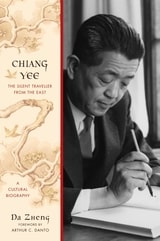
Chiang Yee
The Silent Traveller from the East--A Cultural BiographyZheng, Da
Rutgers University Press, 2010
This biography is more than a recounting of extraordinary accomplishments. It also embraces the transatlantic life experience of Yee who traveled from China to England and then on to the United States, where he taught at Columbia University, to his return to China in 1975, after a forty-two year absence. Interwoven is the history of the communist revolution in China; the battle to save England during World War II; the United States during the McCarthy red scare era; and, eventually, thawing Sino-American relations in the 1970s. Da Zheng uncovers Yee's encounters with racial exclusion and immigration laws, displacement, exile, and the pain and losses he endured hidden behind a popular public image.
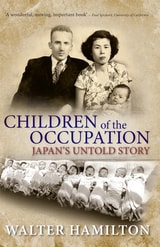
Children of the Occupation
Japan's Untold StoryHamilton, Walter
Rutgers University Press, 2013
Based on interviews with or research on 150 konketsuji—a now-taboo word for "mixed-blood" Japanese—journalist Walter Hamilton presents vivid first-person accounts of these adults as they remember their experiences of childhood loss. Using archival material from organizations dedicated to assisting the children, he combines moving personal tales with historical and political analyses of international race relations and immigration policy, particularly in North America and Australia.
Not only were attitudes and behaviors of the Japanese biased against the mixed-race children, but so were the restrictive and prejudicial immigration policies of the fathers’ native countries. Japan’s racial intolerance was fully matched in the nations it fought against. Hamilton examines how attitudes about race relations have evolved and traces the impact of racial ideology on national policy and cultural identity in Australia, Japan, and the United States.
Chinatown Family
Yutang, Lin
Rutgers University Press, 2006
Lin Yutang (1895–1976), author of more than thirty-five books, was arguably the most distinguished Chinese American writer of the twentieth century. In Chinatown Family, he brings humor and wisdom to issues of culture, race, and religion as he tells the engrossing and heart-warming story of an immigrant, working-class Chinese American family that settled in New York City during the 1930s and 1940s. Tracing their sometimes troubled and sometimes rewarding journey, Lin paints a vivid portrait of the wonder and the woe of settling into a new land. In an era when interracial marriages were frowned upon and it was forbidden for working-class Chinese men to bring their families to America, this story shows how one family struggled to become new Americans by applying their Taoist philosophy to resist peacefully the discriminatory laws and racism they encountered.
Beyond the quest for acceptance and economic success, Chinatown Family also probes deep into the heart of the immigration experience by presenting the perils of assimilation. The burgeoning tensionbetween the desire for material wealth and the traditional Chinese belief in the primary importance of family poses the question: Is it possible to attain the American dream without damaging these primary ties? For each family member, the answer to this question turns out to be different. Through the varied paths that each character takes, the novel dramatizes the ways that Chinese immigrants have negotiated between the competing interests of economic opportunity and traditional values.
Chinatown Film Culture
The Appearance of Cinema in San Francisco’s Chinese NeighborhoodKim K. Fahlstedt
Rutgers University Press, 2020
Chinatown Opera Theater in North America
Nancy Yunhwa Rao
University of Illinois Press, 2017
Irving Lowens Award, Society for American Music (SAM), 2019
Music in American Culture Award, American Musicological Society (AMS), 2018
Certificate of Merit for Best Historical Research in Recorded Country, Folk, Roots, or World Music, Association for Recorded Sound Collections (ARSC), 2018
Outstanding Achievement in Humanities and Cultural Studies: Media, Visual, and Performance Studies, Association for Asian American Studies (AAAS), 2019
The Chinatown opera house provided Chinese immigrants with an essential source of entertainment during the pre–World War II era. But its stories of loyalty, obligation, passion, and duty also attracted diverse patrons into Chinese American communities
Drawing on a wealth of new Chinese- and English-language research, Nancy Yunhwa Rao tells the story of iconic theater companies and the networks and migrations that made Chinese opera a part of North American cultures. Rao unmasks a backstage world of performers, performance, and repertoire and sets readers in the spellbound audiences beyond the footlights. But she also braids a captivating and complex history from elements outside the opera house walls: the impact of government immigration policy; how a theater influenced a Chinatown's sense of cultural self; the dissemination of Chinese opera music via recording and print materials; and the role of Chinese American business in sustaining theatrical institutions. The result is a work that strips the veneer of exoticism from Chinese opera, placing it firmly within the bounds of American music and a profoundly American experience.
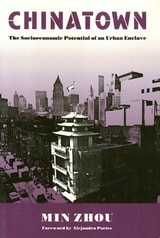
Chinatown
The Socioeconomic Potential of an Urban EnclaveMin Zhou, foreword by Alejandro Portes
Temple University Press, 1995
Min Zhou examines how an ethnic enclave works to direct its members into American society, while at the same time shielding them from it. Focusing specifically on New York's Chinatown, a community established more than a century ago, Zhou offers a thorough and modern treatment of the enclave as a socioeconomic system, distinct form, but intrinsically linked with, the larger society.
Zhou's central theme is that Chinatown does not keep immigrant Chinese from assimilating into mainstream society, but instead provides an alternative means of incorporation into society that does not conflict with cultural distinctiveness. Concentrating on the past two decades, Zhou maintains that community networks and social capital are important resources for reaching socioeconomic goals and social positions in the United States; in Chinatown, ethnic employers use family ties and ethnic resources to advance socially. Relying on her family's networks in New York's Chinatown and her fluency in both Cantonese and Mandarin, the author, who was born in the People's Republic of China, makes extensive use of personal interviews to present a rich picture of the daily work life in the community. She demonstrates that for many immigrants, low-paid menial jobs provide by the enclave are expected as a part of the time-honored path to upward social mobility of the family.
In the series Conflicts in Urban and Regional Development, edited by John R. Logan and Todd Swanstrom.
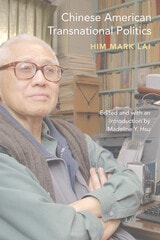
Chinese American Transnational Politics
Him Mark Lai, Edited and with an Introduction by Madeline Y. Hsu
University of Illinois Press, 2010
Born and raised in San Francisco, Lai was trained as an engineer but blazed a trail in the field of Asian American studies. Long before the field had any academic standing, he amassed an unparalleled body of source material on Chinese America and drew on his own transnational heritage and Chinese patriotism to explore the global Chinese experience.
In Chinese American Transnational Politics, Lai traces the shadowy history of Chinese leftism and the role of the Kuomintang of China in influencing affairs in America. With precision and insight, Lai penetrates the overly politicized portrayals of a history shaped by global alliances and enmities and the hard intolerance of the Cold War era. The result is a nuanced and singular account of how Chinese politics, migration to the United States, and Sino-U.S. relations were shaped by Chinese and Chinese American groups and organizations.
Lai revised and expanded his writings over more than thirty years as changing political climates allowed for greater acceptance of leftist activities and access to previously confidential documents. Drawing on Chinese- and English-language sources and echoing the strong loyalties and mobility of the activists and idealists he depicts, Lai delivers the most comprehensive treatment of Chinese transnational politics to date.
Chinese American Transnationalism
The Flow of People, ResourcesSucheng Chan
Temple University Press, 2005
Chinese Americans and the Politics of Race and Culture
Sucheng Chan
Temple University Press, 2008
Sucheng Chan introduces this valuable new anthology with a commanding discussion of the field of Chinese American studies, in which she examines its history and points the way ahead. Here she and Madeline Y. Hsu have brought together leading-edge scholarship from a new generation of thinkers, as useful for scholars as it is for undergraduate readers.
The contributors address a broad range of issues, from the activism of left-wing and Communist Chinese immigrants to the U.S. in the 1920s and early 1930s and humanitarian relief during the Sino-Japanese War to the construction of new Chinese regional identities in New York.
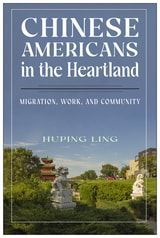
Chinese Americans in the Heartland
Migration, Work, and CommunityHuping Ling
Rutgers University Press, 2022
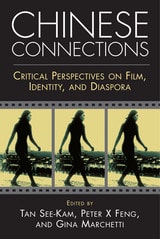
Chinese Connections
Critical Perspectives on Film, Identity, and DiasporaGina Marchetti
Temple University Press, 2009
Chinese Connections is a valuable new anthology that provides a prismatic look at the cross-fertilization between Chinese film and global popular culture. Leading film scholars consider the influence of world cinema on China-related and Chinese-related cinema over the last five decades. Highlighting the neglected connections between Chinese films and American and European cinema, the editors and contributors examine popular works such as Ang Lee’s The Hulk and Olivier Assayas’ Irma Vep to show the nexus of international film production and how national, political, social and sexual identities are represented in the Chinese diaspora.
With talent flowing back and forth between East and West, Chinese Connections explores how issues of immigration, class, race and economic displacement are viewed on a global level, ultimately providing a greater understanding of the impact of Chinese filmmaking at home and abroad.
Contributors include: Grace An, Aaron Anderson, Chris Berry, Evans Chan, Li-Mei Chang, Frances Gateward, Andrew Grossman, Peter Hitchcock, Chuck Kleinhans, Jenny Kwok Wah Lau, Helen Leung, Aaron Magnan-Park, Gayle Wald, Esther C.M. Yau, Emilie Yueh-yu Yeh, Xuelin Zhou and the editors.
Chinese St Louis
From Enclave To Cultural CommunityHuping Ling
Temple University Press, 2004
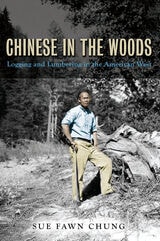
Chinese in the Woods
Logging and Lumbering in the American WestSue Fawn Chung
University of Illinois Press, 2015
Chineseness across Borders
Renegotiating Chinese Identities in China and the United StatesAndrea Louie
Duke University Press, 2004
Louie focuses on “In Search of Roots,” a program that takes young Chinese American adults of Cantonese descent to visit their ancestral villages in China’s Guangdong province. Through ethnographic interviews and observation, Louie examines the experiences of Chinese Americans both during village visits in China and following their participation in the program, which she herself took part in as an intern and researcher. She presents a vivid portrait of two populations who, though connected through family ties generations back, are meeting for the first time in the context of a rapidly changing contemporary China. Louie situates the participants’ and hosts’ shifting understandings of China and Chineseness within the context of transnational flows of people, media, goods, and money; China’s political and economic policies; and the racial and cultural politics of the United States.
Chop Suey and Sushi from Sea to Shining Sea
Chinese and Japanese Restaurants in the United StatesBruce Makoto Arnold
University of Arkansas Press, 2018
The essays in Chop Suey and Sushi from Sea to Shining Sea fill gaps in the existing food studies by revealing and contextualizing the hidden, local histories of Chinese and Japanese restaurants in the United States.
The writer of these essays show how the taste and presentation of Chinese and Japanese dishes have evolved in sweat and hardship over generations of immigrants who became restaurant owners, chefs, and laborers in the small towns and large cities of America. These vivid, detailed, and sometimes emotional portrayals reveal the survival strategies deployed in Asian restaurant kitchens over the past 150 years and the impact these restaurants have had on the culture, politics, and foodways of the United States.
Some of these authors are family members of restaurant owners or chefs, writing with a passion and richness that can only come from personal investment, while others are academic writers who have painstakingly mined decades of archival data to reconstruct the past. Still others offer a fresh look at the amazing continuity and domination of the “evil Chinaman” stereotype in the “foreign” world of American Chinatown restaurants. The essays include insights from a variety of disciplines, including history, sociology, anthropology, ethnography, economics, phenomenology, journalism, food studies, and film and literary criticism.
Chop Suey and Sushi from Sea to Shining Sea not only complements the existing scholarship and exposes the work that still needs to be done in this field, but also underscores the unique and innovative approaches that can be taken in the field of American food studies.
Claiming America
edited by K. Scott Wong and Sucheng Chan
Temple University Press, 1998
The second section shows how children of the immigrants developed a sense of themselves as having a distinct identity as Chinese Americans. For this generation, many of the opportunities available to other immigrants' children were simply inaccessible. In some districts explicit policies kept Chinese children in segregated schools; in many workplaces discriminatory practices kept them from being hired or from advancing beyond the lowest positions. In the 1930s, in fact, some Chinese Americans felt their only option was to emigrate to China, where they could find jobs better matched to their abilities. Many young Chinese women who were eager to take advantage of the educational and work options opening to women in the wider U.S. society first had to overcome their family's opposition and then racism. As the personal testimonies and historical biographies eloquently attest, these young people deeply felt the contradictions between Chinese and American ways; but they also saw themselves as having to balance the demands of the two cultures rather than as having to choose between them.
Claiming Place
On the Agency of Hmong WomenChia Youyee Vang
University of Minnesota Press, 2016
Countering the idea of Hmong women as victims, the contributors to this pathbreaking volume demonstrate how the prevailing scholarly emphasis on Hmong culture and men as the primary culprits of women’s subjugation perpetuates the perception of a Hmong premodern status and renders unintelligible women’s nuanced responses to patriarchal strategies of domination both in the United States and in Southeast Asia.
Claiming Place expands knowledge about the Hmong lived reality while contributing to broader conversations on sexuality, diaspora, and agency. While these essays center on Hmong experiences, activism, and popular representations, they also underscore the complex gender dynamics between women and men and address the wider concerns of gendered status of the Hmong in historical and contemporary contexts, including deeply embedded notions around issues of masculinity.
Organized to highlight themes of history, memory, war, migration, sexuality, selfhood, and belonging, this book moves beyond a critique of Hmong patriarchy to argue that Hmong women have been and continue to be active agents not only in challenging oppressive societal practices within hierarchies of power but also in creating alternative forms of belonging.
Contributors: Geraldine Craig, Kansas State U; Leena N. Her, Santa Rosa Junior College; Julie Keown-Bomar, U of Wisconsin–Extension; Mai Na M. Lee, U of Minnesota; Prasit Leepreecha, Chiang Mai U; Aline Lo, Allegheny College; Kong Pha; Louisa Schein, Rutgers U; Cathy J. Schlund-Vials, U of Connecticut; Bruce Thao; Ka Vang, U of Wisconsin–Eau Claire.
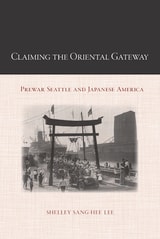
Claiming the Oriental Gateway
Prewar Seattle and Japanese AmericaAuthored by Shelley S. Lee
Temple University Press, 2012
In Claiming the Oriental Gateway, Shelley Sang-Hee Lee explores the various intersections of urbanization, ethnic identity, and internationalism in the experience of Japanese Americans in early twentieth-century Seattle. She examines the development and self-image of the city by documenting how U.S. expansion, Asian trans-Pacific migration, and internationalism were manifested locally—and how these forces affected residents’ relationships with one another and their surroundings.
Lee details the significant role Japanese Americans—both immigrants and U.S. born citizens—played in the social and civic life of the city as a means of becoming American. Seattle embraced the idea of cosmopolitanism and boosted its role as a cultural and commercial "Gateway to the Orient" at the same time as it limited the ways in which Asian Americans could participate in the public schools, local art production, civic celebrations, and sports. She also looks at how Japan encouraged the notion of the "gateway" in its participation in the Alaska-Yukon-Pacific Exposition and International Potlach.
Claiming the Oriental Gateway thus offers an illuminating study of the "Pacific Era" and trans-Pacific relations in the first four decades of the twentieth century.
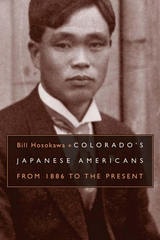
Colorado's Japanese Americans
From 1886 to the PresentBill Hosokawa
University Press of Colorado, 2005
Hosokawa traces personal histories, such as Bob Sakata's journey from internment in a relocation camp to his founding of a prosperous truck farm; the conviction of three sisters for assisting the escape of German POWs; and the years of initiative and determination behind Toshihiro Kizaki's ownership of Sushi Den, a beloved Denver eatery. In addition to personal stories, the author also relates the larger history of the interweave of cultures in Colorado, from the founding of the Navy's Japanese language school at the University of Colorado to the merging of predominantly white and Japanese American congregations at Arvada's Simpson United Methodist Church.
With the author's long view and sharp eye, Colorado's Japanese Americans creates a storied document of lasting legacy about the Issei and Nisei in Colorado.
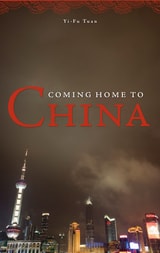
Coming Home to China
Yi-Fu Tuan
University of Minnesota Press, 2007
In the summer of 2005, distinguished geographer Yi-Fu Tuan ventured to China to speak at an international architectural conference, returning for the first time to the place he had left as a child sixty-four years before. He traveled from Beijing to Shanghai, addressing college audiences, floating down the Yangtze River on a riverboat, and visiting his former home in Chongqing.
In this enchanting volume, Tuan’s childhood memories and musings on the places encountered during this homecoming are interspersed with new lectures, engaging overarching principles of human geography as well as the changing Chinese landscape. Throughout, Tuan’s interactions with his hosts, with his colleague’s children, and even with a garrulous tour guide, offer insights into one who has spent his life studying place, culture, and self.
At the beginning of his trip, Tuan wondered if he would be a stranger among people who looked like him. By its end, he reevaluates his own self-definition as a hyphenated American and sheds new light on human identity’s complex roots in history, geography, and language.
Yi-Fu Tuan is author of Cosmos and Hearth, Dear Colleague, and Space and Place, all from Minnesota. He retired from the University of Wisconsin-Madison in 1998.
Common Ground
The Japanese American National Museum and the Culture of CollaborationsAkemi Kikumura-Yano
University Press of Colorado, 2005
Current scholarship in museum studies is generally limited to interpretations by scholars and curators. Common Ground brings descriptive data to the intellectual canon and illustrates how museum institutions must be transformed and recreated to suit the needs of the twenty-first century.
Compositional Subjects
Enfiguring Asian/American WomenLaura Hyun Yi Kang
Duke University Press, 2002
The book opens by tracking the jagged emergence of “Asian American women” as a distinct social identity over the past three decades. Kang then directs critical attention to how the attempts to compose them as discrete subjects of consciousness, visibility, and action demonstrate a broader, ongoing tension between socially particularized subjects and disciplinary knowledges. In addition to the shifting meanings and alignments of “Asian,” “American,” and “women,” the book examines the discourses, political and economic conditions, and institutional formations that have produced Asian/American women as generic authors, as visibly desirable and desiring bodies, as excludable aliens and admissible citizens of the United States, and as the proper labor for transnational capitalism. In analyzing how these enfigurations are constructed and apprehended through a range of modes including autobiography, cinematography, historiography, photography, and ethnography, Kang directs comparative attention to the very terms of their emergence as Asian/American women in specific disciplines.
Finally, Kang concludes with a detailed examination of selected literary and visual works by Korean women artists located in the United States and Canada, works that creatively and critically contend with the problematics of identification and representation that are explored throughout the book. By underscoring the forceful and contentious struggles that animate all of these compositional gestures, Kang proffers Asian/American women as a vexing and productive figure for cultural, political and epistemological critique.
Consoling Ghosts
Stories of Medicine and Mourning from Southeast Asians in ExileJean M. Langford
University of Minnesota Press, 2013
In conversation with emigrants from Laos and Cambodia, Jean M. Langford repeatedly met with spirits: the wandering souls of the seriously ill, dangerous ghosts of those who died by violence, restless ancestors displaced from their homes. For these emigrants, the dead not only appear in memories, safely ensconced in the past, but also erupt with a physical force into the daily life and dreams of the present.
Inspired by these conversations, Consoling Ghosts is a sustained contemplation of relationships with the dying and the dead. At their heart, as Langford’s work reveals, emigrants’ stories are parables not of cultural difference but rather of life and death. Langford inquires how and why spirits become implicated in remembering and responding to violence, whether the bloody violence of war or the more structural violence of social marginalization and poverty. What is at stake, she asks, when spirits break out of their usual confinement as symbolic figures for history, heritage, or trauma to haunt the corridors of hospitals and funeral homes? Emigrants’ theories and stories of ghosts, Langford suggests, inherently question the metaphorical status of spirits, in the process challenging both contemporary bioethics of dying and dominant styles of mourning. Consoling Ghosts explores the possibilities opened up by a more literal existence of ghosts, from the confrontation of shades of past violence through bodily ritual to rites of mourning that unfold in acts of material care for the dead instead of memorialization.
Ultimately the book invites us to consider alternate ways of facing death, conducting relationships with the dead and dying, and addressing the effects of violence that continue to reverberate in bodies and social worlds.
Constellating Home
Trans and Queer Asian American RhetoricsV. Jo Hsu
The Ohio State University Press, 2022
Winner of the 2024 Winifred Bryan Horner Outstanding Book Award
Winner of the 2023 NCA Diamond Anniversary Book Award
Winner of the Innovations in Community Writing Book Award from the Conference on Community Writing
Constellating Home: Trans and Queer Asian American Rhetorics explores how race, migration, gender, and disability entwine in conceptions of deserving citizens. V. Jo Hsu explores three archives of trans and queer Asian American (QTAPI) rhetorics, considering a range of texts including oral histories, photography, personal essays, and performance showcases. To demonstrate how QTAPI use personal narrative to critique and revise the conditions of their exclusion, Hsu forwards a critical approach to storytelling, homing, which deliberately engages sites of alienation and belonging. Through a practice of diasporic listening, Hsu tracks confluences among seemingly divergent journeys and locates trans and queer Asian American experiences within broader US and global politics.
The stories at the heart of Constellating Home center the voices of trans and nonbinary people, disabled people, and others often overlooked in conceptions of US citizenry. Hsu’s analyses demonstrate the inextricability of Asian American activism from queer politics, disability activism, and racial justice, and they consider how stories network individual experiences with resonant histories and struggles. Finding unlikely intimacies among individual and communal histories, Constellating Home provides tools for fostering mutual care, revealing harmful social patterns, and orienting shared values and politics.
Contemporary Asian American Communities
Intersections And Divergencesedited by Linda Trinh Võ and Rick Bonus
Temple University Press, 2002
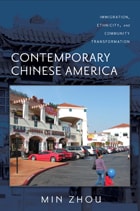
Contemporary Chinese America
Immigration, Ethnicity, and Community TransformationMin Zhou, foreword by Alejandro Portes
Temple University Press, 2009
Contemporary Chinese America is the most comprehensive sociological investigation of the experiences of Chinese immigrants to the United States—and of their offspring—in the late twentieth and early twenty-first centuries. The author, Min Zhou, is a well-known sociologist of the Chinese American experience. In this volume, she collects her original research on a range of subjects, including the causes and consequences of emigration from China, demographic trends of Chinese Americans, patterns of residential mobility in the U.S., Chinese American "ethnoburbs," immigrant entrepreneurship, ethnic enclave economies, gender and work, Chinese language media, Chinese schools, and intergenerational relations. The concluding chapter, "Rethinking Assimilation," ponders the future for Chinese Americans. Also included are an extensive bibliography and a list of recommended documentary films.
While the book is particularly well-suited for college courses in Chinese American studies, ethnic studies, Asian studies, and immigration studies, it will interest anyone who wants to more fully understand the lived experience of contemporary Chinese Americans.
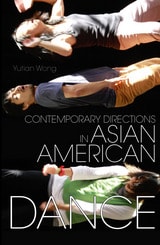
Contemporary Directions in Asian American Dance
Edited by Yutian Wong
University of Wisconsin Press, 2018
The contributors to this volume address such topics as the role of the 1960s Asian American Movement in creating Japanese American taiko groups, and the experience of internment during World War II influencing butoh dance in Canada. Essays about artists such as Jay Hirabayashi, Alvin Tolentino, Shen Wei, Kun-Yang Lin, Yasuko Yokoshi, Eiko & Koma, Sam Kim, Roko Kawai, and Denise Uyehara look closely at the politics of how Asian aesthetics are set into motion and marketed. The volume includes first-person narratives, interviews, ethnography, cultural studies, performance studies, and comparative ethnic studies.
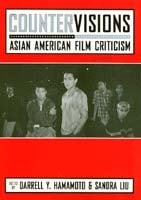
Countervisions
Darrell Hamamoto
Temple University Press, 2000
One of the anthology's key contributions is to trace the evolution of Asian American independent film practice over thirty years. Essays on the Japanese American internment and historical memory, essays on films by women and queer artists, and the reflections of individual film makers discuss independent productions as subverting or opposing the conventions of commercial cinema. But Countervisions also resists simplistic readings of "mainstream" film representations of Asian Americans and enumerations of negative images. Writing about Hollywood stars Anna May Wong and Nancy Kwan, director Wayne Wang, and erotic films, several contributors probe into the complex and ambivalent responses of Asian American audiences to stereotypical roles and commercial success. Taken together, the spirited, illuminating essays in this collection offer an unprecedented examination of a flourishing cultural production.
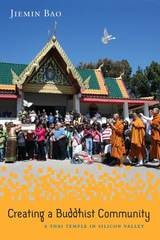
Creating a Buddhist Community
A Thai Temple in Silicon ValleyJiemin Bao
Temple University Press, 2015
In Creating a Buddhist Community, Jiemin Bao shows how the Wat Thai participants practice Buddhism and rework gender relationships in the course of organizing temple space, teaching meditation, schooling children in Thai language and culture, merit making, fundraising, and celebrating festivals.
Bao’s detailed account of the process of creating an inclusive temple community with Thai immigrants as the majority helps to deconstruct the exoticized view of Buddhism in American culture. Creating a Buddhist Community also explores Wat Thai’s identification with both the United States and Thailand and how this transnational perspective reimagines and reterritorializes what is called American Buddhism.
Criminalization/Assimilation
Chinese/Americans and Chinatowns in Classical Hollywood FilmPhilippa Gates
Rutgers University Press, 2019
Cry And Dedication
Carlos Bulosan
Temple University Press, 1995
Cultural Compass
Martin Manalansan
Temple University Press, 2000
Drawing upon recent theoretical discussions and methodological innovations, the contributors explore the construction and displacement of self, community, and home integral to Asian American cultural journeys in the late twentieth century. Some discuss the unique situation of doing ethnographic work "at home" -- that is researching one's own ethnic group or another group with Asian America. Others draw on rich and diverse field experiences. Whether they are doing homework or fieldwork, contributors reflect on the ways that particular matters of identity -- gender, class, sexuality, ethnicity, age -- play out between researchers and informants. Individual essays and the book as a whole challenge the notion of a monolithic, spatially bounded Asian American community, pointing the way to multiple sites of political struggle, cultural critique, and social change.