Results by title
51 books match the query 'Athens' and 3 start with c

Citizens on Stage
Comedy and Political Culture in the Athenian DemocracyJames F. McGlew
University of Michigan Press, 2002
Old Comedy gives Citizens on Stage its chronological backbone; the beginning and end of Aristophanes' career roughly define the period on which the book concentrates. Reading and interpreting comedy provides a model for reading Athenian politics itself. McGlew argues that the plays of Old Comedy, with their fantastic stories of common individuals triumphing over the various social and political dilemmas of democratic Athens, interpreted the relationship of private life and political activity for an Athenian audience, dramatically reaffirming the ties between citizens' personal desires and the will of the collective body. In particular, McGlew argues that comedy transforms private fantasies of personal power and pleasures--what seem most to keep the individual audience members apart--into a collective possession and touchstone of democratic citizen identity.
Citizens on Stage focuses primarily on the democratic citizen and on contemporary representations of him as a decision maker. McGlew shows that the democratic individual, sometimes idealized, sometimes despised, was a dominant concern of the literature and politics of late fifth- and early fourth-century Athens. This book will appeal to students of ancient theater and drama, Athenian politics and democracy, and the relationships between theater and politics. Social historians will also find it an invaluable resource.
James F. McGlew is Assistant Professor of Foreign Languages and Literatures and Classical Studies, Iowa State University.
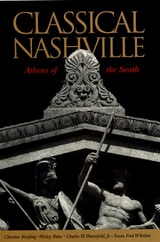
Classical Nashville
Athens of the SouthChristine M. Kreyling
Vanderbilt University Press, 1996
Nashville has been many things: frontier town, Civil War battleground, New South mecca, and Music City, U.S.A. It is headquarters for several religious denominations, and also the home of some of the largest insurance, healthcare, and publishing concerns in the country. Located culturally as well as geographically between North and South, East and West, Nashville is centered in a web of often-competing contradictions.
One binding image of civic identity, however, has been consistent through all of Nashville's history: the classical Greek and Roman ideals of education, art, and community participation that early on led to the city's sobriquet, "Athens of the West," and eventually, with the settling of the territory beyond the Mississippi River, the "Athens of the South."
Illustrated with nearly a hundred archival and contemporary photographs, Classical Nashville shows how Nashville earned that appellation through its adoption of classical metaphors in several areas: its educational and literary history, from the first academies through the establishment of the Fugitive movement at Vanderbilt; the classicism of the city's public architecture, including its Capitol and legislative buildings; the evolution of neoclassicism in homes and private buildings; and the history and current state of the Parthenon, the ultimate symbol of classical Nashville, replete with the awe-inspiring 42-foot statue of Athena by sculptor Alan LeQuire.
Perhaps Nashville author John Egerton best captures the essence of this modern city with its solid roots in the past. He places Nashville "somewhere between the 'Athens of the West' and 'Music City, U.S.A.,' between the grime of a railroad town and the glitz of Opryland, between Robert Penn Warren and Robert Altman." Nashville's classical identifications have always been forward-looking, rather than antiquarian: ambitious, democratic, entrepreneurial, and culturally substantive. Classical Nashville celebrates the continuation of classical ideals in present-day Nashville, ideals that serve not as monuments to a lost past, but as sources of energy, creativity, and imagination for the future of a city.
Courtesans and Fishcakes
The Consuming Passions of Classical AthensJames N. Davidson
University of Chicago Press, 2011
As any reader of the Symposium knows, the ancient Greek philosopher Socrates conversed over lavish banquets, kept watch on who was eating too much fish, and imbibed liberally without ever getting drunk. In other words, James Davidson writes, he reflected the culture of ancient Greece in which he lived, a culture of passions and pleasures, of food, drink, and sex before—and in concert with—politics and principles. Athenians, the richest and most powerful of the Greeks, were as skilled at consuming as their playwrights were at devising tragedies. Weaving together Greek texts, critical theory, and witty anecdotes, this compelling and accessible study teaches the reader a great deal, not only about the banquets and temptations of ancient Athens, but also about how to read Greek comedy and history.