Results by title
79 books match the query 'Avant-garde (Aesthetics)' and 7 start with c
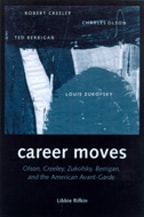
Career Moves
Olson, Creeley, Zukofsky, Berrigan, AndLibbie Rifkin
University of Wisconsin Press, 2000
How much did "making it new" have to do with "making it"? For the four "outsider poets" considered in this book—Charles Olson, Robert Creeley, Louis Zukofsky, and Ted Berrigan—the connection was everything. At once a social history of literary ambition in America in the fifties and sixties and a uniquely collective form of literary biography, Career Moves offers an intimate account of the postwar poetry underground.
Making the controversial claim that anti-Establishment poets were at least as "careerist" as their mainstream peers, Libbie Rifkin shows how the nature of these poets’ ambition actually defined postwar avant-garde identity. In doing so, she clarifies the complicated link between the crafting of a literary career and the defining of a literary canon.
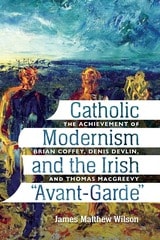
Catholic Modernism and the Irish "Avant-Garde
" The Achievement of Brian Coffey, Denis Devlin, and Thomas MacGreeveyJames Matthew Wilson
Catholic University of America Press, 2023
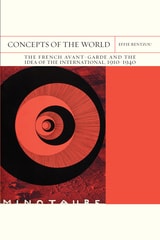
Concepts of the World
The French Avant-Garde and the Idea of the International, 1910–1940Effie Rentzou
Northwestern University Press, 2022
The writers and artists of the French avant-garde aspired to reach a global audience that would be wholly transformed by their work. In this study, Effie Rentzou delves deep into their depictions of the interwar world as an international and modern landscape, one marked by a varied cosmopolitanism. The avant-garde’s conceptualization of the world paralleled, rejected, or expanded prevailing notions of the global sphere.
The historical avant garde—which encompassed movements like futurism, Dada, and surrealism—was self-consciously international, operating across global networks and developed with the whole world as its horizon and its public. In the heady period between the end of the Belle Époque and the tumult of World War II, both individual artists (including Guillaume Apollinaire, Blaise Cendrars, Francis Picabia, Louis Aragon, Leonora Carrington, and Nicolas Calas) and collective endeavors (such as surrealist magazines and exhibitions) grappled with contemporary anxieties about economic growth, imperialism, and colonialism, as well as various universalist, cosmopolitan, and internationalist visions. By probing these works, Concepts of the World offers an alternative narrative of globalization, one that integrates the avant-garde’s enthusiasm for, as well as resistance to, the process. Rentzou identifies within the avant-garde a powerful political language that expressed the ambivalence of living and creating in an increasingly globalized world—a language that profoundly shaped the way the world has been conceptualized and is experienced today.
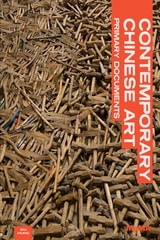
Contemporary Chinese Art
Primary DocumentsWu Hung, editor
Duke University Press, 2010
Publication of the Museum of Modern Art
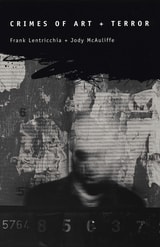
Crimes of Art and Terror
Frank Lentricchia and Jody McAuliffe
University of Chicago Press, 2003
Crimes of Art and Terror reveals how the desire beneath many romantic literary visions is that of a terrifying awakening that would undo the West's economic and cultural order. This is also the desire, of course, of what is called terrorism. As the authority of writers and artists recedes, it is criminals and terrorists, Lentricchia and McAuliffe suggest, who inherit this romantic, destructive tradition. Moving freely between the realms of high and popular culture, and fictional and actual criminals, the authors describe a web of impulses that catches an unnerving spirit.
Lentricchia and McAuliffe's unorthodox approach pairs Dostoevsky's Crime and Punishment with Martin Scorsese's King of Comedy and connects the real-life Unabomber to the surrealist Joseph Cornell and to the hero of Bret Easton Ellis's bestselling novel American Psycho. They evoke a desperate culture of art through thematic dialogues among authors and filmmakers as varied as Don DeLillo, Joseph Conrad, Francis Ford Coppola, Jean Genet, Frederick Douglass, Hermann Melville, and J. M. Synge, among others. And they conclude provocatively with an imagined conversation between Heinrich von Kleist and Mohamed Atta. The result is a brilliant and unflinching reckoning with the perilous proximity of the impulse to create transgressive art and the impulse to commit violence.
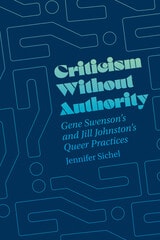
Criticism Without Authority
Gene Swenson's and Jill Johnston’s Queer PracticesJennifer Sichel
University of Chicago Press, 2025
In the early 1960s, Gene Swenson and Jill Johnston began to imagine art criticism as something unruly and expansive, rejecting modernist appeals to purity and coherence that had overtaken the field. These critics were deeply enmeshed in New York’s avant-garde art scene, and both were explicitly and unapologetically queer. First working independently of one another, then later in dialogue, Swenson and Johnston demanded criticism become life-sustaining, subverting protocols and distorting its form beyond recognition. They utilized criticism as a means of navigating queer existence and reclaimed terms like lesbian, homosexual, mad, and psychotic as their own.
Jennifer Sichel follows the intertwined paths of Swenson and Johnston, providing a history of queer practices that were central to the development of avant-garde art but have been largely overlooked. Criticism Without Authority makes their work visible not just as criticism, but as its own form of art. As Sichel shows, Swenson's and Johnston’s practices, bucking categories and disciplinary formations, resist historical streamlining and stand as a key for unlocking the queerness of postwar art history.
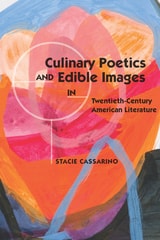
Culinary Poetics and Edible Images in Twentieth-Century American Literature
Stacie Cassarino
The Ohio State University Press, 2018
Cassarino takes the reader through the changing dynamics of food production and consumption, from wartime sensibilities of patriotic eating to the postwar excess of culinary cosmopolitanism and finally to contemporary supermarket pastorals. She pairs chefs and poets—Julia Child and Gertrude Stein, Poppy Cannon and Frank O’Hara, Vertamae Smart-Grosvenor and Harryette Mullen—to argue that each converts eating into an aesthetic opportunity that has the power to impact how people consume. In this way, Cassarino reveals the modern cookbook not just as a literary counterpart to contemporary poetry but also as vital to the literature and art occurring around it. From Futurist cookbooks to fast food lyrics, from Gullah recipes to Eat Art, she reminds us that global foodscapes are connected to aesthetic movements in literature and art.