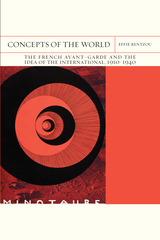
Concepts of the World: The French Avant-Garde and the Idea of the International, 1910–1940
Northwestern University Press, 2022
Cloth: 978-0-8101-4507-8 | Paper: 978-0-8101-4506-1 | eISBN: 978-0-8101-4508-5
Library of Congress Classification PQ307.C67R46 2022
Dewey Decimal Classification 840.93352
Cloth: 978-0-8101-4507-8 | Paper: 978-0-8101-4506-1 | eISBN: 978-0-8101-4508-5
Library of Congress Classification PQ307.C67R46 2022
Dewey Decimal Classification 840.93352
ABOUT THIS BOOK | AUTHOR BIOGRAPHY | REVIEWS | TOC | REQUEST ACCESSIBLE FILE
ABOUT THIS BOOK
How did the avant-garde imagine its interconnected world? And how does this legacy affect our understanding of the global today?
The writers and artists of the French avant-garde aspired to reach a global audience that would be wholly transformed by their work. In this study, Effie Rentzou delves deep into their depictions of the interwar world as an international and modern landscape, one marked by a varied cosmopolitanism. The avant-garde’s conceptualization of the world paralleled, rejected, or expanded prevailing notions of the global sphere.
The historical avant garde—which encompassed movements like futurism, Dada, and surrealism—was self-consciously international, operating across global networks and developed with the whole world as its horizon and its public. In the heady period between the end of the Belle Époque and the tumult of World War II, both individual artists (including Guillaume Apollinaire, Blaise Cendrars, Francis Picabia, Louis Aragon, Leonora Carrington, and Nicolas Calas) and collective endeavors (such as surrealist magazines and exhibitions) grappled with contemporary anxieties about economic growth, imperialism, and colonialism, as well as various universalist, cosmopolitan, and internationalist visions. By probing these works, Concepts of the World offers an alternative narrative of globalization, one that integrates the avant-garde’s enthusiasm for, as well as resistance to, the process. Rentzou identifies within the avant-garde a powerful political language that expressed the ambivalence of living and creating in an increasingly globalized world—a language that profoundly shaped the way the world has been conceptualized and is experienced today.
See other books on: Avant-garde (Aesthetics) | Concepts | Cosmopolitanism in literature | French literature | Historical Events
See other titles from Northwestern University Press