Results by title
134 books match the query 'Business' and 10 start with c
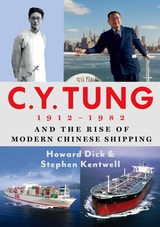
C. Y. Tung (1912–1982) and the Rise of Modern Chinese Shipping
Howard Dick and Stephen Kentwell
Hong Kong University Press, 2026
A business biography of C. Y. Tung, founder of the Orient Overseas Container Line and philanthropist.
Shanghai-born and later Hong Kong–resident shipowner Tung Chao-Yung (1912–1982) is remembered worldwide as a champion for Chinese shipping, founding the companies Chinese Maritime Transport and Island Navigation, and pioneering container shipping for Asia in Orient Overseas Container Line/OOCL. Despite coming from a humble background, by the time of his death he controlled a huge fleet of passenger liners, bulk carriers, tankers, and container ships, while also being diversified into port terminals, dockyards, banks, and prime real estate. This business biography sets out his pathway from a junior executive in the early 1930s to one of the world’s leading private shipowners. The authors argue that Tung achieved his desire to develop Chinese ocean shipping through his ability to learn, innovate, network, and devise strategies through decades of rapid technical and organizational change. He also earned respect for his generous philanthropy. After his death, sons Tung Chee-Hwa and Tung Chee-Chen were able to navigate a financial crisis, restructure the group in the face of intensifying competition in the 1980s, and grow through the challenges and opportunities of globalization and advancement in supply chain management and technology within the industry in the 1990s through 2010s. OOCL became one of the most competitive liner companies in the industry until divestment in 2017. Eight decades since their establishment, privately owned Island Navigation and, now independently, Chinese Maritime Transport continue to trade globally in dry-bulk and tanker markets. C. Y. Tung (1912–1982) and the Rise of Modern Chinese Shipping concludes with an overview of the emergence of the state-owned PRC fleet and brief histories of other multi-generational family companies.

Capitalism’s Tomorrows
Imagining the Future of BusinessGavin Benke
University of Chicago Press, 0
The institutional evolution of “corporate futurism” and its influence on our view of the role of private enterprise in society.
While the bright capitalist future that the power elite of postwar America dreamed of hasn’t come to pass, its influence and repercussions continue to resonate. Gavin Benke shows that the cultural, intellectual, and political rise of neoliberalism was not inevitable. Instead, beginning in the early 1960s, a group that he dubs “corporate futurists” imagined a differently shaped and community-minded version of capitalism. Most interestingly, Benke goes beyond the once-big names in the field (such as Alvin Toffler and Daniel Bell) to show how deep-seated and granular the engagement with futurism was.
Using an incredible array of futurists’ reports, conference proceedings, and internal deliberations at places like the infamous RAND Corporation, Capitalism’s Tomorrows uncovers a moment of genuine introspection about capitalism’s development and shows how it is subject to our imaginative capacity and ability to shape how these systems work.
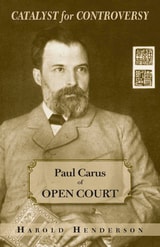
Catalyst for Controversy
Paul Carus of Open CourtHarold Henderson
Southern Illinois University Press, 2009
"I am not a common atheist; I am an atheist who loves God."—Paul Carus, "The God of Science," 1904
In the summer of 1880, while teaching at the military academy of the Royal Corps of Cadets of Saxony in Dresden, Paul Carus published a brief pamphlet denying the literal truth of scripture and describing the Bible as a great literary work comparable to the Odyssey.
This unremarkable document was Carus’s first step in a wide-ranging intellectual voyage in which he traversed philosophy, science, religion, mathematics, history, music, literature, and social and political issues. The Royal Corps, Carus later reported, found his published views "not in harmony with the Christian spirit, in accordance with which the training and education of the Corps of Cadets should be conducted." And so the corps offered the young teacher the choice of asking "most humbly for forgiveness for daring to have an opinion of my own and to express it, perhaps even promise to publish nothing more on religious matters, or to give up my post. I chose the latter. . . . There was thus no other choice for me but to emigrate and, trusting in my own powers, to establish for myself a new home." His resignation was effective on Easter Sunday, 1881.
Carus toured the Rhine, lived briefly in Belgium, and taught in a military college in England to learn English well enough to "thrive in the United States." By late 1884 or early 1885 he was on his way to the New World. Thriving in the United States proved more difficult than it had in England, but before 1885 ended he had published his first philosophical work in English, Monism and Meliorism. The book was not widely read, but it did reach Edward C. Hegeler, a La Salle, Illinois, zinc processor who became his father-in-law as well as his ideological and financial backer.
Established in La Salle, Carus began the work that would place him among the prominent American philosophers of his day and make the Open Court Publishing Company a leading publisher of philosophical, scientific, and religious books. He edited The Open Court and The Monist, offering the finest view of Oriental thought and religion then available in the West, and sought unsuccessfully to bring about a second World Parliament of Religions. He befriended physicist-philosopher Ernst Mach. For eleven years he employed D. T. Suzuki, who later became a great Zen Buddhist teacher. He published more articles by Charles S. Peirce, now viewed as one of the great world philosophers, in The Monist than appeared in any other publication.
Biographer Harold Henderson concludes his study of this remarkable man: "Whenever anyone is so fired with an idea that he or she can’t wait to write it down, there the spirit of Paul Carus remains, as he would have wished, active in the world."
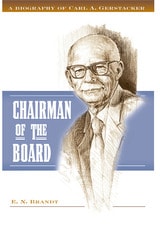
Chairman of the Board
A Biography of Carl A. GerstackerE. N. Brandt
Michigan State University Press, 2003
Carl A. Gerstacker was born in 1916 in Cleveland, Ohio. At an early age his father, Rollin, instilled in him an interest in finance and the stock market. In 1930, when Carl turned fourteen, Rollin advised his son to withdraw his paper-route and odd-job money from a local bank and invest it all in The Dow Chemical Company. It was the beginning of a relationship that would last a lifetime. After high school, Carl landed an hourly position with Dow Chemical as a lab assistant and, at the same time, pursued an engineering degree at the University of Michigan as part of the company’s student training course. After graduating in 1938, Gerstacker continued to work for Dow Chemical until the outbreak of World War II when he joined the U.S. Army. Returning to civilian life in 1946, he was rehired by Dow and quickly moved up the corporate ladder, becoming Treasurer in 1949, Vice-President in 1955, and Chairman of the Board in 1960, a position he retained until 1976. He retired five years later in 1981.
Carl Gerstacker was a business leader who believed that every company had a special personality and that the Dow personality was largely shaped by its employees. “For Dow Chemical, people are the most important asset, not the patents, the plants, nor the products.” Gerstacker’s personal financial acumen was rivaled only by his own contributions to the sound corporate growth of Dow Chemical, a business he loved and to which he devoted his life. Gerstacker died in 1995, leaving a legacy that lives on in the form of numerous philanthropic endeavors he began during his lifetime and on whose boards he once served. Carl A. Gerstacker was one of the towering figures of twentieth-century American industry.
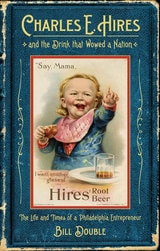
Charles E. Hires and the Drink that Wowed a Nation
The Life and Times of a Philadelphia EntrepreneurBill Double
Temple University Press, 2018
Introduced at the 1876 Centennial Exposition and powered by an historic advertising campaign, Hires Root Beer—launched 10 years before Coca-Cola—blazed the trail for development of the American soft drink industry. Its inventor, Charles Elmer Hires, has been described as “a tycoon with the soul of a chemist.” In addition to creating root beer, Hires, a devoted family man and a pillar of the Quaker community, became a leading importer of botanical commodities, an authority on the vanilla bean. Starting from scratch, he also built one of the world’s largest condensed milk companies.
Charles E. Hires and the Drink that Wowed a Nation chronicles the humble origin and meteoric business success of this extraordinary entrepreneur. Author Bill Double uses published interviews, correspondence, newspaper reports, magazine articles, financial data, and a small family archive to tell this story of native ingenuity. Here, the rough-hewn capitalism of the gilded age, the evolution of the neighborhood drugstore, the rise of advertising in creating mass markets, and the emerging temperance movement all come together in a biography that, well, fizzes with entrepreneurial spirit.
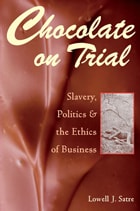
Chocolate on Trial
Slavery, Politics, and the Ethics of BusinessLowell J. Satre
Ohio University Press, 2005
Chocolate on Trial: Cadbury, Slavery and the Economics of Virtue in Imperial Britain gives a lively and highly readable account of the events surrounding the libel trial in which Cadbury Bros. Ltd. sued the London Standard, following the newspaper's accusation that the firm was hypocritical in its use of slave-grown cocoa. As compelling now as at the turn of the previous century, the issues probed by Lowell J. Satre give invaluable historical background to contemporary issues of business ethics, corporate social responsibility, and globalization. The story Satre tells illuminates what a stubbornly persistent institution slavery was and shows how Cadbury, a company with a well-regarded brand name and logo, endured ethical dilemmas and challenges to its record for social responsibility. Chocolate on Trial brings to life the age-old conflict between economic interests and the value of human life.
Satre illuminates the stubborn persistence of the institution of slavery and shows how Cadbury, a company with a well-regarded brand name from the nineteenth century, faced ethical dilemmas and challenges to its record for social responsibility. Chocolate on Trial brings to life the age-old conflict between economic interests and regard for the dignity of human life.
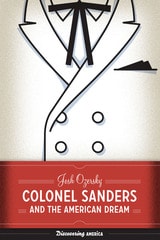
Colonel Sanders and the American Dream
By Josh Ozersky
University of Texas Press, 2012
From Aunt Jemima and Uncle Ben to the Jolly Green Giant and Ronald McDonald, corporate icons sell billions of dollars’ worth of products. But only one of them was ever a real person—Colonel Sanders of Kentucky Fried Chicken/KFC. From a 1930s roadside café in Corbin, Kentucky, Harland Sanders launched a fried chicken business that now circles the globe, serving “finger lickin’ good” chicken to more than twelve million people every day. But to get there, he had to give up control of his company and even his own image, becoming a mere symbol to people today who don’t know that Colonel Sanders was a very real human being. This book tells his story—the story of a dirt-poor striver with unlimited ambition who personified the American Dream.
Acclaimed cultural historian Josh Ozersky defines the American Dream as being able to transcend your roots and create yourself as you see fit. Harland Sanders did exactly that. Forced at age ten to go to work to help support his widowed mother and sisters, he failed at job after job until he went into business for himself as a gas station/café/motel owner and finally achieved a comfortable, middle-class life. But then the interstate bypassed his business and, at sixty-five, Sanders went broke again. Packing his car with a pressure cooker and his secret blend of eleven herbs and spices, he began peddling the recipe for “Colonel Sanders’ Kentucky Fried Chicken” to small-town diners in exchange for a nickel for each chicken they sold. Ozersky traces the rise of Kentucky Fried Chicken from this unlikely beginning, telling the dramatic story of Sanders’ self-transformation into “The Colonel,” his truculent relationship with KFC management as their often-disregarded goodwill ambassador, and his equally turbulent afterlife as the world’s most recognizable commercial icon.
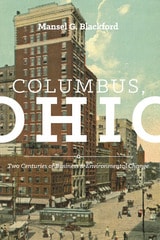
Columbus, Ohio
Two Centuries of Business and Environmental ChangeMansel G. Blackford
The Ohio State University Press, 2016
Precisely because they lived in a midsize, midwestern city, Columbus residents could learn from the earlier experiences of their counterparts in older, larger coastal metropolises, and then go beyond them. Not having large sunk costs in pre-existing water systems, Columbus residents could, for instance, develop new, world-class, state-of-the-art methods for treating water and sewage, steps essential for urban expansion. Columbus, Ohio explores how city residents approached urban challenges—especially economic and environmental ones—and how they solved them.
Columbus, Ohio: Two Centuries of Business and Environmental Change concludes that scholars and policy makers need to pay much more attention to environmental issues in the shaping of cities, and that they need to look more closely at what midwestern metropolises accomplished, as opposed to simply examining coastal cities.
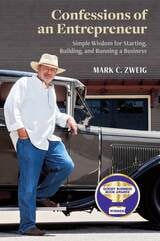
Confessions of an Entrepreneur
Simple Wisdom for Starting, Building, and Running a BusinessMark C. Zweig
Epic Books, 2022
Finalist, 2022 Goody Business Book Awards, Entrepreneur, Start Ups / New Business Category
With more than fifty years of professional experience, Mark C. Zweig has seen it all—from the fear and excitement of starting a new business to the joys and challenges of life as an entrepreneur. In Confessions of an Entrepreneur: Simple Wisdom for Starting, Building, and Running a Business, Zweig draws upon this wealth of experience to offer practical, easy-to-understand guidance for bringing a business to life and cultivating success at every stage of its development. The candid stories he shares from his career provide insight into the realities of business ownership and illustrate proven principles for both personal and professional success. Written by an entrepreneur for entrepreneurs, this book is an indispensable guide filled with wisdom for new and seasoned business leaders alike.
Conspicuous Corporation
Business, Public Policy, and Representative DemocracyNeil J. Mitchell
University of Michigan Press, 1997