57 books match the query 'Business Ethics' and 24 start with c
cover of CASE 2.1 Brenna Schneider at 99Degrees

CASE 2.1 Brenna Schneider at 99Degrees

Carole Carlson and Rachael Weiker

Brandeis University Press, 2024
This case descibes the journey of a social entrepreneur as she establishes a new venture in the garment manufacturing business. It explores how she chose to become an entrepreneur, how she utilized her ecosystem to establish her venture and the choices and challenges she faced creating and financing a new venture. At the end she is faced with strategic decisions about how to grow the venture and its impact. This case provides an excellent illustration of the challenges faced by early stage entrepreneurs, as well as the value of using a hypothesis driven approach to evolving a new venture.
[more]
cover of CASE 2.2 The Kindness of Human Milk: The Founding of Mothers’ MilkBank Northeast

CASE 2.2 The Kindness of Human Milk

The Founding of Mothers’ MilkBank Northeast

Naomi Bromberg Bar-Yam and Mark I. Rosen

Brandeis University Press, 2024
This case explores the formation and growth of an innovative nonprofit venture that provides human milk banking services. It describes the challenges faced by the founder getting medical buy in, establishing operations and adressing intial challenges. This case enables an exploration of the challenges of entering a new and untested market. This case demonstrates the value of using a business model canvas to evolve a new venture as well as the way an entreprenur can utilize key marketing frameworks (5 P and 5 C) to evolve a new venture.
[more]
cover of CASE 3.1 Engage or Divest? Trillium Asset Management, Facebook Governance,and Shareholder Advocacy

CASE 3.1 Engage or Divest? Trillium Asset Management, Facebook Governance,and Shareholder Advocacy

Monique DeSimone, Jess Lynch-Foust, Douglass Guernsey, and Laura Burroughs

Brandeis University Press, 2024
This case presents a challenge facing Trillium Asset Management around whether to continue advancing ESG issues with Facebook or divest. The case provides a window into corporate governance and hard choices that must be made with incomplete information. 
[more]
cover of CASE 3.2A SAMRIDH Blended Finance Facility: Accelerating Pandemic Responseand Building Equitable Health Systems in India (A)

CASE 3.2A SAMRIDH Blended Finance Facility

Accelerating Pandemic Responseand Building Equitable Health Systems in India (A)

Archita Adlakha, Neeta Rao, Achin B. N. Biyani, Ritika Pandey, and Sudheer Nadipally

Brandeis University Press, 2024
Part A of this case introduces students to a US AID/India initiative accelerating the pandemic response while building equitable health systems in India. A modular approach with public and privater partners is degined to accomplish together what they can't do separately. This is an excellent case for exploring financial system innovation and social impact in India, a leading global setting.
[more]
cover of CASE 3.2B SAMRIDH Blended Finance Facility: Accelerating Pandemic Responseand Building Equitable Health Systems in India (B)

CASE 3.2B SAMRIDH Blended Finance Facility

Accelerating Pandemic Responseand Building Equitable Health Systems in India (B)

Archita Adlakha, Neeta Rao, Achin B. N. Biyani, Ritika Pandey, and Sudheer Nadipally

Brandeis University Press, 2024
Part B of this case provides initial results from to a US AID/India initiative accelerating the pandemic response while building equitable health systems in India. Innovative financial approaches are outlined and emergent challenges are identified. This case is excellent for raising issues around the sustainability of financial innovations designed to have a social impact.
[more]
cover of CASE 4.1 HopeWell, Inc.

CASE 4.1 HopeWell, Inc.

Della M. Hughes and Marji Erickson Warfield

Brandeis University Press, 2024
This case explores the work of leaders and staff at Hopewell, an innovative social services nonprofit, to evolve its services and achieve organizational alignment. It includes an in-depth discussion of the use of theory of change and logic models to support transformative change. It also discusses how Hopewell aligned its transformation to organizational values and leveraged and aligned staff to create consensus. This is an excellent case for exploring transformational leadership or organizational change in a nonprofit setting. use a logic model to evolve its services. It includes an in-depth discussion of the use of theory of change and logic models to support transformative change. It also discusses how it aligned its transformation to organizational values and leveraged and aligned staff to create consensus. This case enables instructors to illustrate the value of using a theory of change and logic model to articulate the strategy of and drive change in a high-performance social venture.
[more]
cover of CASE 4.2A Tufts Medicine Health Care System: Merging Hospitals in a New Model (A)

CASE 4.2A Tufts Medicine Health Care System

Merging Hospitals in a New Model (A)

Maher Tabba and Jon Chilingerian

Brandeis University Press, 2024
This case builds on the Tufts Medicine Health Care System (A) case by exploring the barriers and challenges Tufts Medicine faced aligning operations and stakeholders. It discusses the challenges the leaders experienced bringing together an academic medical center with a community hospital system while meeting its goals of maintaining its competitive position while providing high quality care. A discussion of this case will enable instructors to explore the challenges and opportunities of health care mergers in depth.
[more]
cover of CASE 4.2B Tufts Medicine Health Care System: Merging Hospitals in a New Model (B)

CASE 4.2B Tufts Medicine Health Care System

Merging Hospitals in a New Model (B)

Maher Tabba and Jon Chilingerian

Brandeis University Press, 2024
This case builds on the Tufts Medicine Health Care System (A) case by exploring the barriers and challenges Tufts Medicine faced aligning operations and stakeholders. It discusses the challenges the leaders experienced bringing together an academic medical center with a community hospital system while meeting its goals of maintaining its competitive position while providing high quality care. A discussion of this case will enable instructors to explore the challenges and opportunities of health care mergers in depth.
[more]
cover of CASE 4.3 Aligning Transition Supports and Services for Students With Disabilities

CASE 4.3 Aligning Transition Supports and Services for Students With Disabilities

Jennifer Stewart

Brandeis University Press, 2024
This case describes the State of Colorado's initiative to create a state level series of interagency partnership that improve the coordination of support services for students and youth with disabilities and its work piloting and then sustaining this approach. It includes an example of a family including a youth with autism and their challenges navigating the complexites of the support system. The case describes the development of a services sequencing model and the use of four pilot sites to identify the best way to deliver aligned services. The case ends with the challenge of how to plan to expand the sequencing of services model.
[more]
cover of CASE 4.4 The Native Plant Ordinance Meeting

CASE 4.4 The Native Plant Ordinance Meeting

Elizabeth V. Sessions

Brandeis University Press, 2024
This simulation puts students in positions of stakeholders in a fictional community negotiating whether to use 100% native species in new city plantings. Students are assigned roles as advocates, city officials and politicans all with different perspectives and interests. They must find common ground to come to an agreement that is both practical and evironmentally positive. The simulaiton enables instructors to illustrate the benefits of a value creation mindset in negoations.
[more]
cover of CASE 5.1 Boston MedFlight: Leveraging Data to Design a New Helicopter Algorithm

CASE 5.1 Boston MedFlight

Leveraging Data to Design a New Helicopter Algorithm

Matthew Kriegsman

Brandeis University Press, 2024
This case describes the potential introduction of a new helicopter operation named “Smart Launch” at the leading non-profit air ambulance of Boston MedFlight, with the goal of decreasing the estimated arrival time of transports and thereby improving patient outcomes. The case first provides a detailed background for how patient requests turn into successful transports, and thereafter outlines the estimated operational, financial and social impact of implementing this new operation. This is an excellent case for leveraging real transport data and management’s questions, with the challenge to determine if, how, and “what needs to be true?” to successfully unlock the new Smart Launch operation. 
[more]
cover of CASE 5.2 Ford Hall 2015

CASE 5.2 Ford Hall 2015

Avery Brien, Mónica García, Sonia Kikeri, and Miya Ward

Brandeis University Press, 2024
This first-hand account of the student takeover of the campus administration building raises strategic and operational issues through a lens of racial inequities and intersectionality. It has echos of a 1968 protest by black students, which had very similar demands and it happened in the context of student protests and demands across the nation. This is an excellent case for apprciating social protest through an organizational lens and appreciating ways that university campuses can be held to be accountable for their espoused values.
[more]
cover of CASE 5.3 The Interfaith Worker Rights Council Call Center

CASE 5.3 The Interfaith Worker Rights Council Call Center

Joel Cutcher-Gershenfeld

Brandeis University Press, 2024
This case presents multiple operations challenges in a non-profit social services setting, with a focus on immigrant worker rights. The case inlcudes paid staff, volunteers, and executive leadership facing breakdowns in services to clients, legislators, advicates, and others. This is an excellent case for applying process-floew analysis in a social impact setting.
[more]
cover of CASE 6.1 JA Worldwide: Creating a Global Brand

CASE 6.1 JA Worldwide

Creating a Global Brand

Keshia Engwenyi, Julia Robinson-Rosendorff, and Sean C. Rush

Brandeis University Press, 2024
This case presents the branding challenge for Junior Achievement (JA) Worldwide, a very large and impactful social impact organization with limiting brand awareness. Reaching over 10 million students in over 100 countries, there is a great story to be told. The case provides students with the opportunity to lean in on a high impact branding challenge.
[more]
cover of CASE 7.1 Breaking Down Silos to Build Collaborative Systems

CASE 7.1 Breaking Down Silos to Build Collaborative Systems

Lauren Hajjar, Jody Hoffer Gittell, Ninna Meier, and Bill Gunn

Brandeis University Press, 2024
This simulation presents the challenge of integrating regional health system payments in a context where parties each operate independently and the social determinents of health are incompletly addressed. Set in New Hampshire, respoinding to a fedearal initiative, the simulation features five roles, each essential to the integraiton challenge. Ths case provides students with an experiential view on the challenge of breaking down silos in social impact service delivery.
[more]
cover of CASE 7.2 The Unit-BasedTeam Meeting

CASE 7.2 The Unit-BasedTeam Meeting

Joel Cutcher-Gershenfeld

Brandeis University Press, 2024

This simulation puts studens in front-line health care roles navigating typical issues faced in a team-based work system. The facilitator role illustrates the imporance of facilitation (even with a student new to the role). Confidential role information for the five roles brings students to the meeting with both common and competing interests. This is an excellent case for illustrating the front-line dynamics in a high performance worksystem, as well as the value of employee voice.
[more]
cover of Children and Drug Safety: Balancing Risk and Protection in Twentieth-Century America

Children and Drug Safety

Balancing Risk and Protection in Twentieth-Century America

Connolly, Cynthia A

Rutgers University Press, 2018

Winner of the 2018 Arthur J. Viseltear Award from the Medical Care Section of the American Public Health Association​

Children and Drug Safety traces the development, use, and marketing of drugs for children in the twentieth century, a history that sits at the interface of the state, business, health care providers, parents, and children. This book illuminates the historical dimension of a clinical and policy issue with great contemporary significance—many of the drugs administered to children today have never been tested for safety and efficacy in the pediatric population.
 
Each chapter of Children and Drug Safety engages with major turning points in pediatric drug development; themes of children’s risk, rights, protection and the evolving context of childhood; child-rearing; and family life in ways freighted with nuances of race, class, and gender. Cynthia A. Connolly charts the numerous attempts by Congress, the Food and Drug Administration, the American Academy of Pediatrics, and leading pediatric pharmacologists, scientists, clinicians, and parents to address a situation that all found untenable. 


Open access edition funded by the National Endowment for the Humanities.

The text of this book is licensed under a Creative Commons Attribution NonCommercial-NoDerivatives 4.0 International License: https://creativecommons.org/licenses/by-nc-nd/4.0/ 

[more]
cover of Chocolate on Trial: Slavery, Politics, and the Ethics of Business

Chocolate on Trial

Slavery, Politics, and the Ethics of Business

Lowell J. Satre

Ohio University Press, 2005

At the turn of the twentieth century, Cadbury Bros. Ltd. was a successful, Quaker-owned chocolate manufacturer in Birmingham, England, celebrated for its model village, modern factory, and concern for employees. In 1901 the firm learned that its cocoa beans, purchased from Portuguese plantations on the island of São Tomé off West Africa, were produced by slave labor.

Chocolate on Trial: Cadbury, Slavery and the Economics of Virtue in Imperial Britain gives a lively and highly readable account of the events surrounding the libel trial in which Cadbury Bros. Ltd. sued the London Standard, following the newspaper's accusation that the firm was hypocritical in its use of slave-grown cocoa. As compelling now as at the turn of the previous century, the issues probed by Lowell J. Satre give invaluable historical background to contemporary issues of business ethics, corporate social responsibility, and globalization. The story Satre tells illuminates what a stubbornly persistent institution slavery was and shows how Cadbury, a company with a well-regarded brand name and logo, endured ethical dilemmas and challenges to its record for social responsibility. Chocolate on Trial brings to life the age-old conflict between economic interests and the value of human life.

Satre illuminates the stubborn persistence of the institution of slavery and shows how Cadbury, a company with a well-regarded brand name from the nineteenth century, faced ethical dilemmas and challenges to its record for social responsibility. Chocolate on Trial brings to life the age-old conflict between economic interests and regard for the dignity of human life.
[more]
cover of Codes of Conduct: Behavioral Research into Business Ethics

Codes of Conduct

Behavioral Research into Business Ethics

David M. Messick

Russell Sage Foundation, 1996

Despite ongoing efforts to maintain ethical standards, highly publicized episodes of corporate misconduct occur with disturbing frequency. Firms produce defective products, release toxic substances into the environment, or permit dangerous conditions to existin their workplaces. The propensity for irresponsible acts is not confined to rogue companies, but crops up in even the most respectable firms. Codes of Conduct is the first comprehensive attempt to understand these problems by applying the principles of modern behavioral science to the study of organizational behavior. Codes of Conduct probes the psychological and social processes through which companies and their managers respond to a wide array of ethical dilemmas, from risk and safety management to the treatment of employees. The contributors employ a wide range of case studies to illustrate the effects of social influence and group persuasion, organizational authority and communication, fragmented responsibility, and the process of rationalization. John Darley investigates how unethical acts are unintentionally assembled within organizations as a result of cascading pressures and social processes. Essays by Roderick Kramer and David Messick and by George Loewenstein focus on irrational decision making among managers. Willem Wagenaar examines how worker safety is endangered by management decisions that focus too narrowly on cost cutting and short time horizons. Essays by Baruch Fischhoff and by Robyn Dawes review the role of the expert in assessing environmental risk. Robert Bies reviews evidence that employees are more willing to provide personal information and to accept affirmative action programs if they are consulted on the intended procedures and goals. Stephanie Goodwin and Susan Fiske discuss how employees can be educated to base office judgments on personal qualities rather than on generalizations of gender, race, and ethnicity. Codes of Conduct makes an important scientific contribution to the understanding of decisionmaking and social processes in business, and offers clear insights into the design of effective policies to improve ethical conduct.
[more]
cover of Community over Chaos: An Ecological Perspective on Communication Ethics

Community over Chaos

An Ecological Perspective on Communication Ethics

James A. Mackin

University of Alabama Press, 1997

This ecology of ethics seeks to balance the needs of the individual and those of the various levels of community.

As James A. Mackin, Jr., shows, both modernism and postmodernism have undermined the traditional foundations for ethics. Using an ecological model, however, Community over Chaos develops a common ground for ethical judgments about communication, thus countering the current theoretical climate of pessimistic cynicism toward the very possibility of ethics.

This theoretical pessimism is not merely an academic problem. The general public is becoming more and more disillusioned about the possibility of ethical communication. We are unable to teach principles of communicative ethics in our primary and secondary schools because we cannot agree on a common ground for those principles. Instead, we teach a narrow form of competence that is concerned primarily with short-term, individual success. Because our communities are built on our communicative practices, our inability to justify communicative ethics must ultimately lead to the disintegration of our communities.

Mackin's ecological model assumes that each of us is a communicative system operating within larger communicative systems that together form our communicative ecosystem. Virtues of the ecological approach are practical wisdom, based in fuzzy logic, and communicative openness and honesty.

Mackin recognizes the importance of both chaos and community in our communicative ecosystems. Chaos, as the source of originality and creativity, can contribute to growth and development; community provides the source of regularity and nurture that makes chaos endurable.



[more]
cover of Corporate Bodies and Guilty Minds: The Failure of Corporate Criminal Liability

Corporate Bodies and Guilty Minds

The Failure of Corporate Criminal Liability

William S. Laufer

University of Chicago Press, 2006

We live in an era defined by corporate greed and malfeasance—one in which unprecedented accounting frauds and failures of compliance run rampant. In order to calm investor fears, revive perceptions of legitimacy in markets, and demonstrate the resolve of state and federal regulators, a host of reforms, high-profile investigations, and symbolic prosecutions have been conducted in response. But are they enough?

In this timely work, William S. Laufer argues that even with recent legal reforms, corporate criminal law continues to be ineffective. As evidence, Laufer considers the failure of courts and legislatures to fashion liability rules that fairly attribute blame for organizations. He analyzes the games that corporations play to deflect criminal responsibility. And he also demonstrates how the exchange of cooperation for prosecutorial leniency and amnesty belies true law enforcement. But none of these factors, according to Laufer, trumps the fact that there is no single constituency or interest group that strongly and consistently advocates the importance and priority of corporate criminal liability. In the absence of a new standard of corporate liability, the power of regulators to keep corporate abuses in check will remain insufficient.

           
A necessary corrective to our current climate of graft and greed, Corporate Bodies and Guilty Minds will be essential to policymakers and legal minds alike.
 
“[This] timely work offers a dispassionate analysis of problems relating to corporate crime.”—Harvard Law Review
[more]
cover of Corporate Dreams: Big Business in American Democracy from the Great Depression to the Great Recession

Corporate Dreams

Big Business in American Democracy from the Great Depression to the Great Recession

Hoopes, James

Rutgers University Press, 2011

Public trust in corporations plummeted in the wake of the 2008 financial crisis, when “Lehman Brothers” and “General Motors” became dirty words for many Americans. In Corporate Dreams, James Hoopes argues that Americans still place too much faith in corporations and, especially, in the idea of “values-based leadership” favored by most CEOs. The danger of corporations, he suggests, lies not just in their economic power, but also in how their confused and undemocratic values are infecting Americans’ visions of good governance. 

Corporate Dreams proposes that Americans need to radically rethink their relationships with big business and the government. Rather than buying into the corporate notion of “values-based leadership,” we should view corporate leaders with the same healthy suspicion that our democratic political tradition teaches us to view our political leaders. Unfortunately, the trend is moving the other way. Corporate notions of leadership are invading our democratic political culture when it should be the reverse.

To diagnose the cause and find a cure for our toxic attachment to corporate models of leadership, Hoopes goes back to the root of the problem, offering a comprehensive history of corporate culture inAmerica, from the Great Depression to today’s Great Recession. Combining a historian’s careful eye with an insider’s perspective on the business world, this provocative volume tracks changes in government economic policy, changes in public attitudes toward big business, and changes in how corporate executives view themselves.

Whether examining the rise of Leadership Development programs or recounting JFK’s Pyrrhic victory over U.S. Steel, Hoopes tells a compelling story of how America lost its way, ceding authority to the policies and values of corporate culture. But he also shows us how it’s not too late to return to our democratic ideals—and that it’s not too late to restore the American dream.
[more]
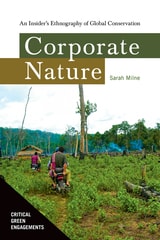
cover of Corporate Nature: An Insider's Ethnography of Global Conservation

Corporate Nature

An Insider's Ethnography of Global Conservation

Sarah Milne

University of Arizona Press, 2022

In 2012, Cambodia’s most prominent environmental activist was brutally murdered in a high-profile conservation area in the Cardamom Mountains. Tragic and terrible, this event magnifies a crisis in humanity’s efforts to save nature: failure of the very tools and systems at hand for advancing global environmental action.

Sarah Milne spent more than a decade working for and observing global conservation projects in Cambodia. During this time, she saw how big environmental NGOs can operate rather like corporations. Their core practice involves rolling out appealing and deceptively simple policy ideas, like Payments for Ecosystem Services (PES). Yet, as policy ideas prove hard to implement, NGOs must also carefully curate evidence from the field to give the impression of success and effectiveness.

In Corporate Nature, Milne delves inside the black box of mainstream global conservation. She reveals how big international NGOs struggle in the face of complexity—especially in settings where corruption and political violence prevail. She uses the case of Conservation International’s work in Cambodia to illustrate how apparently powerful NGOs can stumble in practice: policy ideas are transformed on the ground, while perverse side effects arise, like augmented authoritarian power, illegal logging, and Indigenous dispossession.

The real power of global conservation NGOs is therefore not in their capacity to control what happens in the field but in their capacity to ignore or conceal failings. Milne argues that this produces an undesirable form of socionature, called corporate nature, that values organizational success over diverse knowledges and ethical conduct.
 
[more]
cover of Corporate Stakeholder Democracy: Politicizing Corporate Social Responsibility

Corporate Stakeholder Democracy

Politicizing Corporate Social Responsibility

Robert Braun

Central European University Press, 2019

Most practitioners and decision makers look at corporate social responsibility (CSR) as a socially responsible management practice on top of what company leaders generally do: focus on the sustainable, long term financial profitability of their corporation. This book focuses on a political understanding of CSR: the author bridges politics with corporate social responsibility and in a creative and provocative manner. Braun seeks to explore why and how corporations are to be seen as political actors with important roles in our current societies. The first part discusses the social context, the various stakeholder approaches and it also endeavors – with the help of the historic/political parallel of the bourgeois revolutions in the 19th century – to define the corporate polity. The second part analyses the new kind of political operational logic from the viewpoint of the different areas of corporate operation; it gives an overview of the consequences for the individual areas of operation and indicates how corporate policy can be realized in the given field of operation. The third part of the book introduces the institutions necessary for the creation of the corporate polity.
[more]