Results by title
343 books match the query 'Capitalism' and 58 start with c
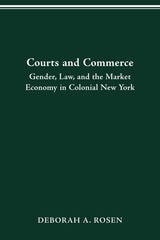
COURTS AND COMMERCE
GENDER, LAW, AND THE MARKET ECONOMY IN COLONIAL NEW YORKDeborah A. Rosen
The Ohio State University Press, 1997
Illuminates the legal engine behind colonial America’s market economy, revealing how law and commerce intertwined to sideline women's participation and lay the groundwork for industrial capitalism.
In Courts and Commerce, Deborah A. Rosen offers a fresh, incisive look at the economic and legal foundations of colonial New York. Drawing on a wide array of 18th-century sources—probate inventories, court records, petitions, and more—Rosen uncovers how law and commerce intertwined to shape a market economy long before the rise of industrial capitalism.
Rosen challenges the romanticized view of colonial America as a bastion of communal values. Instead, she reveals a society already driven by arm’s-length transactions and legal mechanisms that empowered men to expand their economic reach while systematically limiting women’s participation. Her analysis spans both urban and rural settings, highlighting regional contrasts and the gendered impact of legal structures.
This book pushes back against the idea that the nineteenth century marked a sudden economic transformation. Rosen shows that many of the legal and economic patterns associated with industrialization were already in motion a century earlier. Engaging and deeply researched, Courts and Commerce is essential reading for scholars of colonial history, legal and economic development, and gender studies. It reframes our understanding of early American life—and the roots of inequality in the modern economy.

California Futures
Haunted Ecologies, Decolonial RelationsDaniel Lanza Rivers
Duke University Press, 2026
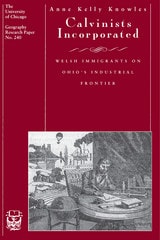
Calvinists Incorporated
Welsh Immigrants on Ohio's Industrial FrontierAnne Kelly Knowles
University of Chicago Press, 1996
capitalist transformation, Anne Kelly Knowles traces a community of
Welsh immigrants to Jackson and Gallia counties in southern Ohio. After
reconstructing the gradual process of community-building, Knowles
focuses on the pivotal moment when the immigrants became involved with
the industrialization of their new region as workers and investors in
Welsh-owned charcoal iron companies. Setting the southern Ohio Welsh in
the context of Welsh immigration as a whole from 1795 to 1850, Knowles
explores how these strict Calvinists responded to the moral dilemmas
posed by leaving their native land and experiencing economic success in
the United States.
Knowles draws on a wide variety of sources, including obituaries and
community histories, to reconstruct the personal histories of over 1,700
immigrants. The resulting account will find appreciative readers not
only among historical geographers, but also among American economic
historians and historians of religion.
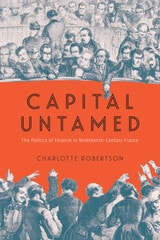
Capital Untamed
The Politics of Finance in Nineteenth-Century FranceCharlotte Robertson
University of Chicago Press, 2026
The story of a bold political experiment in nineteenth-century France to establish power through finance.
Amid the rise of industrial capitalism and revolutionary upheaval, French reformers asserted that finance should be reimagined as an instrument of economic and social transformation rather than left to the logic of private profit and speculation. In the 1850s, under Napoleon III’s authoritarian regime, this vision took institutional form as the Bonapartist state strategically deployed finance, broadened market participation, and sponsored new banks with the promise of directing investment toward infrastructure and industry. Yet this effort to harness and mobilize capital ran into a problem: The financial markets refused to be tamed.
Drawing on rich archival sources—from police surveillance and courtroom transcripts to investment manuals and petitions for incorporation—Capital Untamed reveals how the financial markets became an instrument of political power, frustrated state ambitions, and ultimately escaped attempts at mastery. In this striking debut, historian Charlotte Robertson shows how the French state and its citizens navigated a turbulent era of European capitalism animated by debates over the social purpose of financial capital. Ultimately, politicians’ efforts to establish legitimacy by reorganizing finance—and their confrontations with the limits of that project—set the stage for a form of modern discontent with the financial system that survives to this day.
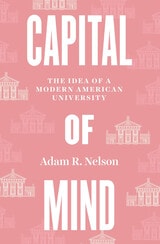
Capital of Mind
The Idea of a Modern American UniversityAdam R. Nelson
University of Chicago Press, 2024
Capital of Mind is the second volume in a breathtakingly ambitious new economic history of American higher education. Picking up from the first volume, Exchange of Ideas, Adam R. Nelson looks at the early decades of the nineteenth century, explaining how the idea of the modern university arose from a set of institutional and ideological reforms designed to foster the mass production and mass consumption of knowledge. This “industrialization of ideas” mirrored the industrialization of the American economy and catered to the demands of a new industrial middle class for practical and professional education. From Harvard in the north to the University of Virginia in the south, new experiments with the idea of a university elicited intense debate about the role of scholarship in national development and international competition, and whether higher education should be supported by public funds, especially in periods of fiscal austerity. The history of capitalism and the history of the university, Nelson reveals, are intimately intertwined—which raises a host of important questions that remain salient today. How do we understand knowledge and education as commercial goods? Should they be public or private? Who should pay for them? And, fundamentally, what is the optimal system of higher education for a capitalist democracy?

Capital, Class & Technology in Contemporary American Culture
Projecting Post-FordismNick Heffernan
Pluto Press, 2000
He turns to the stories we generate and tell ourselves - via fiction, film journalism, theory - to see how change is registered. By investigating a variety of texts, he observes how structural change affects the way people organise their lives economically, socially and culturally. Case studies include Ridley Scott's Blade Runner, William Gibson's cyberspace trilogy, Thomas Pynchon's The Crying of Lot 49, and Wim Wenders's Until the End of the World.
Using the links between narrative cultural forms and the process of historical understanding, he brings together debates that have so far been conducted largely within the separate domains of political economy, social theory and cultural criticism to provide a compelling analysis of contemporary cultural change. By relocating postmodernism in the context of changing modes of capitalism, Heffernan puts the question of class and class agency back at the centre of the critical agenda.

Capital, Interrupted
Agrarian Development and the Politics of Work in IndiaVinay Gidwani
University of Minnesota Press, 2008
The central Gujarat region of western India is home to the entrepreneurial landowning Patel caste who have leveraged their rural dominance to become a powerful global diaspora of merchants, industrialists, and professionals. Investigating the Patels’ intriguing ascent, Vinay Gidwani analyzes its broad implications for the nature of labor and capital worldwide.
With the Patels as his central case, Gidwani interrogates established concepts of value, development, and the relationship between capital and history. Capitalism, he argues, is not a frame of economic organization based on the smooth, consistent operation of a series of laws, but rather an assemblage of contingent and interrupted logics stitched together into the appearance of a deus ex machina. Following this line of thinking, Gidwani points to ways in which political economy might be freed of its lingering Eurocentrism, raises questions about the adequacy of postcolonial studies’ critique of Marx and capitalism, and opens the possibility of situating capitalism as a geographically uneven social formation in which different normative or value-creating practices are imperfectly sutured together in ways that can equally impair and enable profit and accumulation.
Both theoretically astute and empirically informed, Capital, Interrupted unsettles encrusted understandings of staple concepts within the human sciences such as hegemony, governmentality, caste, and agency and, ultimately, does nothing less than rethink the very constitution of capitalism.
Vinay Gidwani is associate professor of geography and global studies at the University of Minnesota.

Capital, State, Empire
The New American Way of Digital WarfareScott Timcke
University of Westminster Press, 2017
The United States presents the greatest source of global geo-political violence and instability. Guided by the radical political economy tradition, this book offers an analysis of the USA’s historical impulse to weaponize communication technologies.
Scott Timcke explores the foundations of this impulse and how the militarization of digital society creates structural injustices and social inequalities. He analyses how new digital communication technologies support American paramountcy and conditions for worldwide capital accumulation. Identifying selected features of contemporary American society, Capital, State, Empire undertakes a materialist critique of this digital society and of the New American Way of War. At the same time it demonstrates how the American security state represses activists—such as Black Lives Matter—who resist this emerging security leviathan. The book also critiques the digital positivism behind the algorithmic regulation used to control labour and further diminish prospects for human flourishing for the ‘99%’.
Capital, State, Empire contributes to a broader understanding of the dynamics of global capitalism and political power in the early 21st century.
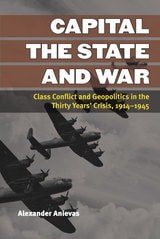
Capital, the State, and War
Class Conflict and Geopolitics in the Thirty Years' Crisis, 1914-1945Alexander Anievas
University of Michigan Press, 2014
The history of the modern social sciences can be seen as a series of attempts to confront the challenges of social disorder and revolution wrought by the international expansion of capitalist social relations. Alexander Anievas focuses on one particularly significant aspect of this story: the intersocietal or geosocial origins of the two world wars, and, more broadly, the confluence of factors behind the Thirty Years’ Crisis between 1914 and 1945.
Anievas presents the Thirty Years’ Crisis as a result of the development of global capitalism with all its destabilizing social and geopolitical consequences, particularly the intertwined and co-constitutive nature of imperial rivalries, social revolutions, and anti-colonial struggles. Building on the theory of uneven and combined development, he unites geopolitical and sociological explanations into a single framework, thereby circumventing the analytical stalemate between primacy of domestic politics and primacy of foreign policy approaches.
Capitalism
Peter Saunders
University of Minnesota Press, 1995
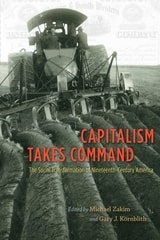
Capitalism Takes Command
The Social Transformation of Nineteenth-Century AmericaEdited by Michael Zakim and Gary J. Kornblith
University of Chicago Press, 2011
Most scholarship on nineteenth-century America’s transformation into a market society has focused on consumption, romanticized visions of workers, and analysis of firms and factories. Building on but moving past these studies, Capitalism Takes Command presents a history of family farming, general incorporation laws, mortgage payments, inheritance practices, office systems, and risk management—an inventory of the means by which capitalism became America’s new revolutionary tradition.
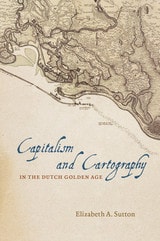
Capitalism and Cartography in the Dutch Golden Age
Elizabeth A. Sutton
University of Chicago Press, 2015
Building her exploration around the central figure of Claes Jansz Vischer, an Amsterdam-based publisher closely tied to the Dutch West India Company, Sutton shows how printed maps of Dutch Atlantic territories helped rationalize the Dutch Republic’s global expansion. Maps of land reclamation projects in the Netherlands, as well as the Dutch territories of New Netherland (now New York) and New Holland (Dutch Brazil), reveal how print media were used both to increase investment and to project a common narrative of national unity. Maps of this era showed those boundaries, commodities, and topographical details that publishers and the Dutch West India Company merchants and governing Dutch elite deemed significant to their agenda. In the process, Sutton argues, they perpetuated and promoted modern state capitalism.
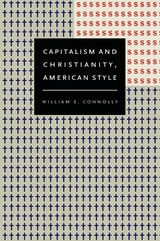
Capitalism and Christianity, American Style
William E. Connolly
Duke University Press, 2008
Connolly describes how the evangelical-capitalist machine works, how its themes resound across class lines, and how it infiltrates numerous aspects of American life. Proposing changes in sensibility and strategy to challenge this machine, Connolly contends that the liberal distinction between secular public and religious private life must be reworked. Traditional notions of unity or solidarity must be translated into drives to forge provisional assemblages comprised of multiple constituencies and creeds. The left must also learn from the political right how power is infused into everyday institutions such as the media, schools, churches, consumption practices, corporations, and neighborhoods. Connolly explores the potential of a “tragic vision” to contest the current politics of existential resentment and political hubris, explores potential lines of connection between it and theistic faiths that break with the evangelical right, and charts the possibility of forging an “eco-egalitarian” economy. Capitalism and Christianity, American Style is William E. Connolly’s most urgent work to date.
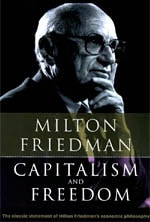
Capitalism and Freedom
Milton Friedman
University of Chicago Press, 1963
"Milton Friedman is one of the nation's outstanding economists, distinguished for remarkable analytical powers and technical virtuosity. He is unfailingly enlightening, independent, courageous, penetrating, and above all, stimulating."-Henry Hazlitt, Newsweek
"It is a rare professor who greatly alters the thinking of his professional colleagues. It's an even rarer one who helps transform the world. Friedman has done both."-Stephen Chapman, Chicago Tribune
Capitalism and Freedom
Milton Friedman
University of Chicago Press, 2020
One of Times Literary Supplement’s 100 Most Influential Books Since the War
One of National Review’s 100 Best Nonfiction Books of the Century
One of the Intercollegiate Studies Institute’s 50 Best Books of the 20th Century
How can we benefit from the promise of government while avoiding the threat it poses to individual freedom? In this classic book, Milton Friedman provides the definitive statement of an immensely influential economic philosophy—one in which competitive capitalism serves as both a device for achieving economic freedom and a necessary condition for political freedom.
First published in 1962, Friedman’s Capitalism and Freedom is one of the most significant works of economic theory ever written. Enduring in its eminence and esteem, it has sold nearly a million copies in English, has been translated into eighteen languages, and continues to inform economic thinking and policymaking around the world. This new edition includes prefaces written by Friedman for both the 1982 and 2002 reissues of the book, as well as a new foreword by Binyamin Appelbaum, lead economics writer for the New York Times editorial board.
Capitalism and Freedom
Fortieth Anniversary EditionMilton Friedman
University of Chicago Press, 2002
How can we benefit from the promise of government while avoiding the threat it poses to individual freedom? In this classic book, Milton Friedman provides the definitive statement of his immensely influential economic philosophy—one in which competitive capitalism serves as both a device for achieving economic freedom and a necessary condition for political freedom. The result is an accessible text that has sold well over half a million copies in English, has been translated into eighteen languages, and shows every sign of becoming more and more influential as time goes on.
Capitalism and Its Economics
A Critical HistoryDouglas Dowd
Pluto Press, 2004
Capitalism and Labor
Towards Critical PerspectivesEdited by Klaus Dörre, Nicole Mayer-Ahuja, Dieter Sauer, and Volker Wittke
Campus Verlag, 2012
Capitalism and the Dialectic
The Uno-Sekine Approach to Marxian Political EconomyJohn R. Bell
Pluto Press, 2009
From the 1960s to the 1990s the ground-breaking Japanese economists Kozo Uno and Thomas Sekine developed a masterful reconfiguration of Marxist economics. The most well-known aspect of which is the levels of analysis approach to the study of capitalism.
Written in Japanese, the Uno-Sekine approach to Marx's work is little understood in West. John Bell seeks to correct this, explaining how problematic elements of Marxian Political Economy such as the law of value and the law of relative surplus population can be solved by using a more rigorous dialectical analysis.
Bell's clear and accessible synthesis provides economists with the tools to interrogate capitalism in a more powerful way than ever before.
Capitalism and the Emergence of Civic Equality in Eighteenth-Century France
William H. Sewell Jr.
University of Chicago Press, 2021
William H. Sewell Jr. argues that the flourishing of commercial capitalism in eighteenth-century France introduced a new independence, flexibility, and anonymity to French social life. By entering the interstices of this otherwise rigidly hierarchical society, expanded commodity exchange colored everyday experience in ways that made civic equality thinkable, possible, even desirable, when the crisis of the French Revolution arrived. Sewell ties together masterful analyses of a multitude of interrelated topics: the rise of commerce, the emergence of urban publics, the careers of the philosophes, commercial publishing, patronage, political economy, trade, and state finance. Capitalism and the Emergence of Civic Equality in Eighteenth-Century France offers an original interpretation of one of history’s pivotal moments.
Capitalism and the Historians
Edited by F. A. Hayek
University of Chicago Press, 1963
Capitalism from Outside?
Economic Cultures in Eastern Europe after 1989János Mátyás Kovács
Central European University Press, 2012

Capitalism in Context
Essays on Economic Development and Cultural Change in Honor of R.M. HartwellEdited by John A. James and Mark Thomas
University of Chicago Press, 1994
Thirteen chapters cover: social progress during economic development; the influence of cultural values on social and economic change; economic foundations of development—labor, capital, and technology; and organizational arrangements—property rights, government, and markets. These studies will appeal to economists, historians, and social scientists alike for their wide-ranging treatments of economic development and cultural change.
The contributors are N. F. R. Crafts, Lance E. Davis, Stanley L. Engerman, David W. Galenson, Robert E. Gallman, Stephen Innes, John A. James, Eric L. Jones, Thomas W. Laqueur, Gary D. Libecap, Joel Mokyr, Douglass C. North, Mark Thomas, John J. Wallis, Jeffrey G. Williamson.
Capitalism in the 21st Century
Through the Prism of ValueMichael Roberts
Pluto Press, 2022
Contemporary capitalism is always evolving. From digital technologies to cryptocurrencies, current trends in political economy are much discussed, but often little understood. So where can we turn for clarity? As Michael Roberts and Guglielmo Carchedi argue, new trends don't necessarily call for a new theory.
In Capitalism in the 21st Century, the authors show how Marx's law of value explains numerous issues in our modern world. In both advanced economies and the periphery, value theory provides a piercing analytical framework through which we can approach topics as varied as labor, profitability, technology, the environment, the role of China, imperialism, and the state.
An ambitious work that will appeal to both heterodox economists and labor movement activists alike, as it demonstrates the ongoing contemporary relevance of Marxist theory to current trends in political economy.
Capitalism with a Comrade's Face
Kenneth Murphy
Central European University Press, 1998
Are nations that are journeying away from communism succeeding in becoming free-market democracies? In what ways do decades of totalitarian rule continue to distort the institutional shape of these societies? Which of communism's legacies may remain as permanent features of their landscape? In an effort to answer these questions, Roman Frydman, Kenneth Murphy, and Andrzej Rapaczynski analyze the turbulent transitions that have taken place in the post-Communist world since the revolutions of 1989-1991.
Each of the essays in this collection dissects the institutional upheaval in a particular institution in transition, such as central banking, the trade union movement, capital markets, or corporate govern-ance. In a lively and accessible style, the authors bring out the links between what was and what will be in the social fabric of Eastern Europe and the former Soviet Union. They expose the fragility of political and economic institutions that can easily threaten the region's rebirth, but they also believe that many post-Communist countries are successfully seizing the opportunity to become reunited with the West and the global economy.
With both sweeping perspective and critical depth, Frydman, Murphy, and Rapaczynski show the wide range of institutional improvisations under way. They weigh the advantages and disadvantages of different reform strategies and assess the role of politics in fostering or arresting the process of transformation. Each essay illuminates the pro-found difficulties of reconciling the needs of economic development with the special interests fighting for their survival.
Capitalism's New Clothes
Enterprise, Ethics and Enjoyment in Times of CrisisColin Cremin
Pluto Press, 2011
Using materialist, psychoanalytic and linguistic approaches, Cremin shows how capitalism, anxiety and desire enter into a mutually supporting relationship. He identifies three ways in which we are tied in to capitalism – through a social imperative for enterprise and competition; through enjoyment and consumption; and through the depoliticisation of ethical debate by government and business.
Capitalism's New Clothes is ideal for students of sociology and for anyone worried about the ethics of capitalism or embarrassed by the enjoyments the system has afforded them.

Capitalism, Colonisation and the Ecocide-Genocide Nexus
Martin Crook
University of London Press, 2024
This timely publication examines the drivers of ecologically induced genocide, in particular, how environmental destruction can lead to conditions that fundamentally threaten a social group’s cultural or physical existence. Focusing on the former British colonies of Kenya and Australia, both united by a discourse of developmentalism, this book draws attention to the critical role that ecological destruction has in the genocide of Indigenous and place-based peoples. The book synthesizes radical political ecology with a political-economic approach, illuminating the chain connection between the inherent genocidal and ecocidal properties of global capitalism, and how this connection intersects with settler and post-colonial structures. In exploring the genocidal effects of climate governance, the economic market for environmental rights, and energy extraction on Indigenous peoples in Kenya and Australia, the book also draws on original interviews to prioritize the lived experiences of the groups that have suffered structural violence and social harm. Fundamentally, Crook calls forward the political economy of genocide. As such, this important book deepens and enriches our knowledge of genocide, the eco-genocidal nature of colonization, and the capitalist mode of production that underpins developmentalism.

Capitalism, Democracy, and Ecology
Departing from MarxTimothy W. Luke
University of Illinois Press, 1999
Using Marx as a touchstone, Timothy W. Luke warns that if communities are not to be overwhelmed by new class economic and political agendas, then the practice of democracy must be reconstituted on a more populist basis. However, the galvanizing force for this new, more community-centered populism will not be the proletariat, as Marx predicted, nor contemporary militant patriotic groups. Rather, Luke argues that many groups unified by a concern for ecological justice present the strongest potential opposition to capitalism.
Wide-ranging and lucid, Capitalism, Democracy, and Ecology is essential reading in the age of information.
Capitalism, God, and a Good Cigar
Cuba Enters the Twenty-first CenturyLydia Chávez, ed.
Duke University Press, 2005
Based on reporting by journalists, writers, and documentary filmmakers since 2001, each of the essays collected here covers a particular dimension of contemporary Cuban society, revealing what it is like to have lived, for more than a decade, suspended between communism and capitalism. There are pieces on hip hop musicians, fiction writing and censorship, the state of ballet and the performing arts, and the role of computers and the Internet. Other essays address the shrinking yet still sizeable numbers of true believers in the promise of socialist revolution, the legendary cigar industry, the changing state of religion, the significance of the recent influx of money and people from Spain, and the tensions between recent Cuban emigrants and previous generations of exiles. Including more than seventy striking documentary photographs of Cuba’s people, countryside, and city streets, this richly illustrated collection offers keen, even-handed insights into the abundant ironies of life in Cuba today.
Contributors. Juliana Barbassa, Ana Campoy, Mimi Chakarova, Lydia Chávez, John Coté, Julian Foley, Angel González, Megan Lardner, Ezequiel Minaya, Daniela Mohor, Archana Pyati, Alicia Roca, Olga R. Rodríguez, Bret Sigler, Annelise Wunderlich
Capitalism, Not Globalism
Capital Mobility, Central Bank Independence, and the Political Control of the EconomyWilliam Roberts Clark
University of Michigan Press, 2009
Capitalism, Politics, and Railroads in Jacksonian New England
Michael J. Connolly
University of Missouri Press, 2003
Capitalism, Slavery, and Republican Values
American Political Economists, 1819-1848By Allen Kaufman
University of Texas Press, 1982
In the troubled days before the American Civil War, both Northern protectionists and Southern free trade economists saw political economy as the key to understanding the natural laws on which every republican political order should be based. They believed that individual freedom was one such law of nature and that this freedom required a market economy in which citizens could freely pursue their particular economic interests and goals.
But Northern and Southern thinkers alike feared that the pursuit of wealth in a market economy might lead to the replacement of the independent producer by the wage laborer. A worker without property is a potential rebel, and so the freedom and commerce that give birth to such a worker would seem to be incompatible with preserving the content citizenry necessary for a stable, republican political order.
Around the resolution of this dilemma revolved the great debate on the desirability of slavery in this country. Northern protectionists argued that independent labor must be protected at the same time that capitalist development is encouraged. Southern free trade economists answered that the formation of a propertyless class is inevitable; to keep the nation from anarchy and rebellion, slavery—justified by racism—must be preserved at any cost.
Battles of the economists such as these left little room for political compromise between North and South as the antebellum United States confronted the corrosive effects of capitalist development. And slavery's retardant effect on the Southern economy ultimately created a rift within the South between those who sought to make slavery more like capitalism and those who sought to make capitalism more like slavery.
Capitalist Development and Democracy
Dietrich Rueschemeyer, Evelyne Huber Stephens, and John D. Stephens
University of Chicago Press, 1992
The authors offer a fresh and persuasive resolution to the controversy arising out of these contrasting traditions. Focusing on advanced industrial countries, Latin America, and the Caribbean, they find that the rise and persistence of democracy cannot be explained either by an overall structural correspondence between capitalism and democracy or by the role of the bourgeoisie as the agent of democratic reform. Rather, capitalist development is associated with democracy because it transforms the class structure, enlarging the working and middle classes, facilitating their self-organization, and thus making it more difficult for elites to exclude them. Simultaneously, development weakens the landed upper class, democracy's most consistent opponent.
The relationship of capitalist development to democracy, however, is not mechanical. As the authors show, it depends on a complex interplay of three clusters of power: the balance of power among social classes, power relations between the state and society, and transnational structures of economic and political power. Looking to the future, the book concludes with some reflections on current prospects for the development of stable democracy in Latin America and Eastern Europe.

Capitalist Humanitarianism
Lucia Hulsether
Duke University Press, 2023
Capturing Finance
Arbitrage and Social DominationCarolyn Hardin
Duke University Press, 2021

Care and Capitalism in the Twentieth Century
Kirsten Swinth and Sarah Knott, editors
Duke University Press, 2027
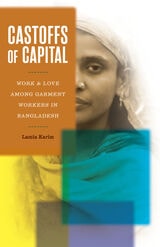
Castoffs of Capital
Work and Love among Garment Workers in BangladeshLamia Karim
University of Minnesota Press, 2022
FINALIST FOR THE GREGORY BATESON PRIZE FROM THE AMERICAN ANTHROPOLOGICAL ASSOCIATION
Dispelling stereotypes about garment workers in the global apparel industry
Castoffs of Capital examines how female garment workers experience their work and personal lives within the stranglehold of global capital. Drawing on fieldwork in Bangladesh, anthropologist Lamia Karim focuses attention onto the lives of older women aged out of factory work, heretofore largely ignored, thereby introducing a new dimension to the understanding of a female-headed workforce that today numbers around four million in Bangladesh.
Bringing a feminist labor studies lens, Castoffs of Capital foregrounds these women not only as workers but as mothers, wives, sisters, lovers, friends, and political agents. Focusing on relations among work, gender, and global capital’s targeting of poor women to advance its market penetration, Karim shows how women navigate these spaces by adopting new subject formations. She locates these women’s aspirations for the “good life” not only in material comforts but also in their longings for love and sexual fulfillment that help them momentarily forget the precarity of their existence under the shadow of capital.
Through richly detailed ethnographic studies, this innovative and beautifully written book examines the making and unmaking of these women’s wants and desires, loves and tribulations, hopes and despairs, and triumphs and struggles.
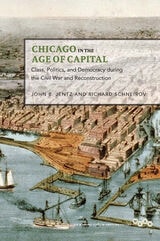
Chicago in the Age of Capital
Class, Politics, and Democracy during the Civil War and ReconstructionJohn B. Jentz and Richard Schneirov
University of Illinois Press, 2015
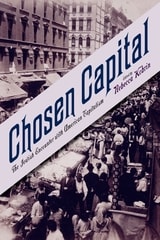
Chosen Capital
The Jewish Encounter with American CapitalismKobrin, Rebecca
Rutgers University Press, 2012
Surveying such diverse topics as Jews’ participation in the real estate industry, the liquor industry, and the scrap metal industry, as well as Jewish political groups and unions bent on reforming American capital, such as the American Labor Party and the International Ladies’ Garment Workers’ Union, contributors to this volume provide a new prism through which to view the Jewish encounter with America. The volume also lays bare how American capitalism reshaped Judaism itself by encouraging the mass manufacturing and distribution of foods like matzah and the transformation of synagogue cantors into recording stars. These essays force us to rethink not only the role Jews played in American economic development but also how capitalism has shaped Jewish life and Judaism over the course of the twentieth century.
Contributors:
Marni Davis, Georgia State University
Phyllis Dillon, independent documentary producer, textile conservator, museum curator
Andrew Dolkart, Columbia University
Andrew Godley, Henley Business School, University of Reading
Jonathan Karp, executive director, American Jewish Historical Society
Daniel Katz, Empire State College, State University of New York
Ira Katznelson, Columbia University
David S. Koffman, New York University
Eli Lederhendler, Hebrew University, Jerusalem
Jonathan Z. S. Pollack, University of Wisconsin—Madison
Jonathan D. Sarma, Brandeis University
Jeffrey Shandler, Rutgers University
Daniel Soyer, Fordham University

Civilization And Violence
Regimes of Representation in Nineteenth-Century ColombiaCristina Rojas
University of Minnesota Press, 2001
Civilization and violence are not necessarily the antagonists we presume-withcivilization taming violence, and violence unmaking civilization. Focusing on postindependence Colombia, this book brings to light the ways in which violenceand civilization actually intertwined and reinforced each other in the development of postcolonial capitalism.
The narratives of civilization and violence, Cristina Rojas contends, play key roles in the formation of racial, gender, and class identities; they also provide pivotal logic to both the formation of the nation and the processes of capitalist development. During the Liberal era of Colombian history (1849-1878), a dominant creole elite enforced a "will to civilization" that sought to create a new world in its own image. Rojas explores different arenas in which this pursuit meant the violent imposition of white, liberal, laissez-faire capitalism. Drawing on a wide range of social theory, Rojas develops a new way of understanding the relationship between violence and the formation of national identity-not just in the history of Colombia, but also in the broader narratives of civilization.
Civilizing Money
Hume, his Monetary Project, and the Scottish EnlightenmentGeorge Caffentzis
Pluto Press, 2021
Taking the Scottish Enlightenment philosopher David Hume as its subject, this book breaks new ground in focusing its lens on a little-studied aspect of Hume’s thinking: his understanding of money.
George Caffentzis makes both an intervention in the field of monetary philosophy and into Marxian conceptions of the relation between philosophy and capitalist development. He vividly charts the ways in which Hume’s philosophy directly informed the project of ‘civilizing’ the people of the Scottish Highlands and pacifying the English proletariat in response to the revolts of both groups at the heart of the empire.
Built on careful historical and philosophical detective work, Civilizing Money offers a stimulating and radical political reading of the ways in which Hume’s fundamental philosophical claims performed concrete political functions.
Class Politics and the Creation of the American State
James Parisot
University of Michigan Press, 2026
Why does the American federal government seem to prioritize elite capitalist interests over those of other groups? Class Politics and the Creation of the American State draws on a wide range of sources—personal letters, official government documents, private notes, and newspaper articles—to reveal that the federal government was built to give the emerging capitalist elite a way to consolidate and institutionalize their power. Challenging both liberal and conservative interpretations about what the US Constitution means, this book tells a new story about how the American state took shape.
The framers of the Constitution constructed an image of the state, enshrined in the Constitution, that presented their power as universal: a system meant to serve all Americans equally. This image helped legitimize the new order, even if the rising capitalist class stood to benefit most of all. Since the United States of the late 1780s was not yet a fully capitalist society, the state that was built opened space for less capitalistically incorporated social classes, including some artisans and yeoman farmers, to have limited representation. Class Politics and the Creation of the American State shows how the structure of the early American state worked primarily to advance capitalist interests, while incorporating other groups enough to maintain a sense of broad representation and inclusion.
Climate Machines, Fascist Drives, and Truth
William E. Connolly
Duke University Press, 2019
Climate, Capitalism and Communities
An Anthropology of Environmental OverheatingAstrid B. Stensrud
Pluto Press, 2019
Colonial Racial Capitalism
Susan Koshy, Lisa Marie Cacho, Jodi A. Byrd, and Brian Jordan Jefferson, editors
Duke University Press, 2022
Contributors. Joanne Barker, Jodi A. Byrd, Lisa Marie Cacho, Michael Dawson, Iyko Day, Ruth Wilson Gilmore, Alyosha Goldstein, Cheryl I. Harris, Kimberly Kay Hoang, Brian Jordan Jefferson, Susan Koshy, Marisol LeBrón, Jodi Melamed, Laura Pulido

Commoning with George Caffentzis and Silvia Federic
Camille Barbagallo, Nicholas Beuret and David Harvie
Pluto Press, 2019
Communication and Capitalism
A Critical TheoryChristian Fuchs
University of Westminster Press, 2020
‘An authoritative analysis of the role of communication in contemporary capitalism and an important contribution to debates about the forms of domination and potentials for liberation in today’s capitalist society.’ — Professor Michael Hardt, Duke University, co-author of the tetralogy Empire, Commonwealth, Multitude, and Assembly
‘A comprehensive approach to understanding and transcending the deepening crisis of communicative capitalism. It is a major work of synthesis and essential reading for anyone wanting to know what critical analysis is and why we need it now more than ever.’ — Professor Graham Murdock, Emeritus Professor, University of Loughborough and co-editor of The Handbook of Political Economy of Communications
Communication and Capitalism outlines foundations of a critical theory of communication. Going beyond Jürgen Habermas’ theory of communicative action, Christian Fuchs outlines a communicative materialism that is a critical, dialectical, humanist approach to theorising communication in society and in capitalism. The book renews Marxist Humanism as a critical theory perspective on communication and society.
The author theorises communication and society by engaging with the dialectic, materialism, society, work, labour, technology, the means of communication as means of production, capitalism, class, the public sphere, alienation, ideology, nationalism, racism, authoritarianism, fascism, patriarchy, globalisation, the new imperialism, the commons, love, death, metaphysics, religion, critique, social and class struggles, praxis, and socialism.
Fuchs renews the engagement with the questions of what it means to be a human and a humanist today and what dangers humanity faces today.
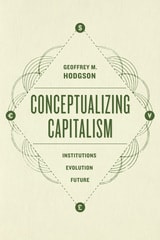
Conceptualizing Capitalism
Institutions, Evolution, FutureGeoffrey M. Hodgson
University of Chicago Press, 2015
With Conceptualizing Capitalism, Geoffrey M. Hodgson offers readers a more precise conceptual framework. Drawing on a new theoretical approach called legal institutionalism, Hodgson establishes that the most important factor in the emergence of capitalism—but also among the most often overlooked—is the constitutive role of law and the state. While private property and markets are central to capitalism, they depend upon the development of an effective legal framework. Applying this legally grounded approach to the emergence of capitalism in eighteenth-century Europe, Hodgson identifies the key institutional developments that coincided with its rise. That analysis enables him to counter the widespread view that capitalism is a natural and inevitable outcome of human societies, showing instead that it is a relatively recent phenomenon, contingent upon a special form of state that protects private property and enforces contracts. After establishing the nature of capitalism, the book considers what this more precise conceptual framework can tell us about the possible future of capitalism in the twenty-first century, where some of the most important concerns are the effects of globalization, the continuing growth of inequality, and the challenges to America’s hegemony by China and others.

Consumption and Violence
Radical Protest in Cold-War West GermanyAlexander Sedlmaier
University of Michigan Press, 2014
Cool Capitalism
Jim McGuigan
Pluto Press, 2009
Thomas Frank coined the term ‘the conquest of cool’. This book shows how this conquest is at the heart of the dynamics of contemporary capitalism.
Jim McGuigan argues that 'cool capitalism' incorporates disaffection into capitalism itself, absorbing rebellion and thereby neutralising opposition to the present system of culture and society.
McGuigan explores a huge variety of cultural examples, from the sleek images of mainstream advertising, to the fringes of artistic production, offering a vigourous critique of our understanding of subversion, resistance and counter-culturalism.
Has capitalism really colonised our planet? McGuigan shows that there is still some space left for rebellion against the seductive power of the free market economy.