Results by title
159 books match the query 'Change' and 15 start with c

Change
Mo Yan
Seagull Books, 2010
In Change, Mo Yan, the 2012 Nobel Laureate in Literature, personalizes the political and social changes in his country over the past few decades in this novella disguised as autobiography—or vice-versa. Unlike most historical narratives from China, which are pegged to political events, Change is a representative of “people’s history,” a bottom-up rather than top-down view of a country in flux. By moving back and forth in time and focusing on small events and everyday people, Mo Yan breathes life into history by describing the effects of larger-than-life events on the average citizen.
“Through a mixture of fantasy and reality, historical and social perspectives, Mo Yan has created a world reminiscent in its complexity of those in the writings of William Faulkner and Gabriel García Márquez, at the same time finding a departure point in old Chinese literature and in oral tradition.”— Nobel Committee for Literature

Change and Continuity in Minangkabau
Local, Regional, and Historical Perspectives on West SumatraLynn L. Thomas
Ohio University Press, 1985
Focusing on Minangkabau proper, and treating several adjacent areas as well, this collection examines the resilience and adaptability of the Minangkabau in the face of outside political and economic pressures and of distortions in social science and legal theory. Individual studies address issues of kinship and other forms of social organization, ideology, and political and economic life. Together, they emphasize the integrity of Minangkabau social forms while revealing fascinating patterns of continuity and change in Minangkabau culture.
This collection will be of particular interest to anthropologists specializing in Southeast Asia, but it will also be important reading for those concerned with the issue of change and continuity in the third world generally.

Change and Harmonization in European Education
Robert Beck
University of Minnesota Press, 1971

Change and Promise
Bilingual Deaf Education and Deaf Culture in Latin AmericaBarbara Gerner Gerner de Garcia
Gallaudet University Press, 2016
Change and Promise describes the historical, cultural, and political contexts for providing bilingual deaf education in Latin America. Bilingual deaf education uses students’ sign language, while simultaneously giving them access to and teaching them the majority spoken/written language. This book describes current bilingual deaf education programs in the region that have increased society’s understandings of Deaf culture and sign languages. This cause, as well as others, have been championed by successful social movements including the push for official recognition of Libras, the sign language of Brazil. Change and Promise covers this expanding empowerment of Deaf communities as they fight for bilingual deaf education, sign language rights, and deaf civil rights.
Despite the vast political and cultural differences throughout Latin America, an epistemological shift has occurred regarding how Deaf people are treated and their stories narrated, from labeling “deaf as handicapped” to being recognized as a linguistic minority. This panoramic study of these challenges and triumphs will provide an invaluable resource for improving outcomes in deaf education and help to secure the rights of deaf children and adults in all societies.
Change and the Persistence of Tradition in India
Five LecturesRichard L. Park, Editor
University of Michigan Press, 1971

Change in Putin's Russia
Power, Money and PeopleSimon Pirani
Pluto Press, 2010
Simon Pirani investigates the interaction of power, money and people in Russia during the presidencies of Vladimir Putin and his successor Dmitry Medvedev.
Profiling the Putin team, including contingents from the security services and pro-market economic "reformers", Pirani argues that the economic growth it presided over during the oil boom was one-sided. The gap between rich and poor widened. Now the boom is over, inequalities will multiply further. As well as explaining Russia's economic trajectory, the book provides a unique account of the social movements that are working against an increasingly authoritarian government to change Russia for the better.
This is the perfect introduction for undergraduates approaching Russia for the first time and those who wish to know how Russia will change during the economic crisis.

Change the World Without Taking Power
The Meaning of Revolution TodayJohn Holloway
Pluto Press, 2019
After a century of failed attempts by radical projects, the concept of revolution itself is in crisis. By asking the deepest questions about the nature of humanity, work, capitalism, organisation and resistance, John Holloway looks sharply at modern protest movements and provides tools for creating new strategies.
First published in 2002, this book marked a shift in the understanding of Autonomism, Anarchism and Marxism, addressing the doubts activists had in their own political history and work, and helped form the perspectives of a new generation who are today changing the world.
Composition in the Twenty-First Century
Crisis and ChangeEdited by Lynn Z. Bloom, Donald A. Daiker, and Edward M. White
Southern Illinois University Press, 1997
Despite its pervasiveness and its significance, composition has an unstable status within the curriculum. Writing programs and writing faculty are besieged by academic, political, and financial concerns that have not been well understood or addressed.
At many institutions, composition functions paradoxically as both the gateway to academic success and as the gatekeeper, reducing access to academic work and opportunity for those with limited facility in English. Although writing programs are expected to provide services that range from instruction in correct grammar to assisting—or resisting—political correctness, expanding programs and shrinking faculty get caught in the crossfire. The bottom line becomes the firing line as forces outside the classroom determine funding and seek to define what composition should do.
In search of that definition, the contributors ask and answer a series of specific and salient questions: What implications—intellectual, political, and institutional—will forces outside the classroom have on the quality and delivery of composition in the twenty-first century? How will faculty and administrators identify and address these issues? What policies and practices ought we propose for the century to come?
This book features sixteen position papers by distinguished scholars and researchers in composition and rhetoric; most of the papers are followed by invited responses by other notable compositionists. In all, twenty-five contributors approach composition from a wide variety of contemporary perspectives: rhetorical, historical, social, cultural, political, intellectual, economic, structural, administrative, and developmental. They propose solutions applicable to pedagogy, research, graduate training of composition teachers, academic administration, and public and social policy. In a very real sense, then, this is the only book to offer a map to the future of composition.
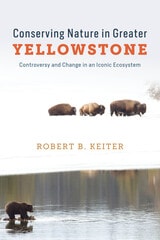
Conserving Nature in Greater Yellowstone
Controversy and Change in an Iconic EcosystemRobert B. Keiter
University of Chicago Press, 2025
For more than 150 years, the Yellowstone region—now widely known as the twenty-three million acre Greater Yellowstone Ecosystem—has played a prominent role in the United States’ nature conservation agenda. In this book, Robert B. Keiter, an award-winning public land law and policy expert, traces the evolution and application of fundamental ecological conservation concepts tied to Yellowstone.
Keiter’s book highlights both the conservation successes and controversies connected with this storied region, which has been enmeshed in change. During the 1980s, leaders in Yellowstone embraced ecosystem management concepts to recover a dwindling grizzly bear population and to support wolf reintroduction. Since then, management policies in the region’s two national parks and adjacent national forests have largely followed suit, prioritizing ecosystem-level conservation over industrial activity. Groundbreaking efforts are currently afoot to protect elk, deer, and pronghorn migration corridors and to maintain the park’s bison population, effectively expanding the scope of regional conservation initiatives. But in the face of explosive human population growth and related development pressures, new efforts must also account for the region’s privately owned lands along with accelerating recreational activities that present quite different problems.
Indeed, the Greater Yellowstone Ecosystem—extending across three states and twenty counties and embracing more than sixteen million acres of federal land as well as private and tribal lands —can only be characterized as a complex, jurisdictionally fragmented landscape. As Keiter makes clear, the quest for common ground among federal land managers, state officials, local communities, conservationists, ranchers, Indigenous tribes, and others is a vital, enduring task.
Exploring both notable conservation accomplishments and the ongoing challenges confronting this special place, Keiter’s book explains the many forces—scientific, political, economic, legal, cultural, climatic, and more—at work driving controversy and change across the region. But more than this, Conserving Nature in Greater Yellowstone shows us that the lessons gleaned from Yellowstone’s expansive nature conservation efforts are profoundly important for both the country and the world.
Conserving Nature in Greater Yellowstone
Controversy and Change in an Iconic EcosystemRobert B. Keiter
University of Chicago Press, 2025
The story of how Yellowstone, established in 1872 as the world’s first national park, has become synonymous with nature conservation—and an examination of today’s challenges to preserve the region’s wilderness heritage.
For more than 150 years, the Yellowstone region—now widely known as the twenty-three million acre Greater Yellowstone Ecosystem—has played a prominent role in the United States’ nature conservation agenda. In this book, Robert B. Keiter, an award-winning public land law and policy expert, traces the evolution and application of fundamental ecological conservation concepts tied to Yellowstone.
Keiter’s book highlights both the conservation successes and controversies connected with this storied region, which has been enmeshed in change. During the 1980s, leaders in Yellowstone embraced ecosystem management concepts to recover a dwindling grizzly bear population and to support wolf reintroduction. Since then, management policies in the region’s two national parks and adjacent national forests have largely followed suit, prioritizing ecosystem-level conservation over industrial activity. Groundbreaking efforts are currently afoot to protect elk, deer, and pronghorn migration corridors and to maintain the park’s bison population, effectively expanding the scope of regional conservation initiatives. But in the face of explosive human population growth and related development pressures, new efforts must also account for the region’s privately owned lands along with accelerating recreational activities that present quite different problems.
Indeed, the Greater Yellowstone Ecosystem—extending across three states and twenty counties and embracing more than sixteen million acres of federal land as well as private and tribal lands —can only be characterized as a complex, jurisdictionally fragmented landscape. As Keiter makes clear, the quest for common ground among federal land managers, state officials, local communities, conservationists, ranchers, Indigenous tribes, and others is a vital, enduring task.
Exploring both notable conservation accomplishments and the ongoing challenges confronting this special place, Keiter’s book explains the many forces—scientific, political, economic, legal, cultural, climatic, and more—at work driving controversy and change across the region. But more than this, Conserving Nature in Greater Yellowstone shows us that the lessons gleaned from Yellowstone’s expansive nature conservation efforts are profoundly important for both the country and the world.

Contact, Structure, and Change
A Festschrift in Honor of Sarah G. ThomasonEdited by Anna M. Babel and Mark A. Sicoli
Michigan Publishing Services, 2021

Continuity and Change on the United States Courts of Appeals
Donald R. Songer, Reginald S. Sheehan, and Susan B. Haire
University of Michigan Press, 2000
The authors present the first comprehensive examination of the shifting role of the Courts of Appeals, investigating changes over time and presenting the first systematic analyses of those changes. Their work is the first book to utilize the database of the U.S. Courts of Appeals, analyzing over 15,000 cases to examine trends between 1925 and 1988. The book answers questions such as who are the judges? What are their decisional tendencies? What has been the role of region and partisan politics? Who are the litigants? And who has won and who has lost throughout the twentieth century? It is the only current, up-to-date book on the Courts of Appeals and an essential read for all scholars and students interested in American politics and judicial behavior.
Donald R. Songer is Professor of Political Science, University of South Carolina. Reginald S. Sheehan is Associate Professor of Political Science and Director of the Program for Law and Juridical Politics, Michigan State University. Susan B. Haire is Assistant Professor of Political Science, University of Georgia

Continuity, Change and Pragmatism in the Law
Essays in Memory of Professor Angelo ForteAndrew R.C. Simpson, Scott Crichton Styles, Euan West and Adelyn L.M. Wilson
Aberdeen University Press, 2016
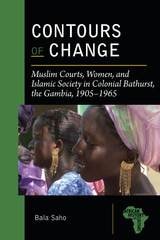
Contours of Change
Muslim Courts, Women, and Islamic Society in Colonial Bathurst, the Gambia, 1905-1965Bala Saho
Michigan State University Press, 2018
Creating a New World Economy
Forces of Change and Plans for Actionedited by Gerald Epstein, Julie Graham and Jessica Nembhard, foreword by Samuel Bowles
Temple University Press, 1993