Results by title
444 books match the query 'Chemistry' and 36 start with c
California Futures
Haunted Ecologies, Decolonial RelationsDaniel Lanza Rivers
Duke University Press, 2026
California
A Fire SurveyStephen J. Pyne
University of Arizona Press, 2016
In this collection of essays on the region, Stephen J. Pyne colorfully explores the ways the region has approached fire management and what sets it apart from other parts of the country. Pyne writes that what makes California’s fire scene unique is how its dramatically distinctive biomes have been yoked to a common system, ultimately committed to suppression, and how its fires burn with a character and on a scale commensurate with the state’s size and political power. California has not only a ferocity of flame but a cultural intensity that few places can match. California’s fires are instantly and hugely broadcast. They shape national institutions, and they have repeatedly defined the discourse of fire’s history. No other place has so sculpted the American way of fire.
California is part of the multivolume series describing the nation’s fire scene region by region. The volumes in To the Last Smoke also cover Florida, the Northern Rockies, the Great Plains, the Southwest, and several other critical fire regions. The series serves as an important punctuation point to Pyne’s fifty-year career with wildland fire—both as a firefighter and a fire scholar. These unique surveys of regional pyrogeography are Pyne’s way of “keeping with it to the end,” encompassing the directive from his rookie season to stay with every fire “to the last smoke.”
Camera Geologica
An Elemental History of PhotographySiobhan Angus
Duke University Press, 2024
Cape Cod
An Environmental History of a Fragile EcosystemJohn T. Cumbler
University of Massachusetts Press, 2014
John T. Cumbler's book offers an environmental, social, and economic history of Cape Cod told through the experiences of residents as well as visitors. He notes that over the past four hundred years the Cape has experienced three regimes of resource utilization. The first regime of Native Americans who lived relatively lightly on the land was supplanted by European settlers who focused on production and extraction. This second regime began in the age of sail but declined through the age of steam as the soil and seas failed to yield the resources necessary to sustain continuing growth. Environmental and then economic crises during the second half of the nineteenth century eventually gave way to the third regime of tourism and recreation. But this regime has its own environmental costs, as residents have learned over the last half century.
Although the Cape remains a special place, its history of resource scarcity and its attempts to deal with that scarcity offer useful lessons for anyone addressing similar issues around the globe.
Captive Ecologies
The Environmental Afterlives of SlaveryJennifer C. James
Duke University Press, 2026
Carbon Criminals, Climate Crimes
Ronald C. Kramer
Rutgers University Press, 2020
Carbon Criminals, Climate Crimes analyzes the looming threats posed by climate change from a criminological perspective. It advances the field of green criminology through a examination of the criminal nature of catastrophic environmental harms resulting from the release of greenhouse gases. The book describes and explains what corporations in the fossil fuel industry, the U.S. government, and the international political community did, or failed to do, in relation to global warming. Carbon Criminals, Climate Crimes integrates research and theory from a wide variety of disciplines, to analyze four specific state-corporate climate crimes: continued extraction of fossil fuels and rising carbon emissions; political omission (failure) related to the mitigation of these emissions; socially organized climate change denial; and climate crimes of empire, which include militaristic forms of adaptation to climate disruption. The final chapter reviews policies that could mitigate greenhouse gas emissions, adapt to a warming world, and achieve climate justice.
Carbon Strategies
How Leading Companies Are Reducing Their Climate Change FootprintAndrew J. Hoffman
University of Michigan Press, 2007
Cataclysms
An Environmental History of HumanityLaurent Testot
University of Chicago Press, 2020
Testot explores the interconnected histories of human evolution and planetary deterioration, arguing that our development from naked apes to Homo sapiens has entailed wide-scale environmental harm. Testot makes the case that humans have usually been catastrophic for the planet, “hyperpredators” responsible for mass extinctions, deforestation, global warming, ocean acidification, and unchecked pollution, as well as the slaughter of our own species. Organized chronologically around seven technological revolutions, Cataclysms unspools the intertwined saga of humanity and our environment, from our shy beginnings in Africa to today’s domination of the planet, revealing how we have blown past any limits along the way—whether by exploding our own population numbers, domesticating countless other species, or harnessing energy from fossils. Testot’s book, while sweeping, is light and approachable, telling the stories—sometimes rambunctious, sometimes appalling—of how a glorified monkey transformed its own environment beyond all recognition.
In order to begin reversing our environmental disaster, we must have a better understanding of our own past and the incalculable environmental costs incurred at every stage of human innovation. Cataclysms offers that understanding and the hope that we can now begin to reform our relationship to the Earth.
Cattle Bring Us to Our Enemies
Turkana Ecology, Politics, and Raiding in a Disequilibrium SystemJ. Terrence McCabe
University of Michigan Press, 2004
Based on sixteen years of fieldwork among the pastoral Turkana people, McCabe examines how individuals use the land and make decisions about mobility, livestock, and the use of natural resources in an environment characterized by aridity, unpredictability, insecurity, and violence. The Turkana are one of the world's most mobile peoples, but understanding why and how they move is a complex task influenced by politics, violence, historical relations among ethnic groups, and the government, as well as by the arid land they call home.
As one of the original members of the South Turkana Ecosystem Project, McCabe draws on a wealth of ecological data in his analysis. His long-standing relationship with four Turkana families personalize his insights and conclusions, inviting readers into the lives of these individuals, their families, and the way they cope with their environment and political events in daily life.
J. Terrence McCabe is Associate Professor of Anthropology, University of Colorado at Boulder.

Chemical Demonstrations, Volume 1
A Handbook for Teachers of ChemistryBassam Z. Shakhashiri
University of Wisconsin Press, 1983
The demonstrations capture interest, teach, inform, fascinate, amaze, and perhaps, most importantly, involve students in chemistry. Nowhere else will you find books that answer, "How come it happens? . . . Is it safe? . . . What do I do with all the stuff when the demo is over?"
Shakhashiri and his collaborators offer 282 chemical demonstrations arranged in 11 chapters. Each demonstration includes seven sections: a brief summary, a materials list, a step-by-step account of procedures to be used, an explanation of the hazards involved, information on how to store or dispose of the chemicals used, a discussion of the phenomena displayed and principles illustrated by the demonstration, and a list of references.

Chemical Demonstrations, Volume 2
A Handbook for Teachers of ChemistryBassam Z. Shakhashiri
University of Wisconsin Press, 1985
The demonstrations capture interest, teach, inform, fascinate, amaze, and perhaps, most importantly, involve students in chemistry. Nowhere else will you find books that answer, "How come it happens? . . . Is it safe? . . . What do I do with all the stuff when the demo is over?"
Shakhashiri and his collaborators offer 282 chemical demonstrations arranged in 11 chapters. Each demonstration includes seven sections: a brief summary, a materials list, a step-by-step account of procedures to be used, an explanation of the hazards involved, information on how to store or dispose of the chemicals used, a discussion of the phenomena displayed and principles illustrated by the demonstration, and a list of references.

Chemical Demonstrations, Volume 3
A Handbook for Teachers of ChemistryBassam Z. Shakhashiri
University of Wisconsin Press, 1989
The demonstrations capture interest, teach, inform, fascinate, amaze, and perhaps, most importantly, involve students in chemistry. Nowhere else will you find books that answer, "How come it happens? . . . Is it safe? . . . What do I do with all the stuff when the demo is over?"
Shakhashiri and his collaborators offer 282 chemical demonstrations arranged in 11 chapters. Each demonstration includes seven sections: a brief summary, a materials list, a step-by-step account of procedures to be used, an explanation of the hazards involved, information on how to store or dispose of the chemicals used, a discussion of the phenomena displayed and principles illustrated by the demonstration, and a list of references. You'll find safety emphasized throughout the book in each demonstration.

Chemical Demonstrations, Volume 4
A Handbook for Teachers of ChemistryBassam Z. Shakhashiri
University of Wisconsin Press, 1992
The demonstrations capture interest, teach, inform, fascinate, amaze, and perhaps, most importantly, involve students in chemistry. Nowhere else will you find books that answer, "How come it happens? . . . Is it safe? . . . What do I do with all the stuff when the demo is over?"
Shakhashiri and his collaborators offer 282 chemical demonstrations arranged in 11 chapters. Each demonstration includes seven sections: a brief summary, a materials list, a step-by-step account of procedures to be used, an explanation of the hazards involved, information on how to store or dispose of the chemicals used, a discussion of the phenomena displayed and principles illustrated by the demonstration, and a list of references. You'll find safety emphasized throughout the book in each demonstration.
Chemical Demonstrations, Volume 5
A Handbook for Teachers of ChemistryBassam Z. Shakhashiri
University of Wisconsin Press, 2011
Color and light are the focus of this long-awaited fifth volume in the Chemical Demonstrations series, which describes demonstrations that effectively communicate science to both students and general audiences. Using full color illustrations, the book provides meticulous instructions for safely demonstrating colorful phenomena and illustrating scientific principles. A rich introductory section explores the science of color and light, outlines the chemical processes of vision, and explains what happens when visual information enters the human eye and is perceived by the brain. With more than fifty demonstrations and multiple procedures included, this volume offers abundant opportunities to arouse and sustain interest in science for both classroom and public presentations.
Each demonstration includes:
• a brief description of the demonstration
• a materials list
• a step-by-step account of procedures to be used
• an explanation of the potential hazards involved
• information on safely storing and disposing the chemicals used
• a full discussion of the phenomena displayed and principles illustrated
• a list of references.
Created by acclaimed chemists and science educators Bassam Shakhashiri and his collaborators Rodney Schreiner and Jerry Bell, these demonstrations make an impressive addition to the earlier volumes, which have been lauded for guiding teachers and scientists in effectively communicating science. Like all volumes in the series, Volume 5 communicates chemistry using pedagogical knowledge to enhance the effectiveness of demonstrations to all audiences.
Chemical Lands
Pesticides, Aerial Spraying, and Health in North America’s Grasslands since 1945David D. Vail
University of Alabama Press, 2018
An exploration of the elaborate relationship between farmers, aerial sprayers, agriculturalists, crop pests, chemicals, and the environment.
The controversies in the 1960s and 1970s that swirled around indiscriminate use of agricultural chemicals—their long-term ecological harm versus food production benefits—were sparked and clarified by biologist Rachel Carson’s Silent Spring (1962). This seminal publication challenged long-held assumptions concerning the industrial might of American agriculture while sounding an alarm for the damaging persistence of pesticides, especially chlorinated hydrocarbons such as DDT, in the larger environment.
In Chemical Lands: Pesticides, Aerial Spraying, and Health in North America’s Grasslands since 1945 David D. Vail shows, however, that a distinctly regional view of agricultural health evolved. His analysis reveals a particularly strong ethic in the North American grasslands where practitioners sought to understand and deploy insecticides and herbicides by designing local scientific experiments, engineering more precise aircraft sprayers, developing more narrowly specific chemicals, and planting targeted test crops. Their efforts to link the science of toxicology with environmental health reveal how the practitioners of pesticides evaluated potential hazards in the agricultural landscape while recognizing the production benefits of controlled spraying.
Chemical Lands adds to a growing list of books on toxins in the American landscape. This study provides a unique Grasslands perspective of the Ag pilots, weed scientists, and farmers who struggled to navigate novel technologies for spray planes and in the development of new herbicides/insecticides while striving to manage and mitigate threats to human health and the environment.

Chemistry and Medicine
Papers Presented at the Fiftieth Anniversary of the Founding of the Medical School of the University of MinnesotaMaurice B. Visscher
University of Minnesota Press, 1940
Chemistry and Medicine was first published in 1940. Minnesota Archive Editions uses digital technology to make long-unavailable books once again accessible, and are published unaltered from the original University of Minnesota Press editions.
Choked
Life and Breath in the Age of Air PollutionBeth Gardiner
University of Chicago Press, 2019
Air pollution prematurely kills seven million people every year, including more than one hundred thousand Americans. It is strongly linked to strokes, heart attacks, many kinds of cancer, dementia, and premature birth, among other ailments. In Choked, Beth Gardiner travels the world to tell the story of this modern-day plague, taking readers from the halls of power in Washington and the diesel-fogged London streets she walks with her daughter to Poland’s coal heartland and India’s gasping capital. In a gripping narrative that’s alive with powerful voices and personalities, she exposes the political decisions and economic forces that have kept so many of us breathing dirty air. This is a moving, up-close look at the human toll, where we meet the scientists who have transformed our understanding of pollution’s effects on the body and the ordinary people fighting for a cleaner future.
In the United States, air is far cleaner than it once was. But progress has failed to keep up with the science, which tells us that even today’s lower pollution levels are doing real damage. And as the Trump administration rips up the regulations that have brought us where we are, decades of gains are now at risk. Elsewhere, the problem is far worse, and choking nations like China are scrambling to replicate the achievements of an American agency—the EPA—that until recently was the envy of the world.
Clean air feels like a birthright. But it can disappear in a puff of smoke if the rules that protect it are unraveled. At home and around the world, it’s never been more important to understand how progress happened and what dangers might still be in store. Choked shows us that we hold the power to build a cleaner, healthier future: one in which breathing, life’s most basic function, no longer carries a hidden danger.
Christianity, Wilderness, and Wildlife
Susan Bratton
University of Scranton Press, 2009
Citizens, Experts, and the Environment
The Politics of Local KnowledgeFrank Fischer
Duke University Press, 2000
Where information ideologues see the modern increase in information as capable of making everyone smarter, others see the emergence of a society divided between those with and those without knowledge. Suggesting realistic strategies to bridge this divide, Fischer calls for meaningful nonexpert involvement in policymaking and shows how the deliberations of ordinary citizens can help solve complex social and environmental problems by contributing local contextual knowledge to the professionals’ expertise. While incorporating theoretical critiques of positivism and methodology, he also offers hard evidence to demonstrate that the ordinary citizen is capable of a great deal more participation than is generally recognized. Popular epidemiology in the United States, the Danish consensus conference, and participatory resource mapping in India serve as examples of the type of inquiry he proposes, showing how the local knowledge of citizens is invaluable to policy formation. In his conclusion Fischer examines the implications of the approach for participatory democracy and the democratization of contemporary deliberative structures.
This study will interest political scientists, public policy practitioners, sociologists, scientists, environmentalists, political activists, urban planners, and public administrators along with those interested in understanding the relationship between democracy and science in a modern technological society.
Civic Empowerment in an Age of Corporate Greed
Edward C. Lorenz
Michigan State University Press, 2012
A thought-provoking investigation of an urgent issue facing American communities today, Edward C. Lorenz’s book examines the intersection of corporate irresponsibility and civic engagement. At the heart of this case study is a group of firms responsible for seven of the most contaminated Superfund sites in the United States, the largest food contamination accident in U.S. history, stunning stock and financial manipulations, and a massive shift of jobs off shore. In the face of these egregious environmental, employee, and investor abuses, several communities impacted by these firms organized to confront and combat failures in corporate and bureaucratic leadership, winning notable victories over major financiers, lobbyists, and indifferent or ineffective government agencies. A critical analysis of public and private leadership, business and economic ethics, and civic life, this book concludes with a stirring blueprint for other communities facing similarly overwhelming opposition.
Climate Change and the New Polar Aesthetics
Artists Reimagine the Arctic and AntarcticLisa E. Bloom
Duke University Press, 2022

Cold Running River
David N. Cassuto
University of Michigan Press, 1994
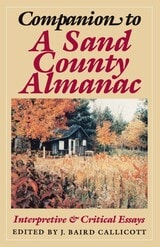
Companion to A Sand County Almanac
Interpretive and Critical EssaysJ. Baird Callicott
University of Wisconsin Press, 1987
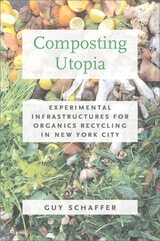
Composting Utopia
Experimental Infrastructures for Organics Recycling in New York CityGuy Schaffer
University of Massachusetts Press, 2023
New Yorkers generate millions of tons of trash annually, which, through the magic of infrastructure and one of the largest waste management systems in the world, disappears from city sidewalks each night. Under pressure from environmentalists, activists, policymakers, and industry, the New York City Department of Sanitation started exploring ways to divert organic material from the waste stream, and in 2013, launched its composting pilot program.
Drawing on three years of ethnographic fieldwork with community composters and microhaulers in New York City, alongside the rollout of the city’s curbside organics collection system, Composting Utopia describes how local, grassroots organizations intervened in the city’s waste system, enacting change and presenting an alternative vision of the composting city. As Guy Shaffer argues, movement-driven infrastructure projects develop new tools for organizing the world, give communities agency over urban design, and promote just sustainability.
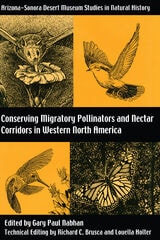
Conserving Migratory Pollinators and Nectar Corridors in Western North America
Gary Paul Nabhan
University of Arizona Press, 2004
This book, a unique work of comparative zoogeography and conservation biology, is the first to bring together studies of these important migratory pollinators and of what we must do to conserve them. It considers the similarities and differences among the behavior and habitat requirements of several species of migratory pollinators and seed dispersers in the West—primarily rufous hummingbirds, white-winged doves, lesser long-nosed bats, and monarch butterflies. It examines the population dynamics of these four species in flyways that extend from the Pacific Ocean to the continental backbone of the Sierra Madre Oriental and Rocky Mountains, and it investigates their foraging and roosting behaviors as they journey from the Tropic of Cancer in western Mexico into the deserts, grasslands, and thornscrub of the U.S.-Mexico borderlands. The four pollinators whose journeys are traced here differ dramatically from one another in foraging strategies and stopover fidelities, but all challenge many of the truisms that have emerged regarding the status of migratory species in general. The rufous hummingbird makes the longest known avian migration in relation to body size and is a key to identifying nectar corridors running through northwestern Mexico to the United States. And there is new evidence to challenge the long-supposed separation of eastern and western monarch butterfly populations by the Rocky Mountains as these insects migrate.
Conserving Migratory Pollinators and Nectar Corridors in Western North America demonstrates new efforts to understand migratory species and to determine whether their densities, survival rates, and health are changing in response to changes in the distribution and abundance of nectar plants found within their ranges. Representing collaborative efforts that bridge field ecology and conservation biology in both theory and practice, it is dedicated to safeguarding dynamic interactions among plants and pollinators that are only now being identified.

Constructing Modern Chemistry
J. B. Dumas and the French AtomAlan J. Rocke
University of Chicago Press, 0
A history of chemical atomic theory that centers on France and Jean-Baptiste Dumas, yielding new perspectives on the origins of modern chemistry.
Constructing Modern Chemistry examines the early history of the chemical atomic theory, focusing on France. Rather than beginning with John Dalton and the theory of the atom, skipping right to the periodic system, and rushing headlong into the discovery of subatomic particles, Alan J. Rocke traces relevant ideas and practices from their origins in Britain shortly after 1800 to their early reception in France. Then he addresses their history, especially among French and Francophone chemists (including connections to Britain, Sweden, and the German-speaking lands), up until about 1860. The major figure in the book is the curiously understudied but extraordinarily influential Jean-Baptiste Dumas (1800–1884).
The atomic theory is to the history of chemistry what Copernican cosmology is to the history of astronomy, what Newtonian mechanics is to the history of physics, and what evolution is to the history of biology: each of these ideas structures the very nature of scientific thought within its field. Constructing Modern Chemistry explores the changing nature of chemical theory, and of scientific theory in general, during the nineteenth century. Rocke sets out to show that the early history of chemical atomism provides important insight into theoretical patterns that became characteristic of the modern science of chemistry.
But while Rocke’s work will appeal to philosophers and others who value his analysis of theory and its workings, he places equal emphasis on social context: personal backstories, interpersonal relations, cultural and scientific institutions, and contingent events. The history that emerges is rich with insight into the origins of chemistry and its practices as we know it.
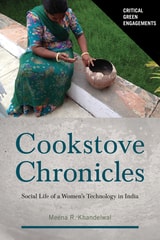
Cookstove Chronicles
Social Life of a Women’s Technology in IndiaMeena R. Khandelwal
University of Arizona Press, 2024
Based on anthropological research in Rajasthan, Cookstove Chronicles argues that the supposedly obsolete chulha persists because it offers women control over the tools needed to feed their families. Their continued use of old stoves alongside the new is not a failure to embrace new technologies but instead a strategy to maximize flexibility and autonomy. The chulha is neither the villain nor hero of this story. It produces particulate matter that harms people’s bodies, leaves soot on utensils and walls, and accelerates glacial melting and atmospheric warming. Yet it also depends on renewable biomass fuel and supports women’s autonomy as a local, do-it-yourself technology.
Meena Khandelwal, a feminist anthropologist, describes her collaboration with engineers, archaeologists, and others. She employs critical social theory and reflections from fieldwork to bring together research from a range of fields, including history, geography, anthropology, energy and environmental studies, public health, and science and technology studies (STS). In so doing she not only demystifies multidisciplinary research but also highlights the messy reality of actual behavior.
Cookstove Chronicles critically examines why, despite extensive development efforts, use of the chulha persists. It offers an important new framework for looking at development, technology, environmental change, and human behavior.
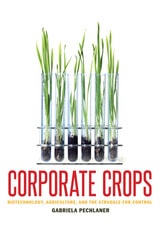
Corporate Crops
Biotechnology, Agriculture, and the Struggle for ControlBy Gabriela Pechlaner
University of Texas Press, 2012
Biotechnology crop production area increased from 1.7 million hectares to 148 million hectares worldwide between 1996 to 2010. While genetically modified food is a contentious issue, the debates are usually limited to health and environmental concerns, ignoring the broader questions of social control that arise when food production methods become corporate-owned intellectual property. Drawing on legal documents and dozens of interviews with farmers and other stakeholders, Corporate Crops covers four case studies based around litigation between biotechnology corporations and farmers. Pechlaner investigates the extent to which the proprietary aspects of biotechnologies—from patents on seeds to a plethora of new rules and contractual obligations associated with the technologies—are reorganizing crop production.
The lawsuits include patent infringement litigation launched by Monsanto against a Saskatchewan canola farmer who, in turn, claimed his crops had been involuntarily contaminated by the company’s GM technology; a class action application by two Saskatchewan organic canola farmers launched against Monsanto and Aventis (later Bayer) for the loss of their organic market due to contamination with GMOs; and two cases in Mississippi in which Monsanto sued farmers for saving seeds containing its patented GM technology. Pechlaner argues that well-funded corporate lawyers have a decided advantage over independent farmers in the courts and in creating new forms of power and control in agricultural production. Corporate Crops demonstrates the effects of this intersection between the courts and the fields where profits, not just a food supply, are reaped.

Cowbirds and Other Brood Parasites
Catherine P. Ortega
University of Arizona Press, 1998
In this timely book, Catherine Ortega summarizes and synthesizes a wealth of information on cowbirds from around the world that has appeared since the publication of Herbert Friedmann's classic 1929 monograph on these birds. Most of this information has appeared in the last quarter-century and reflects advances in our understanding of how brood parasitism influences, and is influenced by, host species. Ortega shows that in order to manage cowbirds without further damaging delicate balances in host-parasite relationships, it is necessary to understand such factors as behavior, reproduction, population dynamics, and response to landscape patterns. She examines and explains the origin, evolution, and costs of brood parasitism, and she discusses the philosophical and ecological considerations regarding the management of cowbirds—a controversial issue because of their perceived influence on threatened and endangered birds.
Because brood parasitism has evolved independently in various bird families, information on this adaptive strategy is of great ecological interest and considerable value to wildlife management. Cowbirds and Other Brood Parasites is an important reference on these creatures that enhances our understanding of both their behavior and their part in the natural world.

Cracked Coverage
Television News, The Anti-Cocaine Crusade, and the Reagan LegacyJimmie L. Reeves and Richard Campbell
Duke University Press, 1994
The authors persuasively argue, for example, that powder cocaine in the early Reagan years was understood and treated very differently on television and by the state than was crack cocaine, which was discovered by the news media in late 1985. In their critical analysis of 270 news stories broadcast between 1981 and 1988, Reeves and Campbell demonstrate a disturbing disparity between the earlier presentation of the middle- and upper-class "white" drug offender, for whom therapeutic recovery was an available option, and the subsequent news treatment of the inner-city "black" drug delinquent, often described as beyond rehabilitation and subject only to intensified strategies of law and order. Enlivened by provocative discussions of Nancy Reagan’s antidrug activism, the dramatic death of basketball star Len Bias, and the myth of the crack baby, the book argues that Reagan’s war on drugs was at heart a political spectacle that advanced the reactionary agenda of the New and Religious Right—an agenda that dismissed social problems grounded in economic devastation as individual moral problems that could simply be remedied by just saying "no."
Wide ranging and authoritative, Cracked Coverage: Television News, the Anti-Cocaine Crusade, and the Reagan Legacy is a truly interdisciplinary work that will attract readers across the humanities and social sciences in addition to students, scholars, journalists, and policy makers interested in the media and drug-related issues.

Cracked Coverage
Television News, The Anti-Cocaine Crusade, and the Reagan LegacyJimmie L. Reeves and Richard Campbell
Duke University Press, 0
The authors persuasively argue, for example, that powder cocaine in the early Reagan years was understood and treated very differently on television and by the state than was crack cocaine, which was discovered by the news media in late 1985. In their critical analysis of 270 news stories broadcast between 1981 and 1988, Reeves and Campbell demonstrate a disturbing disparity between the earlier presentation of the middle- and upper-class "white" drug offender, for whom therapeutic recovery was an available option, and the subsequent news treatment of the inner-city "black" drug delinquent, often described as beyond rehabilitation and subject only to intensified strategies of law and order. Enlivened by provocative discussions of Nancy Reagan’s antidrug activism, the dramatic death of basketball star Len Bias, and the myth of the crack baby, the book argues that Reagan’s war on drugs was at heart a political spectacle that advanced the reactionary agenda of the New and Religious Right—an agenda that dismissed social problems grounded in economic devastation as individual moral problems that could simply be remedied by just saying "no."
Wide ranging and authoritative, Cracked Coverage: Television News, the Anti-Cocaine Crusade, and the Reagan Legacy is a truly interdisciplinary work that will attract readers across the humanities and social sciences in addition to students, scholars, journalists, and policy makers interested in the media and drug-related issues.
Crisis of the Wasteful Nation
Empire and Conservation in Theodore Roosevelt's AmericaIan Tyrrell
University of Chicago Press, 2014
In Crisis of the Wasteful Nation, Ian Tyrrell gives us a cohesive picture of Roosevelt’s engagement with the natural world along with a compelling portrait of how Americans used, wasted, and worried about natural resources in a time of burgeoning empire. Countering traditional narratives that cast conservation as a purely domestic issue, Tyrrell shows that the movement had global significance, playing a key role in domestic security and in defining American interests around the world. Tyrrell goes beyond Roosevelt to encompass other conservation advocates and policy makers, particularly those engaged with shaping the nation’s economic and social policies—policies built on an understanding of the importance of crucial natural resources. Crisis of the Wasteful Nation is a sweeping transnational work that blends environmental, economic, and imperial history into a cohesive tale of America’s fraught relationships with raw materials, other countries, and the animal kingdom.
Cultivating Environmental Justice
A Literary History of U.S. Garden WritingRobert S. Emmett
University of Massachusetts Press, 2016
Drawing on ecocriticism, environmental history, landscape architecture, and recent work in environmental justice and food studies, Emmett explores how the language of environmental justice emerged in descriptions of gardening across a variety of literary forms. He reveals early egalitarian associations found in garden writing, despite a popular focus on elite sites such as suburban lawns and formal southern gardens. Cultivating Environmental Justice emphasizes the intergenerational work of gardeners and garden writers who, from the 1930s on, asserted increasingly radical socioeconomic and ecological claims to justice. Emmett considers a wide range of texts by authors including Bernard M'Mahon, Scott and Helen Nearing, Katharine S. White, Elizabeth Lawrence, Alice Walker, and Novella Carpenter.
Cultural Values and Human Ecology in Southeast Asia
Karl L. Hutterer, A. Terry Rambo, and George Lovelace, Editors
University of Michigan Press, 1981
Culture and Global Change
Social Perceptions of Deforestation in the Lacandona Rain Forest in MexicoLourdes Arizpe, Fernanda Paz, and Margarita Velazquez
University of Michigan Press, 1996
The authors of this compelling book argue that before suitable solutions can be found to pressing environmental problems, we need a way to gather information on the human dimensions of global changes. How do small and everyday individual actions add up to the intricate networks of global interactions? What are our rights and responsibilities as humans toward the planet and its natural resources?
The Lacandon rain forest in Mexico provides a vivid example of an environmental challenge that will demand the concerted efforts of many different groups, and not only technical solutions, to resolve successfully. Using data taken largely from in-depth interviews with landowners, farm workers, cattle raisers, housewives, professionals, and civil servants, the authors draw a rich portrait of the varied perceptions and positions these groups and individuals hold. At issue are the social, rather than psychological, bases of their perspectives.
Culture and Global Change offers a model for how the social sciences, and anthropology in particular, can lead the way in developing comprehensive understandings of the interrelationships between groups at the local, regional, and international levels that affect perceptions of the environment and thus the viability of solutions. It is required reading for anthropologists and environmental activists alike.
Lourdes Arizpe is Assistant Director-General for Culture, UNESCO. Fernanda Paz and Margarita Vel´zquez work for the Centro Regional de Investigaciones Multidisciplinarias, Universidad Nacional Autonoma de México.
Custodians of the Land
Ecology and Culture in the History of TanzaniaGregory H. Maddox
Ohio University Press, 1995
Farming and pastoral societies inhabit ever-changing environments. This relationship between environment and rural culture, politics and economy in Tanzania is the subject of this volume which will be valuable in reopening debates on Tanzanian history.
In his conclusion, Isaria N. Kimambo, a founding father of Tanzanian history, reflects on the efforts of successive historians to strike a balance between external causes of change and local initiative in their interpretations of Tanzanian history.
He shows that nationalist and Marxist historians of Tanzanian history, understandably preoccupied through the first quarter-century of the country's post-colonial history with the impact of imperialism and capitalism on East Africa, tended to overlook the initiatives taken by rural societies to transform themselves.
Yet there is good reason for historians to think about the causes of change and innovation in the rural communities of Tanzania, because farming and pastoral people have constantly changed as they adjusted to shifting environmental conditions.