74 books match the query 'Church' and 7 start with c
cover of Catholic Dogmatic Theology: A Synthesis, Book 3: On the Church and the Sacraments

Catholic Dogmatic Theology

A Synthesis, Book 3: On the Church and the Sacraments

Jean-Herve Nicolas

Catholic University of America Press, 2024
Every discipline, including theology, requires a synthetic overview of its acquisitions and open questions, a kind of "topography" to guide the new student and refresh the gaze of specialists. In his Synthèse dogmatique, Fr. Jean-Hervé Nicolas, OP (1910-2001) presents just such a map of Thomistic theology, focusing on the central topics of Dogmatic Theology: The One and Triune God, Christology, Mariology, Ecclesiology, the Sacraments, and the Last Things. Drawing on decades of research and teaching, Fr. Nicolas synthetically presents these topics from a faithfully Thomistic perspective. While broadly and genially engaging the theological literature of the 20th century, he nonetheless remains deeply indebted to the Thomistic school that would have formed him in his youth as a theologian. This provides the reader with an unparalleled theological vision, masterfully bringing forth, at once, what is new and what is classical. Catholic Theology: A Dogmatic Synthesis is being published in English as a multi-volume work. In this volume, Fr. Nicolas takes up the raison d’être for the mission of the Holy Spirit: the work of sanctification in and through the Church, the mystical body of Christ and sacrament of salvation. In the ecclesiology articulated in this volume, he presents a theology of the Church that is at once wholly Thomistic and also faithful to the great themes of the Second Vatican Council, drawing especially from the works of Journet, Congar, and Bouyer, in critical dialogue with other theologians of his day. He then presents a complete and detailed sacramental theology, both concerning the nature of the sacraments in general, as well as concerning each sacrament in particular, carefully striving to balance positive and scholastic theology. Serving as a professor for decades, including at the University of Fribourg, Fr. Nicolas was at once a profound scholar and a masterful pedagogue. Gathering the work of a lifetime into a single pedagogical narrative, Fr. Nicolas's Catholic Theology: A Dogmatic Synthesis provides a resource for students and scholars alike. In view of the hyper-specialization of theology today, this series of volumes provides readers with a synthetic and sapiential overview of the fundamentals of dogmatic theology from a robust and profound Thomistic perspective.
[more]
cover of Church and Communion: An Introduction to Ecumenical Theology, Second Edition

Church and Communion

An Introduction to Ecumenical Theology, Second Edition

Philip Goyret

Catholic University of America Press, 2021
This book is about ecumenism, from a Catholic point of view. The first part, chapters 1 and 2, describe the history of divisions within the Church, as well as of the efforts to bring about Christian unity. The second part examines Ecumenism from a systematic theological perspective. This first part takes into account the different factors that led to definitive ruptures within the Church, which usually are not only theological. The text gives useful information about what happened after the respective divisions as well as about the various attempts to restore unity, the development of the Ecumenical Movement in the 20th Century, and the current situation of ecumenical dialogue within the Catholic Church. While offering insight into the sad history that has led to the present disunity, this work also highlights the way Christians have sought to bring to fulfill the petition of Christ that his disciples might be one, as He and the Father are one. The second part―chapters three, four and five―offers a systematic theological analysis of unity in the Church, from the point of view of dogmatic theology. We find here an explanation of the Catholic concept of ecumenism, of how Catholic theology understands the unity of the Church, and, finally, of the Catholic principles which sustain the efforts for regaining unity in the Church. The Second Vatican Council, and particularly the Constitution Lumen gentium and the Decree Unitatis redintegratio, are at the foundation of these reflections. At the same time, since the theology of the Church and the life of the Church are intimately connected, there is a profound link between this dogmatic section and the earlier historical section. The last chapter, about the practice of ecumenism, is also written from a theological perspective, but with more links with life and spirituality. The chapter recalls that ecumenism can never simply remain a set of theological principles, but rather inspires an attitude and action in charity which are essential to the Christian life.
[more]
cover of Church and People in Interregnum Britain

Church and People in Interregnum Britain

Edited by Fiona McCall

University of London Press, 2021
The English Civil War was followed by a period of unprecedented religious tolerance and the spread of new religious ideas and practices. Britain experienced a period of so-called “Godly religious rule” and a breakdown of religious uniformity that was perceived as a threat to social order by some and a welcome innovation to others. The period of Godly religious rule has been significantly neglected by historians—we know remarkably little about religious organization or experience at a parochial level in the 1640s and 1650s. This volume addresses these issues by investigating important questions concerning the relationship between religion and society in the years between the first Civil War and the Restoration. How did ordinary people experience this period of dramatic upheaval? How did religious imperatives change and develop? Did people resist Godly imperatives?With its nuanced analysis of Cromwell's England, Church and People in Interregnum Britain will interest religious scholars, enthusiasts of military history, and public historians.
[more]
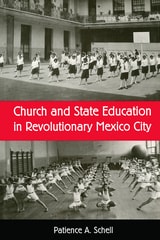
cover of Church and State Education in Revolutionary Mexico City

Church and State Education in Revolutionary Mexico City

Patience A. Schell

University of Arizona Press, 2003
Revolution in Mexico sought to subordinate church to state and push the church out of public life. Nevertheless, state and church shared a concern for the nation's social problems. Until the breakdown of church-state cooperation in 1926, they ignored the political chasm separating them to address those problems through education in order to instill in citizens a new sense of patriotism, a strong work ethic, and adherence to traditional gender roles. This book examines primary, vocational, private, and parochial education in Mexico City from 1917 to 1926 and shows how it was affected by the relations between the revolutionary state and the Roman Catholic Church. One of the first books to look at revolutionary programs in the capital immediately after the Revolution, it shows how government social reform and Catholic social action overlapped and identifies clear points of convergence while also offering vivid descriptions of everyday life in revolutionary Mexico City. Comparing curricula and practice in Catholic and public schools, Patience Schell describes scandals and successes in classrooms throughout Mexico City. Her re-creation of day-to-day schooling shows how teachers, inspectors, volunteers, and priests, even while facing material shortages, struggled to educate Mexico City's residents out of a conviction that they were transforming society. She also reviews broader federal and Catholic social action programs such as films, unionization projects, and libraries that sought to instill a new morality in the working class. Finally, she situates education among larger issues that eventually divided church and state and examines the impact of the restrictions placed on Catholic education in 1926. Schell sheds new light on the common cause between revolutionary state education and Catholic tradition and provides new insight into the wider issue of the relationship between the revolutionary state and civil society. As the presidency of Vicente Fox revives questions of church involvement in Mexican public life, her study provides a solid foundation for understanding the tenor and tenure of that age-old relationship.
[more]
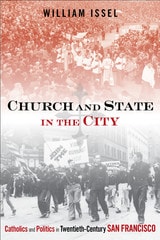
cover of Church and State in the City: Catholics and Politics in Twentieth-Century San Francisco

Church and State in the City

Catholics and Politics in Twentieth-Century San Francisco

William Issel

Temple University Press, 2012

Church and State in the City provides the first comprehensive analysis of the city’s long debate about the public interest. Historian William Issel explores the complex ways that the San Francisco Catholic Church—and its lay men and women—developed relationships with the local businesses, unions, other community groups, and city government to shape debates about how to define and implement the common good. Issel’s deeply researched narrative also sheds new light on the city’s socialists, including Communist Party activists—the most important transnational challengers of both capitalism and Catholicism during the twentieth century.

Moreover, Church and State in the City is revisionist in challenging the notion that the history of urban politics and policy can best be understood as the unfolding of a progressive, secular modernization of urban political culture. Issel shows how tussles over the public interest in San Francisco were both distinctive to the city and shaped by its American character.

In the series Urban Life, Landscape, and Policy, edited by Zane L. Miller, David Stradling, and Larry Bennett
[more]
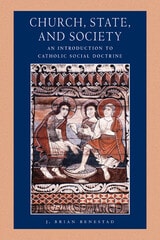
cover of Church, State, and Society: An Introduction to Catholic Social Doctrine

Church, State, and Society

An Introduction to Catholic Social Doctrine

J. Brian Benestad

Catholic University of America Press, 2011
Church, State, and Society explains the nuanced understanding of human dignity and the common good found in the Catholic intellectual tradition.
[more]
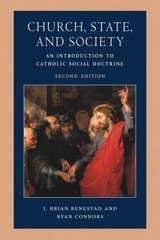
cover of Church, State, and Society: An Introduction to Catholic Social Doctrine, Second Edition

Church, State, and Society

An Introduction to Catholic Social Doctrine, Second Edition

J. Brian Benestad

Catholic University of America Press, 2025

Church, State, and Society explains the nuanced understanding of human dignity and the common good found in the Catholic intellectual tradition. It makes the case that liberal-arts education is an essential part of the common good because it helps people understand their dignity and all that justice requires. The book is divided into four parts. The first treats key themes of social life: the dignity of the human person, human rights, natural law, and the common good. Part two focuses on the three principal mediating institutions of civil society: the family, the Church, and the Catholic university. Part three considers the economy, work, poverty, immigration, and the environment, while part four focuses on the international community and just war principles. The conclusion discusses tension between Catholic Social Doctrine and liberal democracy. This second edition contains new chapters on religious liberty, cooperation with evil, issues around gender ideology, and contemporary questions of Catholics in political life, including regarding the reception of the sacraments. The book also includes new material on economic and social teaching of the Magisterium promulgated since the first edition, especially related to the teaching of Benedict XVI.
[more]