Results by title
172 books match the query 'Citizenship' and 31 start with c
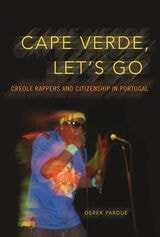
Cape Verde, Let's Go
Creole Rappers and Citizenship in PortugalDerek Pardue
University of Illinois Press, 2015
Drawing on fieldwork and archival research in Portugal and Cape Verde, Derek Pardue introduces Lisbon's kriolu rap scene and its role in challenging metropolitan Portuguese identities. Pardue demonstrates that Cape Verde, while relatively small within the Portuguese diaspora, offers valuable lessons about the politics of experience and social agency within a postcolonial context that remains poorly understood. As he argues, knowing more about both Cape Verdeans and the Portuguese invites clearer assessments of the relationship between the experience and policies of migration. That in turn allows us to better gauge citizenship as a balance of individual achievement and cultural ascription.
Deftly shifting from domestic to public spaces and from social media to ethnographic theory, Pardue describes an overlooked phenomenon transforming Portugal, one sure to have parallels in former colonial powers across twenty-first-century Europe.
Caribbean Inhospitality
The Poetics of Strangers at HomeNatalie Lauren Belisle
Rutgers University Press, 2025
Cities and Citizenship
James Holston, ed.
Duke University Press, 1998
Just as relations between nations are changing in the current phase of global capitalism, so too are relations between nations and cities. Written by internationally prominent scholars, the essays in Cities and Citizenship propose that “place” remains fundamental to these changes and that cities are crucial places for the development of new alignments of local and global identity. Through case studies from Africa, Europe, Latin America, and North America, the volume shows how cities make manifest national and transnational realignments of citizenship and how they generate new possibilities for democratic politics that transform people as citizens. Previously published as a special issue of Public Culture that won the 1996 Best Single Issue of a Journal Award from the Professional/Scholarly Publishing Division of the Association of American Publishers, the collection showcases a photo essay by Cristiano Mascaro, as well as two new essays by James Holston and Thomas Bender.
Cities and Citizenship will interest students and scholars of anthropology, geography, sociology, planning, and urban studies, as well as globalization and political science.
Contributors. Arjun Appadurai, Etienne Balibar, Thomas Bender, Teresa P. R. Caldeira, Mamadou Diouf, Dilip Parameshwar Gaonkar, James Holston, Marco Jacquemet, Christopher Kamrath, Cristiano Mascaro, Saskia Sassen, Michael Watts, Michel Wieviorka
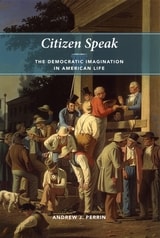
Citizen Speak
The Democratic Imagination in American LifeAndrew J. Perrin
University of Chicago Press, 2006
When we think about what constitutes being a good citizen, routine activities like voting, letter writing, and paying attention to the news spring to mind. But in Citizen Speak, Andrew J. Perrin argues that these activities are only a small part of democratic citizenship—a standard of citizenship that requires creative thinking, talking, and acting.
For Citizen Speak, Perrin met with labor, church, business, and sports organizations and proposed to them four fictive scenarios: what if your senator is involved in a scandal, or your police department is engaged in racial profiling, or a local factory violates pollution laws, or your nearby airport is slated for expansion? The conversations these challenges inspire, Perrin shows, require imagination. And what people can imagine doing in response to those scenarios depends on what’s possible, what’s important, what’s right, and what’s feasible. By talking with one another, an engaged citizenry draws from a repertoire of personal and institutional resources to understand and reimagine responses to situations as they arise. Building on such political discussions, Citizen Speak shows how a rich culture of association and democratic discourse provides the infrastructure for a healthy democracy.
Citizens on Stage
Comedy and Political Culture in the Athenian DemocracyJames F. McGlew
University of Michigan Press, 2002
Old Comedy gives Citizens on Stage its chronological backbone; the beginning and end of Aristophanes' career roughly define the period on which the book concentrates. Reading and interpreting comedy provides a model for reading Athenian politics itself. McGlew argues that the plays of Old Comedy, with their fantastic stories of common individuals triumphing over the various social and political dilemmas of democratic Athens, interpreted the relationship of private life and political activity for an Athenian audience, dramatically reaffirming the ties between citizens' personal desires and the will of the collective body. In particular, McGlew argues that comedy transforms private fantasies of personal power and pleasures--what seem most to keep the individual audience members apart--into a collective possession and touchstone of democratic citizen identity.
Citizens on Stage focuses primarily on the democratic citizen and on contemporary representations of him as a decision maker. McGlew shows that the democratic individual, sometimes idealized, sometimes despised, was a dominant concern of the literature and politics of late fifth- and early fourth-century Athens. This book will appeal to students of ancient theater and drama, Athenian politics and democracy, and the relationships between theater and politics. Social historians will also find it an invaluable resource.
James F. McGlew is Assistant Professor of Foreign Languages and Literatures and Classical Studies, Iowa State University.
Citizenship Debates
A ReaderGershon Shafir
University of Minnesota Press, 1998
Citizenship and Crisis
Arab Detroit After 9/11Russell Sage Foundation, 2009
Citizenship and Governance in a Changing City
Somerville, MASusan Ostrander
Temple University Press, 2013
In Citizenship and Governance in a Changing City, Susan Ostrander shows how beneath current high levels of engagement by Somerville residents lies a struggle about who should be the city's elected leaders and how they should conduct the city's affairs. It is a struggle waged between diverse residents--relatively new immigrants and a new middle class-trying to gain a foothold in democratic participation, and the city's political "old guard."
Citizenship and Governance in a Changing City informs current debates about the place of immigrants in civic and political life, and the role of voluntary associations in local politics and government. In the process, Ostrander provides useful lessons for many midsize urban communities.

Citizenship and Social Class
Tom Bottomore and T. H. Marshall
Pluto Press, 1992
Citizenship and Those Who Leave
The Politics of Emigration and ExpatriationEdited by Nancy L. Green and Fran‡ois Weil
University of Illinois Press, 2006
Exit, like entry, has helped define citizenship over the last two centuries, yet little attention has been given to the politics of emigration. How have countries impeded or facilitated people leaving? How have they perceived and regulated those who leave? What relations do they seek to maintain with their citizens abroad and why? Citizenship and Those Who Leave reverses the immigration perspective to examine how nations define themselves not just through entry but through exit as well.
Citizenship from Below
Erotic Agency and Caribbean FreedomMimi Sheller
Duke University Press, 2012
Attending to the hidden linkages among intimate realms and the public sphere, Sheller explores specific struggles for freedom, including women's political activism in Jamaica; the role of discourses of "manhood" in the making of free subjects, soldiers, and citizens; the fiercely ethnonationalist discourses that excluded South Asian and African indentured workers; the sexual politics of the low-bass beats and "bottoms up" moves in the dancehall; and the struggle for reproductive and LGBT rights and against homophobia in the contemporary Caribbean. Through her creative use of archival sources and emphasis on the connections between intimacy, violence, and citizenship, Sheller enriches critical theories of embodied freedom, sexual citizenship, and erotic agency in all post-slavery societies.
Citizenship in Cold War America
The National Security State and the Possibilities of DissentAndrea Friedman
University of Massachusetts Press, 2014
The stories told here capture a wide-ranging debate about the workings of the national security state and the meaning of American citizenship. Some of the participants in this debate—women like war bride Ellen Knauff and Pentagon employee Annie Lee Moss—were able to make their own experiences compelling examples of the threats posed by the national security regime. Others, such as Ruth Reynolds and Lolita Lebrón, who advocated an end to American empire in Puerto Rico, or the psychiatrist Fredric Wertham, who sought to change the very definition of national security, were less successful. Together, however, they exposed the gap between democratic ideals and government policies.
Friedman traverses immigration law and loyalty boards, popular culture and theoretical treatises, U.S. court-rooms and Puerto Rican jails, to demonstrate how Cold War repression made visible in new ways the unevenness and limitations of American citizenship. Highlighting the ways that race and gender shaped critiques and defenses of the national security regime, she offers new insight into the contradictions of Cold War political culture.
Citizenship in Question
Evidentiary Birthright and StatelessnessBenjamin N. Lawrance and Jacqueline Stevens, editors
Duke University Press, 2017
Citizenship in the American Republic
Brian L. Fife
University of Michigan Press, 2021
The Constitution has governed the United States since 1789, but many Americans are not aware of the structural rules that govern the oldest democracy in the world. Important public policy challenges require a knowledgeable, interested citizenry able to address the issues that represent the rich pageantry of American society. Issues such as climate change, national debt, poverty, pandemics, income inequality, and more can be addressed sufficiently if citizens play an active role in their own republic. Collectively, citizens are vulnerable to exploitation and manipulation if we place limits on our individual political knowledge. A more informed, engaged citizenry can best rise to the great policy challenges of contemporary society and beyond.
Brian L. Fife provides readers with essential information on all aspects of American politics, showing them how to use political knowledge to shape the future of the republic. Activist citizens are the key to making the United States a more vibrant democracy. Fife equips citizens and would-be citizens with the tools and understanding they need to engage fully in the political process. At the end of each chapter, he analyzes why citizenship matters and how citizens can use that chapter’s material in their own lives. Fife also provides readers with a citizen homework section that presents web links to further explore issues raised in each chapter.
Citizenship, Belonging, and Political Community in Africa
Dialogues between Past and PresentEmma Hunter
Ohio University Press, 2016
Africa, it is often said, is suffering from a crisis of citizenship. At the heart of the contemporary debates this apparent crisis has provoked lie dynamic relations between the present and the past, between political theory and political practice, and between legal categories and lived experience. Yet studies of citizenship in Africa have often tended to foreshorten historical time and privilege the present at the expense of the deeper past.
Citizenship, Belonging, and Political Community in Africa provides a critical reflection on citizenship in Africa by bringing together scholars working with very different case studies and with very different understandings of what is meant by citizenship. By bringing historians and social scientists into dialogue within the same volume, it argues that a revised reading of the past can offer powerful new perspectives on the present, in ways that might also indicate new paths for the future.
The project collects the works of up-and-coming and established scholars from around the globe. Presenting case studies from such wide-ranging countries as Sudan, Mauritius, South Africa, Côte d’Ivoire, and Ethiopia, the essays delve into the many facets of citizenship and agency as they have been expressed in the colonial and postcolonial eras. In so doing, they engage in exciting ways with the watershed book in the field, Mahmood Mamdani’s Citizen and Subject.
Contributors: Samantha Balaton-Chrimes, Frederick Cooper, Solomon M. Gofie, V. Adefemi Isumonah, Cherry Leonardi, John Lonsdale, Eghosa E.Osaghae, Ramola Ramtohul, Aidan Russell, Nicole Ulrich, Chris Vaughan, and Henri-Michel Yéré.
Citizenship, Democracy and Belonging in Suburban Britain
Making the LocalDavid Jeevendrampillai
University College London, 2021
An activist group in outer London’s Surbiton suburb, the Seething Villagers commemorate a fictional local history through tongue-in-cheek community festivals. These admittedly “stupid” gatherings celebrate a mythical village of Seething and its many adventures, including a run-in with a mountain-crushing giant. Citizenship, Democracy and Belonging in Suburban Britain explores how the Seething Villagers and other suburbanite fantasies fashion community in the face of neoliberal isolation. By taking the artists’ playfulness seriously, David Jeevendrampillai demonstrates how suburbanites develop fellow-feeling without access to traditional community centers.
Citizenship, Faith, and Feminism
Jewish and Muslim Women Reclaim Their RightsJan Feldman
Brandeis University Press, 2011
Citizenship, Political Engagement, and Belonging
Immigrants in Europe and the United StatesReed-Danahay, Deborah
Rutgers University Press, 2008
Immigration is continuously and rapidly changing the face of Western countries. While newcomers are harbingers of change, host nations also participate in how new populations are incorporated into their social and political fabric.
Bringing together a transcontinental group of anthropologists, this book provides an in-depth look at the current processes of immigration, political behavior, and citizenship in both the United States and Europe. Essays draw on issues of race, national identity, religion, and more, while addressing questions, including: How should citizenship be defined? In what ways do immigrants use the political process to achieve group aims? And, how do adults and youth learn to become active participants in the public sphere?
Among numerous case studies, examples include instances of racialized citizenship in “Algerian France,” Ireland’s new citizenship laws in response to asylum-seeking mothers, the role of Evangelical Christianity in creating a space for the construction of an identity that transcends state borders, and the Internet as one of the new public spheres for the expression of citizenship, be it local, national, or global.
Citizenship, Politics, Difference
Perspectives from Sub-Saharan Signed Language CommunitiesAudrey C. Cooper
Gallaudet University Press, 2015
This collection centers upon two interrelated purposes: to examine sub-Saharan African deaf people’s perspectives on citizenship, politics, and difference in relation to SSSL practices, and to analyze SSSL practices in relation to sociopolitical histories and social change interests (including addressing aspects of culture, gender, language usage, race, ethnicity, sexuality, and ability). The editors have organized these themes under three main sections, Sub-Saharan Signed Languages and Deaf Communities, The Politics of Mobilizing Difference, and Citizenship. Such wide-ranging subjects as the ethics of studying Kenyan signed language, sign language and Deaf communities in Eritrea, and overcoming cultural and linguistic barriers to HIV/AIDS education drive home the importance of the unique and varied research in this collection.
Citizenship
A ReaderPaul A. B. Clarke
Pluto Press, 1994

Citoyennes
Women and the Ideal of Citizenship in Eighteenth-Century FranceAnnie K. Smart
University of Delaware Press, 2012
Did women have a civic identity in eighteenth-century France? In Citoyennes: Women and the Ideal of Citizenship in Eighteenth-Century France, Annie Smart contends that they did. While previous scholarship has emphasized the ideal of domestic motherhood or the image of the republican mother, Smart argues persuasively that many pre-revolutionary and revolutionary texts created another ideal for women–the ideal of civic motherhood. Smart asserts that women were portrayed as possessing civic virtue, and as promoting the values and ideals of the public sphere.
Contemporary critics have theorized that the eighteenth-century ideal of the Republic intentionally excluded women from the public sphere. According to this perspective, a discourse of “Rousseauean” domestic motherhood stripped women of an active civic identity, and limited their role to breastfeeding and childcare. Eighteenth-century France marked thus the division between a male public sphere of political action and a female private sphere of the home.
Citoyennes challenges this position and offers an alternative model of female identity. This interdisciplinary study brings together a variety of genres to demonstrate convincingly that women were portrayed as civic individuals. Using foundational texts such as Jean-Jacques Rousseau’s Emile, or on Education (1762), revolutionary gouaches of Lesueur, and vaudeville plays of Year II of the Republic (1793/1794), this study brilliantly shows that in text and image, women were represented as devoted to both the public good and their families.
In addition, Citoyennes offers an innovative interpretation of the home. Through re-examining sphere theory, this study challenges the tendency to equate the home with private concerns, and shows that the home can function as a site for both private life and civic identity.
Citoyennes breaks new ground, for it both rectifies the ideal of domestic Rousseauean motherhood, and brings a fuller understanding to how female civic identity operated in important French texts and images.
Published by University of Delaware Press. Distributed worldwide by Rutgers University Press.
Civic Intimacies
Black Queer Improvisations on CitizenshipNiels van Doorn
Temple University Press, 2019
Black queer lives often exist outside conventional civic institutions and therefore have to explore alternative intimacies to experience a sense of belonging. Civic Intimacies examines how—and to what extent—these different forms of intimacy catalyze the values, aspirations, and collective flourishing of Black queer denizens of Baltimore. Niels van Doorn draws on 18 months of immersive ethnographic fieldwork for his innovative cross-disciplinary analysis of contemporary debates in political and cultural theory.
Van Doorn describes the way that these systematically marginalized communities improvise on citizenship not just to survive but also to thrive despite the proliferation of violence and insecurity in their lives. By reimagining citizenship as the everyday reparative work of building support structures, Civic Intimacies highlights the extent to which sex, kinship, memory, religious faith, and sexual health are rooted in collective practices that are deeply political. These systems sustain the lives of Black queer Baltimoreans who find themselves stuck in a city they cannot give up on—even though it has in many ways given up on them.
Civics in a Digital Republic
A Transformative CurriculumRobert A. Waterson
West Virginia University Press, 2012
This innovative curriculum book provides key materials, resources, and tools to help secondary educators prepare their students to be engaged citizens of their community, state, nation and world. Five complete units of instruction, based on West Virginia Content Standards and Objectives, provide meaningful lessons while being mindful of the transition from tangible text to more digital curricula:
•Rights of the Individual•Freedoms of the Individual
•Responsibilities of the Individual
•Beliefs Concerning Societal Conditions
•Financial Literacy
•4 culminating activities for enrichment opportunities
•A matrix illustrating the West Virginia Content Standards and Objectives covered
•A matrix illustrating compliance with the National Council for the Social Studies Standards
•A curriculum toolbox that provides over 70 engaging web sites to visit and explore.
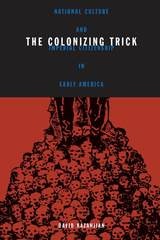
Colonizing Trick
National Culture And Imperial Citizenship In Early AmericaDavid Kazanjian
University of Minnesota Press, 2003
An illuminating look at the concepts of race, nation, and equality in eighteenth- and nineteenth-century America
The idea that “all men are created equal” is as close to a universal tenet as exists in American history. In this hard-hitting book, David Kazanjian interrogates this tenet, exploring transformative flash points in early America when the belief in equality came into contact with seemingly contrary ideas about race and nation. The Colonizing Trick depicts early America as a white settler colony in the process of becoming an empire-—one deeply integrated with Euro-American political economy, imperial ventures in North America and Africa, and pan-American racial formations.
Kazanjian traces tensions between universal equality and racial or national particularity through theoretically informed critical readings of a wide range of texts: the political writings of David Walker and Maria Stewart, the narratives of black mariners, economic treatises, the personal letters of Thomas Jefferson and Phillis Wheatley, Charles Brockden Brown’s fiction, congressional tariff debates, international treaties, and popular novelettes about the U.S.–Mexico War and the Yucatán’s Caste War. Kazanjian shows how emergent racial and national formations do not contradict universalist egalitarianism; rather, they rearticulate it, making equality at once restricted, formal, abstract, and materially embodied.
Competing Responsibilities
The Ethics and Politics of Contemporary LifeSusanna Trnka and Catherine Trundle, editors
Duke University Press, 2017
Contributors
Barry D. Adam, Elizabeth Anne Davis, Filippa Lentzos, Jessica Robbins-Ruszkowski, Nikolas Rose, Rosalind Shaw, Cris Shore, Jessica M. Smith, Susanna Trnka, Catherine Trundle, Jarrett Zigon
Constructing Citizenship
Transnational Workers and Revolution on the Mexico-Guatemala Border, 1880--1950Catherine A. Nolan-Ferrell
University of Arizona Press, 2012
Constructing Muslims in France
Discourse, Public Identity, and the Politics of CitizenshipJennifer Fredette
Temple University Press, 2014
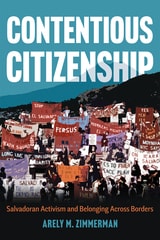
Contentious Citizenship
Salvadoran Activism and Belonging Across BordersArely M. Zimmerman
University of Arizona Press, 2026
Drawing on nearly fifty interviews with activists who fled El Salvador, Zimmerman traces how political refugees carried with them strategies of resistance and community organizing that shaped social justice movements in the United States. The book addresses the political turmoil and grassroots mobilizations in El Salvador, the sanctuary movement of the 1980s, contemporary activism, and the impact of women’s strategies and forms of resistance.
Essential reading for scholars and students of migration, Central American studies, and political movements, Contentious Citizenship is a bold intervention into contemporary debates on identity, legality, and resistance. Zimmerman’s work honors the ingenuity and resilience of Salvadoran activists and invites readers to consider what it means to belong.
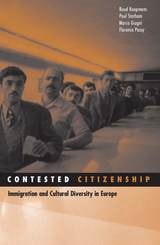
Contested Citizenship
Immigration and Cultural Diversity in EuropeRuud Koopmans
University of Minnesota Press, 2005
Revealing striking cross-national differences in how immigration and diversity are contended by different national governments, these authors find that how citizenship is constructed is the key variable defining the experience of Europe’s immigrant populations. Contested Citizenship provides nuanced policy recommendations and challenges the truism that multiculturalism is always good for immigrants. Even in an age of European integration and globalization, the state remains a critical actor in determining what points of view are sensible and realistic—and legitimate—in society.
Ruud Koopmans is professor of sociology at Free University, Amsterdam. Paul Statham is reader in political communications at the University of Leeds. Marco Giugni is a researcher and teacher of political science at the University of Geneva. Florence Passy is assistant professor of political science at the University of Lausanne, Switzerland.
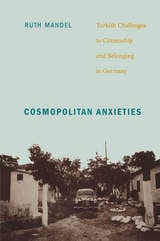
Cosmopolitan Anxieties
Turkish Challenges to Citizenship and Belonging in GermanyRuth Mandel
Duke University Press, 2008
Mandel explains that within Germany the popular understanding of what it means to be German is often conflated with citizenship, so that a German citizen of Turkish background can never be a “real German.” This conflation of blood and citizenship was dramatically illustrated when, during the 1990s, nearly two million “ethnic Germans” from Eastern Europe and the former Soviet Union arrived in Germany with a legal and social status far superior to that of “Turks” who had lived in the country for decades. Mandel analyzes how representations of Turkish difference are appropriated or rejected by Turks living in Germany; how subsequent generations of Turkish immigrants are exploring new configurations of identity and citizenship through literature, film, hip-hop, and fashion; and how migrants returning to Turkey find themselves fundamentally changed by their experiences in Germany. She maintains that until difference is accepted as unproblematic, there will continue to be serious tension regarding resident foreigners, despite recurrent attempts to realize a more inclusive and “demotic” cosmopolitan vision of Germany.
Cruelty as Citizenship
How Migrant Suffering Sustains White DemocracyCristina Beltrán
University of Minnesota Press, 2020
Why are immigrants from Mexico and Latin America such an affectively charged population for political conservatives?
More than a decade before the election of Donald Trump, vitriolic and dehumanizing rhetoric against migrants was already part of the national conversation. Situating the contemporary debate on immigration within America’s history of indigenous dispossession, chattel slavery, the Mexican-American War, and Jim Crow, Cristina Beltrán reveals white supremacy to be white democracy—a participatory practice of racial violence, domination, and exclusion that gave white citizens the right to both wield and exceed the law. Still, Beltrán sees cause for hope in growing movements for migrant and racial justice.
Forerunners is a thought-in-process series of breakthrough digital works. Written between fresh ideas and finished books, Forerunners draws on scholarly work initiated in notable blogs, social media, conference plenaries, journal articles, and the synergy of academic exchange. This is gray literature publishing: where intense thinking, change, and speculation take place in scholarship.