Results by title
188 books match the query 'City planning' and 17 start with c

Challenging Uneven Development
An Urban Agenda for the 1990sNyden, Philip
Rutgers University Press, 1991
The editors and contributors to this volume are not willing to accept what is known as uneven development, where some cities win and some lose. They look at two practical consequences of urban growth: the change in residence patterns as neighborhoods gentrify, and the change in employment patterns, as factory workers lose jobs and white-collar workers gain jobs. The editors' goal is to highlight the alternatives to uneven development and to the growth ideology. They outline and advocate specific policies, including affordable housing, changes in taxation, and direct community participation in planning and zoning decisions.
Challenging Uneven Development begins with a rousing discussion of the pervasiveness of the community redevelopment ideology. The growth machine defines the language of the debate. The next group of chapters examine residence patterns--how communities have organized to fight gentrification, why residential integration is essential for good planning as well as morality, and what strategies can be used to achieve racial diversity. Another chapter emphasizes the role of lenders in regulating the flow of credit within communities. Disinvestment by credit providers causes decline, and opens the way for gentrification, which displaces local residents. The impact of taxes in stimulating the growth machine is also explained.
Later chapters move beyond gentrification issues to examine other problems of economic restructuring. They look at how blacks, Latinos, and women have been affected by the growth of service sector jobs. The final chapter serves as a strategic guide to those who wish to establish a progressive agenda for community-based economic development. The authors call for social change, not unimaginative reform.
The contributors to this volume are leaders or researchers from community organizations, civic groups, government agencies, and universities. In addition to the editors, they are Mel King, Teresa Cordova, Daniel Lauber, Jena Pogge, David Flax-Hatch, Arthur Lyons, Wendy Wintermute, Charles Hicklin, Jeffrey D. Reckinger, David Mosena, Charlotte Chun, Raymndo Flores, Luther Snow, Deborah Bennett, John Betancur, and Patricia Wright. They have presented "state-of-the-art" progressive policy solutions for urban problems.
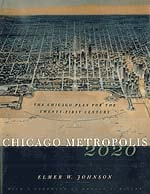
Chicago Metropolis 2020
The Chicago Plan for the Twenty-First CenturyElmer W. Johnson
University of Chicago Press, 2001
Nearly a century later, Chicago, like all cities, faces similar dilemmas: how to reconcile privatism with public control, growth with restraint, wealth with poverty, and beauty with industry. And as it did a hundred years ago with the Burnham Plan, the Commercial Club has sponsored a wholly contemporary plan for the city's future development. Written by Elmer W. Johnson, a lawyer and civic leader, Chicago Metropolis 2020 is a guide for those in all spheres of influence who are working to make cities economically and socially vigorous while addressing the greatest problems modern metropolises face. While Burnham's plan primarily addressed architecture and spatial planning, Chicago Metropolis 2020 addresses all facets of urban life, from public education to suburban sprawl, from transportation to social and economic segregation, with the expressed goal of continuing Chicago's tradition of renewal and foresight.
Chicago Metropolis 2020 is an ambitious and necessary plan for a major city at the turn of the century. In scope and execution, it aims at nothing less than economic vibrancy, quality of life, and equity of opportunity.

Chicago's North Michigan Avenue
Planning and Development, 1900-1930John W. Stamper
University of Chicago Press, 1991
John W. Stamper traces the complex development of North Michigan Avenue from the 1880s to the 1920s building boom that solidified its character and economic base, describing the initiation of the planning process by private interests to its execution aided by the city's powerful condemnation and taxation proceedings. He focuses on individual buildings constructed on the avenue, including the Renaissance- and Gothic-inspired Wrigley Building, Tribune Tower, and Drake Hotel, and places them within the context of factors governing their construction—property ownership, financing, zoning laws, design theory, and advertising.
Stamper compares this stylistically diverse mixture of low- and high-rise structures with earlier, rejected planning proposals, all of which had prescribed a uniformly designed, European-like avenue of continuous cornice heights, consistent facade widths, and complementary stylistic features. He analyzes the drastically different character the avenue took by 1930, with high-rise towers reaching thirty stories and beyond, in terms of the clash among economic, political, and architectural interests. His argument—that the discrepancies between the rejected plans and reality illustrate the developers' choice of economic return on their investment over aesthetic community—is extended through to the present avenue and the virtual disregard of the urban qualities proposed at its inception. Generously illustrated, with an epilogue condensing the avenue's history between the end of World War II and the present, this is an exhaustive account of an important topic in the history of modern architecture and city planning.
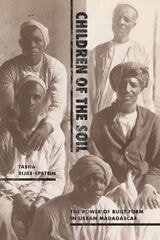
Children of the Soil
The Power of Built Form in Urban MadagascarTasha Rijke-Epstein
Duke University Press, 2023
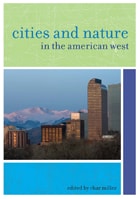
Cities and Nature in the American West
Char Miller
University of Nevada Press, 2010
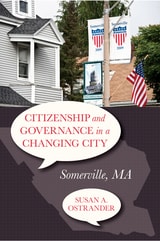
Citizenship and Governance in a Changing City
Somerville, MASusan Ostrander
Temple University Press, 2013
In Citizenship and Governance in a Changing City, Susan Ostrander shows how beneath current high levels of engagement by Somerville residents lies a struggle about who should be the city's elected leaders and how they should conduct the city's affairs. It is a struggle waged between diverse residents--relatively new immigrants and a new middle class-trying to gain a foothold in democratic participation, and the city's political "old guard."
Citizenship and Governance in a Changing City informs current debates about the place of immigrants in civic and political life, and the role of voluntary associations in local politics and government. In the process, Ostrander provides useful lessons for many midsize urban communities.
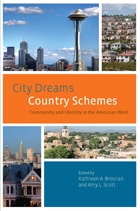
City Dreams, Country Schemes
Community and Identity in the American WestKathleen A. Brosnan
University of Nevada Press, 2011
The American West, from the beginning of Euro-American settlement, has been shaped by diverse ideas about how to utilize physical space and natural environments to create cohesive, sometimes exclusive community identities. When westerners developed their towns, they constructed spaces and cultural identities that reflected alternative understandings of modern urbanity. The essays in City Dreams, Country Schemes utilize an interdisciplinary approach to explore the ways that westerners conceptualized, built, and inhabited urban, suburban, and exurban spaces in the twentieth century.
The contributors examine such topics as the attractions of open space and rural gentrification in shaping urban development; the role of tourism in developing national parks, historical sites, and California's Napa Valley; and the roles of public art, gender, and ethnicity in shaping urban centers. City Dreams, Country Schemes reveals the values and expectations that have shaped the West and the lives of the people who inhabit it.
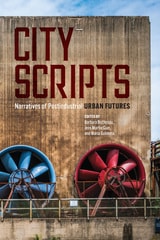
City Scripts
Narratives of Postindustrial Urban FuturesEdited by Barbara Buchenau, Jens Martin Gurr, and Maria Sulimma
The Ohio State University Press, 2023
Storytelling shapes how we view our cities, legitimizing histories, future plans, and understandings of the urban. City Scripts responds to calls by literary theorists to engage a new kind of narrative analysis that recalibrates close reading and interpretation to the multiple ways in which narratives “do things”—how they intervene in the world and take action in everyday life. A multidisciplinary cast of contributors approaches this new way of looking at cities through the stories people tell about them, looking especially at political activism and urban planning, which depend on the invention of plausible stories of connectedness and of a redemptive future.
The stakes are especially high in cities where economic, ecological, and social futures are delimited by histories of large-scale extraction and racialized industrial labor. Contributors thus focus on cities in postindustrial areas of Germany and the United States, examining how narratives about cities become scripts and how these scripts produce real-life results. This approach highlights how uses of narrative and scripting appeal to stakeholders in urban change. These actors continually deploy narrative, media, and performance, with consequences for urban futures worldwide.
Contributors:
Lieven Ameel, Juliane Borosch, Barbara Buchenau, Florian Deckers, Barbara Eckstein, Kornelia Freitag, Walter Grünzweig, Randi Gunzenhäuser, Jens Martin Gurr, Elisabeth Haefs, Chris Katzenberg, Johannes Maria Krickl, Renee M. Moreno, Hanna Rodewald, Julia Sattler, Maria Sulimma, James A. Throgmorton, Michael Wala, Katharina Wood
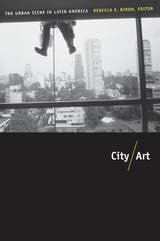
City/Art
The Urban Scene in Latin AmericaRebecca E. Biron , ed.
Duke University Press, 2009
Contributors delve into the aspirations embodied in the modernist urbanism of Brasília and the work of Lotty Rosenfeld, a Santiago performance artist who addresses the intersections of art, urban landscapes, and daily life. One author assesses the political possibilities of public art through an analysis of subway-station mosaics and Julio Cortázar’s short story “Graffiti,” while others look at the representation of Buenos Aires as a “Jewish elsewhere” in twentieth-century fiction and at two different responses to urban crisis in Rio de Janeiro. The collection closes with an essay by a member of the São Paulo urban intervention group Arte/Cidade, which invades office buildings, de-industrialized sites, and other vacant areas to install collectively produced works of art. Like that group, City/Art provides original, alternative perspectives on specific urban sites so that they can be seen anew.
Contributors. Hugo Achugar, Rebecca E. Biron, Nelson Brissac Peixoto, Néstor García Canclini, Adrián Gorelik, James Holston, Amy Kaminsky, Samuel Neal Lockhart, José Quiroga, Nelly Richard, Marcy Schwartz, George Yúdice
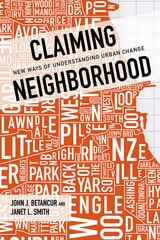
Claiming Neighborhood
New Ways of Understanding Urban ChangeJohn Betancur
University of Illinois Press, 2016
As the authors show, a diverse collection of people including urban policy experts, elected officials, investors, resident leaders, institutions, community-based organizations, and many others compete to control how neighborhoods change and are characterized. Betancur and Smith argue that neighborhoods have become sites of consumption and spaces to be consumed. Discourse is used to add and subtract value from them. The romanticized image of "the neighborhood" exaggerates or obscures race and class struggles while celebrating diversity and income mixing. Scholars and policy makers must reexamine what sustains this image and the power effects produced in order to explain and govern urban space more equitably.

Climatic Media
Transpacific Experiments in Atmospheric ControlYuriko Furuhata
Duke University Press, 2022
Constitutional Modernism
Architecture and Civil Society in Cuba, 1933-1959Timothy Hyde
University of Minnesota Press, 2013
How does architecture make its appearance in civil society? Constitutional Modernism pursues this challenging question by exploring architecture, planning, and law as cultural forces. Analyzing the complex entanglements between these disciplines in the Cuban Republic, Timothy Hyde reveals how architects joined with other professionals and intellectuals in efforts to establish a stable civil society, from the promulgation of a new Cuban Constitution in 1940 up until the Cuban Revolution.
By arguing that constitutionalism was elaborated through architectural principles and practices as well as legal ones, Hyde offers a new view of architectural modernism as a political and social instrument. He contends that constitutionalism produced a decisive confluence of law and architecture, a means for planning the future of Cuba. The importance of architecture in this process is laid bare by Hyde’s thorough scrutiny of a variety of textual, graphical, and physical artifacts. He examines constitutional articles, exhibitions, interviews, master plans, monuments, and other primary materials as acts of design.
Read from the perspective of architectural history, Constitutional Modernism demonstrates how the modernist concepts that developed as an international discourse before the Second World War evolved through interactions with other disciplines into a civil urbanism in Cuba. And read from the perspective of Cuban history, the book explains how not only material products such as buildings and monuments but also the immaterial methods of architecture as a cultural practice produced ideas that had consequential effects on the political circumstances of the nation.
Constructing the Patriarchal City
Gender and the Built Environments of London, Dublin, Toronto, and Chicago, 1870s into the 1940sMaureen A. Flanagan
Temple University Press, 2018
In the Anglo-Atlantic world of the late nineteenth century, groups of urban residents struggled to reconstruct their cities in the wake of industrialization and to create the modern city. New professional men wanted an orderly city that functioned for economic development. Women’s vision challenged the men’s right to reconstruct the city and resisted the prevailing male idea that women in public caused the city’s disorder.
Constructing the Patriarchal City compares the ideas and activities of men and women in four English-speaking cities that shared similar ideological, professional, and political contexts. Historian Maureen Flanagan investigates how ideas about gender shaped the patriarchal city as men used their expertise in architecture, engineering, and planning to fashion a built environment for male economic enterprise and to confine women in the private home. Women consistently challenged men to produce a more equitable social infrastructure that included housing that would keep people inside the city, public toilets for women as well as men, housing for single, working women, and public spaces that were open and safe for all residents.
Contentious City
The Politics of Recovery in New York CityJohn Mollenkopf
Russell Sage Foundation, 2005
Control and Order in French Colonial Louisbourg, 1713-1758
A.J.B. Johnston
Michigan State University Press, 2001
Control and Order in French Colonial Louisbourg, 1713-1758 is the culmination of nearly a quarter century of research and writing on 18th-century Louisbourg by A. J. B. Johnston. The author uses a multitude of primary archival sources-official correspondence, court records, parish registries, military records, and hundreds of maps and plans-to put together a detailed analysis of a distinctive colonial society. Located on Cape Breton Island (then known as Île Royale), the seaport and stronghold of Louisbourg emerged as one of the most populous and important settlements in all of New France. Its economy was based on fishing and trade, and the society that developed there had little or nothing to do with the fur trade, or the seigneurial regime that characterized the Canadian interior. Johnston traces the evolution of a broad range of controlling measures that were introduced and adapted to achieve an ordered civil and military society at Louisbourg. Town planning, public celebrations, diversity in the population, use of punishments, excessive alcohol consumption, the criminal justice system, and sexual abuse are some of the windows that reveal attempts to control and regulate society. A. J. B. Johnston's Control and Order in French Colonial Louisbourg offers both a broad overview of the colony's evolution across its half-century of existence, and insightful analyses of the ways in which control was integrated into the mechanisms of everyday life.

Cultural Quarters
Principles and PracticeSimon Roodhouse
Intellect Books, 2006
Extending this investigation, the author provides an explicit analysis of Bolton Borough Council’s moves towards establishing a cultural sector in the town centre, with references to previous funding models employed by Birmingham City Council and the British Museum. The book offers a concise illustration of how cultural practice is maintained and expanded within an urban environment. This single volume, packed with detail, can be used in higher education courses to support the study of cultural policy, management and regeneration.
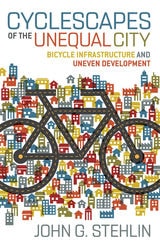
Cyclescapes of the Unequal City
Bicycle Infrastructure and Uneven DevelopmentJohn G. Stehlin
University of Minnesota Press, 2019
A critical look at the political economy of urban bicycle infrastructure in the United States
Not long ago, bicycling in the city was considered a radical statement or a last resort, and few cyclists braved the inhospitable streets of most American cities. Today, however, the urban cyclist represents progress and the urban “renaissance.” City leaders now undertake ambitious new bicycle infrastructure plans and bike share schemes to promote the environmental, social, and economic health of the city and its residents. Cyclescapes of the Unequal City contextualizes and critically examines this new wave of bicycling in American cities, exploring how bicycle infrastructure planning has become a key symbol of—and site of conflict over—uneven urban development.
John G. Stehlin traces bicycling’s rise in popularity as a key policy solution for American cities facing the environmental, economic, and social contradictions of the previous century of sprawl. Using in-depth case studies from San Francisco, Philadelphia, and Detroit, he argues that the mission of bicycle advocacy has converged with, and reshaped, the urban growth machine around a model of livable, environmentally friendly, and innovation-based urban capitalism. While advocates envision a more sustainable city for all, the deployment of bicycle infrastructure within the framework of the neoliberal city in many ways intensifies divisions along lines of race, class, and space.
Cyclescapes of the Unequal City speaks to a growing interest in bicycling as an urban economic and environmental strategy, its role in the politics of gentrification, and efforts to build more diverse coalitions of bicycle advocates. Grounding its analysis in both regional political economy and neighborhood-based ethnography, this book ultimately uses the bicycle as a lens to view major shifts in today’s American city.