112 books match the query 'Commentaries' and 32 start with c
cover of Commentaries on Aristotle's "On Sense and What Is Sensed" and "On Memory and Recollection" (Thomas Aquinas in Translation)

Commentaries on Aristotle's "On Sense and What Is Sensed" and "On Memory and Recollection" (Thomas Aquinas in Translation)

Saint Thomas Aquinas

Catholic University of America Press, 2005
The translations presented in this volume are based on the critical Leonine edition of the commentaries, which includes the Latin translations of the Aristotelian texts on which Aquinas commented.
[more]
cover of Commentaries on the Cantatas of Johann Sebastian Bach: A Selective Guide

Commentaries on the Cantatas of Johann Sebastian Bach

A Selective Guide

Hans-Joachim Schulze. Translated by James A. Brokaw II

University of Illinois Press, 2024

Internationally recognized Bach authority Hans-Joachim Schulze authored a 225-part series on the cantatas of Johann Sebastian Bach. In this collection, James A. Brokaw II translates a selection of the essays, illuminating a wide range of biographical and cultural features of Bach’s life and creative milieu. Schulze’s lively and engaging discussions provide a wealth of rewarding insights and perspectives focusing on individual cantatas, their texts, and the questions of chronology and context that attend them.

The University of Illinois Press has paired the volume with a special web-based companion overseen by the translator and hosted by the Illinois Open Publishing Network. This online resource includes Brokaw’s translations of all 225 of Schulze’s essays alongside digital tools for searching, sorting, and bundling the commentaries according to date of composition, position within the liturgical church year sequence, and librettist.
[more]
cover of Commentaries on the Laws of England, A Facsimile of the First Edition of 1765-1769

Commentaries on the Laws of England, A Facsimile of the First Edition of 1765-1769

William Blackstone

University of Chicago Press, 2002

Perhaps the most important legal treatise ever written in the English language, Sir William Blackstone's Commentaries on the Laws of England (1765-69) was the first effort to consolidate English common law into a unified and rational system. Clearly and elegantly written, the work achieved immediate renown and exerted a powerful influence on legal education both in England and America. This handsomely produced, slipcased four-volume set includes facsimiles of the eighteenth-century first edition, undistorted by later interpolations.

The Commentaries is divided into four books. The first, introduced by Stanley N. Katz, deals with what Blackstone called "the rights of persons," what a modern lawyer would call constitutional law, the legal structure of government. Book II includes an introduction by A. W. Brian Simpson and describes the law of property. Book III, introduced by John H. Langbein, analyzes civil procedure and remedies. The last book, which is devoted to criminal law and procedure, includes an introduction by Thomas A. Green.

Now regarded as a literary, as well as a legal classic, Blackstone's Commentaries brilliantly laid out the system of English law in the mid-eighteenth century, demonstrating that as a system of justice, it was comparable to Roman law and the civil law of the Continent. Ironically, the work also revealed to the colonists the insufficiencies of the system and became a model for the legal system of the fledgling American nation in 1789. Supplemented with commentary by experts in the field, these classic facsimile volumes belong on every lawyer's bookshelves.

Volume I: Of the Rights of Persons (1765)
Volume II: Of the Rights of Things (1766)
Volume III: Of Private Wrongs (1768)
Volume IV: Of Public Wrongs (1769)
[more]
cover of Commentaries on the Laws of England, Volume 1: A Facsimile of the First Edition of 1765-1769

Commentaries on the Laws of England, Volume 1

A Facsimile of the First Edition of 1765-1769

William Blackstone

University of Chicago Press, 1979

Sir William Blackstone's Commentaries on the Laws of England (1765-1769) stands as the first great effort to reduce the English common law to a unified and rational system. Blackstone demonstrated that the English law as a system of justice was comparable to Roman law and the civil law of the Continent. Clearly and elegantly written, the work achieved immediate renown and exerted a powerful influence on legal education in England and in America which was to last into the late nineteenth century. The book is regarded not only as a legal classic but as a literary masterpiece.

Previously available only in an expensive hardcover set, Commentaries on the Laws of England is published here in four separate volumes, each one affordably priced in a paperback edition. These works are facsimiles of the eighteenth-century first edition and are undistorted by later interpolations. Each volume deals with a particular field of law and carries with it an introduction by a leading contemporary scholar.

In his introduction to this first volume, Of the Rights of Persons, Stanley N. Katz presents a brief history of Blackstone's academic and legal career and his purposes in writing the Commentaries. Katz discusses Blackstone's treatment of the structure of the English legal system, his attempts to justify it as the best form of government, and some of the problems he encountered in doing so.
[more]
cover of Commentaries on the Laws of England, Volume 2: A Facsimile of the First Edition of 1765-1769

Commentaries on the Laws of England, Volume 2

A Facsimile of the First Edition of 1765-1769

William Blackstone

University of Chicago Press, 1979

Sir William Blackstone's Commentaries on the Laws of England (1765-1769) stands as the first great effort to reduce the English common law to a unified and rational system. Blackstone demonstrated that the English law as a system of justice was comparable to Roman law and the civil law of the Continent. Clearly and elegantly written, the work achieved immediate renown and exerted a powerful influence on legal education in England and in America which was to last into the late nineteenth century. The book is regarded not only as a legal classic but as a literary masterpiece.

Previously available only in an expensive hardcover set, Commentaries on the Laws of England is published here in four separate volumes, each one affordably priced in a paperback edition. These works are facsimiles of the eighteenth-century first edition and are undistorted by later interpolations. Each volume deals with a particular field of law and carries with it an introduction by a leading contemporary scholar.

Introducing this second volume, Of the Rights of Things, A. W. Brian Simpson discusses the history of Blackstone's theory of various aspects of property rights—real property, feudalism, estates, titles, personal property, and contracts—and the work of his predecessors.
[more]
cover of Commentaries on the Laws of England, Volume 3: A Facsimile of the First Edition of 1765-1769

Commentaries on the Laws of England, Volume 3

A Facsimile of the First Edition of 1765-1769

William Blackstone

University of Chicago Press, 1979

Sir William Blackstone's Commentaries on the Laws of England (1765-1769) stands as the first great effort to reduce the English common law to a unified and rational system. Blackstone demonstrated that the English law as a system of justice was comparable to Roman law and the civil law of the Continent. Clearly and elegantly written, the work achieved immediate renown and exerted a powerful influence on legal education in England and in America which was to last into the late nineteenth century. The book is regarded not only as a legal classic but as a literary masterpiece.

Previously available only in an expensive hardcover set, Commentaries on the Laws of England is published here in four separate volumes, each one affordably priced in a paperback edition. These works are facsimiles of the eighteenth-century first edition and are undistorted by later interpolations. Each volume deals with a particular field of law and carries with it an introduction by a leading contemporary scholar.

Introducing this third volume, Of Private Wrongs, John H. Langbein discusses Blackstone's account of procedure and jurisdiction, jury trial, and equity. He also examines Blackstone's uneasy attitude toward the celebrated legal frictions of English civil procedure.
[more]
cover of Commentaries on the Laws of England, Volume 4: A Facsimile of the First Edition of 1765-1769

Commentaries on the Laws of England, Volume 4

A Facsimile of the First Edition of 1765-1769

William Blackstone

University of Chicago Press, 1979

Sir William Blackstone's Commentaries on the Laws of England (1765-1769) stands as the first great effort to reduce the English common law to a unified and rational system. Blackstone demonstrated that the English law as a system of justice was comparable to Roman law and the civil law of the Continent. Clearly and elegantly written, the work achieved immediate renown and exerted a powerful influence on legal education in England and in America which was to last into the late nineteenth century. The book is regarded not only as a legal classic but as a literary masterpiece.

Previously available only in an expensive hardcover set, Commentaries on the Laws of England is published here in four separate volumes, each one affordably priced in a paperback edition. These works are facsimiles of the eighteenth-century first edition and are undistorted by later interpolations. Each volume deals with a particular field of law and carries with it an introduction by a leading contemporary scholar.

Introducing this fourth and final volume, Of Public Wrongs, Thomas A. Green examines Blackstone's attempt to rationalize the severity of the law with what he saw as the essentially humane inspiration of English law. Green discusses Blackstone's ideas on criminal law, criminal procedure, and sentencing.
[more]
cover of Commentaries on the Psalms, Volume

Commentaries on the Psalms, Volume

St. Hilary of Poitiers

Catholic University of America Press, 2027
Hilary of Poitiers (d. 367), famous for his role in the Trinitarian debates of the fourth century, was a key figure in the emergence of Western, Latin theology and biblical exegesis. His writings reflect his deep engagement with the major Greek thinkers of his time as well as his distinctive approach to the moral and spiritual meaning of Scripture. His extensive treatment of the Psalms, translated here into English for the first time, is the earliest that survives from the Latin West. The work, which Hilary composed between 364 and his death in 367, reflects his mature theology, comprising an Instructio or introduction, as well as commentary on fifty-seven Psalms (1, 2, 9, 13, 14, 51–69, 91, 119 to 150; LXX numbering) and an extended treatise on Psalm 118. While the Commentaries have received relatively little scholarly attention, they reward close reading. They reflect not only Hilary’s own keen interest in the linguistic and theological features of the biblical text, but also his debts to the traditions of interpretation that were circulating among the pro-Nicene thinkers of his time. Close study of this work reveals how Hilary supplemented his own earlier methods of figurative exegesis by engaging Greek sources, especially the thought of Origen of Alexandria (c. 185–c. 255), and by incorporating insights from his developing pro-Nicene theology. Although Hilary attends to the historical meaning of the Psalms, he regularly views Christ as the true author of the prayers. Thus, the Commentaries are closely linked to his Christological and Trinitarian writings, as well as to his theology of kenosis and deification.
[more]
cover of Commentary on Galatians

Commentary on Galatians

Catholic University of America Press, 2011
Jerome's Commentary on Galatians is presented here in English translation in its entirety.
[more]
cover of Commentary on Genesis

Commentary on Genesis

Catholic University of America Press, 2016
Blind since early childhood, the Egyptian theologian and monk Didymus (ca. 313-398) wielded a masterful knowledge of Scripture, philosophy, and previous biblical interpretation, earning the esteem of his contemporaries Athanasius, Antony of Egypt, Jerome, Rufinus, and Palladius, as well as of the historians Socrates and Theodoret in the decades following his death. He was, however, anathematized by the Fifth Ecumenical Council in 553 because of his utilization and defense of the works of Origen, and this condemnation may be responsible for the loss of many of Didymus's writings. Jerome and Palladius mentioned that Didymus had written commentaries on Old Testament books; these commentaries were assumed to be no longer extant until the discovery in 1941 in Tura, Egypt, of papyri containing commentaries on Genesis, Zechariah, Job, Ecclesiastes, and some of the Psalms.
[more]
cover of Commentary on Matthew

Commentary on Matthew

D.H. St. Hilary of Poiters

Catholic University of America Press, 2012
St. Jerome (347-420) has been considered the pre-eminent scriptural commentator among the Latin Church Fathers. His Commentary on Matthew, written in 398 and profoundly influential in the West, appears here for the first time in English translation.
[more]
cover of Commentary on Matthew

Commentary on Matthew

Saint Jerome

Catholic University of America Press, 2008
His Commentary on Matthew, written in 398 and profoundly influential in the West, appears here for the first time in English translation. Jerome covers the entire text of Matthew's gospel by means of brief explanatory comments that clarify the text literally and historically.
[more]
cover of Commentary on Zechariah

Commentary on Zechariah

Robert C. Didymus the Blind

Catholic University of America Press, 2006
A disciple of Origen, whose work on Zechariah reached only to chapter five and is no longer extant, Didymus's commentary on this apocalyptic book illustrates the typically allegorical approach to the biblical text that we associate with Alexandria
[more]
cover of Commentary on the Apocalypse

Commentary on the Apocalypse

Catholic University of America Press, 2012
Striking a balance between the symbolic language of the book and its literal, prophetic fulfillment, Andrew?s interpretation is a remarkably intelligent, spiritual, and thoughtful commentary that encourages the pursuit of virtue and confidence in the love of God for humanity
[more]
cover of Commentary on the Apocalypse

Commentary on the Apocalypse

John N. Oecumenius

Catholic University of America Press, 2006
No description available
[more]
cover of Commentary on the Epistle to the Romans

Commentary on the Epistle to the Romans

Peter Abelard

Catholic University of America Press, 2011
Despite its importance and the frequent references made to it by modern scholars, this commentary has never before been translated into English in its entirety. This volume, which includes an extensive introduction, fills this gap, thus providing a needed contribution to medieval scholarship.
[more]
cover of Commentary on the Epistle to the Romans, Books 1-5

Commentary on the Epistle to the Romans, Books 1-5

Catholic University of America Press, 2001
No description available
[more]
cover of Commentary on the Epistle to the Romans, Books 6-10

Commentary on the Epistle to the Romans, Books 6-10

Catholic University of America Press, 2002
No description available
[more]
cover of Commentary on the Gospel According to John, Books 13-32

Commentary on the Gospel According to John, Books 13-32

Catholic University of America Press, 1989
No description available
[more]
cover of Commentary on the Gospel of John, Books 1-10

Commentary on the Gospel of John, Books 1-10

Catholic University of America Press, 1989
No description available
[more]
cover of Commentary on the Gospel of John, Chapters 6-12

Commentary on the Gospel of John, Chapters 6-12

Thomas Aquinas

Catholic University of America Press, 2010
No description available
[more]
cover of Commentary on the Gospel of John: Chapters 1-5

Commentary on the Gospel of John

Chapters 1-5

Thomas Aquinas

Catholic University of America Press, 2010
No description available
[more]
cover of Commentary on the Gospel of John: Chapters 13-21

Commentary on the Gospel of John

Chapters 13-21

Thomas Aquinas

Catholic University of America Press, 2010
No description available
[more]
cover of Commentary on the Old Greek and Peshitta of Isaiah 1–25

Commentary on the Old Greek and Peshitta of Isaiah 1–25

Ronald L. Troxel

SBL Press, 2020

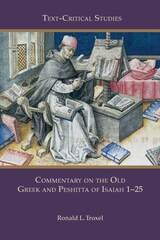
The first thorough commentary on the Old Greek and Peshitta of Isaiah

Ronald L. Troxel’s new textual commentary on Isaiah focuses on the book’s Greek and Syriac translations and seeks to recover, as much as possible, the Hebrew texts on which these early translations relied. Troxel treats the Greek and Syriac together in order to present a detailed analysis of their relationship, devoting particular attention to whether the Syriac was directly or indirectly influenced by the Greek. This comparison sheds light on both the shared and distinct approaches that the translators took in rendering lexemes, phrases, verses, and even passages. In addition Troxel presents observations about the literary structures the translators created that differ from those implicit in their source texts (as we understand them), to produce coherent discourse in the target language.

Features:

  • Textual commentary on the life of the text of Isaiah 1–25
  • Use of the Dead Sea Scrolls to shed light on particular issues
  • Detailed comparison of the Masoretic Text, the Old Greek, and the Peshitta
[more]
cover of Commentary on the Psalms, Psalms 1-72

Commentary on the Psalms, Psalms 1-72

Robert C. Theodoret of Cyrus

Catholic University of America Press, 2000
No description available
[more]
cover of Commentary on the Songs of Songs

Commentary on the Songs of Songs

Vittorio Rupert of Deutz

Catholic University of America Press, 2024
This is the first English translation of a major work by Rupert of Deutz, arguably the most prolific Christian author since Augustine. During his lifetime, which spanned the eleventh and twelfth centuries, Rupert engaged in controversies on the Eucharist and on predestination and composed works on the Trinity, salvation in Christ, and other major theological topics. An ardent defender of a monastic theology that focused on the interpretation of Scripture and the liturgy, Rupert is well known also for his distinctive hermeneutical approach to the Bible. His Commentary on the Songs of Songs builds on the long Hebrew-Christian tradition of allegorical interpretation of this Old Testament book but adds a radically original dimension to it: it interprets the text as a dialogue between Jesus and Mary and unfolds in this context a novel approach to Mary, who is presented as the teacher of the apostles and assumed to have participated in the Apostolic Council, described in Acts 15. Rupert has prefaced his commentary with a letter to Thietmar, bishop of Verden (in northern Germany), as well as a prologue in which he reflects on his experience of being called to perform this exegetical task. The complete translation by Jieon Kim and Vittorio Hösle of this major work (up to now translated only into German) is preceded by an introduction that discusses Rupert's life and works, as well as the history of the interpretation of the Song of Songs, and offers hermeneutical reflections on Rupert's methodology.
[more]
cover of Commentary on the Twelve Prophets

Commentary on the Twelve Prophets

Robert C. Theodore of Mopsuestia

Catholic University of America Press, 2004
No description available
[more]
cover of Commentary on the Twelve Prophets, Volume 1

Commentary on the Twelve Prophets, Volume 1

Saint Cyril of Alexandria

Catholic University of America Press, 2007
No description available
[more]
cover of Commentary on the Twelve Prophets, Volume 2

Commentary on the Twelve Prophets, Volume 2

Saint Cyril of Alexandria

Catholic University of America Press, 2007
No description available
[more]
cover of Commentary on the Twelve Prophets, Volume 3

Commentary on the Twelve Prophets, Volume 3

Catholic University of America Press, 2012
No description available
[more]
cover of Condition Red: Essays, Interviews, and Commentaries

Condition Red

Essays, Interviews, and Commentaries

Yusef Komunyakaa; Edited by Radiclani Clytus

University of Michigan Press, 2017
Condition Red collects writing by one of America’s most gifted and revered poets, Yusef Komunyakaa. While themes from his earlier prose collection, Blue Notes, run through Condition Red, this volume expresses a greater sense of urgency about the human condition and the role of the artist. Condition Red includes his powerful letter to Poetry magazine, asserting that “we writers (artists) cannot forget that we are responsible for what we conjure and embrace through language, whether in essays, novels, plays, poems, or songs.” Also included are essays and interviews on: coming home to Bogalusa, Louisiana; the influence of religion on black poetry; language and eroticism; the visual artist Floyd Tunson; and the poets Robert Hayden, Walt Whitman, Clarence Major, and Etheridge Knight. The book features an extended introduction by editor Radiclani Clytus, who concludes that “Condition Red issues readers much more than a critical warning; it reminds us that our innate cultural capacity for language is, and always has been, the sum total of that which defines us.”
[more]
cover of Constructing Antichrist: Paul, Biblical Commentary, and the Development of Doctrine in the Early Middle Ages

Constructing Antichrist

Paul, Biblical Commentary, and the Development of Doctrine in the Early Middle Ages

Kevin L. Hughes

Catholic University of America Press, 2005

Constructing Antichrist engages readers with the question: what does Paul have to do with the Antichrist? Integrating new scholarship in apocalypticism and the history of exegesis, this book is the first longitudinal study of the role of Paul in apocalyptic thought
[more]