58 books match the query 'Commercial policy' and 7 start with c
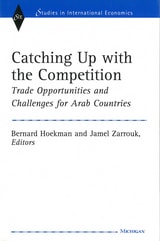
cover of Catching Up with the Competition: Trade Opportunities and Challenges for Arab Countries

Catching Up with the Competition

Trade Opportunities and Challenges for Arab Countries

Bernard Hoekman and Jamel Zarrouk, Editors

University of Michigan Press, 2000

At a time when countries in the Middle East and North Africa (MENA) are joining the World Trade Organization, the lack of an economically sound analysis of trade policies in the region is especially notable. This volume remedies the situation by bringing together a distinguished group of applied trade economists to provide a broad view of the state of trade in and among the region's nations. The contributors provide original empirical analyses on key reform issues, and their work reflects deep knowledge of government concerns and policies.
Part 1 sets the scene by comparing the performance of the MENA region with the rest of the world on a large number variables and indicators. Part 2 contains a number of CGE model-based analyses of trade policy reform options. Part 3 focuses on specific policy areas: standards as nontariff barriers and red tape, trade facilitation, an assessment of the impact of protecting intellectual property using partial equilibrium techniques, and a review of the existing Euro-Med agreements. Part 4 discusses how the region could benefit from WTO membership and from changing the existing regional integration schemes into arrangements that help promote a growth enhancing reform agenda.
The volume will be essential reading for economists and policymakers working in and with the MENA nations, as well as officials at the multilateral and regional institutions.
Contributors are A. Halis Akder, Benita Cox, Dean De Rosa, Hana'a Kheir El Din, Sherine El Ghoneim, Oleh Havrylyshyn, Bernard Hoekman, Denise Konan, Peter Kunzel, Will Martin, Keith Maskus, Mustapha Nabli, Thomas Rutherford, Elisabet Rutstrom, David Tarr, Subidey Togan, L. Alan Winters, Alexander Yeats, and Jamel Zarrouk.
Bernard Hoekman is an Economist with the Development Research Group's Trade team of the World Bank. Jamel Zarrouk is an Economist with the Arab Monetary Fund.
[more]
cover of Chicago Essays in Economic Development

Chicago Essays in Economic Development

David Wall

University of Chicago Press, 1972

What happens when the methods of the Chicago school of economics are applied to development problems? By collecting fifteen prime examples for this volume, David Wall has shown that these methods go a long way toward the clarification and solution of the economic problems faced by the world's underdeveloped countries. The contributors, all members of the Department of Economics at the University of Chicago, are Theodore Schultz, Harry G. Johnson, Arnold C. Harberger, Bert F. Hoselitz, and Larry A. Sjaastad, and D. Gale Johnson.

These Chicago economists share a common intellectual framework universally recognized in the profession and derived from three beliefs: first, that theory is of fundamental importance; second, that theory is irrelevant unless set in a definite empirical context; and third, that in the absence of evidence to the contrary, the market works. Critics of the Chicago school tend to ignore the first two of these and to overlook the qualifying proviso of the third. This volume sets out to rectify that misunderstanding and to circulate more widely some of the best work produced by the Chicago school.

The essays in the opening "general" section clearly illustrate the characteristics of the Chicago school while also reflecting some well-known idiosyncrasies of four of its more prominent spokesmen. The other two sections, "Domestic Policy" and "Trade and Aid," cover topics on which Chicago authors have made a marked impact. Together, these essays will provide a basic reference book for students of the subject, illustrating one of the leading methods of analyzing economic development problems.
[more]
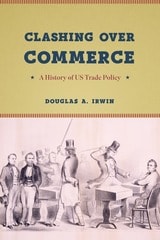
cover of Clashing over Commerce: A History of US Trade Policy

Clashing over Commerce

A History of US Trade Policy

Douglas A. Irwin

University of Chicago Press, 2017

Should the United States be open to commerce with other countries, or should it protect domestic industries from foreign competition? This question has been the source of bitter political conflict throughout American history. Such conflict was inevitable, James Madison argued in The Federalist Papers, because trade policy involves clashing economic interests. The struggle between the winners and losers from trade has always been fierce because dollars and jobs are at stake: depending on what policy is chosen, some industries, farmers, and workers will prosper, while others will suffer.
           
Douglas A. Irwin’s Clashing over Commerce is the most authoritative and comprehensive history of US trade policy to date, offering a clear picture of the various economic and political forces that have shaped it. From the start, trade policy divided the nation—first when Thomas Jefferson declared an embargo on all foreign trade and then when South Carolina threatened to secede from the Union over excessive taxes on imports. The Civil War saw a shift toward protectionism, which then came under constant political attack. Then, controversy over the Smoot-Hawley tariff during the Great Depression led to a policy shift toward freer trade, involving trade agreements that eventually produced the World Trade Organization. Irwin makes sense of this turbulent history by showing how different economic interests tend to be grouped geographically, meaning that every proposed policy change found ready champions and opponents in Congress.

As the Trump administration considers making major changes to US trade policy, Irwin’s sweeping historical perspective helps illuminate the current debate. Deeply researched and rich with insight and detail, Clashing over Commerce provides valuable and enduring insights into US trade policy past and present.
 
[more]
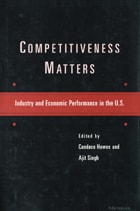
cover of Competitiveness Matters: Industry and Economic Performance in the U.S.

Competitiveness Matters

Industry and Economic Performance in the U.S.

Candace Howes and Ajit Singh, Editors

University of Michigan Press, 2000
This book argues, against the current view, that competitiveness--that is, the competitiveness of the manufacturing sector--matters to the long-term health of the U.S. economy and particularly to its long-term capacity to raise the standard of living of its citizens. The book challenges the arguments popularized most recently by Paul Krugman that
competitiveness is a dangerous obsession that distracts us from the question most central to solving the problem of stagnant real income growth, namely, what causes productivity growth, especially in the service sector.
The central argument is that, if the U.S. economy is to achieve full employment with rising real wages, it is necessary to enhance the competitiveness of its tradable goods sector. The book shows that current account deficits cannot be explained by macroeconomic mismanagement but are rather the consequence of an uncompetitive manufacturing sector. It finds that the long-term health of the manufacturing sector requires not only across-the-board policies to remedy problems of low or inefficient investment, but also sectoral policies to address problems that are strategic to resolving the balance of payments problems. Lessons are drawn from the experience of some European and Asian countries.
This book will be of interest to economists, political scientists, and business researchers concerned with the place of the manufacturing sector in overall health of the U.S. economy, with issues of industrial policy and industrial restructuring, and with the conditions for rising standards of living.
Candace Howes is Associate Professor, Barbara Hogate Ferrin Chair, Connecticut College. Ajit Singh is Professor of Economics, Queens College, Cambridge.
[more]
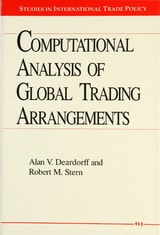
cover of Computational Analysis of Global Trading Arrangements

Computational Analysis of Global Trading Arrangements

Alan V. Deardorff and Robert M. Stern

University of Michigan Press, 1990
The Michigan Model of World Production and Trade, developed in the 1970s by Alan V. Deardorff and Robert M. Stern, has become a valuable tool widely used in research on the economic effects of national and multilateral trade policies. Computational Analysis of Global Trading Arrangements presents the recent developments and enhancements of the Michigan Model together with the major results that it has provided in the last seven years. The book provides a detailed exposition of the model, and chapters describe its applications to a variety of important issues of trade policy in the United States, Japan, and other major industrialized and developing countries. It includes an analysis of negotiating options in the GATT (Uruguay) Round of Multilateral Trade Negotiations. The Michigan Model discussed here provides an empirical framework within which to analyze the twenty-nine producing sectors that make up each of the world's major industrialized and developing countries. Hence, it allows the authors to demonstrate the impact upon a given country—on top of the effects of its own trade policies—of the tariffs and nontariff barriers of foreign countries. The authors of Computational Analysis of Global Trading Arrangements have compiled a volume that underscores the importance of economic interdependence in the global trading system.
[more]
cover of Constituent Interests and U.S. Trade Policies

Constituent Interests and U.S. Trade Policies

Alan V. Deardorff and Robert M. Stern

University of Michigan Press, 1998
The contributors to this volume, economists and political scientists from academic institutions, the private sector, and the Ways and Means Committee of the U.S. House of Representatives, came together to discuss an important topic in the formation of U.S. international trade policy: the representation of constituent interests. In the resulting volume they address the objectives of groups who participate in the policy process and examine how each group's interests are identified and promoted. They look at what means are used for these purposes, and the extent to which the groups' objectives and behavior conform to how the political economy of trade policy is treated in the economic and political science literature. Further, they discuss how effective each group has been.
Each of the book's five parts offers a coherent view of important components of the topic. Part I provides an overview of the normative and political economy approaches to the modeling of trade policies. Part 2 discusses the context of U.S. trade policies. Part 3 deals with the role of sectoral producing interests, including the relationship of trade policy to auto, steel, textile, semiconductor, aircraft, and financial services. Part 4 examines other constituent interests, including the environment, human rights, and the media. Part 5 provides commentary on such issues as the challenges that trade policy poses for the new administration and the 105th Congress.
The volume ultimately offers important and more finely articulated questions on how trade policy is formed and implemented.
Contributors are Robert E. Baldwin, Jagdish Bhagwati, Douglas A. Brook, Richard O. Cunningham, Jay Culbert, Alan V. Deardorff, I. M. Destler, Daniel Esty, Geza Feketekuty, Harry Freeman, John D. Greenwald, Gene Grossman, Richard L. Hall, Jutta Hennig, John H. Jackson, James A. Levinsohn, Mustafa Mohatarem, Robert Pahre, Richard C. Porter, Gary R. Saxonhouse, Robert E. Scott, T. N. Srinivasan, Robert M. Stern, Joe Stroud, John Sweetland, Raymond Waldmann, Marina v.N. Whitman, and Bruce Wilson.
Alan V. Deardorff and Robert M. Stern are Professors of Economics and Public Policy, University of Michigan.
[more]
cover of Contesting Trade in Central America: Market Reform and Resistance

Contesting Trade in Central America

Market Reform and Resistance

By Rose J. Spalding

University of Texas Press, 2014

In 2004, the United States, five Central American countries, and the Dominican Republic signed the Central American Free Trade Agreement (CAFTA), signaling the region’s commitment to a neoliberal economic model. For many, however, neoliberalism had lost its luster as the new century dawned, and resistance movements began to gather force. Contesting Trade in Central America is the first book-length study of the debate over CAFTA, tracing the agreement’s drafting, its passage, and its aftermath across Central America.

Rose J. Spalding draws on nearly two hundred interviews with representatives from government, business, civil society, and social movements to analyze the relationship between the advance of free market reform in Central America and the parallel rise of resistance movements. She views this dynamic through the lens of Karl Polanyi’s “double movement” theory, which posits that significant shifts toward market economics will trigger oppositional, self-protective social countermovements. Examining the negotiations, political dynamics, and agents involved in the passage of CAFTA in Costa Rica, El Salvador, and Nicaragua, Spalding argues that CAFTA served as a high-profile symbol against which Central American oppositions could rally. Ultimately, she writes, post-neoliberal reform “involves not just the design of appropriate policy mixes and sequences, but also the hard work of building sustainable and inclusive political coalitions, ones that prioritize the quality of social bonds over raw economic freedom.”

[more]