Results by title
12 books match the query 'Geologists'
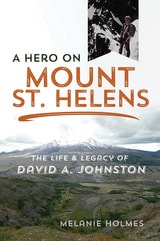
A Hero on Mount St. Helens
The Life and Legacy of David A. JohnstonMelanie Holmes. Foreword by Jeff Renner
University of Illinois Press, 2019
Melanie Holmes tells the story of Johnston's journey from a nature-loving Boy Scout to a committed geologist. Blending science with personal detail, Holmes follows Johnston through his encounters with Aleutian volcanoes, his work helping the Portuguese government assess the geothermal power of the Azores, and his dream job as a volcanologist with the U.S. Geological Survey. Interviews and personal writings reveal what a friend called “the most unjaded person I ever met,” an imperfect but kind and intelligent young scientist passionately in love with his life and work and determined to make a difference.
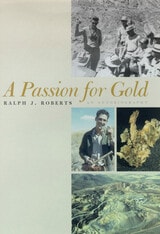
A Passion For Gold
An AutobiographyRalph J. Roberts
University of Nevada Press, 2002
Ralph J. Roberts is not a household name in Nevada, but it should be—it was he who discovered the Carlin Belt gold deposits that created a major mining boom in the state in the last four decades of the twentieth century. But this discovery was only one episode of his remarkably eventful life. This colorful and personal account of the author's search for his passion—gold—is a story as adventurous as that of any fictional character.
Clarence Edward Dutton
An AppraisalStegner, Wallace
University of Utah Press, 2006
This combination of biography, history, and environmental primer written with the flair and the technical skill of a novelist who could masterfully evoke scenes and sustain a gripping factual narrative sprang from Clarence Edward Dutton: An Appraisal. Seldom has such a classic book had such a humble beginning.
Stegner was a young English instructor at the University of Utah when he produced the Dutton essay. He was ambitious and desperate for recognition, a raise (he was earning $1,700 a year), and steady employment in the Depression years. The essay contains hints, in terms of style and content, of what Stegner would eventually produce. Dutton was Stegner’s first published work of nonfiction, and it is fair to say that it lead him, in conjunction with Bernard DeVoto’s prodding, to the subject of conservation."
—from the foreword
Clarence Edward Dutton: An Appraisal was first published by the University of Utah in 1936 and has since become a rarity on the antiquarian book market. It is reproduced in facsimile for this edition.
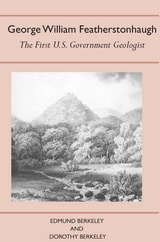
George William Featherstonhaugh
The First U.S. Government GeologistEdmund Berkeley and Dororthy Berkeley
University of Alabama Press, 1988
—Choice
"For anyone interested in the history of American geology, knowledge of G. W. Featherstonhaugh (1780-1866) is both essential and hard to obtain. He was the force behind the first railroad in America; a pioneer in scientific agriculture; an essayist, poet, and novelist; a lobbyist; a linguist; and a daring diplomat who saved the king and queen of France from certain death. [Yet] his strongest tie was with the geology. [This] biography is interesting, well researched and well written. It is a balanced study of a complex man who did so much work and generated such controversy."
—Earth Sciences History
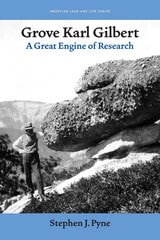
Grove Karl Gilbert
A Great Engine of ResearchStephen J. Pyne
University of Iowa Press, 1980
Gilbert knew most of geology's grand figures--including John Wesley Powell, Clarence Dutton, and Clarence King--and Pyne's chronicle of the imperturbable, quietly unconventional Gilbert is couterpointed with sketches of these prominent scientists. The man who wrote that "happiness is sitting under a tent with walls uplifted, just after a brief shower,", created answers to the larger questions of the earth in ways that have become classics of his science.
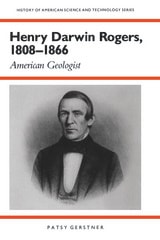
Henry Darwin Rogers, 1808–1866
American GeologistPatsy Gerstner
University of Alabama Press, 1994
The life and legacy of a pioneer who helped shape American geology.
Henry Darwin Rogers, 1808–1866: American Geologist is the first comprehensive biography of Henry Darwin Rogers, one of the pioneering figures who helped establish geology as a professional scientific discipline in the United States. Written by historian Patsy Gerstner, this meticulously researched study traces Rogers's life from his early education and scientific interests to his leadership of the groundbreaking geological surveys of New Jersey and Pennsylvania.
At a time when American science was still in its formative stages, Rogers distinguished himself through extensive fieldwork, influential publications, and innovative theories about the formation of mountain systems. His investigations of Pennsylvania's Appalachian region led to one of the first distinctly American theories of mountain elevation and helped advance understanding of the earth's geological structure. Gerstner places these achievements within the broader context of nineteenth-century scientific institutions, professional rivalries, and the growing importance of state-sponsored research
More than a scientific biography, the book offers a compelling account of the emergence of American geology and the individuals who transformed natural history into a rigorous scientific enterprise. It is an indispensable resource for understanding the history of science, the development of geological thought, and the evolution of scientific professionalism in the United States.
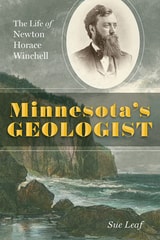
Minnesota's Geologist
The Life of Newton Horace WinchellSue Leaf
University of Minnesota Press, 2026
Winner of the 2021 Minnesota Book Award for Minnesota Nonfiction
The story of the scientist who first mapped Minnesota’s geology, set against the backdrop of early scientific inquiry in the state
At twenty, Newton Horace Winchell declared, “I know nothing about rocks.” At twenty-five, he decided to make them his life’s work. As a young geologist tasked with heading the Minnesota Geological and Natural History Survey, Winchell (1839–1914) charted the prehistory of the region, its era of inland seas, its volcanic activity, and its several ice ages—laying the foundation for the monumental five-volume Geology of Minnesota. Tracing Winchell’s remarkable path from impoverished fifteen-year-old schoolteacher to a leading light of an emerging scientific field, Minnesota’s Geologist also recreates the heady early days of scientific inquiry in Minnesota, a time when one man’s determination and passion for learning could unlock the secrets of the state’s distant past and present landscape.
Traveling by horse and cart, by sailboat and birchbark canoe, Winchell and his group surveyed rock outcrops, river valleys, basalt formations on Lake Superior, and the vast Red River Valley. He studied petrology at the Sorbonne in Paris, bringing cutting-edge knowledge to bear on the volcanic rocks of the Arrowhead region. As a founder of the American Geological Society and founding editor of American Geologist, the first journal for professional geologists, Winchell was the driving force behind scientific endeavor in early state history, serving as mentor to many young scientists and presiding over a household—the Winchell House, located on the University of Minnesota’s present-day mall—that was a nexus of intellectual ferment. His life story, told here for the first time, draws an intimate picture of this influential scientist, set against a backdrop of Minnesota’s geological complexity and splendor.

Minnesota's Geologist
The Life of Newton Horton WinchellSue Leaf
University of Minnesota Press, 2020
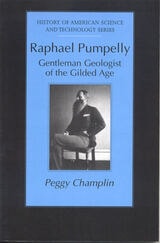
Raphael Pumpelly
Gentleman Geologist of the Gilded AgePeggy Champlin
University of Alabama Press, 1994
A definitive biography illuminating the scientific, industrial, and exploratory contributions of America’s pioneering economic geologist.
Raphael Pumpelly: Gentleman Geologist of the Gilded Age provides an excellent opportunity to look at the development of the profession of geology during the years spanned by his career, from 1860 to the early twentieth century. In this period, the practical applications of geology to resource development were of major importance, but geologists were also investigating new subjects, such as petrology, geomorphology, glaciology, and structural geology. These investigations resulted in an explosion of knowledge in these areas and in the growth of subdisciplines. Pumpelly did research in these fields but like others of his generation did not limit himself to any one of them; he remained a generalist in a time of increasing specialization, a transitional figure in a period of rapid change.
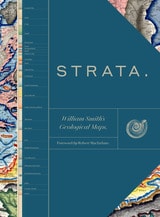
Strata
William Smith’s Geological MapsEdited by the Oxford University Museum of Natural History
University of Chicago Press, 2020
This sumptuous volume begins with an introduction by Douglas Palmer that places Smith’s work in the context of earlier, concurrent, and subsequent ideas regarding the structure and natural processes of the earth, geographical mapping, and biostratigraphical theories. The book is then organized into four parts, each beginning with four sheets from Smith’s hand-colored, 1815 strata map, accompanied by related geological cross-sections and county maps, and followed by fossil illustrations by Smith contemporary James Sowerby, all organized by strata. Essays between each section explore the aims of Smith’s work and its application in the fields of mining, agriculture, cartography and hydrology. Strata concludes with reflections on Smith’s later years as an itinerant geologist and surveyor, plagiarism by a rival, receipt of the first Wollaston Medal in recognition of his achievements, and the influence of his geological mapping and biostratigraphical theories on the sciences—all of which culminated in the establishment of the modern geological timescale.
Featuring a foreword by Robert Macfarlane, Strata is a glorious testament to the lasting geological and illustrative genius of William Smith, a collection as colossal and awe-inspiring as the layers of the Earth themselves.
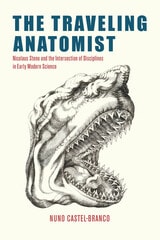
The Traveling Anatomist
Nicolaus Steno and the Intersection of Disciplines in Early Modern ScienceNuno Castel-Branco
University of Chicago Press, 2025
Nicolaus Steno (1638–1686) was a renowned anatomist in his lifetime. He reformed the anatomical understanding of glands, argued that the heart was a muscle, renamed the so-called female testicles as ovaries, and developed a mathematical model for understanding muscle contraction—discoveries that were fundamental to the fields of anatomy and physiology. However, other aspects of Steno’s life have come to define him: his claim that mountains’ strata reveal the history of the Earth and his conversion to Catholicism as a practicing scientist. This excessive attention to his geological discoveries and to asking whether science and religion are compatible, Nuno Castel-Branco argues, has obscured his significant accomplishments as an anatomist. The Traveling Anatomist thus restores Steno to his rightful place as a crucial figure in early modern science.
Using Steno’s extensive travels as a framework, this book depicts him as an active participant in the Republic of Letters. Castel-Branco traverses Leiden, Paris, Copenhagen, Florence, and Rome as he follows Steno in his sojourns through different scientific academies, courts, and artisanal workshops. There he developed new friends, some of whom were women, with whom he researched and exchanged ideas. Drawing on Steno’s books, correspondence, and novel archival material, Castel-Branco invites us to approach Steno and his accomplishments in anatomy, mathematics, and geology through the eyes of his contemporaries. Doing so, Castel-Branco reconstructs the rich and overlapping worlds of scientific disciplines that shaped Steno’s work, revealing the richness of interdisciplinary research in early modern intellectual life. And through Steno, he illustrates larger developments and new networks of significance in mid-seventeenth-century science. By focusing on ideas, scientific genres, institutions, and friendships, Castel-Branco offers a way others might also productively study science from the early modern period until today.
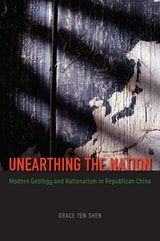
Unearthing the Nation
Modern Geology and Nationalism in Republican ChinaGrace Yen Shen
University of Chicago Press, 2014
The first major history of modern Chinese geology, Unearthing the Nation introduces the key figures in the rise of the field, as well as several key organizations, such as the Geological Society of China, and explains how they helped bring Chinese geology onto the world stage.