54 books match the query 'Contemporary (1945-)' and 5 start with c
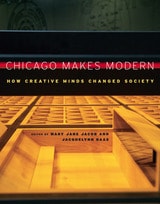
cover of Chicago Makes Modern: How Creative Minds Changed Society

Chicago Makes Modern

How Creative Minds Changed Society

Edited by Mary Jane Jacob and Jacquelynn Baas

University of Chicago Press, 2012

Chicago is a city dedicated to the modern—from the skyscrapers that punctuate its skyline to the spirited style that inflects many of its dwellings and institutions, from the New Bauhaus to Hull-House. Despite this, the city has long been overlooked as a locus for modernism in the arts, its rich tradition of architecture, design, and education disregarded. Still the modern in Chicago continues to thrive, as new generations of artists incorporate its legacy into fresh visions for the future. Chicago Makes Modern boldly remaps twentieth-century modernism from our new-century perspective by asking an imperative question: How did the modern mind—deeply reflective, yet simultaneously directed—help to dramatically alter our perspectives on the world and make it new?

Returning the city to its rightful position at the heart of a multidimensional movement that changed the face of the twentieth century, Chicago Makes Modern applies the missions of a brilliant group of innovators to our own time. From the radical social and artistic perspectives implemented by Jane Addams, John Dewey, and Buckminster Fuller to the avant-garde designs of László Moholy-Nagy and Mies van der Rohe, the prodigious offerings of Chicago's modern minds left an indelible legacy for future generations. Staging the city as a laboratory for some of our most heralded cultural experiments, Chicago Makes Modern reimagines the modern as a space of self-realization and social progress—where individual visions triggered profound change. Featuring contributions from an acclaimed roster of contemporary artists, critics, and scholars, this book demonstrates how and why the Windy City continues to drive the modern world.
[more]
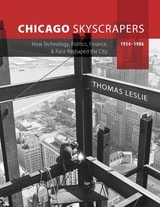
cover of Chicago Skyscrapers, 1934-1986: How Technology, Politics, Finance, and Race Reshaped the City

Chicago Skyscrapers, 1934-1986

How Technology, Politics, Finance, and Race Reshaped the City

Thomas Leslie

University of Illinois Press, 2023

Winner of The Pattis Family Foundation Chicago Book Award, by The Pattis Family Foundation and the Newberry Library

From skyline-defining icons to wonders of the world, the second period of the Chicago skyscraper transformed the way Chicagoans lived and worked. Thomas Leslie’s comprehensive look at the modern skyscraper era views the skyscraper idea, and the buildings themselves, within the broad expanse of city history. As construction emerged from the Great Depression, structural, mechanical, and cladding innovations evolved while continuing to influence designs. But the truly radical changes concerned the motivations that drove construction. While profit remained key in the Loop, developers elsewhere in Chicago worked with a Daley political regime that saw tall buildings as tools for a wholesale recasting of the city’s appearance, demography, and economy. Focusing on both the wider cityscape and specific buildings, Leslie reveals skyscrapers to be the physical results of negotiations between motivating and mechanical causes.

Illustrated with more than 140 photographs, Chicago Skyscrapers, 1934–1986 tells the fascinating stories of the people, ideas, negotiations, decision-making, compromises, and strategies that changed the history of architecture and one of its showcase cities.
[more]
cover of Chicago's Historic Hyde Park

Chicago's Historic Hyde Park

Susan O'Connor Davis

University of Chicago Press, 2013
Stretching south from 47th Street to the Midway Plaisance and east from Washington Park to the lake’s shore, the historic neighborhood of Hyde Park—Kenwood covers nearly two square miles of Chicago’s south side. At one time a wealthy township outside of the city, this neighborhood has been home to Chicago’s elite for more than one hundred and fifty years, counting among its residents presidents and politicians, scholars, athletes, and fiery religious leaders. Known today for the grand mansions, stately row houses, and elegant apartments that these notables called home, Hyde Park—Kenwood is still one of Chicago’s most prominent locales.

Physically shaped by the Columbian Exposition of 1893 and by the efforts of some of the greatest architects of the nineteenth and twentieth centuries—including Daniel Burnham, Frank Lloyd Wright, Mies Van Der Rohe—this area hosts some of the city’s most spectacular architecture amid lush green space. Tree-lined streets give way to the impressive neogothic buildings that mark the campus of the University of Chicago, and some of the Jazz Age’s swankiest high-rises offer spectacular views of the water and distant downtown skyline.

In Chicago’s Historic Hyde Park, Susan O’Connor Davis offers readers a biography of this distinguished neighborhood, from house to home, and from architect to resident. Along the way, she weaves a fascinating tapestry, describing Hyde Park—Kenwood’s most celebrated structures from the time of Lincoln through the racial upheaval and destructive urban renewal of the 1940s, 50s, and 60s into the preservationist movement of the last thirty-five years. Coupled with hundreds of historical photographs, drawings, and current views, Davis recounts the life stories of these gorgeous buildings—and of the astounding talents that built them. This is architectural history at its best.

[more]
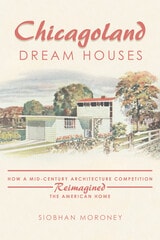
cover of Chicagoland Dream Houses: How a Mid-Century Architecture Competition Reimagined the American Home

Chicagoland Dream Houses

How a Mid-Century Architecture Competition Reimagined the American Home

Siobhan Moroney

University of Illinois Press, 2024
“Chicagoland Dream Houses is an engaging addition to the growing body of scholarship concerning Chicago’s twentieth-century residential landscape characterized by a diverse group of architects and builders.”--Michelangelo Sabatino, coauthor of Modern in the Middle: Chicago Houses 1929–1975
[more]
cover of Co-Curating the City: Universities and Urban Heritage Past and Future

Co-Curating the City

Universities and Urban Heritage Past and Future

Edited by Clare Melhuish, Henric Benesch, Dean Sully, and Ingrid Martins Holmberg

University College London, 2022

A significant contribution to knowledge about university spatial development in urban contexts.

Co-Curating the City explores the role of universities in the construction and mobilization of heritage discourses in urban development and regeneration processes, with a focus on six case study sites ranging from Sweden to Brazil. The book expands the field of critical heritage studies in the urban domain, arguing that universities should position themselves as significant institutions in the development of urban heritage narratives and heavily influence urban development. The case studies investigate how universities, as mixed communities of interest dispersed across buildings and urban sites, utilize strategies of engagement with local people and neighborhoods and ask how this could contribute to a reshaping of ideas, narratives, and lived experience of urban heritage in which universities have a distinctive agency.
[more]