Results by title
365 books match the query 'Correspondence' and 22 start with c
Cabal!
The Plot Against General Washington, The Conway Cabal ReconsideredMark Edward Lender
Westholme Publishing, 2024
In the spring of 1778, General George Washington wrote to his friend Landon Carter about a rumored “disposition in the Northern Officers to see me superceded in my Command.” This was as candid a statement as the general ever made about the so-called “Conway Cabal” of patriot officers and politicians critical of his leadership. Most early historians of the Revolution took the threat to Washington seriously, but by the mid-twentieth century interpretations had reversed, with the plot—if one existed—posing no real danger to the commander-in-chief. Yet, as historian Mark Edward Lender reveals in his compelling Cabal! The Plot Against General Washington, clues found in original new research provide a more comprehensive understanding of the personalities and political maneuverings of those involved in the Cabal, and the real nature of the challenge to Washington.
Rather than the “classic Cabal” of Generals Horatio Gates, Thomas Mifflin, and Thomas Conway in a plot to remove Washington quickly, the threat to Washington’s command was a gradual administrative attempt by the Board of War and political allies to take over the war effort. Reorganized in late 1777 under the leadership of Mifflin, with Gates assuming the board presidency in January 1778, the Board of War sought authority to determine military policy and strategic goals, all training, organizational, personnel, and logistical functions, and even the assignment of theater commanders. Had they succeeded, Washington’s title of commander-in-chief would have been utterly hollow. The Cabal tested Washington as few other things did during the war and perhaps tempered him into the man we remember today. Washington adroitly navigated the challenges to his leadership, meeting and defeating every attempt to curtail his authority. His response revealed a leadership style that saw him safely through the war, and gave him overwhelming support from his countrymen to become their first president.
Captain W. W. Withenbury's 1838-1842 "Red River Reminiscences"
Jacques D. Bagur
University of North Texas Press, 2014
Carl Schmitt and Leo Strauss
The Hidden DialogueHeinrich Meier
University of Chicago Press, 1995
Meier contends that their exchange only ostensibly revolves around liberalism. At its heart, their “hidden dialogue” explores the fundamental conflict between political theology and political philosophy, between revelation and reasonand ultimately, the vital question of how human beings ought to live their lives.
Cleanth Brooks and Allen Tate
Collected Letters, 1933-1976Edited by Alphonse Vinh & Intro by Louis D. Rubin, Jr.
University of Missouri Press, 1998
Offering all of the extant letters exchanged by two of the twentieth century's most distinguished literary figures, Cleanth Brooks and Allen Tate: Collected Letters, 1933-1976 vividly depicts the remarkable relationship, both professional and personal, between Brooks and Tate over the course of their lifelong friendship.
An accomplished poet, critic, biographer, and teacher, Allen Tate had a powerful influence on the literary world of his era. Editor of the Fugitive and the Sewanee Review, Tate greatly affected the lives and careers of his fellow literati, including Cleanth Brooks. Esteemed coeditor of An Approach to Literature and Understanding Poetry, Brooks was one of the principal creators of the New Criticism. His Modern Poetry and the Tradition and The Well Wrought Urn, as well as his two-volume study of Faulkner, remain among the classics read by any serious student of literature. The correspondence between these two gentlemen-scholars, which began in the 1930s, extended over five decades and covered a vast amount of twentieth-century literary history.
In the more than 250 letters collected here, the reader will encounter their shared concerns for and responses to the work of their numerous friends and many prominent writers, including T. S. Eliot, William Faulkner, and Robert Lowell. Their letters offer details about their own developing careers and also provide striking insight into the group dynamics of the Agrarians, the noteworthy community of southern writers who played so influential a role in the literature of modernism.
Brooks once said that Tate treated him like a younger brother, and despite great differences between their personalities and characters, these two figures each felt deep brotherly affection for the other. Whether they contain warm invitations for the one to visit the other, genteel or honest commentaries on their families and friends, or descriptions of the vast array of social, professional, and even political activities each experienced, the letters of Brooks and Tate clearly reveal the personalities of both men and the powerful ties of their strong camaraderie.
Invaluable to both students and teachers of literature, Cleanth Brooks and Allen Tate provides a substantial contribution to the study of twentieth-century American, and particularly southern, literary history.
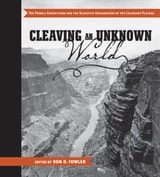
Cleaving an Unknown World
The Powell Expeditions and the Scientific Exploration of the Colorado PlateauDon D Fowler
University of Utah Press, 2011
In 2009 the University of Utah Press and the Utah State Historical Society co-published three volumes of long out-of-print journals, letters, and other documents from John Wesley Powell’s expeditions down the Colorado River. We are proud to announce the fourth and final volume. Cleaving an Unknown World collects Powell’s journal (Smithsonian Journal of History, 1968); Jack Hillers’s diary and photographs, previously published as Photographed All the Best Scenery, edited by Don D. Fowler (University of Utah Press, 1972); original maps from Francis Marion Bishop (Utah Historical Quarterly, 1969); Frederick S. Dellenbaugh’s letters (Utah Historical Quarterly, 1969); and John C. Sumner’s journal from the first Powell expedition (Utah Historical Quarterly, 1969). Roy Webb’s foreword provides the context for these disparate pieces.
This beautifully illustrated book features Hillers’s photographs—long regarded as a remarkable and unique record of the Colorado River and the Grand Canyon. Cleaving an Unknown World belongs in the library of any reader interested in the exploration of the American West.
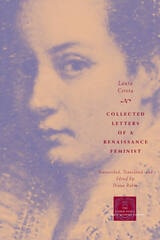
Collected Letters of a Renaissance Feminist
Laura Cereta
University of Chicago Press, 1997
Yet these letters also furnish a detailed portrait of an early modern woman’s private experience, for Cereta addressed many letters to a close circle of family and friends, discussing highly personal concerns such as her difficult relationships with her mother and her husband. Taken together, these letters are a testament both to an individual woman and to enduring feminist concerns.
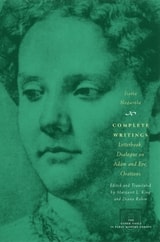
Complete Writings
Letterbook, Dialogue on Adam and Eve, OrationsIsotta Nogarola
University of Chicago Press, 2004
This volume presents English translations of all of Nogarola's extant works and highlights just how daring and original her convictions were. In her letters and orations, Nogarola elegantly synthesized Greco-Roman thought with biblical teachings. And striding across the stage in public, she lectured the Veronese citizenry on everything from history and religion to politics and morality. But the most influential of Nogarola's works was a performance piece, Dialogue on Adam and Eve, in which she discussed the relative sinfulness of Adam and Eve—thereby opening up a centuries-long debate in Europe on gender and the nature of woman and establishing herself as an important figure in Western intellectual history. This book will be a must read for teachers and students of Women's Studies as well as of Renaissance literature and history.
Concordance to the Letters of Emily Dickinson
Cynthia MacKenzie
University Press of Colorado, 2000
The similarities between the letters and the poems makes the typical concordance search for the poet's thematically significant words and biographical references particularly relevant. Tracing Dickinson's thoughts through her correspondence complements the ideas within her poetry and thus provides a more comprehensive insight into the poet's personal and artistic development. The concordance will facilitate an understanding of words or concepts that may be obscure in the poetry by itself. Research into Dickinson's problematic style, characterized by gaps, disjunctions, and ellipses, will be greatly enhanced.
By listing Dickinson's words together with their contexts and frequencies, the concordance provides the scholar with the ability to answer confidently questions of a statistical or stylistic nature. Finally, one of the most important functions of this concordance is to provide scholar, student, and general reader alike with endless opportunities to make exciting and unexpected discoveries by way of browsing.
Conflict and Negotiation in the Early Church
Letters from Late Antiquity, Translated from the Greek, Latin, and SyriacBronwen Neil
Catholic University of America Press, 2020
Conflict and Negotiation in the Early Church focuses on the period 500 to 700 CE, one of the least documented periods in the history of the church, but also one of the most formative, whose conflicts resonate still in contemporary Christian communities, especially in the Middle East.
To uncover the hidden history of this period and its theological controversies, Neil and Allen have tapped a little known written source, the letters that were exchanged by bishops, emperors and other civic leaders of the sixth and seventh centuries. This was an era of crisis for the Byzantine empire, at war first with Persia, and then with the Arab forces united under the new faith of Islam. Official letters were used by the churches of Rome and Constantinople to pursue and defend their claims to universal and local authority, a constant source of conflict. As well as the east-west struggle, Christological disagreements with the Syrian church demanded increasing attention from the episcopal and imperial rulers in Constantinople, even as Rome set itself adrift and looked to the West for new allies.
From this troubled period, 1500 letters survive in Greek, Latin, and Syriac. With translations of a number of these, many rendered into English for the first time, Conflict and Negotiation in the Early Church examines the ways in which diplomatic relations between churches were developed, and in some cases hindered or even permanently ruptured, through letter-exchange at the end of Late Antiquity.
Contra Keynes and Cambridge
Essays, CorrespondenceF. A. Hayek
University of Chicago Press, 1995
When the journal Economica published a review of Keynes's Treatise on Money by Hayek in 1931, Keynes's response consisted principlally of an attack on Hayek's own work on monetary theory, Prices and Production. Conducted almost entirely in economics journals, the battle that followed revealed two very different responses to a world in economic crisis. Keynes sought a revision of the liberal political order—arguing for greater government intervention in the hope of protecting against the painful fluctuations of the business cycle. Hayek instead warned that state involvement would cause irreparable damage to the economy.
This volume begins with Hayek's 1963 reminiscence "The Economics of the 1930s as Seen from London," which has never been published before. The articles, letters, and reviews from journals published in the 1930s are followed by Hayek's later reflections on Keynes's work and influence. The Introduction by Bruce Caldwell puts the debate in context, providing detailed information about the economists in Keynes's circle at Cambridge, their role in the acceptance of his ideas, and the ways in which theory affected policy during the interwar period.
Caldwell calls the debate between Hayek and Keynes "a battle for the minds of the rising generation of British-trained economists." There is no doubt that Keynes won the battle during his lifetime. Now, when many of Hayek's ideas have been vindicated by the collapse of collectivist economies and the revival of the free market around the world, this book clarifies Hayek's work on monetary theory—formed in heated opposition to Keynes—and illuminates his efforts to fight protectionism in an age of economic crisis.
F. A. Hayek (1899-1992), recipient of the Medal of Freedom in 1991 and co-winner of the Nobel Memorial Prize in Economics in 1974, was a pioneer in monetary theory and the principal proponent of classical liberal thought in the twentieth century. He taught at the University of London, the University of Chicago, and the University of Freiburg.
Correspondence
Paul Celan and Ingeborg Bachmann
Seagull Books, 2019
Collected here for the first time in English are their letters written between 1948 and 1961. Their correspondence forms a moving testimony of the discourse of love in the age after Auschwitz, with all the symptomatic disturbances and crises caused by their conflicting backgrounds and their hard-to-reconcile designs for living—as a woman, as a man, as writers. In addition to the almost 200 letters, the volume includes an important exchange between Bachmann and Gisèle Celan-Lestrange, who married Celan in 1951, as well as the letters between Paul Celan and Swiss writer Max Frisch.
“Scarcely more breathlessly and desperately can two lovers ever have struggled for words. Little known among German literary historians, the relationship between these two poets amounts to one of the most dramatic and momentous occurrences in German literature.”—FAZ, on the German edition
Correspondence Across a Room
Vsevolod I. Ivanov and M.O. Gershenzon
Northwestern University Press, 1984
Day-long conversations having drawn them away from their literary tasks, the two then decided to converse in writing. Correspondence, the result, examines the condition and future of Western culture-whose values, according to the historian Gershenzon, have deteriorated into a deadly burden upon mankind, into mankind's ultimate prison. For the poet Ivanov, it is not the disavowal of a cultural heritage but the struggle to recover man's own unity with God that alone guarantees his true, his spiritual freedom.
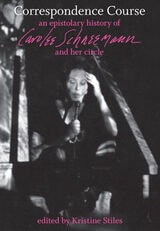
Correspondence Course
An Epistolary History of Carolee Schneemann and Her CircleKristine Stiles, ed.
Duke University Press, 2010
Kristine Stiles selected, edited, annotated, and wrote the introduction to the letters, assembling them so that readers can follow the development of Schneemann’s art, thought, and private and public relationships. The correspondence chronicles a history of energy and invention, joy and sorrow, and charged personal and artistic struggles. It sheds light on the internecine aesthetic politics and mundane activities that constitute the exasperating vicissitudes of making art, building an artistic reputation, and negotiating an industry as unpredictable and demanding as the art world in the mid- to late twentieth century.
Correspondence of Jeremy Bentham Volume 5
January 1794 to December 1797Jeremy Bentham, edited by Alexander Taylor Milne, and series edited by J.H. Burns
University College London, 2017
Correspondence of Jeremy Bentham, Volume 13
July 1828 to June 1832Edited by Philip Schofield, Tim Causer, and Chris Riley
University College London, 2024
The Correspondence of Jeremy Bentham, Volume 13 contains authoritative and fully annotated texts of all known and publishable letters sent both to and from Bentham between 1st July 1828 and his death on 6th June 1832. In addition to 474 letters, the volume contains three memorandums concerning Bentham’s health shortly before his death, his last will and testament, and extracts from both the autobiography and the manuscript diaries of Bentham’s nephew George. Among the letters that have already been published, most are drawn from the edition of The Works of Jeremy Bentham, prepared under the superintendence of Bentham’s literary executor John Bowring. A small number of letters have been reproduced from newspapers and periodicals.
This volume publishes, for the first time, the entire extant correspondence between Bentham and Daniel O’Connell, the Irish Liberator. Other new acquaintances include the barrister and law reformer, Charles Sinclair Cullen, and the Real Property Commissioner, John Tyrrell. Throughout the period, Bentham maintained regular contact with old friends and connections, but he also engaged in sporadic correspondence with such leading figures in government as the Duke of Wellington, Robert Peel, and Henry Brougham. Further afield, Bentham corresponded, amongst others, with the Marquis de La Fayette in France, Edward Livingston in the United States of America, and José Del Valle in Guatemala.
Correspondence of Jeremy Bentham, Volume 1
1752 to 1776Jeremy Bentham, edited by Timothy L. S. Sprigge, and series edited by J.H. Burns
University College London, 2017
Correspondence of Jeremy Bentham, Volume 2
1777 to 1780Jeremy Bentham, edited by Timothy L. S. Sprigge, and series edited by J.H. Burns
University College London, 2017
Correspondence of Jeremy Bentham, Volume 3
January 1781 to October 1788Jeremy Bentham, edited by Ian R. Christie, and series edited by J.H. Burns
University College London, 2017
Correspondence of Jeremy Bentham, Volume 4
October 1788 to December 1793Jeremy Bentham, edited by Alexander Taylor Milne, and general editor John R. Dinwiddy
University College London, 2017
Correspondence on Christology and Grace
Rob Roy McGregor
Catholic University of America Press, 2013
Correspondence
Volume Fourteen, Scholarly EditionHerman Melville
Northwestern University Press, 1993
This scholarly edition presents a text as close to the author's intention as his difficult handwriting or other surviving evidence permits. Fifty-two newly discovered letters by Melville, more than half of which are presented here for the first time, are added to those printed in the 1960 edition. This text is an Approved Text of the Center for Editions of American Authors (Modern Language Association of America).
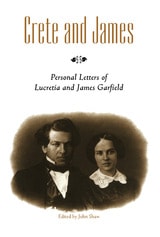
Crete and James
Personal Letters of Lucretia and James GarfieldJohn Shaw
Michigan State University Press, 1994
Crete and James is a collection of letters exchanged by James A. Garfield and Lucretia Randolph Garfield during the mid-nineteenth century. Of the 1,200 or so letters written, the 300 included this work chronicle their courtship and marriage, and also discuss the Civil War, political affairs, and the details of daily life during the years 1853-1881. In them, we watch Crete grow from a shy girl into a self-confident woman who guides her husband in social and political matters. Through James’s flamboyant yet scholarly style, and Lucretia’s detailed, perceptive insights, we come to know them as though they were our close friends. Through their correspondence, the reader also meets the many people involved in their lives. Crete and James will be of great interest to those studying women’s history.