87 books match the query 'Criticism, Textual' and 5 start with c
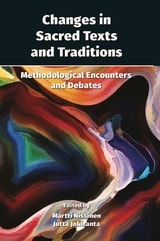
cover of Changes in Sacred Texts and Traditions: Methodological Encounters and Debates

Changes in Sacred Texts and Traditions

Methodological Encounters and Debates

Martti Nissinen

SBL Press, 2024

This volume presents the work of the international, interdisciplinary research project Changes in Sacred Texts and Traditions (CSTT), whose members focused on cultural, ideological, and material changes in the period when the sacred traditions of the Hebrew Bible were created, transmitted, and transformed. Specialists in the textual study of the Hebrew and Greek Bibles, archaeology, Assyriology, and history, working across their fields of expertise, trace how changes occurred in biblical and ancient Near Eastern texts and traditions. Contributors Tero Alstola, Anneli Aejmelaeus , Rick Bonnie, Francis Borchardt, George J. Brooke, Cynthia Edenburg, Sebastian Fink, Izaak J. deHulster , Patrik Jansson, Jutta Jokiranta, Tuukka Kauhanen, Gina Konstantopoulos, Lauri Laine, Michael C. Legaspi, Christoph Levin, Ville Mäkipelto, Reinhard Müller, Martti Nissinen, Jessi Orpana, Juha Pakkala, Dalit Rom-Shiloni, Christian Seppänen, Jason M. Silverman, Saana Svärd, Timo Tekoniemi, Hanna Tervanotko, Joanna Töyräänvuori, and Miika Tucker demonstrate that rigorous yet respectful debate results in a nuanced and complex understanding of how ancient texts developed.
[more]
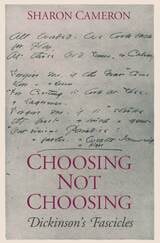
cover of Choosing Not Choosing

Choosing Not Choosing

Sharon Cameron

University of Chicago Press, 1992

Although Emily Dickinson copied and bound her poems into manuscript notebooks, in the century since her death her poems have been read as single lyrics with little or no regard for the context she created for them in her fascicles. Choosing Not Choosing is the first book-length consideration of the poems in their manuscript context. Sharon Cameron demonstrates that to read the poems with attention to their placement in the fascicles is to observe scenes and subjects unfolding between and among poems rather than to think of them as isolated riddles, enigmatic in both syntax and reference. Thus Choosing Not Choosing illustrates that the contextual sense of Dickinson is not the canonical sense of Dickinson.

Considering the poems in the context of the fascicles, Cameron argues that an essential refusal of choice pervades all aspects of Dickinson's poetry. Because Dickinson never chose whether she wanted her poems read as single lyrics or in sequence (nor is it clear where any fascicle text ends, or even how, in context, a poem is bounded), "not choosing" is a textual issue; it is also a formal issue because Dickinson refused to chose among poetic variants; it is a thematic issue; and, finally, it is a philosophical one, since what is produced by "not choosing" is a radical indifference to difference. Extending the readings of Dickinson offered in her earlier book Lyric Time, Cameron continues to enlarge our understanding of the work of this singular American poet.
[more]
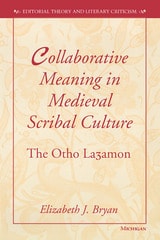
cover of Collaborative Meaning in Medieval Scribal Culture: The Otho La3amon

Collaborative Meaning in Medieval Scribal Culture

The Otho La3amon

Elizabeth J. Bryan

University of Michigan Press, 1999

Before the technology of print, every book was unique. Two manuscripts of the "same" text could package and transmit that text very differently, depending on the choices made by scribes, compilers, translators, annotators, and decorators. Is it appropriate, Elizabeth Bryan asks, for us to read these books as products of a single author's consciousness? And if not, how do we read them?
In Collaborative Meaning in Medieval Scribal Culture, Bryan compares examples from the British Library Cotton Otho C.xiii manuscript of La3amon's Brut, the early thirteenth-century verse history that translated King Arthur into English for the first time. She discovers cultural attitudes that valued communal aspects of manuscript texts--for example, a view of the physical book as connecting all who read or even held it to each other.
The study is divided into two parts. Part one presents Early Middle English concepts of "enjoining" texts and explores the theoretical and methodological challenges they pose to present-day readers of scribally-produced texts. Part two conducts a detailed study of the multiple interpretations built into the manuscript text. Illustrations of manuscript pages accompany analysis, and the reader is invited to engage in interpreting the manuscript text.
Collaborative Meaning in Medieval Scribal Culture will be of interest to students and specialists in medieval chronicle histories, Middle English, Arthurian literature, and literary and textual theory.
Elizabeth J. Bryan is Associate Professor of English, Brown University.

[more]
cover of Colonizing Trick: National Culture And Imperial Citizenship In Early America

Colonizing Trick

National Culture And Imperial Citizenship In Early America

David Kazanjian

University of Minnesota Press, 2003

An illuminating look at the concepts of race, nation, and equality in eighteenth- and nineteenth-century America

The idea that “all men are created equal” is as close to a universal tenet as exists in American history. In this hard-hitting book, David Kazanjian interrogates this tenet, exploring transformative flash points in early America when the belief in equality came into contact with seemingly contrary ideas about race and nation. The Colonizing Trick depicts early America as a white settler colony in the process of becoming an empire-—one deeply integrated with Euro-American political economy, imperial ventures in North America and Africa, and pan-American racial formations.

Kazanjian traces tensions between universal equality and racial or national particularity through theoretically informed critical readings of a wide range of texts: the political writings of David Walker and Maria Stewart, the narratives of black mariners, economic treatises, the personal letters of Thomas Jefferson and Phillis Wheatley, Charles Brockden Brown’s fiction, congressional tariff debates, international treaties, and popular novelettes about the U.S.–Mexico War and the Yucatán’s Caste War. Kazanjian shows how emergent racial and national formations do not contradict universalist egalitarianism; rather, they rearticulate it, making equality at once restricted, formal, abstract, and materially embodied.
[more]
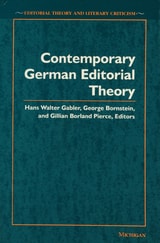
cover of Contemporary German Editorial Theory

Contemporary German Editorial Theory

Hans Walter Gabler, George Bornstein, and Gillian Borland Pierce, Editors

University of Michigan Press, 1995

Over the past decade, Anglo-American notions of textual construction and editorial theory have begun major paradigm shifts. Many of the key emergent issues of Anglo-American debate -- such as theories of versions - -are already familiar in German theory. In other respects, including systematic reflection on the design and function of editorial apparatus, the German debate has already produced paradigms and procedures as yet unformulated in English. Contemporary German Editorial Theory makes available for the first time in English ten major essays by seven German theorists, together with an original introductory meditation by Hans Walter Gabler, editor of the celebrated edition of James Joyce's Ulysses. The volume thus participates in the paradigm shift in editorial theory that has led both to theoretical reconception of the field and to groundbreaking practical results. Topics discussed include the distinction between historical record and editor's interpretation, the display of multiple versions, concepts of authorization and intention, and the relations of textual theory to approaches like deconstruction and semiotics. The book also includes suggestions for further reading in both languages and a glossary of technical terms.Bringing together the heretofore separate Anglo-American and German approaches will strengthen each separately and prepare the way for a new hybrid combining the advantages of both orientations. Contributors are Hans Zeller, Miroslav Červenka, Elisabeth Höpker-Herberg, Gunter Martens, Henning Boetius, Siegfried Scheibe, and Gerhard Seidel.
[more]