Results by title
51 books match the query 'Cultural Politics' and 6 start with c
Capturing the Beat Moment
Cultural Politics and the Poetics of PresenceErik Mortenson
Southern Illinois University Press, 2010
CHOICE Outstanding Academic Title
Examining “the moment” as one of the primary motifs of Beat writing, Erik Mortenson offers the first book to investigate immediacy and its presence and importance in Beat writing. Capturing the Beat Moment: Cultural Politics and the Poetics of Presence places an expanded canon of Beat writers in an early postmodern context that highlights their importance in American poetics and provides an account of Beat practices that reveal how gender and race affect Beat politics of the moment.
Mortenson argues that Beat writers focused on action, desire, and spontaneity to establish an authentic connection to the world around them and believed that “living in the moment” was the only way in which they might establish the kind of life that led to good writing. With this in mind, he explores the possibility that, far from being the antithesis of their times, the Beats actually were a product of them. Mortenson outlines the effects of gender and race on Beat writing in the postwar years, as well as the Beats’ attempts to break free of the constrictive notions of time and space prevalent during the 1950s.
Mortenson discusses such topics as the importance of personal visionary experiences; the embodiment of sexuality and the moment of ecstasy in Beat writing; how the Beats used photographs to evoke the past; and the ways that Beat culture was designed to offer alternatives to existing political and social structures. Throughout the volume, Mortenson moves beyond the Kerouac-Ginsberg-Burroughs triumvirate commonly associated with Beat literature, discussing women—such as Diane di Prima, Janine Pommy Vega, and Joyce Johnson—and African American writers, including Bob Kaufman and Amiri Baraka. With the inclusion of these authors comes a richer understanding of the Beat writers’ value and influence in American literary history.
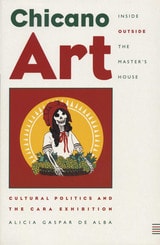
Chicano Art Inside/Outside the Master’s House
Cultural Politics and the CARA ExhibitionBy Alicia Gaspar de Alba
University of Texas Press, 1997
In the early 1990s, a major exhibition Chicano Art: Resistance and Affirmation, 1965-1985 toured major museums around the United States. As a first attempt to define and represent Chicano/a art for a national audience, the exhibit attracted both praise and controversy, while raising fundamental questions about the nature of multiculturalism in the U.S.
This book presents the first interdisciplinary cultural study of the CARA exhibit. Alicia Gaspar de Alba looks at the exhibit as a cultural text in which the Chicano/a community affirmed itself not as a "subculture" within the U.S. but as an "alter-Native" culture in opposition to the exclusionary and homogenizing practices of mainstream institutions. She also shows how the exhibit reflected the cultural and sexual politics of the Chicano Movement and how it serves as a model of Chicano/a popular culture more generally.
Drawing insights from cultural studies, feminist theory, anthropology, and semiotics, this book constitutes a wide-ranging analysis of Chicano/a art, popular culture, and mainstream cultural politics. It will appeal to a diverse audience in all of these fields.
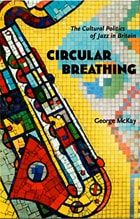
Circular Breathing
The Cultural Politics of Jazz in BritainGeorge McKay
Duke University Press, 2005
McKay explores the music in relation to issues of whiteness, blackness, and masculinity—all against a backdrop of shifting imperial identities, postcolonialism, and the Cold War. He considers objections to the music’s spread by the “anti-jazzers” alongside the ambivalence felt by many leftist musicians about playing an “all-American” musical form. At the same time, McKay highlights the extraordinary cultural mixing that has defined British jazz since the 1950s, as musicians from Britain’s former colonies—particularly from the Caribbean and South Africa—have transformed the genre. Circular Breathing is enriched by McKay’s original interviews with activists, musicians, and fans and by fascinating images, including works by the renowned English jazz photographer Val Wilmer. It is an invaluable look at not only the history of jazz but also the Left and race relations in Great Britain.

Claiming Individuality
The Cultural Politics of DistinctionEdited by Vered Amit and Noel Dyck
Pluto Press, 2006
Cultural Politics
edited by Marcy Darnovsky, Barbara Epstein and Richard Flacks
Temple University Press, 1995
Bridging the worlds of activism and academia-social movement theory informed with the real experiences of activists-this volume of accessible essays brings together insights from European New Social Movement theorists, U.S. scholars of social movements, and activists involved in social movements from the 1960s to the 1990s.
Contributors: Alice Echols, Barbara Epstein, Richard A. Cloward, Marcy Darnovsky, Jeffrey Escoffier, Ilene Rose Feinman, Richard Flacks, Cynthia Hamilton, Allen Hunter, L. A. Kauffman, Rebecca E. Klatch, Margit Mayer, Alberto Melucci, Bronislaw Misztal, Osha Neumann, Frances Fox Piven, Craig Reinarman, Roland Roth, Arlene Stein, Mindy Spatt, Andrew Szasz, Noél Sturgeon, Howard Winant.
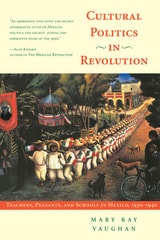
Cultural Politics in Revolution
Teachers, Peasants, and Schools in Mexico, 1930-1940Mary Kay Vaughan
University of Arizona Press, 1997
To show the significance of this facet of the Revolution, Mary Kay Vaughan analyzes the educational effort of the state during the 1930s, locating it within the broader sweep of Mexican history to illustrate how the government sought to nationalize and modernize rural society. Vaughan focuses on activities in rural schools, where central state policy makers, teachers, and people of the countryside came together to forge a national culture. She examines the cultural politics of schooling in four rural societies in the states of Sonora and Puebla that are representative of the peasant societies in revolutionary Mexico, and she shows how the state's program of socialist education became an arena for intense negotiations over power, culture, knowledge, rights, and gender practices. The real cultural revolution, Vaughan observes, lay not in the state's efforts at socialist education but in the dialogue between state and society that took place around this program. In the 1930s, rural communities carved out a space to preserve their local identities while the state succeeded in nurturing a multi-ethnic nationalism based on its promise of social justice and development.
Vaughan brings to her analysis a comparative understanding of peasant politics and educational history, extensive interviews, and a detailed examination of national, regional, and local archives to create an evocative and informative study of Mexican politics and society during modern Mexico's formative years. Cultural Politics in Revolution clearly shows that only by expanding the social arena in which culture was constructed and contested can we understand the Mexican Revolution's real achievements.